










Running a fabrication business often looks simple from the outside. You take in drawings, cut metal, weld parts, deliver on time, and move to the next job. But anyone who has spent time on the shop floor knows that the real challenge sits outside the weld seam.
Most fabrication businesses struggle because the business side never gets the same level of attention as the work itself. Decisions around positioning, pricing, systems, and visibility quietly shape whether the shop stays stable or constantly feels under pressure.
In this blog, we break down what a fabrication business looks like today, how profitable shops are built and run, and how to approach growth once the core is strong without breaking what already works.
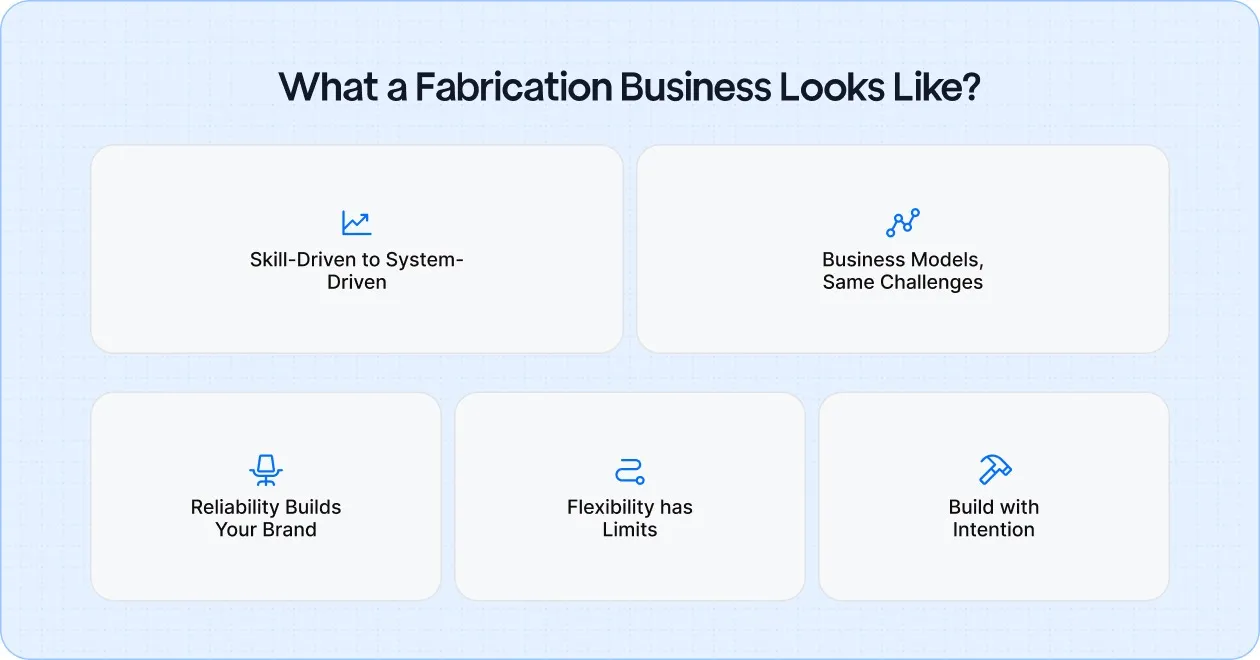
What a Fabrication Business Looks Like?
A fabrication business today sits at the intersection of craft and structure. The work still depends on skill, experience, and problem-solving on the shop floor. But whether the business survives or scales is decided by how well that work is organized, priced, and repeated.
The work on the shop floor is only one part of the picture. The rest happens before and after it.
From Skill-Driven to System-Driven
In the past, many fabrication businesses were built around individual expertise. If you knew how to weld, cut, bend, or assemble well, work followed. That still holds true at the beginning.
But as soon as volume increases, skill alone stops being enough.
Today, fabrication businesses are expected to operate with:
- Clear service boundaries
- Reliable lead times
- Consistent quality across jobs
- Predictable pricing and delivery
These expectations apply whether the shop has two people or fifty. Without structure, even a small increase in work can create delays, missed margins, and frustrated customers.
Different Business Models, Same Core Challenges
Fabrication businesses now fall into clearer models, even if owners don’t always label them.
Some businesses focus on general fabrication, taking on a wide range of custom jobs. Others specialize in certain materials, processes, or industries. Some depend on one-off work, while others build around repeat customers or long-term contracts.
Each model attracts different types of work, but they all face the same underlying questions:
- What work is actually profitable
- How much capacity exists right now
- Which jobs stretch the shop too thin
- Where time and money quietly leak out
These questions matter just as much when starting out as they do when expanding.
Capability and Reliability Build Your Brand
Modern buyers assume fabrication capability. They expect machines, tools, and technical know-how to be in place.
What they pay attention to instead is reliability.
That means:
- Jobs delivered when promised
- Fewer revisions and surprises
- Clear communication when something changes
- Confidence that the next order will go smoothly
Reliability is not something you market first. It is something the business earns through repeatable processes and realistic commitments.
Flexibility Has Limits
Being flexible helps early on. Saying yes to different types of work can keep cash flowing and expose the business to different customers.
But unlimited flexibility becomes a problem as the business grows.
Too much variation increases:
- Quoting difficulty
- Scheduling conflicts
- Setup time and rework
- Stress on people and equipment
Strong fabrication businesses learn where to draw the line. They stay flexible within a defined scope instead of stretching in every direction.
A Fabrication Business Must Be Built With Intention
Whether you are starting, stabilizing, or scaling, the same truth applies. A fabrication business cannot rely only on effort.
It needs intentional design.
That design shows up in how services are defined, how capacity is understood, how jobs are priced, and how information moves from quote to production to delivery.
When these pieces work together, growth feels manageable. When they don’t, even steady demand feels overwhelming.
How to Build and Run a Profitable Fabrication Business
A profitable fabrication business is the result of deliberate choices made early and reinforced every day. Choices about what kind of work to take on, how to price it, which customers to prioritize, and how tightly the operation is run.
Let's build a plan for running a fabrication business the right way:
Define The Type of Fabrication Business
Every fabrication business operates within a model, whether the owner defines it or not. The problem is that many businesses drift into a model through circumstance rather than choice. Over time, that drift creates confusion in pricing, workflow, and customer expectations.
Being clear about what kind of fabrication business you want to run gives structure to every other decision. It determines what equipment makes sense, which jobs fit your shop, and how you should position yourself in the market.
Most fabrication businesses fall into a few clear categories:
- Job shop fabrication
- One-off or small-batch custom work
- High variability in jobs, drawings, and timelines
- Requires tight quoting and scheduling control to stay profitable
- Contract or repeat fabrication
- Ongoing production runs or preferred-vendor relationships
- More predictable demand and cash flow
- Relies heavily on consistency and delivery reliability
- Niche or specialized fabrication
- Architectural metal, structural steel, automotive custom, precision parts
- Fewer job types with deeper expertise
- Stronger pricing power when positioned correctly
Problems start when a business tries to operate across all three at once. That lack of focus increases complexity without increasing margin.
Once the model is clear, services should be shaped around the problems you solve best:
- Fast turnaround and prototyping
- Heavy-duty or industrial fabrication
- End-to-end design, fabrication, and assembly
That positioning must be obvious everywhere the business shows up:
- On the website
- In quotes and proposals
- In outreach and sales conversations
- In networking and referrals
Clear positioning does more than attract the right work. It filters out the wrong work before it reaches your shop.
Price for Profit
Pricing is where many fabrication businesses undermine themselves without realizing it. When work slows down or competition increases, pricing decisions often become emotional. Quotes are adjusted to “win the job” rather than to protect the business.
The reality is simple. A fabrication business can be busy every day and still be losing money.
Strong pricing starts with understanding your true cost base. That includes:
- Machine acquisition, depreciation, and maintenance
- Shop rent, utilities, and overhead
- Labor costs, including the owner’s time
- Consumables, materials, scrap, and rework
- Software, compliance, insurance, and safety costs
Once costs are clear, pricing needs structure so decisions are consistent, not reactive.
Profitable fabrication businesses rely on:
- Defined labor and machine hourly rates
- Minimum job fees to protect low-value work
- Rush pricing that reflects real disruption
- Complexity premiums for unclear drawings or tight tolerances
Discounting to stay busy creates long-term damage:
- It teaches customers to undervalue skilled work
- It erodes margins job by job
- It damages team morale when effort is underpriced
The moment a fabrication business stops undercharging for work that is difficult to replace, profitability improves.
Choose the Right Customers
Not all revenue is equal. Some customers create stability, while others create stress. The difference becomes obvious over time.
Profitable fabrication businesses are selective. They understand that long-term success comes from predictable, respectful buyers who value reliability as much as price.
Customers who tend to support profitable growth include:
- Industrial buyers with ongoing needs
- Engineers and product companies that value precision
- Construction and infrastructure partners who plan ahead
Customers that require caution include:
- Bargain hunters focused only on the lowest number
- Last-minute buyers expecting miracles without paying rush fees
- One-off customers with unclear specifications
Over time, strong fabrication businesses work toward building anchored relationships:
- Repeat manufacturing runs
- Contract fabrication agreements
- Preferred-vendor or retainer-style arrangements
These relationships stabilize cash flow and reduce the pressure to accept poor-fit work just to keep machines running.
Attract Better-Fit Work
Build marketing that filters serious buyers and reduces low-quality RFQs before they hit your shop.


Invest in Capacity With Intent
Buying equipment feels like progress. In reality, poorly timed equipment purchases can increase financial strain without improving profitability.
Before investing in new machines, profitable fabrication businesses slow down and ask practical questions:
- Will this reduce outsourcing costs we already incur?
- Will it unlock work we are already turning away?
- Do we have consistent demand, not just short-term interest?
Smart capacity planning focuses first on bottlenecks, not wish lists.
Common constraints include:
- Cutting capacity
- Welding availability
- Finishing or coating delays
Once constraints are identified, attention shifts to utilization:
- Better scheduling to keep machines running
- Preventive maintenance to avoid downtime
- Operator training to reduce errors and rework
Idle machines quietly drain cash. Machines used consistently and intentionally protect margins.
Maintain Operational Discipline
Most fabrication businesses do not fail because of poor workmanship. They fail because the work is poorly organized.
As volume grows, relying on memory and informal communication breaks down. Profitable fabrication businesses introduce structure early:
- Intake
- Confirm drawings, specs, quantities, and timelines before quoting or scheduling
- Flag unknowns early instead of “figuring it out on the floor”
- Design and approval
- Lock drawings and revisions before production begins
- Make responsibility clear for approving changes
- Production
- Release jobs only when materials, hardware, and outsourced steps are confirmed
- Use job travelers or checklists so operators aren’t relying on memory
- Quality checks
- Build inspection points into the process
- Catch issues before they move downstream and get expensive
- Delivery and invoicing
- Close the loop cleanly so finished work doesn’t sit unpaid
- Make sure invoicing is tied to job completion
Discipline also means documenting what you already know.
Basic systems support this discipline:
- Job tracking that shows what is in progress
- Invoicing processes that ensure work gets paid for
- Deadlines with accountability, not assumptions
When work lives in systems instead of people’s heads, consistency becomes possible.
Build a Skilled, Stable Team Around Responsibility
Machines amplify output, but people determine profitability.
Strong fabrication businesses invest in building teams that take ownership of quality, safety, and efficiency. Skill matters, but reliability matters more.
This means:
- Hiring for responsibility and mindset
- Continuous training around safety and standards
- Clear expectations around quality and accountability
Retention improves when teams see:
- Fair compensation
- Clear growth paths
- Recognition for consistent performance
A fabrication business’s reputation is built every day by the people running machines, programming jobs, and checking welds. No system can replace that.
Market Like a Modern Fabrication Business
Relying only on word of mouth limits growth and visibility. Profitable fabrication businesses make it easy for serious buyers to evaluate them before making contact.
Marketing in fabrication is about clarity and proof.
A strong online presence shows:
- Real examples of completed work
- Industries served and types of jobs handled
- Capabilities, materials, and tolerances
It reinforces trust with:
- Case studies
- Before-and-after photos
- Testimonials or long-term customer relationships
Visibility also matters:
- An accurate Google Business Profile
- Consistent LinkedIn presence
- Partnerships with engineers, architects, and contractors
Buyers cannot choose you if they cannot find you or quickly confirm you are a good fit.
Protect Cash Flow Ruthlessly
Profit on paper means little without cash in the bank. Many fabrication businesses fail slowly through unpaid invoices, not lack of demand.
Strong businesses enforce payment discipline:
- Deposits upfront
- Milestone payments for larger jobs
- Clear, enforced payment terms
They avoid financing customers indefinitely:
- No silent extensions
- No open-ended credit
They track cash actively:
- Outstanding invoices
- Job-level profitability
- Monthly cash position
Cash flow is the oxygen of a fabrication business. Protecting it is essential.
Think Beyond Fabrication and Build Value
The most profitable fabrication businesses eventually stop positioning themselves as commodity vendors.
They become partners.
This often involves adding value through:
- Design support
- Engineering review
- Assembly or installation
- Early-stage manufacturing input
Over time, one-off jobs turn into long-term relationships.
Growing a Fabrication Business With 6 Strategies
Growth in a fabrication business should never come first. It comes after the shop knows what work it is good at, how it prices that work, and how reliably it delivers. When growth is chased before that foundation is stable, it usually shows up as late jobs, stressed teams, thin margins, and frustrated customers.
Once the core is understood and under control, growth becomes less about chasing more work and more about attracting the right work. This is where visibility, marketing, and reputation start to matter.
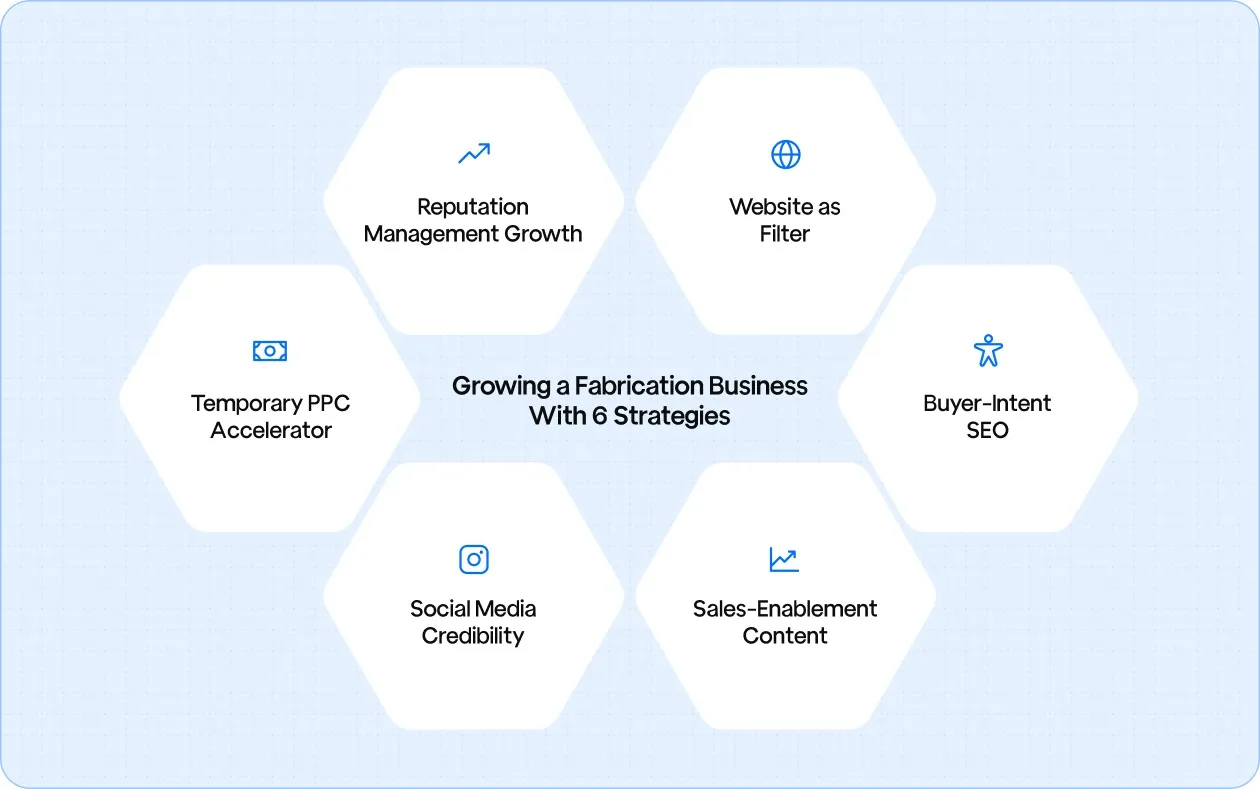
A Clear Website That Acts as a Qualification System
In fabrication, the website is not a branding asset. It is a pre-sales filter. Buyers use it to decide whether you are capable, reliable, and worth engaging before they ever send an RFQ. If the site is vague, generic, or incomplete, it attracts the wrong conversations and wastes quoting time.
What a fabrication website must include and how it should be structured:
- Capability-driven page structure: The website should have separate, indexable pages for each core capability such as cutting, welding, forming, assembly, or specialized fabrication, instead of listing everything on one generic services page.
- Performance and page speed optimization: Fabrication buyers often access sites from offices, plants, or mobile devices, so page speed matters. Image-heavy portfolio pages must be compressed properly, unnecessary scripts removed, and performance monitored continuously.
- Schema markup for industrial services: Structured data should be implemented for services, locations, and business information so search engines clearly understand what the shop does and where it operates.
- Technical clarity over marketing copy: Pages should clearly state materials handled, thickness ranges, tolerances, certifications, and industries served, so engineers and procurement teams can self-qualify quickly.
- Logical internal linking: Capability pages, content pieces, and RFQ pages should be linked intentionally so buyers can move from understanding to action without friction.
- Conversion paths that reflect real workflows: RFQ forms should request the information needed to quote accurately, such as drawings, quantities, and timelines, instead of generic contact forms.
A clear website improves growth by reducing chaos.
Qualify Buyers Before They Quote
Turn your website into a clear pre-sales filter that shows capabilities, constraints, and fit upfront.
SEO That Reflects How Fabrication Buyers Actually Search
SEO only works for fabrication businesses when it mirrors real buyer intent. Engineers and purchasing teams do not search the way marketers assume they do. They search with specific processes, materials, and problems in mind.
What SEO must include and how it should be implemented:
- Technical SEO foundation: This includes crawlability, clean URL structures, fast page loads, mobile usability, proper indexing, and resolving site errors that block search engines from accessing key pages.
- Keyword research rooted in buyer intent: Keywords should be mapped around fabrication processes, materials, industries, and applications. This includes separating informational searches from RFQ-ready searches.
- On-page SEO for service and capability pages: Each core page must be optimized with clear headings, structured content, internal links, and metadata that reflect how buyers actually search for fabrication services.
- Local SEO for fabrication suppliers: Location-based optimization, Google Business Profile alignment, and consistent NAP data help capture buyers who prefer regional fabrication partners.
- Content-led SEO for long-term demand: Blog and resource content should target technical questions, purchasing concerns, and design considerations that buyers research before shortlisting suppliers.
- Ongoing SEO audits and competitor analysis: SEO must be reviewed regularly to identify gaps, lost rankings, and competitor weaknesses that can be overtaken with better technical depth.
Proper SEO brings fewer leads, but far better ones.
Get Found by Serious Buyers
Align SEO with how engineers and procurement teams actually search for fabrication partners.
Content That Functions as Sales Enablement
Content in a fabrication business is not meant to entertain or build awareness. It exists to remove uncertainty for buyers who are evaluating risk quietly before making contact.
What fabrication content should cover and how it should be used:
- Technical explanation content: Content should explain fabrication processes, tolerances, material behavior, and design constraints so buyers understand what is feasible.
- Purchasing and RFQ preparation guidance: Articles and resources should help buyers submit better drawings, specifications, and timelines, reducing rework and misalignment.
- Pricing and lead-time education: Content should explain what affects pricing and delivery schedules so buyers understand why quotes differ and delays occur.
- Quality and repeatability clarification: Content should outline inspection processes, documentation, and controls that reduce risk for repeat orders.
- Sales-integrated usage: Content must be actively used by sales teams during follow-ups, quoting discussions, and early conversations instead of being left passive on the site.
- Embedded placement within service pages: Content should support core service pages directly, not live separately as disconnected blog posts.
Good content shortens sales cycles and filters out unprepared buyers.
Remove Buyer Uncertainty
Create content that explains processes, tolerances, and timelines so buyers come prepared.
Social Media as a Credibility Reinforcement Layer
Social media does not generate demand for fabrication businesses. It validates demand that already exists. Buyers check social presence to confirm that the shop is active, real, and competent.
How social media should be structured and used:
- LinkedIn as the primary platform: Fabrication buyers are in a professional mindset on LinkedIn, making it the most relevant channel.
- Process and work visibility: Posts should show ongoing work, shop activity, process improvements, and problem-solving, not promotional graphics.
- Industry relevance over self-promotion: Sharing broader industry content helps position the business as part of the buyer’s professional ecosystem.
- Leadership and sales profile activity: Individual profiles often build more trust than company pages and should be used consistently.
- Consistency over creativity: Regular, clear posting builds familiarity and legitimacy more effectively than occasional high-effort posts.
Social media supports growth by reinforcing trust between touchpoints.
PPC as a Controlled and Temporary Accelerator
Paid advertising should never be the foundation of fabrication business growth. It should only be used to accelerate visibility for specific, well-defined services once the core systems are in place.
How PPC should be implemented without wasting budget:
- High-intent keyword targeting: Campaigns must focus on specific processes, materials, or services rather than broad fabrication terms.
- Tight geographic and audience filters: Ads should be limited to regions and buyer profiles that match operational capacity.
- Service-specific landing pages: Every ad should point to a page that directly explains the exact capability being promoted.
- Clear lead-quality monitoring: Inquiries should be reviewed for fit, not volume, and poor-quality keywords should be cut quickly.
- Short-term usage with clear exit points: PPC should support growth while SEO matures, not replace it indefinitely.
Used incorrectly, PPC attracts chaos. Used correctly, it fills controlled gaps.
Reputation Management as a Long-Term Growth Multiplier
In fabrication, reputation compounds faster than any marketing channel. Buyers remember missed deliveries and unclear communication long after they forget ads or websites.
What reputation management includes and how it should be handled:
- Delivery discipline: Meeting commitments consistently is the foundation of reputation, not online activity.
- Clear communication during issues: Early, honest updates reduce damage when constraints or delays arise.
- Intentional capture of proof: Testimonials, case examples, and repeat customer stories should be documented and reused.
- Accurate and maintained business profiles: Listings and profiles should reflect current capabilities, hours, and contact details.
- Feedback loops after completed jobs: Post-job reviews help identify issues early and reinforce strong relationships.
Reputation reduces sales friction, increases pricing power, and stabilizes growth.
How Gushwork Helps Fabrication Businesses Build Visibility?
Most fabrication shops don’t need more marketing activity. They need clearer visibility in the places buyers actually research, and a system that turns that visibility into better-fit RFQs.
Gushwork helps you build organic demand by combining AI and human expertise to improve how your fabrication services show up in search and AI-driven answers, without relying on ads or random tactics.
- AI Visibility + SEO: We map keywords to real fabrication buyer intent (process, material, use case, RFQ intent), then build and optimize pages that match how engineers and procurement teams shortlist vendors.
- Execution that stays operational: We prioritize technical health, site structure, and content that reflects real constraints, lead times, and decision criteria.
- Lead capture clarity: We support lead tracking with dashboards and alerts so enquiries don’t get missed, and you can see what drives quality conversations.
The outcome is a visibility system that filters better-fit work and makes growth feel controlled.
Conclusion
A strong fabrication business runs on clarity. When services are defined, pricing is structured, operations are organized, and visibility reflects reality, the business starts to behave differently. Conversations with customers improve. Decisions become easier. Growth feels intentional instead of forced.
This is what separates businesses that stay stuck in survival mode from those that move forward with confidence. Over time, that control compounds into better customers, healthier margins, and a business that can actually support the people running it.
Ready to Grow With Control
Build a system that supports profitability, reliability, and steady demand without adding chaos.


.webp)






.webp)


.svg)


