









Most countertop installation projects begin long before a homeowner fills out a form or makes a call. They start with quiet research.
People scroll through photos, compare materials, read about timelines, and look for signs that an installer understands the work beyond surface claims. Countertop installation native advertising fits this research phase by placing useful content inside articles, guides, and sites that homeowners already trust.
Instead of interrupting the process, it stays present while questions are answered and options are compared. For installers and growing teams, this approach supports steady demand by matching content to how buyers actually choose who to contact.
What Native Advertising Looks Like for Countertop Installation?
Native advertising for countertop installation appears as content that fits naturally into the page a homeowner is already reading. It looks like an article or guide and focuses on materials, process, and finished results.
For countertop businesses, native ads usually lead to:
- Material comparisons
- Installation explainers
- Pricing factor breakdowns
- Visual project galleries
The aim is to stay visible during research and answer questions that shape decisions. Research shows native ads receive about 53% more views than classic display ads because they fit the content environment better.
Common native placements used for countertop installation content syndication
Native content appears in three formats:
- In-feed content units: Stories placed inside article feeds on home improvement or lifestyle sites.
- Content recommendation widgets: Links shown at the end of articles under sections like “More to read.”
- Sponsored article placements: Full articles hosted on publisher sites with room for detail and visuals.
How native ads differ from search ads within a countertop installation campaign
- Search ads appear when someone is close to contacting an installer.
- Native ads appear earlier, while homeowners are still comparing options.
Search responds to existing intent. Native supports understanding before the intent is fully formed.
Some installs win before the quote is even asked for.
If your content answers the same questions homeowners keep googling, your brand shows up earlier and feels familiar sooner.


Understand the Countertop Installation Target Audience
Homeowners researching countertop installation are not all at the same stage. Some are still learning. Others are close to reaching out. Native advertising mostly reaches people in the earlier phase, when preferences are still forming.
In home services, 78% of local mobile searches lead to a purchase, and over 55% of consumers research providers online before scheduling an appointment, showing how early research matters.
Before contacting an installer, homeowners usually look for:
- Material comparisons in real spaces
- Typical installation timelines
- Pricing factors that affect final quotes
- Photos from completed projects
These questions shape confidence before any outreach happens.
Native advertising aligns with this behavior by placing answers inside articles and guides homeowners are already reading, allowing interest to build without pressure.
Build the Foundation Before Launching Ads
Before any countertop installation ads go live, the basics need to be clear. Native advertising works best when homeowners immediately understand what happens next and what to expect if they reach out.
Define the offer clearly
Homeowners hesitate when the next step feels vague. A clear offer removes that hesitation. This usually means spelling out:
- How measurement appointments work
- When quotes are shared after measurement
- What installation scheduling typically looks like
Clarity at this stage sets expectations and prevents confusion later.
Establish proof and credibility
Native ads often lead homeowners to read before they act. What they see during that time shapes trust. Strong foundations include:
- Before-and-after galleries from real installs
- Reviews that speak to workmanship and reliability
- Clear explanations of materials offered and how installation is handled
This information reassures readers that the installer understands the work in detail.
Set clear service area boundaries
Relevance matters as much as visibility. Ads should reflect where the business actually operates.
- ZIP-based targeting keeps exposure aligned with coverage
- Exclusion zones prevent wasted attention outside service areas
Clear boundaries protect countertop installation performance and ensure follow-up conversations stay relevant.
If the next step feels unclear, homeowners stop reading.
Clear pages, clear topics, and clear expectations give native ads a destination that makes sense.
Targeting Strategies That Match Countertop Research Behavior
Targeting countertop installation, native advertising works best when it reflects how homeowners actually research, not how advertisers want them to act. At this stage, relevance comes from context and behavior, not direct intent.
Core targeting layers
Effective targeting starts with narrowing exposure to situations where countertop planning is already top of mind.
- Geographic alignment with service coverage: Ads appear only where installation is realistically possible, keeping attention local and relevant.
- Contextual placements around renovation content: Native ads are shown alongside articles about home upgrades, kitchen planning, or remodel preparation, where countertop research naturally fits.
- Topic and keyword adjacency: Content appears near discussions about materials, layouts, or renovation costs, reaching readers already thinking through countertop decisions.
This approach keeps exposure focused without relying on personal data.
Audience refinement signals
As homeowners interact with content, additional signals help refine who continues to see follow-up messages.
- Content engagement depth: Readers who scroll, pause, or explore multiple sections show stronger interest.
- Time spent on page: Longer reading time often signals active comparison rather than casual browsing.
- Gallery and pricing page interaction: Views of images or cost-related sections indicate growing seriousness.
These signals help narrow attention to homeowners who are still researching but clearly engaged, without forcing action too early.
Must Read: How a Building Material Supplier Cut Lead Costs 42% - The Digital Marketing Strategy You Can Use
The 3-Step Native Advertising Funnel for Countertop Installation
A native advertising funnel for countertop installation works when each step respects how confidence builds over time. Homeowners do not move from reading to contacting in one jump. Each stage answers a different question in their mind.
Step 1: Content-first discovery
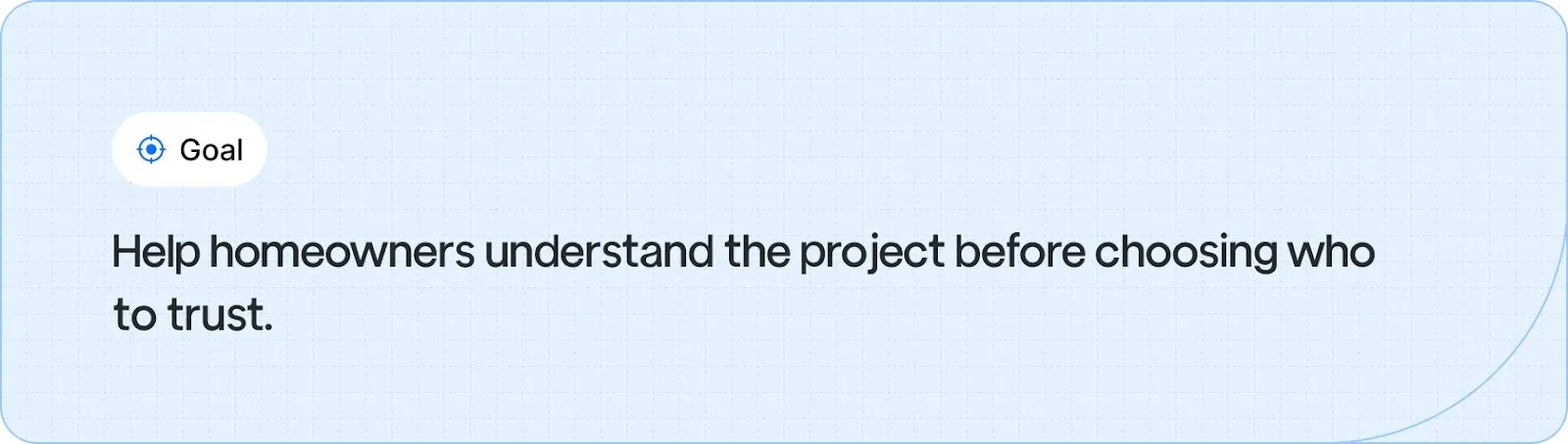
At this stage, the reader is not comparing installers. They are trying to understand the project itself. Content here removes uncertainty by covering topics such as:
- Quartz vs granite and where each works best
- Typical countertop installation timelines
- Pricing factors that influence final quotes
- Sink cutouts, edge profiles, and backsplash planning
- What usually happens on installation day
The focus stays on clarity, not persuasion. This forms the base layer of countertop installation sales content.
Step 2: Countertop installation retargeting campaign
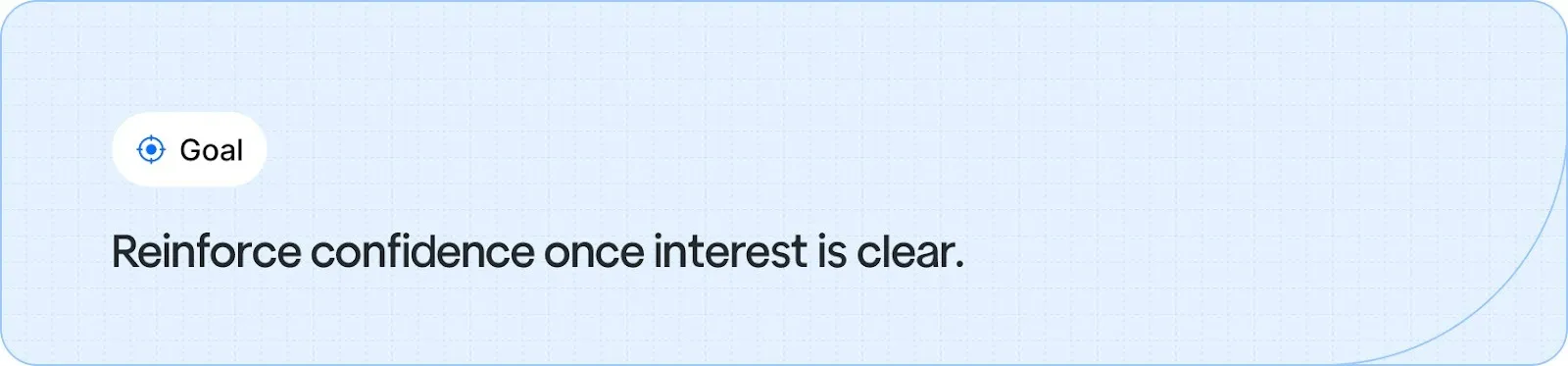
After someone engages with content, their questions change. They already understand the basics. Now they want reassurance. Retargeting at this stage focuses on:
- Real installation examples that show finished work
- Reviews that reflect consistency and reliability
- Process explanations that reduce second-guessing
These countertop installation retargeting ads support decision confidence without repeating earlier information.
Step 3: Quote and measurement conversion

Once confidence is established, friction becomes the main risk. Conversion at this stage depends on:
- Short inquiry forms that feel quick to complete
- Clear click-to-call options
- Straightforward explanations of what happens after contact
Each step in the funnel narrows focus, from learning, to reassurance to action, without forcing homeowners forward before they feel prepared.
For real-world examples of how content-led native advertising has been executed in practice, the case studies linked here are worth reading.
Great ads don’t fix weak content.
When your guides, pages, and proof are planned like a system, the funnel stops feeling random.
Creative and Copywriting That Drives Engagement
Native ads succeed or fail based on how naturally they fit into the reading experience. For countertop installation, creative and copy need to feel informative first, promotional last.
Visual guidelines for native ads
Homeowners pause on visuals that help them judge quality. Effective native creatives usually share a few traits:
- Real project photography over stock images: Finished kitchens and bathrooms signal authenticity and workmanship more clearly than styled placeholders.
- Focus on surfaces and details: Edges, seams, cutouts, and transitions often matter more compared to wide room shots when someone is comparing installers.
- Minimal overlays and text: Clean images preserve the look of editorial content and prevent the ad from feeling disruptive.
These choices help the content blend in while still drawing attention.
Countertop installation copywriting principles
The copy surrounding native creatives works best when it mirrors how homeowners think during research.
- Plain, descriptive language: Clear explanations feel more trustworthy than polished sales phrasing.
- Clear outcomes without exaggeration: Readers want to understand what changes after installation, not promises that feel vague.
- Headlines framed around homeowner questions: Questions about materials, process, or planning naturally invite clicks because they match active curiosity.
Strong creative and copy do not push decisions. They hold attention long enough for understanding to grow.
Landing Pages Built for Native Traffic
Native traffic arrives with a different mindset. Homeowners click through expecting continuity, not a hard shift into sales mode. Landing pages need to respect the context that brought them there.
Content landing pages
These pages work best when they continue the story started by the ad. Key elements include:
- Ad-aligned headlines: The headline should echo the question or topic that earned the click, so visitors feel they landed in the right place.
- Visual examples placed early: Images from real projects help readers quickly connect the content to their own space.
- Clear explanations of pricing, process, or materials: Straightforward sections that explain what affects cost, how installation works, or how materials differ keep readers engaged.
- Soft transitions into contact options: Contact prompts appear as a natural next step, not an interruption.
Quote and measurement pages
When homeowners decide to reach out, simplicity matters most.
- Short forms with essential fields only: Fewer questions reduce hesitation.
- Visible service area confirmation: Clear location coverage reassures visitors before they submit.
- Proof placed near the form: Reviews, photos, or brief process notes reinforce confidence at the moment of action.
Landing pages for native traffic succeed when they continue the learning experience first, then make contact feel easy and predictable.
Measure Countertop Installation Ad Performance
Measuring native advertising for countertop installation is less about volume and more about signal quality. The goal is to understand which content attracts serious homeowners and which interactions lead to meaningful conversations.
Tracking setup essentials
Effective measurement starts with visibility across the full path, not just the first click.
- Campaign-level tracking: Shows which content themes and placements attract the right type of interest.
- Creative-level attribution: Helps identify which visuals and headlines draw deeper attention, not just clicks.
- Call and form tracking: Connects inquiries back to the content that started the interaction.
This structure ensures performance is reviewed in context, not in isolation.
Performance signals that matter
Native advertising success shows up through behavior, not surface metrics.
- Engagement quality: Readers who scroll, pause, or explore multiple sections signal genuine interest.
- Page interaction depth: Time spent with galleries, pricing sections, or process explanations indicates active consideration.
- Call and inquiry relevance: Conversations that reference materials, timelines, or specific questions reflect stronger alignment.
Tying outcomes back to the campaign
The most useful insights come from tracing outcomes to their origin. When installers can see which content influenced inquiries, future campaigns become more focused, consistent, and easier to refine.
Performance measurement, done well, turns native advertising into a learning system rather than a one-off effort.
30-Day Execution Plan
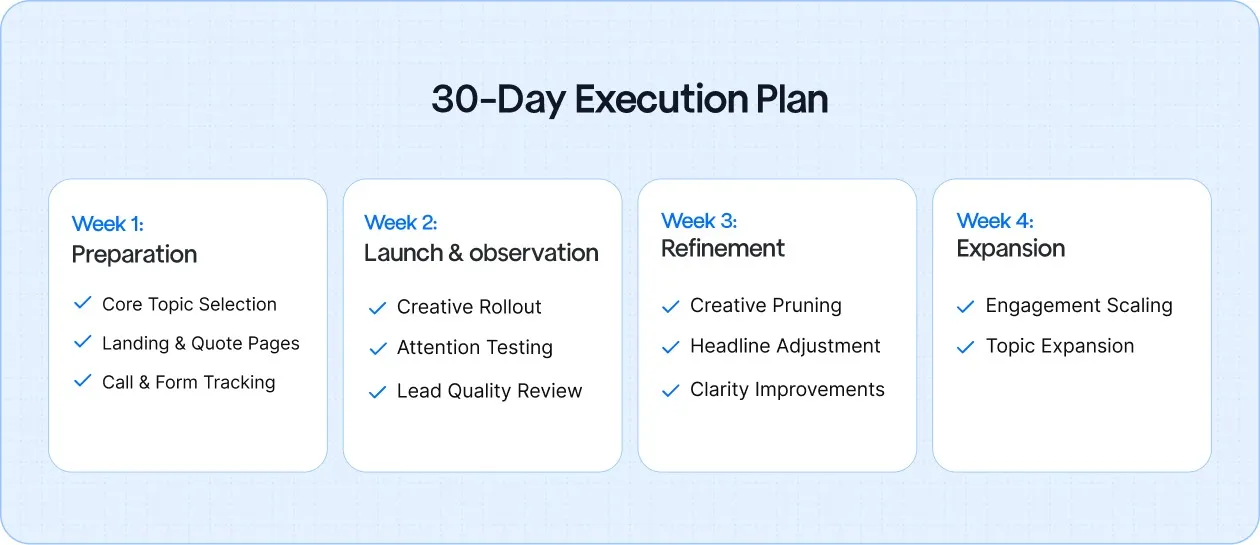
A 30-day rollout works best when each week has a clear purpose. The goal is not speed, but controlled learning that compounds over time.
Week 1: Preparation
The first week sets the direction for everything that follows. Decisions here should reduce uncertainty later.
- Select one core content topic tied to common homeowner questions
- Build one content-focused landing page and one quote or measurement page
- Set up call and form tracking so early signals are visible
This week is about clarity, not volume.
Week 2: Launch and observation
With the foundation in place, the focus shifts to watching how real homeowners respond.
- Launch multiple creatives across a small set of placements
- Observe which topics hold attention and which lose it quickly
- Review early inquiries for relevance and question quality
The goal is to learn, not to optimize yet.
Week 3: Refinement
Patterns usually start to emerge by the third week. This is where small changes create meaningful improvement.
- Pause creatives that fail to hold attention
- Adjust headlines or page sections that cause drop-offs
- Improve clarity where readers hesitate or exit
Refinement at this stage sharpens what already works instead of starting over.
Week 4: Expansion
The final week focuses on controlled growth.
- Increase exposure to content that drives deeper engagement
- Introduce new topics based on the questions homeowners asked during the month
Expansion works best when it follows evidence, not assumptions.
By the end of 30 days, the campaign shifts from setup mode to a repeatable system that can be extended with confidence.
How Native Advertising Supports Real Countertop Buying Decisions
Countertop installation decisions usually form over time. Homeowners read, compare, and look for proof before contacting an installer. What they learn during this phase often shapes who they reach out to later.
Native advertising supports this process by placing useful content where research already happens. It helps homeowners understand materials, timelines, and what to expect, without forcing action too early.
When this content appears consistently, conversations start with clearer expectations and more informed questions. That early clarity is what turns research into dependable demand.
Want your content to work before the first call?
Gushwork helps teams plan, write, and structure SEO content so buyers understand the work before they ever reach out.


.webp)






.webp)


.svg)


