









You fix comfort problems fast. Your marketing should do the same. HVAC PPC (pay-per-click) connects you with people at the exact moment they need help.
In moments of emergencies, they’re not browsing, they’re ready to call.
PPC puts your name at the top of search instantly. And when your ad message and landing page align with what people are looking for, that click can quickly turn into a booked job.
In this blog, we’ll break down how HVAC PPC works, the types of PPC ads that deliver the best results, and how it fits within your overall digital strategy to help you generate more leads and get a stronger return on every ad dollar spent.
What Is HVAC PPC?
HVAC PPC (Pay-Per-Click) is a digital advertising model that helps heating, ventilation, and air conditioning companies appear at the top of search results when homeowners need quick service. Instead of waiting for organic rankings, PPC lets you pay for visibility. You’re charged only when someone clicks your ad.
A strong HVAC PPC strategy focuses on matching your ads to high-intent searches, people who are ready to book a repair, replacement, or tune-up right now. By using the right keywords, ad copy, and landing pages, PPC campaigns can turn a single search into a real lead.
It’s especially powerful for local service businesses because it targets your exact service area, filters out unqualified traffic, and puts your company in front of homeowners at the moment they’re looking for help.
How Does PPC Work?
Let's learn how it works:
1. Keywords, Bidding, and the Ad Auction
PPC begins with keywords. These are the search terms people type into Google, such as “AC repair near me” or “furnace replacement cost.”
When someone runs one of these searches, Google instantly runs an ad auction. Every advertiser bidding on that keyword enters the auction at that moment.
Your ads can appear across different placements depending on the campaign type, be it Google Search Ads, Google Local Services Ads (LSAs), Microsoft (Bing) Ads or Retargeting ads (Display and YouTube).
Winning the auction does not depend on budget alone. Google evaluates who provides the most relevant and useful experience for the searcher.
2. You Pay for Engagement and Not Exposure
With PPC, you don’t pay for showing up. You pay when someone clicks.
This model ensures your budget is spent on people who actively engage with your ad. You can control daily budgets, campaign limits, and bid strategies, which makes PPC flexible for both small HVAC companies and larger multi-location providers.
However, clicks alone don’t equal success. What happens after the click matters more.
3. Quality Score Determines Cost and Visibility
Quality Score is one of the most important concepts in PPC, yet one of the least understood.
Google assigns each keyword a Quality Score based on three factors:
- Keyword relevance: How closely your keyword matches the search intent. Tightly grouped keywords and service-specific targeting improve relevance.
- Ad relevance and expected CTR: How well your ad copy aligns with the keyword and whether users are likely to click it. Ads that clearly match the search perform better.
- Landing page experience: How useful, fast, and relevant your landing page is once someone clicks.
Higher Quality Scores lead to:
- Lower cost per click
- Better ad positions
- More consistent visibility
Poor Quality Scores force you to overpay just to stay competitive.
4. Improving Keyword and Ad Relevance
Relevance starts with structure.
Strong HVAC PPC campaigns use:
- One core service per ad group
- Closely related keywords grouped together
- Ads that mirror the exact language of the search
For example, “emergency AC repair” should lead to an ad and landing page focused entirely on emergency AC repair, not general HVAC services.
This alignment improves Quality Score and conversion rates at the same time.
5. Landing Pages Turn Clicks Into Leads
Once someone clicks your ad, Google steps back and your website takes over.
Landing pages play a critical role in PPC performance. Google evaluates them, and customers judge them even faster.
Effective HVAC landing pages:
- Load quickly on mobile
- Match the promise made in the ad
- Focus on one service and one action
- Make phone numbers and booking options obvious
- Show trust signals early, such as reviews or guarantees
A weak landing page can undo even the best keyword and ad strategy.
6. From Click to Conversion
A conversion is the action you want someone to take, usually a phone call, form submission, or booking request.
PPC campaigns should track:
- Calls from ads and landing pages
- Form submissions
- Click-to-call actions on mobile
This data allows you to see which keywords and ads actually drive real conversations, not just traffic.
7. Data, Learning, and Continuous Optimization
Every click feeds data back into the system.
Over time, PPC reveals:
- Which keywords drive calls versus low-quality inquiries
- Which services perform best by location
- Which ads convert under pressure
- Where budget is being wasted
This data is what makes PPC powerful. Campaigns improve not because of one-time setup, but because decisions are refined using real performance insights.
When managed correctly, PPC becomes a feedback loop. The more you run it, the smarter and more efficient it gets.
Over time, you can adjust your targeting, keywords, and bids to get higher-quality leads at lower costs.
Put these pieces in place, and your HVAC PPC stops being “paid traffic” and starts acting like a reliable booking engine.
10 Steps to Succeed with HVAC PPC
Running a PPC campaign for an HVAC business isn’t just about throwing money into Google Ads and hoping calls come in. It’s about knowing who you want to reach, what they’re searching for, and how to make them pick up the phone when they see your ad.
Here’s a complete, beginner-friendly breakdown of how to plan, launch, and manage a PPC campaign that actually gets you paying customers.
1. Define Who You Want Calling Before You Spend
PPC gives HVAC businesses control over who sees their ads, but that control is often underused. Many campaigns fail because they try to attract every possible customer at once.
Before launching ads, decide which types of jobs matter most to your business right now.
Common focus areas include:
- Emergency AC or furnace repair
- Full system replacement or installation
- Seasonal tune-ups and maintenance plans
- Commercial or property management contracts
Each of these audiences searches differently, has different urgency levels, and converts at different rates. Ads, keywords, and landing pages should be built around one clear intent at a time.
When messaging is vague or mixed, clicks increase but bookings do not.
2. Choose the Right PPC Platform for Your HVAC Business
Every PPC platform drives a different type of lead. HVAC campaigns perform best when platforms are selected based on the kind of work you’re trying to book, not convenience or popularity.
Instead of trying to be everywhere, focus on the channels that match your service mix and response capacity.
Google Search Ads: These are the standard paid listings you see at the top of Google results. You bid on keywords (like “furnace repair Denver”), and you pay when someone clicks your ad. They’re ideal for:
- Immediate service leads (repairs, replacements, tune-ups)
- Seasonal promotions
- High-intent buyers already comparing providers
Google Local Services Ads (LSAs): These appear above regular search ads with the “Google Guaranteed” badge. You only pay when a lead actually calls or messages you. They’re great if:
- You have verified licensing, insurance, and background checks
- You can answer calls quickly
- You want leads that are ready to book now
Microsoft Ads (Bing): Bing often has less competition and lower cost per click than Google. It tends to perform well with older demographics and desktop users, making it a useful secondary channel once Google campaigns are producing consistent results.
Most HVAC companies see the best results by starting with Google Search or LSAs, then expanding into additional platforms only after performance data supports the move.
3. Build Keyword Lists Around Booking Intent
High-performing HVAC campaigns prioritize keywords that show someone is ready to take action. These searches usually include urgency, location, or cost signals, which indicate the person is closer to booking a service.
Examples of high-intent searches include:
- “AC repair near me”
- “furnace replacement cost”
- “emergency HVAC service”
These terms may not always have the highest search volume, but they consistently produce better calls and more booked jobs.
Use structured tools to find terms your audience is actually typing and uncover opportunities you might miss otherwise:
- Google Keyword Planner for search volume and keyword suggestions
- Search term reports in Google Ads to see what people actually typed to trigger your ads
- Competitor research tools, like SEMrush to find gaps in your keyword mix
4. Set a Budget That Matches Your Market
A realistic budget is what keeps your PPC running long enough to collect useful data.
Here’s a simple way to think about it:
- Smaller towns: start around $1,000/month
- Mid-size cities: $2,000–$3,000/month
- Big metros: $3,000–$5,000/month or more
HVAC clicks average around $25–$35 per click depending on your area. But those clicks often turn into real jobs if your ad and landing page are set up right.
In the beginning, your goal is to learn which keywords convert. Once you see patterns, shift budget toward what’s working and pause what isn’t.
Pro tip: Set a daily limit in Google Ads to avoid overspending. Even $40–$50/day can generate data to work with in smaller markets.
5. Create Ads That Match Real Customer Needs
Good HVAC ads need clarity and confidence. People searching for HVAC help are often stressed, hot, or freezing. Speak directly to that urgency.
Here’s a simple structure:
- Headline 1: “Same-Day AC Repair in Albany”
- Headline 2: “Licensed & Insured Technicians”
- Headline 3: “Call Now for a Free Quote”
- Description: “Fast, reliable HVAC service. Repair and replacement available today. Local technicians ready 24/7.”
Then, add call extensions and location extensions so people can click to call or get directions right from the ad.
Pro tip: Always test two ad versions per service (like one focused on “speed” and one on “quality”). After a week, keep the better-performing one and test again.
6. Build a Landing Page That Does One Job
When someone clicks your ad, don’t send them to your homepage, that’s one of the biggest beginner mistakes. Send them to a dedicated landing page that’s built for conversions.
Your landing page should:
- Have your phone number big and visible at the top
- Mention your service area in the headline (e.g., “HVAC Repair in Dallas”)
- Show quick trust signals: reviews, ratings, licenses, or “Google Guaranteed”
- Include a short contact form (name, number, issue)
- Load fast, especially on mobile (over 60% of HVAC clicks come from phones)
You only have a few seconds before a visitor clicks “back”, make it count.
Pro tip: Keep it human. A real project photo or a short testimonial works better than stock photos every time.
7. Track Every Call, Form, and Click
A reliable HVAC PPC setup connects user actions back to the ads and keywords that triggered them.
At a minimum, this includes:
- Call tracking for each campaign: Unique tracking numbers allow you to see which ads and keywords generate phone calls. This helps separate high-intent searches from clicks that never turn into conversations.
- Form tracking using Google Tag Manager: Google Tag Manager lets you track form submissions, button clicks, and phone link taps without modifying your website every time. This ensures no meaningful action goes unrecorded.
- Google Ads conversion tracking: Conversion tracking links calls and form submissions directly back to keywords and ads. Without it, Google Ads cannot optimize bidding or delivery effectively.
While Google Ads shows what triggered a conversion, Google Analytics explains what happened in between.
Analytics helps you understand:
- How visitors move through your site
- Where they drop off before contacting you
- Which landing pages hold attention and which don’t
- Differences between mobile and desktop behavior
This context helps identify friction points that affect conversion rates, even when ads are driving traffic successfully.
8. Maintain and Optimize Weekly
The best PPC results come from small, steady improvements.
Each week:
- Check your search term report and add new negative keywords
- Pause ad groups or keywords with high cost and no conversions
- Review call recordings. See what kind of calls you’re getting and how well they’re handled
- Look at which ad headlines got the most clicks and update your underperforming ones
Each month:
- Test one new landing page headline or layout
- Adjust bids for devices, mobile users usually convert faster
- Revisit your budget to double down on profitable areas
9. Combine PPC with Local SEO for Compounding Results
PPC drives quick leads, but SEO builds long-term momentum. When both are active, they strengthen each other. Your PPC ads bring immediate calls, and your local SEO ensures people can still find you organically later.
If someone sees your ad today and your Google Business Profile tomorrow, they’re twice as likely to trust you.
Pro tip: Always link your website and Google Business Profile in ads. When people check your reviews before calling, it boosts your credibility instantly.
10. Use Automation and AI Tools
Automation works best once a campaign has clean data and a clear structure. With enough conversion history, AI systems can identify patterns faster than manual review alone.
Common areas where automation helps include:
- Automated bidding strategies: Google Ads offers options like Maximize Conversions or Target CPA, which adjust bids in real time based on the likelihood of a conversion. These strategies work best after accurate conversion tracking is in place and performance has stabilized.
- Smart Campaigns for coverage and support: Google Smart Campaigns simplify targeting and ad delivery. While they offer less control, they can be useful for expanding reach or supporting smaller markets once core campaigns are performing reliably.
- Rules and alerts: Automated rules can pause ads with poor performance, limit overspending, or flag sudden changes. This prevents small issues from turning into costly problems.
What Automation Should Not Replace?
Automation is not a shortcut for poor setup. Without strong keyword structure, accurate tracking, and clear conversion goals, AI tools optimize toward the wrong outcomes.
Automation should not replace:
- Keyword research and intent analysis
- Landing page testing and improvement
- Review of call quality and booking rates
- Strategic budget decisions
Human oversight remains essential to ensure the system is optimizing toward real business results.
Get Seen First, Book More Jobs
Make sure your HVAC business shows up when it matters most. Target the right searches and outshine competitors.


Types of PPC Ads for HVAC
For HVAC, you have several ad formats that work together to capture urgent repair calls, installation quotes, and maintenance plans.
Here’s a clear rundown of the main HVAC PPC options, what they’re best for, and quick setup tips:
1) Google Local Services Ads (LSAs)
These are pay-per-lead ads that appear at the very top of Google when homeowners search for local services. You pay when a lead calls or messages you.
Best for: Emergency repair, same-day service, high-intent local jobs.
Tips:
- Complete all verification steps; pick accurate categories (e.g., HVAC contractor).
- Set service areas and hours; push reviews weekly.
- Mark spam/invalid leads and optimize your bidding per lead quality.
2) Google Search Ads
Text ads triggered by keywords. You bid on keywords and your ad shows when someone searches. You pay when they click.
Best for: Capturing intent across repair, maintenance, installs, ductless, IAQ, and commercial.
Tips:
- Split campaigns by job type and urgency (e.g., “Emergency AC Repair,” “Furnace Install”).
- Use exact/phrase for money terms; add strong negatives (DIY, jobs you don’t do).
- Send traffic to matching landing pages with tap-to-call and short forms.
3) Call-Only / Call Ads
Ads optimized for mobile that focus on calling directly from the ad. The “click” often becomes a phone call.
Best for: Business hours, after-hours emergencies, teams ready to answer.
Tips:
- Show during staffed times; use call extensions elsewhere.
- Track calls ≥60s as conversions to gauge real lead quality.
4) Google Performance Max (PMax)
A meta-campaign type that uses Search + Display + YouTube + Maps in one. Google uses your assets and goals to serve ads broadly.
Best for: Filling volume when Search is capped; promoting installs/maintenance across the funnel.
Tips:
- Feed quality assets (service photos, short video, offers), precise locations, and real conversion goals.
- Add account-level negatives; watch lead sources and quality.
5) YouTube Ads
Video ads (skippable, bumper, in-stream) that play on YouTube or partner sites.
Best for: Seasonal promos (tune-ups), brand building, retargeting site visitors who didn’t book.
Tips:
- Keep videos 15–30s; hook in 5s; add clear CTA (“Book a tune-up”).
- Layer geographic targeting and custom segments (people searching HVAC terms).
6) Retargeting Ads
Retargeting focuses on people who have already interacted with your website or ads. These users are more familiar with your brand, which makes follow-up messaging more effective than reaching cold audiences.
Retargeting ads are shown to users who have taken specific actions, such as:
- Visiting a service or repair page
- Clicking an ad without calling
- Spending time on replacement or installation pages
- Visiting your site during peak seasons
Different ad formats serve different purposes.
- Display ads reinforce brand visibility across websites and apps
- YouTube ads support awareness and explanation through short videos
- Service-specific retargeting highlights the exact service a visitor viewed
Simple, consistent messaging performs better than aggressive promotions.
7) Microsoft (Bing) Ads
Similar to Google Search ads, but on Bing/Yahoo/partner networks. Often, there is less competition and a lower CPC.
Best for: Extra coverage in metro areas with older desktop audiences and B2B/commercial searches.
Tips:
- Import your best Google campaigns; keep bids lower; watch CPL, often cheaper traffic.
8) Local Campaigns / Demand Gen
Image/video ads that promote local presence across Google surfaces.
Best for: Promoting showrooms, seasonal tune-ups, or new-market launches.
Tips:
- Use strong visuals (crews, trucks, before/after), location extensions, and clear offers.
How HVAC PPC Works With SEO and Google Business Profile (GBP)
The best results come when your HVAC PPC, SEO, and Google Business Profile (GBP) support each other.
PPC brings quick wins and data; SEO builds durable rankings; GBP earns trust in the map-pack. Together, they help you show up more often and convert more searches into booked jobs.
PPC + SEO
- Own more real estate on Google. Ads plus organic results increase total clicks and reduce room for competitors.
- Let PPC data guide SEO. Top-converting PPC queries (e.g., “ac not cooling” + city) become targets for new service pages and blogs.
- Bridge the ramp-up. Run PPC for new services/locations while SEO pages climb; taper ad spend as organic traffic grows.
- Match intent by season. Push “repair” terms during heat waves/cold snaps; build evergreen SEO around maintenance and “how much” guides.
PPC + GBP
- Show up where calls start. Many local clicks go to the map-pack. A complete GBP (photos, services, hours, service areas) raises map visibility; PPC captures the rest of the demand.
- Reviews lift both. Ask for Google reviews after every job. Better star ratings improve GBP rank and ad performance (extensions, LSAs).
- Consistent NAP = fewer lost leads. Keep name, address, phone consistent across GBP, site, and ads to avoid confusion and call leakage.
- Use call features. Add call assets in PPC and “Call now” on GBP; route to tracked numbers so you can see which channel booked the job.
- Stack with LSAs. If you run Local Services Ads, keep GBP spotless: categories, reviews, and hours influence LSA rank and lead quality.
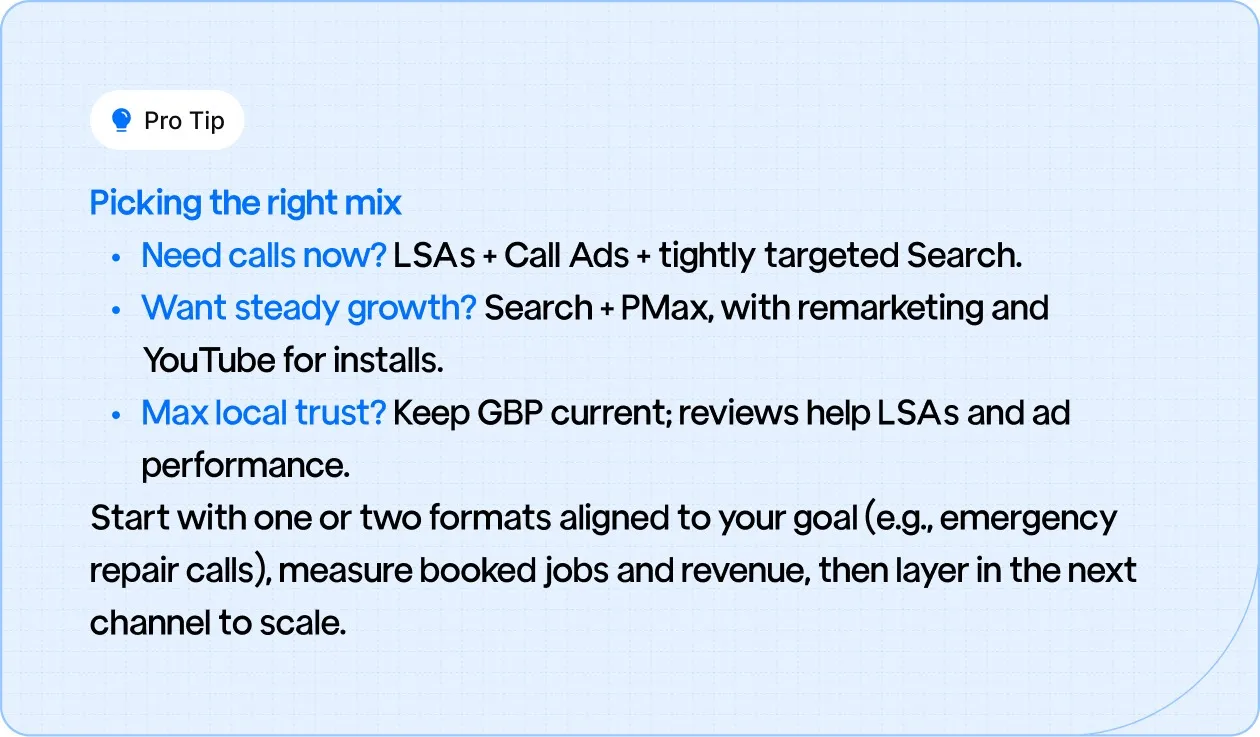
A simple channel playbook
- Now (immediate leads): PPC + LSAs with call-heavy ads and emergency keywords.
- Soon (compounding wins): Build/refresh SEO pages for top PPC terms and key cities you serve.
- Always (trust + coverage): Keep GBP current: new photos, Posts, Q&A, and steady review requests.
Turn Every Click Into a Customer
From SEO and Google Business Profiles to PPC setups that bring real leads, Gushwork helps your HVAC business get found and booked faster.
Bring Your HVAC Business to the Top
When your ads are relevant, your landing pages are clear, and your message is consistent, every click becomes an opportunity. Keep refining, keep testing, and let data guide your decisions.
Because at the end of the day, HVAC PPC is about creating visibility that keeps your phones ringing and your schedule full.
Grow Your HVAC Business with Gushwork
At Gushwork, we help service-based businesses turn digital traffic into real leads. From PPC setup to SEO-ready websites and Google Business optimization, we make sure your marketing brings measurable results.


.webp)




.webp)


.svg)


