









Running an industrial business with a small team and limited resources can make marketing feel like a major challenge. You want to connect with the right people, those who truly need your services, but high costs and complex strategies often get in the way.
Industrial lead magnets solve this problem. By offering something valuable in exchange for attention, you can start building relationships with potential customers who are already looking for solutions like yours.
This article will help you discover 11 practical lead magnet ideas that reach the right people and grow your business without the need for a big budget.
What is an Industrial Lead Magnet?
An industrial lead magnet is a targeted resource that helps SMBs in the industrial sector capture qualified leads by offering something valuable in exchange for their attention.
You need to provide a solution to a problem your potential customers face, making it easier for them to engage with your business.
These lead magnets can be:
- Guides: Step-by-step instructions on improving operations or complying with regulations.
- Tools: Calculators or cost-saving tools that provide immediate value.
- Checklists: Simple, actionable lists for maintaining safety or optimizing workflows.
- Templates: Editable resources to streamline common industrial processes.
- Reports: Research or insights into trends affecting the industry.
By offering these resources, you not only attract the right prospects but also demonstrate your expertise, building trust along the way.
11 Types of Lead Magnets and How to Create Them
When it comes to attracting the right customers in the industrial space, lead magnets can be your most valuable tool. They help you provide immediate value and address the real needs of your target audience.
Here are 11 lead magnet ideas that can set you up for success, plus simple steps to create them.
1. ROI Calculators & Cost-Saving Tools
An interactive tool that helps potential customers calculate their return on investment or savings when using your product or service.
How to create it:
- Use simple tools like Google Sheets or Ucalc to create interactive ROI calculators or cost-saving tools.
- Allow users to input their own data to calculate potential savings or returns.
- Provide immediate, personalized value by showing how your solution benefits their specific situation.
- Make the tool easy to use and accessible for potential customers to engage with right away.
ROI Formula:
To help industrial businesses understand the impact of your product or service, use this formula to calculate ROI:

- Net Profit = Revenue from investment - Investment Cost
- Investment Cost = Total amount spent on the investment
Example: If you spend $5,000 on a piece of equipment that generates $7,500 in new revenue, your ROI would be 50%. Simple, actionable insights like this attract leads who are looking to make smart, data-driven decisions.
2. Case Studies of Successful Applications
Case studies offer real-world examples that show the effectiveness of your solution and help build trust. They show your product's value and its tangible impact on your clients.
How to create it:
- Identify customers who have seen measurable results from your solution.
- Highlight their challenges, how your product solved them, and the measurable outcomes.
- Make sure the case study mirrors your target audience’s challenges for relatability.
Why it works: Case studies demonstrate the real-world impact of your solutions, helping prospects connect the dots between their pain points and the benefits you offer. It's proof that your product works in scenarios similar to theirs.
3. Compliance Checklists and Industry Templates
Regulatory hurdles are a common challenge in industrial sectors. Offering checklists or templates helps businesses navigate compliance requirements easily, saving them time and avoiding errors.
How to create it:
- Research key industry regulations and focus on areas where businesses often face compliance issues.
- Create simple, easy-to-follow checklists or editable templates in accessible formats like PDF or Excel.
- Provide clear instructions to make sure users can apply them right away.
Why it works: By offering downloadable and customizable resources, you position your business as a trusted advisor, and your lead magnet becomes a tool they can use immediately, helping you build strong relationships.
4. Cost Comparison Calculator for Industrial Solutions
Buyers love a clear breakdown of how your product stacks up against competitors. A cost comparison calculator gives them a quick, visual way to see the advantages of your solution.
How to create it:
- Develop a calculator that compares your product's cost, efficiency, and longevity against competitor offerings.
- Use tools like Google Sheets or specialized software to create an easy-to-use interface.
- Ensure the comparisons are clear, with side-by-side visuals that highlight the value of your solution.
Why it works: A cost comparison calculator makes the decision process simpler, providing your prospects with a concrete reason to choose your solution based on value.
5. Interactive Learning Experiences (Webinars, Live Demos, Product Trials)
Engage prospects with live demonstrations and webinars that allow them to experience your product’s benefits firsthand and ask real-time questions.
How to create it:
- Webinars & Live Demos: Plan live sessions on relevant topics, hosted on platforms like Zoom or YouTube Live.
- Product Trials: Follow up with trials to allow users to experience your solution’s benefits themselves.
Why it Works: Interactive learning experiences offer prospects a tangible understanding of your product and its benefits, fostering deeper trust.
6. Interactive Industry Assessments & Supplier Evaluation Tools
Allow prospects to assess their current situation and provide personalized feedback or recommendations.
How to create it:
- Self-Assessments: Create a questionnaire using tools like Typeform or SurveyMonkey to gather key pain points from your audience.
- Supplier Evaluation Tool: Develop a simple tool for evaluating suppliers based on factors like cost, quality, and timeliness.
Why it works: These tools give your audience immediate value while positioning your brand as an expert who understands their specific challenges.
7. Workforce Training Resources & Certification
Continuous training is key in industrial sectors. Offering online training resources and certifications can position your business as a knowledge leader and add value to your clients’ workforce.
How to create it:
- Build online training modules that focus on practical, industry-relevant skills.
- Use platforms like Teachable or Thinkific to offer certification upon completion.
- Focus on real-world applications, making sure the training is directly relevant to your audience’s needs.
Why it works: Providing workforce training positions your brand as an expert in the field, while helping your clients stay competitive through skill development.
8. Industry Research Reports & Market Insights
Providing valuable insights into industry trends and emerging technologies positions you as an authority. These reports help businesses stay informed and make smarter decisions.
How to create it:
- Gather data from reputable sources such as industry reports, surveys, and studies.
- Present the information in a concise, easy-to-read report format.
- Highlight actionable insights and how businesses can apply this information to stay ahead.
Why it works: Research reports are an effective way to add value while demonstrating your expertise. Providing timely insights makes you a trusted source for critical industry knowledge.
9. "Behind-the-Scenes" Factory or Production Line Virtual Tour
Transparency is key in building trust. A virtual tour allows prospects to see your production process and quality standards firsthand, strengthening your credibility.
How to create it:
- Use platforms like Google 360 or YouTube to create an immersive virtual tour of your production facility.
- Focus on the key processes, safety standards, and quality control measures in place.
- Highlight your commitment to quality, transparency, and safety.
Why it works: A behind-the-scenes look builds trust and shows that your business values transparency and high-quality production, creating a stronger connection with prospects.
10. Exclusive Networking Events or Masterminds
Networking and collaboration create valuable opportunities for professionals in your industry. Exclusive events help prospects connect with others facing similar challenges, fostering relationships that can turn into business.
How to create it:
- Host virtual mastermind sessions or networking events on platforms like Zoom or Slack.
- Focus on a clear topic or agenda that addresses a current industry challenge.
- Keep the group small and intimate to encourage meaningful discussions.
Why it works: Networking events allow prospects to engage with industry peers, offering them real value beyond your product. This builds your reputation as a connector in the industry.
11. Future Trends or Emerging Tech Reports
Position your business as forward-thinking by providing insights into new technologies and trends shaping the industry.
How to create it:
- Research emerging technologies such as automation, IoT, AI, or other innovations affecting your industry.
- Present this information in an accessible, research-driven format.
- Highlight how businesses can leverage these new trends to stay competitive.
Why it works: This type of lead magnet keeps your audience informed about the future and demonstrates that you’re staying ahead of the curve, adding long-term value to your relationship.
The best lead magnets solve problems instantly.
Improve how your lead magnets attract the right audience through stronger SEO and content strategy.


Optimize Your Lead Magnets for Search
SEO plays a crucial role in helping your lead magnet reach the right prospects at the right time. By applying the right strategies, you can make sure your valuable content is found and used by potential customers who need it.
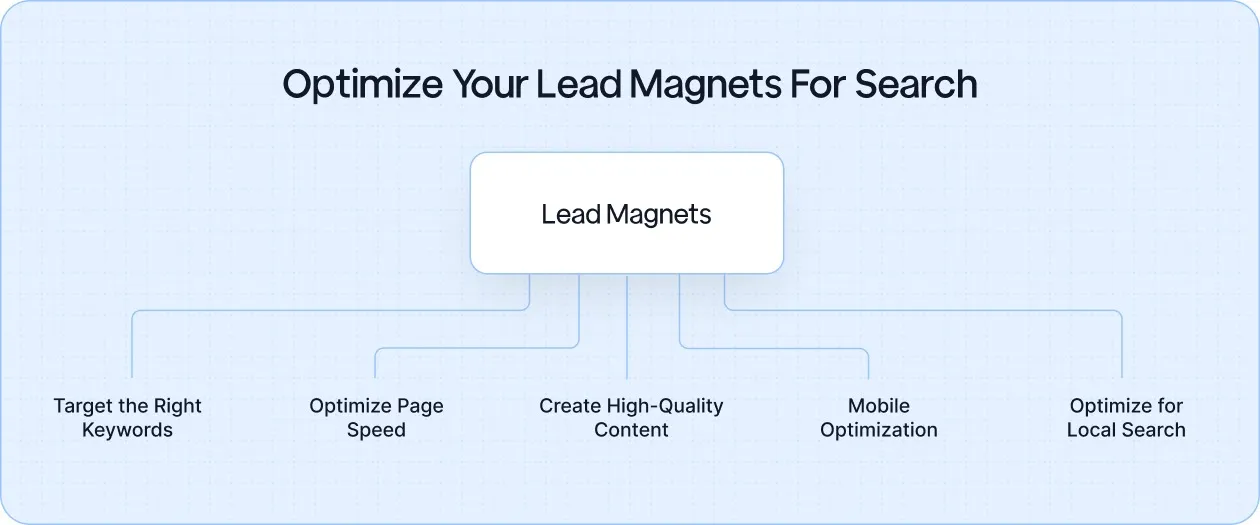
Let’s dive into some simple yet effective SEO tips that will improve your lead magnet’s visibility and bring in the right audience:
1. Target the Right Keywords
The first step in optimizing your lead magnet is making sure it’s discoverable by the right people. By focusing on specific keywords that your ideal customers are searching for, you can get your lead magnet in front of them exactly when they need it.
How to do it:
- Use tools like Google Keyword Planner or Ubersuggest to identify relevant keywords.
- Focus on long-tail keywords that are highly specific to your industry. These keywords often have less competition and are more likely to attract high-quality prospects.
- Integrate these keywords naturally into your landing page title, description, and within the content itself.
Must Read: 8 Industrial Manufacturing Marketing Moves Most Ignore
2. Optimize Page Speed
If your landing page takes too long to load, potential customers will lose interest before they even get a chance to see your lead magnet. Page speed is a ranking factor for Google, so optimizing it improves user experience and helps with your search engine ranking.
How to do it:
- Compress images using tools like TinyPNG to reduce file sizes without sacrificing quality.
- Minimize JavaScript and CSS files to streamline page load times.
- Use a reliable hosting provider that offers fast loading speeds.
3. Create High-Quality Content
Google loves content that provides real value to users. By offering actionable and relevant content that addresses the needs of your target audience, you increase your chances of ranking higher in search results.
How to do it:
- Write content that answers your audience’s most pressing questions or challenges.
- Use clear, concise language and avoid jargon.
- Include testimonials or case studies to build credibility and demonstrate real-world success.
4. Mobile Optimization
With more people browsing on mobile devices, your lead magnet landing page must be mobile-friendly. Google also prioritizes mobile-first websites in its rankings.
How to do it:
- Use a responsive design so that your page adjusts to different screen sizes.
- Test your page on multiple devices to ensure that it displays correctly.
5. Optimize for Local Search
If your industrial business serves a specific region, local SEO can be a game-changer. Make sure your lead magnet pages are optimized to show up for location-based searches.
How to do it:
- Include location-specific keywords (e.g., “industrial packaging solutions in Chicago”).
- Add your business to Google My Business to improve local search visibility.
Let’s look at a real-world example to see how these strategies work.
Case Study: John Maye Gets 17 Leads in The First 30 Days of Adopting AI SEO

John Maye, a well-established packaging equipment supplier, was struggling with a lack of online visibility, despite their years of industry experience.
After implementing AI-powered SEO strategies, including optimizing their website for the right keywords and improving page speed, John Maye saw immediate results. In just 30 days, they generated 17 qualified leads, all from organic search.
What they did:
- Targeted high-intent keywords related to packaging equipment.
- Overhauled their website to improve load speed and mobile responsiveness.
- Integrated a lead capture system to manage the influx of new leads.
Your Next Step to Attracting the Right Leads
Building a successful lead magnet requires providing real value and solving the specific problems of your target audience.
By following the tips we’ve covered, you can create a resource that captures attention and helps you build lasting relationships with your ideal prospects.
Here’s a quick recap to guide your lead magnet creation journey:
- Understand Your Audience: Know their pain points and offer solutions that resonate.
- Make it Actionable: Provide something your audience can use immediately to see real results.
- Optimize for Visibility: Leverage simple SEO strategies and ensure your lead magnet is easy to find.
- Keep It Relevant: Personalize your lead magnet to the needs of your specific industry or niche to maximize impact.
To create your lead magnet, remember that it's important to start conversations and build trust, which requires expert help and guidance. It could be a valuable guide, a case study, or an interactive tool; offering something of real worth will set you apart.
Create your first lead magnet and attract the right audience.
Gushwork’s SEO and content optimization services are designed to help you refine your approach and reach your target customers more effectively.


.webp)








.webp)



.svg)


