










Most manufacturing teams do not struggle because they lack SEO tools. They struggle because they are surrounded by too many of them, all promising insight, none offering clarity on what actually matters.
Between keyword data, technical audits, traffic reports, and rankings, it becomes easy to track activity without understanding the impact. The right SEO tools simplify decisions. The wrong ones create noise, slow teams down, and disconnect SEO from real business outcomes.
In this blog, we break down the best SEO tools for manufacturing, how each category supports a specific part of the SEO process, and how to use them to measure visibility, quality, and performance without overcomplicating your workflow.
What Is Manufacturing SEO?
Manufacturing SEO is about being visible at the moment a real buying decision starts to take shape. It helps your business appear when someone is researching suppliers, comparing capabilities, checking materials, or trying to understand whether a manufacturer can actually meet their requirements.
Manufacturing buyers do not move quickly or casually. They search in phases, often over weeks or months, asking technical questions, validating specifications, and narrowing options internally. A solid manufacturing SEO foundation supports that entire journey.
Important SEO KPIs To Measure Success
In manufacturing, the right KPIs focus less on raw traffic and more on visibility, relevance, and commercial intent across long buying cycles.
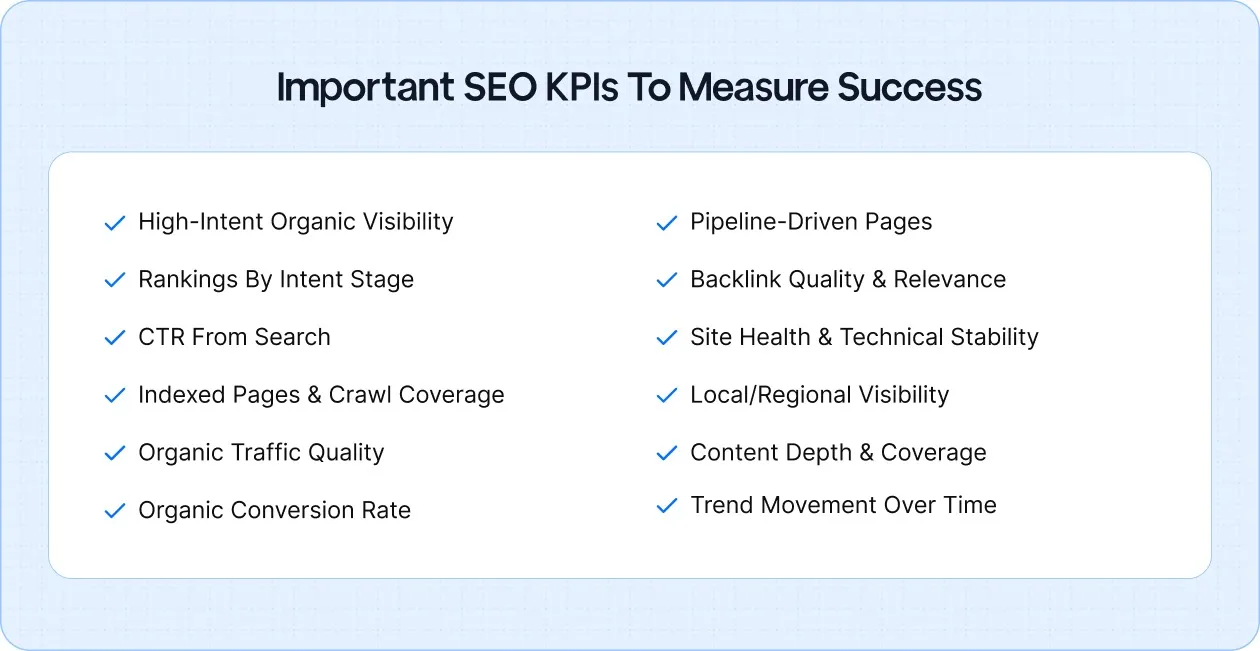
Below are the most important SEO metrics tools that help track, and why each one matters in a manufacturing context.
- Organic visibility for high-intent keywords: This measures how often your site appears for searches tied to capabilities, processes, materials, or services. It helps you understand whether you are visible where real buying research happens.
- Keyword rankings by intent stage: Tracking rankings by early research, comparison, and decision-stage keywords shows whether your content supports the full buyer journey. Tools help separate surface-level visibility from commercially meaningful presence.
- Click-through rate (CTR) from search results: CTR indicates how compelling your titles and descriptions are compared to competitors. In manufacturing, low CTR often signals unclear positioning or overly generic messaging.
- Indexed pages and crawl coverage: This KPI shows how much of your site search engines can actually access and understand. It is critical for large manufacturing sites with many service, capability, or product pages.
- Organic traffic quality: Rather than total sessions, this focuses on engagement metrics like time on page, scroll depth, and repeat visits. High-quality traffic usually reflects alignment between search intent and page content.
- Conversion rate from organic traffic: This measures how often SEO traffic turns into enquiries, quote requests, or meaningful actions. It is one of the strongest indicators of whether SEO is attracting the right audience.
- Top-performing pages by pipeline contribution: Identifies which pages consistently assist or generate leads. This helps prioritise optimisation and content expansion around pages that already influence revenue.
- Backlink quality and referring domain relevance: Tools track not just how many links you have, but where they come from. In manufacturing, links from industry publications, suppliers, or technical resources carry far more weight than generic sites.
- Site health and technical stability score: This includes page speed, broken links, mobile usability, and indexing issues. Technical instability can quietly suppress rankings even when content quality is strong.
- Local and regional visibility: For manufacturers serving specific geographies, local ranking data shows whether the business is discoverable in priority regions.
- Content coverage and topical depth: Measures whether your site sufficiently covers the topics buyers expect to see addressed. Tools surface gaps where competitors provide more complete answers.
- Trend movement over time: SEO tools help track whether visibility and engagement are improving, stagnating, or declining. Direction matters more than short-term fluctuations.
When tracked together, these KPIs show whether SEO is building authority, attracting qualified demand, and supporting long-term growth.
Simplify Manufacturing SEO
Turn tools, metrics, and workflows into a clear system that supports enquiries and growth.


20+ Best Tools for SEO for Manufacturing
Manufacturing SEO rarely breaks because of one missing tool. It breaks when teams use the wrong tools for the wrong job, or rely on a single platform to solve problems that span research, technical health, content quality, and performance tracking.
The tools below are grouped by what they actually help you do in a manufacturing SEO workflow. You do not need all of them. You need the right mix, used with intent.
Keyword Research And Search Intent Discovery Tools
These tools help uncover how engineers, buyers, and procurement teams phrase their searches at different stages of evaluation.
- Google Keyword Planner: While designed for advertisers, this tool is valuable for manufacturers because it reveals commercial intent through CPC and competition data. It helps validate whether keywords relate to purchasing activity or early-stage research.
- Google Autocomplete: Autocomplete surfaces real queries users type into Google, making it especially useful for identifying problem-driven searches. Manufacturers can use it to spot application-based and comparison-style queries that rarely appear in traditional keyword tools.
- AnswerThePublic: This tool visualises how buyers phrase questions around processes, materials, tolerances, and use cases. It is particularly effective for shaping blog content and FAQ sections that support early research stages.
- AlsoAsked: AlsoAsked shows how search questions branch logically, which helps structure long-form content and pillar pages. For manufacturing SEO, it’s useful for understanding how buyers progress from general questions to technical validation.
- Keywords Everywhere: This extension adds search volume, CPC, and competition data directly inside Google search results. It is useful for quick keyword validation when reviewing SERPs or evaluating new content ideas.
- Google Trends: Google Trends helps manufacturers identify rising demand, seasonal patterns, and declining interest across products or processes. It is especially helpful when prioritising which services or capabilities to invest in content for.
Competitor, Market, And SERP Intelligence Tools
These tools help manufacturers understand where authority exists and what level of competition is realistic.
- Ahrefs: Ahrefs is widely used to analyse backlink profiles, identify authoritative industry links, and understand which competitor pages attract visibility. It helps manufacturers see how authority is built within their niche.
- Semrush: Semrush provides a broad view of keyword rankings, competitor overlap, and content gaps. Manufacturing teams often use it to benchmark their visibility against similar suppliers and distributors.
- SimilarWeb: SimilarWeb offers directional insights into competitor traffic sources and audience behaviour. It helps determine whether competitors rely heavily on SEO, paid media, or partnerships.
- ProductRank.ai: This tool tracks how brands appear in AI-generated search experiences. As buyers increasingly rely on AI summaries, ProductRank.ai helps manufacturers monitor visibility beyond traditional SERPs.
Content Optimization And Topic Coverage Tools
These tools help ensure content meets depth and relevance expectations without compromising clarity.
- Surfer: Surfer analyses top-ranking pages and provides guidance on structure, headings, and topical coverage. It is useful for refining service pages and technical blogs where completeness matters.
- Clearscope: Clearscope focuses on semantic relevance and topic coverage rather than keyword density. Manufacturing teams use it to ensure complex topics are fully addressed in one place.
- Claude: Claude is often used to simplify technical explanations, improve clarity, and proofread long-form content. It supports human-led writing rather than replacing it.
Technical SEO And Site Health Tools
Manufacturing websites often face challenges with crawl depth, heavy media, and legacy structures.
- Screaming Frog: Screaming Frog crawls websites to identify broken links, duplicate content, redirect chains, and indexability issues. It is essential for auditing large manufacturing sites.
- Google Search Console: Search Console provides first-party data on impressions, clicks, indexing status, and technical errors. It is one of the most reliable tools for understanding how Google views your site.
- Bing Webmaster Tools: Bing’s toolset offers additional diagnostics and crawl insights. It often highlights technical issues that complement Google’s data.
Rank Tracking And Performance Monitoring Tools
These tools track how visibility changes over time for high-intent manufacturing keywords.
- SE Ranking: SE Ranking provides affordable rank tracking, audits, and competitor monitoring. It is well-suited for manufacturers managing regional or niche keyword sets.
- Nightwatch: Nightwatch is often used for precise local and regional rank tracking. It supports manufacturers targeting specific geographic markets.
Analytics, Reporting, And Attribution Tools
These tools help connect SEO efforts to business outcomes.
- Google Analytics 4: GA4 tracks user behaviour, engagement, and conversions from organic traffic. It helps manufacturers understand which pages support enquiries and lead paths.
- Looker Studio: Looker Studio allows teams to combine SEO, traffic, and conversion data into clear dashboards. This is useful for internal reporting and executive visibility.
Website Platforms Built For SEO Execution
Execution matters as much as strategy.
- Webflow: Webflow allows manufacturers to build fast, structured, and SEO-friendly websites. It supports clean URLs, responsive design, and flexible content architecture without heavy development overhead.
12 Proven Strategies for Successful Manufacturing SEO
Manufacturing SEO works when it is intentional, structured, and grounded in how industrial buyers actually research suppliers. The strategies below are not shortcuts. They reflect what consistently improves visibility, enquiry quality, and long-term authority for manufacturing companies.
1. Intent-Driven Keyword Mapping
Map every search phrase to a buyer task and create content that answers that exact task. Start by breaking your universe of terms into clear buckets: capability research, specification validation, supplier comparison, and RFQ/procurement. For each bucket:
- Build keyword sets that include technical qualifiers buyers use — material grades, tolerances, standards, throughput ranges, and equipment types. Capture variations in phrasing used by engineers (e.g., “±0.02mm” vs “0.02 mm tolerance”).
- Create an intent matrix that assigns each keyword to one canonical page type (capability page, spec sheet, comparison guide, or procurement form). Don’t let multiple pages compete for the same commercial intent.
- Add contextual modifiers for buyers: include “lead time”, “minimum order quantity”, “certified”, “lot traceability”, and similar modifiers as separate target keywords where they match buyer behaviour.
- Maintain a living keyword map that ties search phrases to buyer personas, e.g., procurement searches vs. engineering searches, so content tone and depth match the visitor.
- Use these maps to inform page templates: specify which sections a capability page must contain (spec table, equipment list, QA methods, lead times) based on the highest-value keywords assigned to it.
Focus on Real Buyer Intent
Identify how engineers and procurement teams actually search so SEO effort stays tied to commercial demand.
2. Capability Pages That Match How Buyers Evaluate Suppliers
Design each capability page as a self-contained dossier that answers feasibility questions at a glance and provides depth on demand.
- Open with a concise capability statement that names the process, materials, and typical part geometries. Follow with a short “fit” line describing where you are commonly selected (industries, part types).
- Provide a compact spec table up front: materials supported, max/min dimensions, tolerance range, surface finishes, typical batch sizes, throughput rates, and standard tooling constraints.
- Follow with an equipment and capacity section listing machine models, critical tooling, automation level, and fallback options. Buyers read this to assess whether their part fits your factory.
- Include a quality & inspection section detailing inspection methods, frequency, and what test reports look like (e.g., CMM reports, hardness tests). Give buyers the language they can include in their procurement documents.
- Add an applications section with short, specific examples of parts you make and the performance outcomes achieved (e.g., “brackets for HVAC assemblies, delivered with ASME-compliant welds”).
- Close with clear, intent-matching CTAs: download the spec sheet, request an indicative lead time for X qty, or request a capability review with a short form that asks only technical qualifiers (material, part size, tolerance).
3. Technical Proof Built Into Content
Place proof where buyers look for it: next to specifications, not in separate marketing pages.
- Embed certification snapshots and scopes within the capability page and label what the certificate actually covers (e.g., processes, facilities, product families). Buyers need scope clarity more than logos.
- Write short process notes on inspection steps, sampling plans, and acceptance criteria directly under related spec entries so readers immediately see how quality is controlled for their exact requirement.
- Add anonymised sample reports or redacted inspection screenshots showing typical CMM output, measurement headers, and tolerance calls. Explain what each section communicates to a procurement reviewer.
- Describe material traceability practices in plain terms: lot coding, supplier verification steps, and how you handle non-conforming materials. Buyers evaluate traceability early in supplier selection.
- Summarise testing capabilities and limits (e.g., tensile testing up to X kN, salt spray testing hours) and link to deeper resources for engineers who require full protocols.
Build Content That Earns Trust
Create technically accurate content that supports research, comparison, and shortlisting.
4. Crawlable Site Architecture for Large Catalogs
Organise content so it maps to the buyer’s mental model and search behaviour.
- Define a strict taxonomy and URL pattern that reflects buyer journeys: /industries/[industry]/[capability]/[process-or-material]/[case-study-or-spec]. Use this template consistently as new pages are created.
- Create industry landing pages that act as entry funnels; each should summarise relevant capabilities, link to the capability pages, and surface typical applications. These pages match early-stage discovery queries.
- For capability pages, ensure a single canonical URL. Use canonical tags for variations and avoid allowing faceted navigation to create indexable permutations unless they represent distinct buyer queries.
- Build resource hubs that aggregate spec sheets, test reports, and case studies by capability and make them discoverable from both industry and capability pages. This keeps technical proof within two clicks of discovery.
- Maintain an internal linking rule: every new capability page must be reachable from an industry page and from at least one resource or case study page to avoid orphans.
5. On-Page SEO That Improves Shortlisting
Make the page’s purpose and buyer fit visible in search results and on-page headings.
- Use title tags that combine the process, material/application, and the most important differentiator (e.g., capacity or tolerance). This immediately signals fit in search results.
- Structure H2s and H3s as evaluation prompts: “Materials and Grades Supported”, “Tolerance & Surface Finish Capabilities”, “Inspection & Certification”, “Typical Lead Time & Batch Sizes”.
- Write meta descriptions that communicate three quick facts buyers care about: capability, a specific proof point (e.g., ISO scope), and an action (download spec or request quote).
- Place a short “at-a-glance” section near the top that answers buyers’ immediate filter questions, yes/no style bullets for material, max size, tolerance, and certifications, so they can self-select before reading deeper.
- Use FAQ blocks that address procurement and engineering questions in plain, precise language; answer format should be concise and technical rather than marketing-oriented.
6. Internal Linking That Mirrors Real Buyer Paths
Use links to move buyers logically from discovery to procurement, not from one generic page to another.
- From industry pages, link to capability pages with anchor text reflecting buyer intent (e.g., “custom injection molding for medical devices”).
- Within capability pages, link to spec sheets, downloadable test reports, and relevant case studies using action-oriented anchors like “view typical CMM report” or “download packing & handling specs”.
- In blog posts or technical articles that explain a manufacturing problem, insert contextual CTAs that point directly to the capability page that solves it (e.g., an article on corrosion resistance links to your stainless processing capability with a matching CTA).
- Build a “related capabilities” section on each capability page that surfaces complementary services or secondary processes a buyer often needs during production planning.
- Keep anchor text descriptive and technical; avoid “click here” and use precise terms buyers will search for in the future.
7. Technical Hygiene as a Baseline
Treat technical stability as a gating factor for visibility and buyer experience.
- Audit indexation rules and set clear guidelines for which page types should be indexable (capabilities, industry pages, spec resources) and which should not (admin, temporary campaign filters).
- Standardise templates to avoid accidental duplication: capability pages should follow the same field structure so search engines and buyers find consistent information.
- Implement clear redirect rules for moved pages and maintain a redirect map; never leave deprecated URLs without structured 301 fallbacks that lead to the most relevant canonical page.
- Optimise page templates for performance: ensure spec tables render quickly, images are lazy-loaded where appropriate, and PDF downloads are served efficiently without blocking page load.
- Use server-side logs and crawl reports to identify crawl budget waste — reduce low-value indexable pages and improve the crawl prioritisation of capability and resource pages.
8. Content That Supports Engineering-Led Research
Produce content that speaks the buyer’s language and directly supports engineering evaluation.
- Create technical comparison guides that break down trade-offs, thresholds, and rule-of-thumb calculations (e.g., when a part should be machined vs. cast based on volume, complexity, and tolerance).
- Publish material selection notes that cover performance in specific environments (temperature, corrosive exposure, fatigue scenarios) and include practical tables of properties and recommended applications.
- Offer detailed process descriptions that include achievable tolerances, normal defect rates, typical setup times, and any common constraints engineers should be aware of.
- Provide downloadable decision tools and templates, e.g., a one-page checklist for sample qualification, a template for RFQ technical requirements, that procurement teams can reuse and that embed your brand into their internal process.
- Maintain a technical glossary and a short-form “how to read our spec sheet” guide so non-technical procurement stakeholders can translate engineer-level documentation into procurement decisions.
9. SERP Ownership for Comparison Searches
Comparison searches sit very close to a buying decision. When someone searches “supplier A vs supplier B” or “process X vs process Y,” they are actively narrowing options, not browsing.
- Publish pages that compare suppliers, processes, or approaches without overt selling. Focus on criteria buyers care about: capability scope, tolerance ranges, material compatibility, lead times, quality systems, and typical use cases.
- Build pages such as “CNC machining vs die casting for low-volume parts” or “in-house fabrication vs contract manufacturing.” Explain cost structures, setup effort, scalability, and constraints so buyers can self-select the right option.
- Create “how to evaluate” guides that walk buyers through what to check during supplier vetting: certifications, inspection methods, sample approval, documentation, and communication practices. These pages often rank well and support downstream RFQs.
- Tables, checklists, and side-by-side summaries perform well for both users and search engines. They help buyers scan quickly and help search systems understand comparative intent.
- Comparison content should naturally route buyers to your capability pages once they understand where you fit, without forcing a sales pitch.
10. Authority Building from Relevant Ecosystems
Manufacturing authority is earned inside ecosystems buyers already trust. Generic backlinks rarely influence industrial purchasing decisions.
- Contribute technical articles, application notes, or process explainers to trade publications and industrial blogs where engineers and procurement teams already read.
- Membership pages, technical committees, certification listings, and association directories often provide highly relevant links and credibility signals that search engines value.
- Request inclusion on supplier, distributor, or partner resource pages with proper context describing your role, capabilities, and certifications.
- Co-author technical guides, host joint webinars, or contribute case studies with material suppliers, OEMs, or integrators. These collaborations often lead to durable, high-quality links.
- A handful of links from deeply relevant industrial sources typically outperform dozens of generic marketing links in manufacturing SEO.
11. AI Visibility Readiness (AEO Fundamentals)
As AI-driven search and answer engines grow, manufacturing content must be structured so it can be quoted accurately and confidently.
- For each capability, process, or term, include short definition blocks written in plain, technical language. Avoid metaphors or marketing phrasing that could distort meaning.
- AI systems often extract information from tables. Include clear rows for materials, tolerances, lead times, certifications, and use cases.
- Include step-by-step summaries of how a process works, its limits, and its typical outputs. These sections are frequently surfaced in AI-generated answers.
- Use questions sourced from RFQs, sales calls, and Search Console data. Keep answers precise, factual, and scoped to avoid ambiguity.
- Ensure that definitions, specs, and terminology are consistent across your site. Inconsistency reduces trust signals for AI systems.
12. Conversion Paths That Match Manufacturing Enquiries
Manufacturing enquiries are rarely casual. Your site should make it easy for serious buyers to move forward without friction.
- Place RFQ and enquiry CTAs directly on capability pages, spec pages, and comparison content.
- Ask only for information buyers expect to provide: process, material, quantity, tolerance, timeline, and a drawing upload option. Avoid unnecessary marketing fields.
- Use labels such as “Request capability review” or “Get indicative lead time” instead of generic “Contact us.”
- Offer lighter-commitment options like spec downloads or sample requests for buyers who are not ready to submit a full RFQ.
- Identify which capability, comparison, and technical content pages consistently appear in the paths leading to enquiries so SEO priorities stay aligned with revenue.
How Gushwork Helps Manufacturing Teams Turn Tools Into Growth
Most manufacturing SEO programs fail because tools are treated like the strategy. Teams collect data, run audits, and track rankings, but execution stays fragmented, and outcomes stay unclear.

Gushwork helps you turn SEO tooling into a system. We combine AI and human strategy to improve manufacturing visibility across search and AI responses, and link that visibility to enquiry quality.
- SEO strategies tied directly to manufacturing buying behaviour: Gushwork maps keywords and content to how engineers, procurement teams, and operations managers actually research suppliers. This ensures visibility aligns with commercial intent, not just informational traffic.
- Content depth that reflects technical and operational reality: Their SEO content goes beyond surface-level explanations, focusing on specifications, processes, use cases, and decision criteria that buyers expect to see before trusting a manufacturer.
- Website structure designed for scale and clarity: Gushwork prioritises site architecture, internal linking, and content hierarchy so large manufacturing websites remain crawlable and easy to expand without losing clarity.
- Measurement focused on lead quality and pipeline contribution: Instead of reporting on traffic alone, they track how SEO influences enquiries, sales conversations, and downstream opportunities, making performance easier for leadership teams to evaluate.
Gushwork is a strong fit for manufacturers who want SEO to reduce sales friction, improve enquiry quality, and support long-term growth.
Conclusion
The best SEO tools make manufacturing SEO manageable.
When chosen correctly, tools help you understand how buyers search, where your site falls short, which content builds authority, and whether SEO is actually supporting enquiries and growth. They remove confusion and replace it with direction.
You do not need every platform listed. You need a stack that fits your size, your sales cycle, and your technical reality. Start with tools that reveal intent and performance. Add others only when they help you make better decisions. When tools support strategy instead of driving it, SEO becomes a system you can trust.
Ready for SEO That Actually Helps
Align tools, strategy, and execution around real manufacturing buying behaviour.


.webp)








.webp)



.svg)


