


Home

Resources
Blogs
Blog
Get insights on AI, productivity, and the future of work.


Thank you! Your submission has been received!
Oops! Something went wrong while submitting the form.

Digital Marketing
Dec 10, 2025
5 mins
The Start-Up Cost Junk Removal Pros Never Share With New Businesses
Ishani Mitra
If you’ve been thinking about starting a junk removal business, the first question that usually comes up is simple: “How much does it actually cost to get started?”
And it’s a fair question, because the numbers you see online can range from a few hundred dollars to tens of thousands, depending on who you ask.
The truth is, you don’t need a huge budget or a brand-new truck to enter this industry. What you do need is a clear understanding of the real costs, the optional costs and the hidden costs that most beginners only discover the hard way.
In this blog, you’ll learn the complete cost breakdown for starting a junk removal business, the price differences between lean and full-setup launches and the most efficient ways to spend and save your money in your first few months.
What Is a Junk Removal Business?
A junk removal business is a service that helps people clear out unwanted items quickly and responsibly. This includes old furniture, appliances, yard waste, renovation debris, garage clutter, estate cleanouts and anything else a homeowner or business can’t move or dispose of on their own.
These companies handle the heavy lifting, sorting, hauling and proper disposal or recycling. For customers, it’s a simple solution to reclaim space without dealing with the physical work, transport or local disposal rules.
A junk removal business sells convenience, speed and relief, and that’s why it continues to grow as more people look for fast, stress-free cleanouts.
Why Do You Need A Plan Before Starting A Junk Removal Business?
Starting a junk removal business might look simple, but without a plan, it quickly becomes chaotic and expensive.
Here’s why it matters:
- You understand your local demand. You’ll know who needs your service and how often.
- You avoid overspending on equipment. A plan stops you from buying tools or vehicles you don’t need yet.
- You set clear prices. Pricing becomes easier when you know your costs and competitors.
- You prepare for disposal rules. Every city has its own dump fees and recycling requirements.
- You stay profitable from day one. A plan helps you track expenses and protect your margins.
- You grow with purpose. You know what services to add, when to hire and how to scale properly.
Reach the Right Customers From Day One
Build an ICP and keyword plan that targets local homeowners, contractors and businesses searching for junk removal help.
Refine Your Targeting


Understanding 7 Essential Junk Removal Business Startup Costs
Launching a junk removal business requires understanding every cost you’ll face before your first job. These expenses don’t just determine your initial investment, but they shape your pricing, profitability, and how fast you can grow.
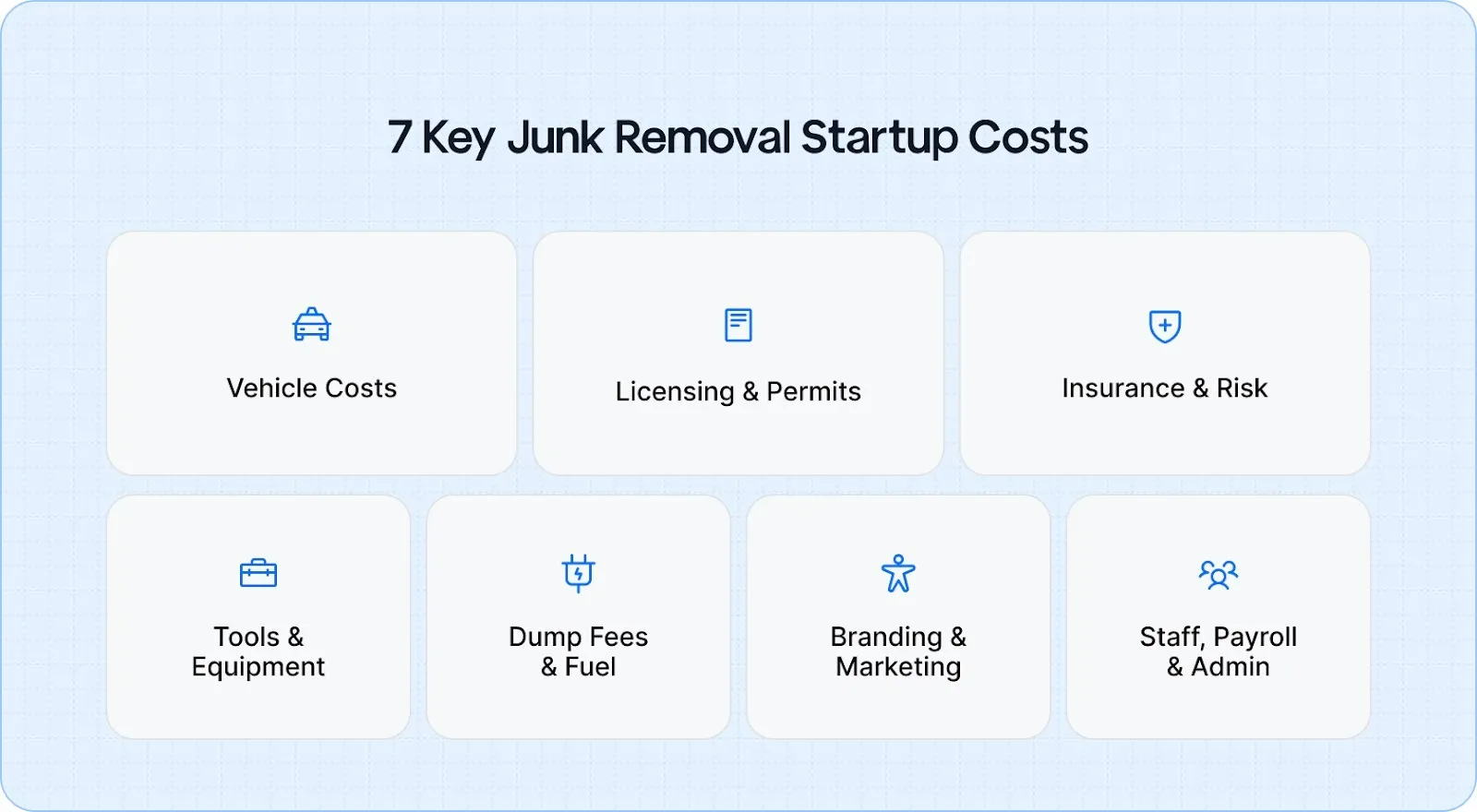
This section breaks down each core startup cost in simple, practical terms so you can budget confidently and avoid surprises:
1. Vehicle Costs
Your vehicle is your office, billboard, and revenue engine.
What you might spend
- Used pickup or cargo van: $5,000–$20,000 depending on age, mileage, and condition.
- New or nearly new truck: $30,000+ (commonly financed).
- Trailer (if you already have a tow vehicle): $1,500–$5,000 for a decent utility or dump trailer.
Sources aimed at junk hauling show the truck/vehicle alone often sits around $20,000–$30,000 in a “typical” startup budget, before tools or branding.
What You Can Do:
- Start with a reliable used truck and plan to upgrade; avoid anything that constantly needs repairs.
- Consider a trailer + existing truck combo if your current vehicle can safely tow.
- Wraps can wait. Begin with magnetic door signs and simple branding, then upgrade to a full wrap once cash flow is stable.
2. Licensing, Permits, And Legal Setup
You need to be legal and insurable from day one.
You Will Need:
- Business Registration (LLC, etc.): $100–$500 depending on your state and whether you use a filing service.
- Local Business License / Hauling Permit: $50–$500 (varies by city/county).
- Waste disposal permits or accounts with local transfer stations/landfills: sometimes free, sometimes a few hundred dollars a year.
One recent guide estimates permits and licences around $3,500 for a more formal setup, though many solo operators pay less if they keep it lean and local.
What You Can Do:
- Talk to your county/city solid waste department and landfill/transfer station about requirements before you spend.
- Choose a legal structure (often an LLC in the US) that protects personal assets once you start hauling heavy loads into people’s driveways.
3. Insurance And Risk Protection
Junk removal touches people’s homes, driveways, and sometimes hazardous materials. One bad incident can wipe out your savings if you’re uninsured.
Common policies
- General liability: Often $500–$2,000/year to start, depending on coverage and location.
- Commercial auto insurance: Typically, more than a personal policy, budget $1,500–$3,000/year per vehicle for planning.
- Workers’ comp: Required if you hire employees; costs vary by state and payroll size.
Put combined liability + auto insurance in the $300–$800/year “starter” range for very lean setups, but expect to pay more as revenue, staff, or risk grows.
Points to Remember:
- Get quotes from multiple brokers who understand contractor/home-service risks.
- Make sure your policy covers loading/unloading and customer premises, not just driving.
4. Tools, Safety Gear, And Basic Equipment
You don’t need a warehouse full of gear to start, but you do need enough to work safely and efficiently.
Core gear list:
- Dollies and hand trucks
- Furniture sliders and moving blankets
- Straps, tarps, and tie-downs
- Shovels, rakes, brooms
- Basic tool set (drills, wrenches, etc.)
- PPE: gloves, masks/respirators, eye protection, steel-toe boots, high-visibility vests
For basic tools, you will need $600–$1,000, but for heavier equipments, it can go $6,000 plus, if you’re setting up more industrial or multi-service operations.
Budget range to plan:
- Lean setup: $500–$1,500
- Pro one-truck setup with extra gear: $2,000–$5,000
5. Dump Fees, Fuel, And Early Operating Costs
Even in month one, you’ll pay to get rid of junk and keep your truck moving.
What To Expect:
- Dump/landfill fees: Often charged per ton or per load; plan $200–$600 for initial jobs.
- Fuel: Depends on your market, but budgeting $250–$500 for the first month is reasonable if you’re active.
- Basic maintenance: Oil changes, tire checks, minor fixes, set aside at least $100–$200/month.
Treat these as startup working capital, cash you keep in the bank so you can run jobs without stressing over every dump ticket.
6. Branding, Website, And Marketing
A small, focused marketing budget up front can be the difference between a truck that sits and a truck that stays booked.
Key Requirements:
- Logo and Basic Brand Kit: $150–$1,000 (agency help, or DIY + future upgrade).
- Simple Website: $0–$2,000+, depending on whether you build it yourself or hire someone.
- Google Business Profile: Free, but you’ll want good photos and a process to collect reviews.
- Initial Ads and Local Promotion: $300–$2,500+ depending on how aggressive you want to be.
One detailed junk removal cost breakdown suggests $2,500 for initial marketing in a more fully built launch, while ultra-lean setups sometimes start with $50–$200 on basic promotion and scale as revenue comes in.
Build a Brand Customers Notice and Trust
Create clear messaging, strong visuals and simple marketing that make your junk removal business stand out locally.
Strengthen Your Brand
7. Staff, Payroll, And Admin
If you’re starting solo, this section might be small at first, but don’t ignore it if you plan to grow.
Startup Considerations:
- Helpers/crew: You may pay per job or hourly; budgeting $12,000 or more per year for early staffing isn’t unusual for a more serious operation.
- Admin tools: Phone line, accounting software, invoicing, booking tools, often $50–$200/month combined.
- Office or yard space: Many new operators work from home and rent storage later; more established operations spend $700–$2,000/month on office/yard space.
Start lean, then build systems and people into your cost structure once revenue is predictable.
Three Example Junk Removal Startup Budgets
To make all of this less abstract, here are three simplified example scenarios. These aren’t quotes, just planning lenses to help you decide where you fit.
Scenario A: Ultra-Lean Solo Operator
You already own a truck, work from home, and do most jobs yourself.
- Legal and licences: $3500
- Insurance (basic liability + upgraded auto): $500 to $5,000
- Tools & PPE: $500–$1,000
- Dump/fuel starter fund: $400–$800
- Basic branding + DIY website + low-budget ads: $500–$1,500
Estimated startup range: roughly $2,500–$6,000 cash needed to get moving.
Good fit if you want to test the market, keep your day job initially, or stay very local.
Scenario B: Professional One-Truck Brand
You’re committed to full-time, buying a decent used truck, and want to look established from day one.
- Used truck: $15,000–$25,000
- Legal, licences, permits: $3,500
- Insurance (liability + commercial auto): $500 to $5,000
- Tools & equipment: $500–$2,000
- Initial marketing (website, logo, photos, ads, signage): $2,500
- Working capital for dump fees, fuel, small repairs: $1,500–$3,000
Estimated startup range: Often $22,000–$40,000, depending on vehicle cost and how polished you go on branding.
Good fit if you want to compete seriously with the established players in your city.
Scenario C: Growth-Oriented Multi-Truck Launch
You’re launching with staff, more than one vehicle, and dedicated yard/office space.
- Two vehicles (used or new mix): $40,000–$80,000+
- Legal, licences, expanded permits: $3,500
- Insurance for multiple trucks and crew: $3,000–$8,000
- Tools & equipment for multiple crews: $4,000–$10,000
- Office/yard setup (first few months of rent, utilities): $3,000–$10,000
- Strong marketing push (brand, site, SEO, PPC, offline ads): $5,000–$20,000+
- Payroll buffer and working capital: $10,000–$30,000
Estimated startup range: Easily $60,000–$150,000+, similar to some of the higher-end estimates you’ll see in industry guides that quote up to $300,000 for fully built-out multi-location operations.
This path is for operators with capital, experience, or backing, often aiming to own a whole region, not just a neighborhood.
Recurring Costs You Should Plan For
When you think “startup cost,” it’s easy to only count what you spend before your first job. But some costs kick in fast and need to be baked into your planning:
- Card processing and software fees (5–10+ tools over time)
- Website hosting and domain renewals
- Recurring ads (Google, Facebook, local directories)
- Increased insurance premiums as revenue and vehicles grow
- Vehicle wear and tear (tires, brakes, suspension get abused in junk work)
- Disposal fees that spike when you land larger cleanouts or construction debris jobs
The simplest safeguard: keep 1–3 months of operating expenses in reserve if you can. That cushion turns a broken alternator or slow month into an inconvenience, not a crisis.
5 Tips on How To Keep Junk Removal Startup Costs Under Control
You want to look professional without overspending. A few practical rules:
- Go used and reliable on the truck. Avoid both extremes: don’t buy a clunker that lives at the mechanic, and don’t over-stretch on a brand-new truck if revenue is unproven.
- Phase your marketing. Start with: Google Business Profile, simple website, reviews, and a small PPC budget. Add more channels (SEO, mailers, local sponsorships) once your core offer and pricing are dialed in.
- Rent or borrow rarely used tools. For specialized jobs (heavy equipment, certain demolition tools), rent until you know you’ll use them often.
- Build repeat and referral systems early. A simple follow-up text/email after each job, plus a review request, can generate a pipeline of low-cost repeat work, which keeps your cost per lead down.
- Track everything. Even in a simple spreadsheet, record: jobs, revenue, dump fees, fuel, ads, and profit. Within a few months, you’ll see what you can increase, cut, or renegotiate.
Conclusion
Starting a junk removal business doesn’t require franchise-level capital, but it does require clear eyes about the real costs. For your junk removal business startup cost will be shaped by the truck you choose, how polished you want to look on day one, and how fast you plan to grow.
Start with the numbers. Decide which launch level fits you. Then build a business that’s as solid and dependable as the service you plan to offer.
Ready to Launch Your Junk Removal Business the Right Way?
Get guidance on planning costs, choosing equipment and building a solid first-year strategy.
Book A Consultation

SEO
Dec 10, 2025
5 mins
What Top Manufacturers Know About Industrial Sales Lead Flow That Others Learn Too Late
Ishani Mitra
Industrial sales used to start with outreach. Today they start with research. Buyers don’t want pressure. They want clarity. They want proof. They want to feel confident in a partner long before they ever schedule a call.
This means the companies winning the best industrial sales leads are more helpful, more visible and more consistent. They show buyers what they know, how they work, and why their solutions matter.
Strong industrial leads are the result of intentional communication that meets buyers where they already are: learning, evaluating, and deciding. And your business can guide every step of that journey.
What Is Lead Generation in an Industrial Context?
Lead generation in the industrial world involves identifying companies that genuinely need a new supplier or have an upcoming project. These buyers move slower than consumers and usually involve several people in the decision. They care about your capabilities, certifications, tolerances, and whether you can support them long term.
In this space, a lead is a buyer with a real technical need, a timeline, and the authority to move a project forward. Effective lead generation helps these buyers discover your capabilities early, understand what you can handle, and trust you enough to start a conversation or issue.
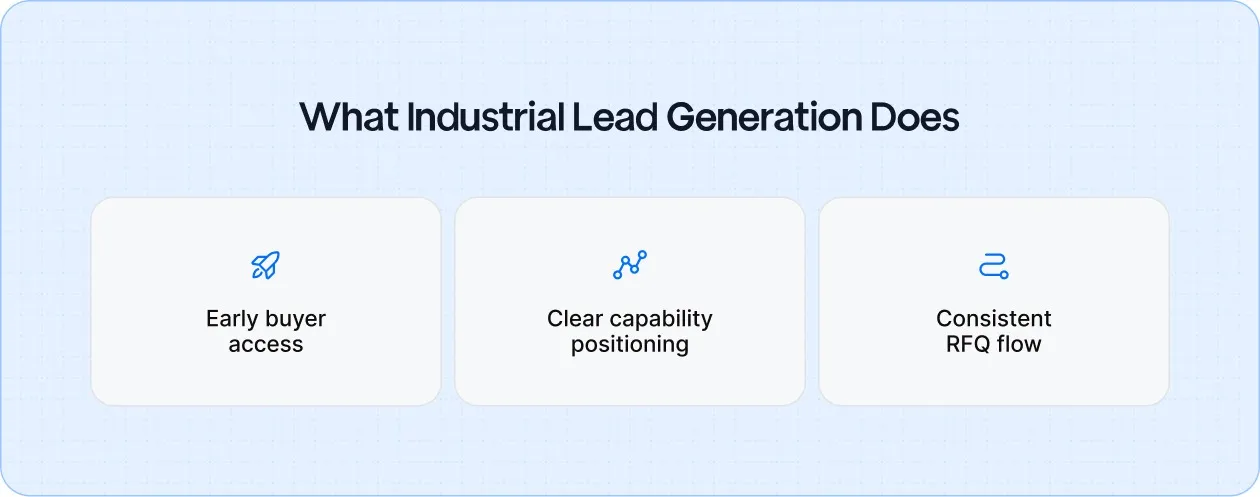
Industrial lead generation does three things for you:
- Gets you in front of buyers before competitors do, especially when sourcing cycles reopen or new programs begin.
- Position your technical capabilities clearly, so buyers know whether you can meet their tolerances, volumes, materials, and compliance requirements.
- Builds a steady, predictable flow of RFQs, helping you reduce dependency on word-of-mouth or seasonal demand swings.
Reach the Right Industrial Buyers
Build an ICP and keyword plan that aligns with the capabilities, applications and industries you serve best.
Refine Your Targeting
12 Practical Ways to Generate Qualified Industrial Sales Leads
Below are the methods that consistently attract the right kind of leads, the ones with defined needs and a high chance of becoming repeat customers.
1. Turn Your Product Catalog Into a Lead Generation Asset
Most industrial companies already have a product catalog or capabilities brochure. The problem is that it often sits as a static PDF, buried three clicks deep on the website.
To make your catalog generate leads:
- Put it online in a searchable, filterable format so visitors can find parts by material, size, tolerance, or application.
- Add simple calls to action next to each product or family: “Request quote,” “Ask an engineer,” or “Check stock.”
- Offer gated access to CAD models, STEP files, or spec sheets in exchange for basic details like company, role, and project type.
- Track which products and families are viewed most, and pass these signals into your CRM so sales can prioritize follow-up.
When your catalog is easy to search and tied to RFQ or enquiry forms, it becomes a continuous source of qualified industrial sales leads, not just a reference document.
2. Use Your Website as a Technical Resource
Industrial buyers and engineers spend a lot of time researching before they ever speak to sales. Your website should help them do that work.
Useful content that supports lead generation:
- Application notes that show how your components or assemblies work in specific end uses.
- Design guides that explain acceptable tolerances, materials, finishes, and design-for-manufacture guidelines.
- Case studies that connect your capabilities to cost savings, reliability, or faster launches for customers like them.
The more your website answers real technical questions, the more often you’ll earn contact from serious buyers.
Want a quick health check on your website? Drop it into our AI Analyzer and get instant insights to help turn more visitors into paying customers.
3. Invest in Video Content for Technical Buyers
Video remains underused in manufacturing, yet engineers and buyers watch videos to understand processes, compare suppliers, and validate capabilities.
What to create:
- Short process walkthroughs (machining, fabrication, finishing, QA steps).
- Engineering explainers (tolerances, materials, manufacturability guidance).
- “Inside the factory” videos that demonstrate equipment, certifications, and capacity.
- Customer success stories with real ROI or performance improvements.
Video builds trust faster than text. Seeing your machines, people, and process reduces perceived risk, especially for buyers sourcing a new supplier.
4. Build Enquiry Forms That Filter
A generic “Contact us” form attracts everything from students to one-off prototype requests. Quotation forms and project enquiry forms let you qualify leads earlier.
To make forms work for you:
- Ask for the few details that really matter: part type, annual volume band, required certifications, target timeline, and whether drawings are available.
- Add simple dropdowns that flag poor fit early (for example, volume ranges below your minimum).
- Route form submissions directly into your CRM with tags for process, material, or product family.
A focused prospect form helps your team decide which leads to call first and which to park or decline politely.
5. Reach Engineers and Buyers Where They Already Look
Industrial buyers rarely start on social media. They start on channels built for engineering and sourcing. Your job is to show up there with clear, technical information.
Places to consider:
- Industry directories and sourcing platforms that your ideal customers already use.
- Engineering communities where CAD models, reference designs, or application notes are shared.
- Niche trade portals for your specific sector (electronics, fabricated metals, plastics, process equipment, etc.)
If you invest time or budget in these channels, make sure your listings:
- Show your core capabilities and certifications accurately.
- Link back to your best-performing pages and RFQ forms.
- Include clear contact options for both engineering and purchasing.
Treat each platform as a feeder into your own website and sales process, not as a disconnected listing.
6. Maintain Your Google Business Profile (GBP)
GBP is one of the most overlooked sources of high-intent industrial sales leads, especially for regional manufacturers, fabrication shops, job shops, and machining companies.
What to do:
- Add photos of equipment, facility, and sample parts.
- Update service descriptions with specific processes (e.g., 5-axis machining, TIG welding, PCB assembly).
- Post updates monthly: certifications, new machines, project highlights.
- Collect reviews from long-term customers who can speak to quality, communication, and on-time delivery.
A strong GBP helps you appear when local engineers and buyers search things like “metal fabrication near me”, “precision machining supplier”, or “custom PCB assembly shop”.
Make Your Plant Easy to Find Locally
Optimise your Google Business Profile so engineers and buyers see your capabilities, photos and contact details clearly.
Improve Your GBP
7. Use Email for Targeted, Technical Outreach
Email still works in manufacturing, as long as it respects the receiver’s time and context.
Two main use cases:
- Nurturing existing contacts: share application notes, new capabilities, or design tips tied to their industry and past enquiries.
- Targeted outreach: carefully researched messages to specific accounts with a clear reason for contact (for example, capacity in a process they are known to outsource).
To keep email effective:
- Segment by industry, role, and past behaviour (quotations or contact, downloads, webinars).
- Focus on one useful topic per email, with a clear next step (“Send your drawing,” “Reply with your current supplier challenges,” etc.)
- Avoid generic newsletters that try to speak to everyone; industrial recipients tune those out quickly.
Email becomes a lead generation tool when each message connects a real problem to a specific capability you can offer.
8. Align Sales and Marketing Around Target Accounts
In manufacturing, a single account can represent years of revenue. That makes account-based thinking more practical than chasing random leads.
To align around key accounts:
- Agree on a short list of priority companies in each segment and region.
- Map who is involved in decisions (engineering, procurement, quality, plant operations).
- Coordinate touches across channels: digital marketing, email, LinkedIn outreach, invites to facility tours or webinars.
- Track activity for these accounts in your CRM to see when interest is building.
The goal is not just more names in the database, but deeper engagement inside the companies that matter most to your growth.
9. Use Technical Events and Webinars as Lead Engines
Trade shows and webinars are expensive if they only deliver business cards. They are valuable if they feed into a structured follow-up process.
To make events generate industrial sales leads:
- Design session topics around specific production problems or design challenges your ideal clients face.
- Collect meaningful information during registration (industry, role, primary process interest).
- Offer post-event resources like slide decks, calculators, or checklists in exchange for permission to follow up.
- Within a few days, pass the attendee list through a simple qualification filter and prioritize outreach to those who match your ICP.
Think of events as concentrated lead generation moments. The real value is harvested in the weeks after, not only during the trade show marketing.
10. Support Distributors and Channel Partners With Lead-Ready Materials
If you sell through distributors, reps, or integrators, they are also a source of industrial sales leads. But they need more than a logo and a price list.
Give partners tools that directly support lead generation:
- Co-branded datasheets and landing pages so buyers see a unified offer.
- Short technical training sessions so reps can spot where your product is a better fit.
- Simple checklists to qualify opportunities before they reach you (volume, application, regulatory requirements).
When partners are equipped to explain where you fit best, you receive cleaner, better-qualified opportunities instead of mismatched requests.
11. Use a Multi-Channel Approach
Industrial purchasing rarely depends on one person. Engineers, procurement, quality, and operations all influence decisions. A multi-channel approach ensures your brand shows up at different stages of their process, even when they’re researching quietly.
How to use it effectively:
- Combine search (SEO + PPC), email outreach, industry directories, LinkedIn, and trade media placements.
- Repurpose the same technical insight across channels to stay consistent while reducing workload.
- Track which channels bring the most engaged companies and shift budget accordingly.
Multi-channel doesn’t mean “be everywhere.” It means showing up where your specific buyers already look for suppliers.
Be Found for the Capabilities You Want to Sell
Strengthen your SEO so buyers searching by process, material or tolerance can find you when it matters.
Boost Your SEO
12. Use Analytics
Without measurement, it’s easy to over-invest in channels that generate “activity” rather than revenue.
At a basic level, track:
- Which pages and resources are most viewed before forms are submitted.
- Which channels (search, directories, email, events) lead to qualified opportunities in your CRM.
- How long it takes for different types of leads to become quotes and orders.
You don’t need a complex dashboard to start; a simple monthly review with sales is enough to see what is bringing in leads worth quoting and what is not.
How to Tell a Qualified Industrial Sales Lead From a Non-Qualified One
Not every enquiry deserves the same amount of time. Clear qualification criteria help your team focus on leads that can become profitable, repeat business.
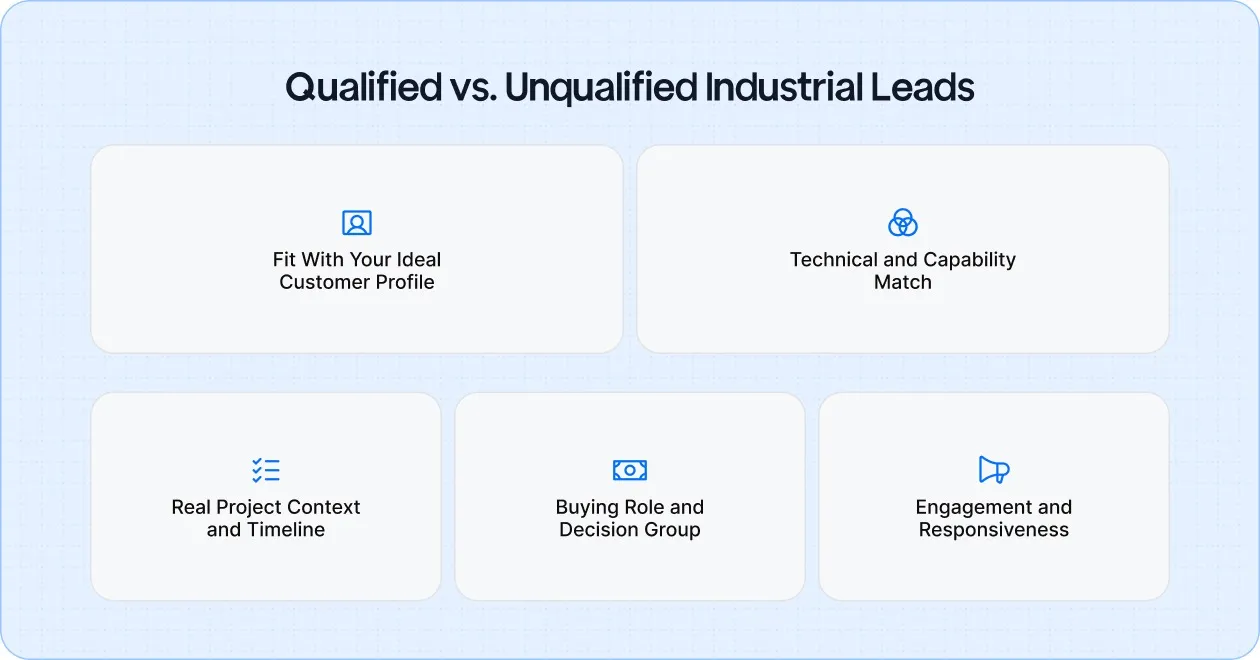
1. Fit With Your Ideal Customer Profile
A qualified lead usually:
- Operates in industries you understand and can support.
- Orders at volumes and frequencies that suit your equipment and capacity.
- Is located in regions you can ship to reliably and competitively.
Non-qualified leads often sit outside your target sectors or require project sizes that are too small (or occasionally too large) for you to serve well.
2. Technical and Capability Match
Check whether:
- The required materials, tolerances, and processes are ones you already run successfully.
- The product type fits with your existing tooling, certifications, and quality systems.
- There are special compliance or regulatory needs you can meet.
If a lead needs something you have never done, or that would disrupt your core production, it may be better to decline or refer.
3. Real Project Context and Timeline
Qualified industrial sales leads usually come with a clear context:
- A defined project or program, even if early-stage.
- A rough timeline for sampling, validation, and production.
- A sense of annual volume or spend.
Red flags include vague timing (“sometime next year”), no clear use case, or a request that appears purely exploratory with no identified project behind it.
4. Buying Role and Decision Group
In B2B manufacturing, the person who contacts you may be:
- A design engineer exploring options.
- A buyer comparing suppliers.
- A project manager gathering information.
All can be valuable, but a qualified lead usually has visibility into the broader decision group or is willing to involve others. If a contact cannot explain who approves suppliers, who signs off on specs, or how sourcing decisions are made, treat it as early-stage until that clarity is gained.
5. Engagement and Responsiveness
Lead quality also shows up in behaviour:
- Do they respond promptly to clarifying questions?
- Do they share drawings, specs, and constraints when asked?
- Are they open about what they are trying to solve?
If a prospect goes silent for weeks, refuses to share basic information, or only asks for “your best price” without dialogue, they may be more interested in price shopping than true partnership.
A Simple Qualification Checklist
To make this practical, you can build a short checklist for every new lead:
- Does the company fit our target industries and size range?
- Does the enquiry match our core capabilities and certifications?
- Is there a defined project or program with an approximate timeline?
- Do we know who is involved in the decision?
- Did the contact engage meaningfully once we responded?
If most answers are “yes,” you have a qualified industrial sales lead. If several are “no” or unclear, treat it as lower priority or nurture until it matures.
Conclusion
The companies that grow steadily are the ones that make it easy for the right buyers to understand what they do, see proof that it works, and start a focused conversation.
If you turn your catalog into a working asset, build flows that filter instead of flood, show up in the channels your buyers already use, and agree internally on what “qualified” really means, lead generation stops being guesswork. It becomes another well-run process in your operation, measured, improvable, and tied directly to the kind of business you want more of.
Ready to Bring In More Qualified Industrial Leads
Get guidance on building a lead system that attracts the right projects and filters early.
Book A Consultation

SEO
Dec 10, 2025
5 mins
56 Powerful Roofing Marketing Moves to Outshine Competitors in 2026
Batul Beawarwala
In the roofing business, the real work begins when you make sure people in your community know who you are and why they should choose you when their roof needs repair or replacement.
With storm damage, leaks, worn-out shingles, seasonal maintenance, and those unexpected roofing emergencies, homeowners are constantly searching for a reliable, trustworthy roofer.
But with so many options out there, how do you stand out? Let’s dive into 56 roofing marketing ideas that will help you connect with more clients, build your reputation, and grow your business in 2026.
Building a Strong Online Presence
A strong online presence is the foundation of any successful roofing business. With an optimized website, effective SEO strategies, and active business listings, you can increase visibility, attract the right customers, and build trust.
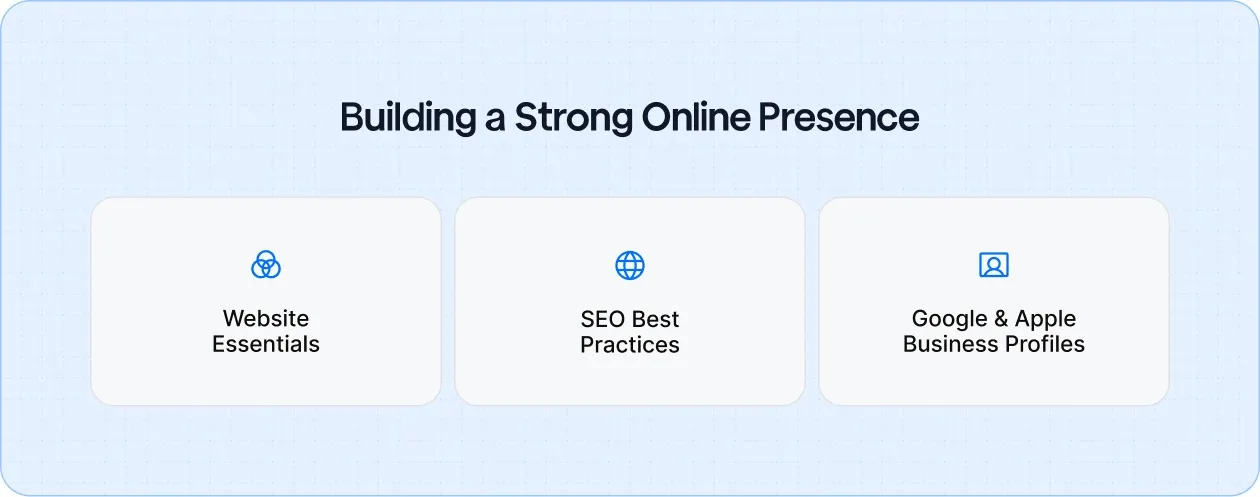
Here's how to create a website that attracts attention and converts visitors into loyal clients.
a) Website Essentials
1. Clear, user-friendly design with easy navigation: Your website should be simple to navigate, allowing users to find information effortlessly.
2. Display your contact info and services on every page: Make sure your contact details are visible throughout the site to drive easy access for potential customers.
3. Show before/after photos and client testimonials prominently: Real-life proof of your work goes a long way in building trust with visitors.
b) SEO Best Practices (For Long-Term Results)
4. Conduct keyword research personalized to roofing services (e.g., “roof leak repair near me”): Target search terms that your customers are using to find services like yours.
5. Optimize for local SEO by targeting location-based keywords (e.g., “roofing contractors in New York”): Make sure you’re visible for customers searching specifically in your area.
6. Use schema markup to enhance visibility in search results: Implement schema to help search engines better understand your business and improve your site’s visibility.
7. Build backlinks by collaborating with local businesses and organizations: Work with local businesses to exchange links, helping your site rank better.
8. Ensure your website is mobile-friendly for a seamless user experience: A mobile-friendly site ensures that visitors have a smooth experience no matter what device they use.
c) Google Business Profile & Apple Business Connect
9. Claim and optimize both Google Business Profile and Apple Business Connect listings: Keep your information consistent across both to enhance your online presence.
10. Upload high-quality photos of your roofing projects: A picture is worth a thousand words. Showcase your work with professional photos.
11. Ensure your business details are accurate and up-to-date to prevent confusion and build trust with potential customers.
12. Respond to reviews to build customer trust by showing that you care about customer feedback.
13. Highlight your unique services on both profiles to stand out from your competitors in local searches.
Want more homeowners to notice your roofing business online?
Your online content decides whether people call you or scroll past; the right help can make your business easier to find when someone needs a roofer.
Get Noticed Easily with SEO
Social Media Marketing
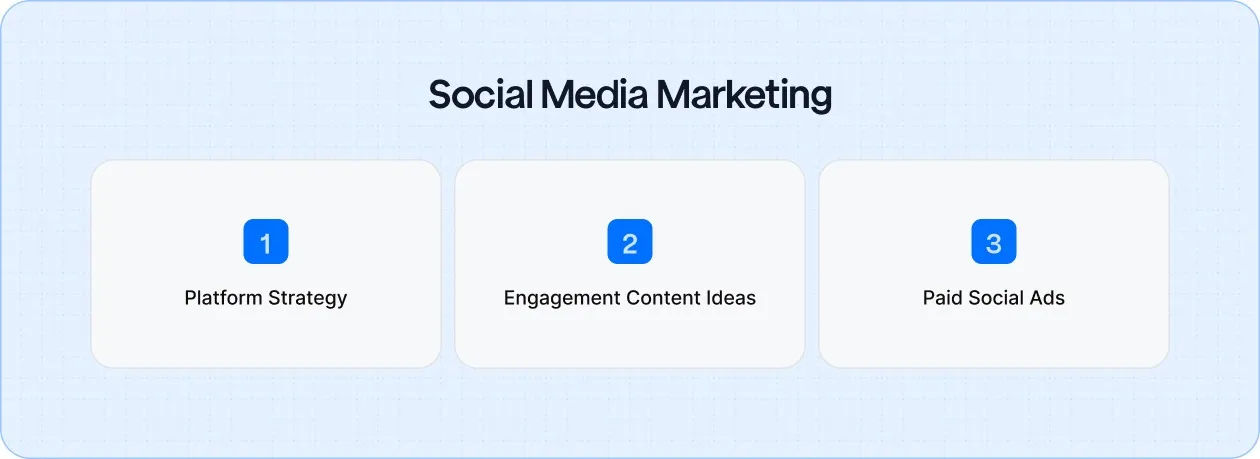
By creating engaging content personalized to different platforms and incorporating paid ads, you can increase your reach and show your community that you're the go-to expert for their roofing needs.
Here’s how to take your social media strategy to the next level and create a consistent, valuable presence online.
a) Social Media Platform Strategy
14. Focus on Facebook for local engagement with homeowners in your area: Connect with the local community and showcase your expertise.
15. Instagram for showcasing project photos, time-lapse videos, and customer testimonials: Visuals work well to capture attention and establish your authority.
16. TikTok for fun, behind-the-scenes roofing content and project reveals: Engage younger audiences with light-hearted, fun content showcasing your team and projects.
17. YouTube for educational roofing tutorials and project walkthroughs: Offer value to your followers with how-to guides and tips.
b) Content Ideas to Improve Engagement
18. Share before-and-after photos of completed roofing projects: Show real results and let your work speak for itself.
19. Post roofing tips, maintenance advice, and solutions for common roofing issues: Educate your audience and position yourself as a helpful resource.
20. Go live to answer customer questions or show your roofing processes: Live interactions help to humanize your brand and build trust.
21. Share user-generated content (e.g., customers tagging you after a job completion): Let your satisfied customers spread the word.
c) Paid Social Ads
22. Target Facebook ads to homeowners in your local area who need roof repairs or replacements: Focus on your community for a more personalized approach.
23. Use Instagram Stories ads to highlight limited-time promotions and specials: Create urgency with time-sensitive offers.
24. Run TikTok ads to showcase roofing projects and seasonal discounts: Reach a wider, younger audience while promoting your services.
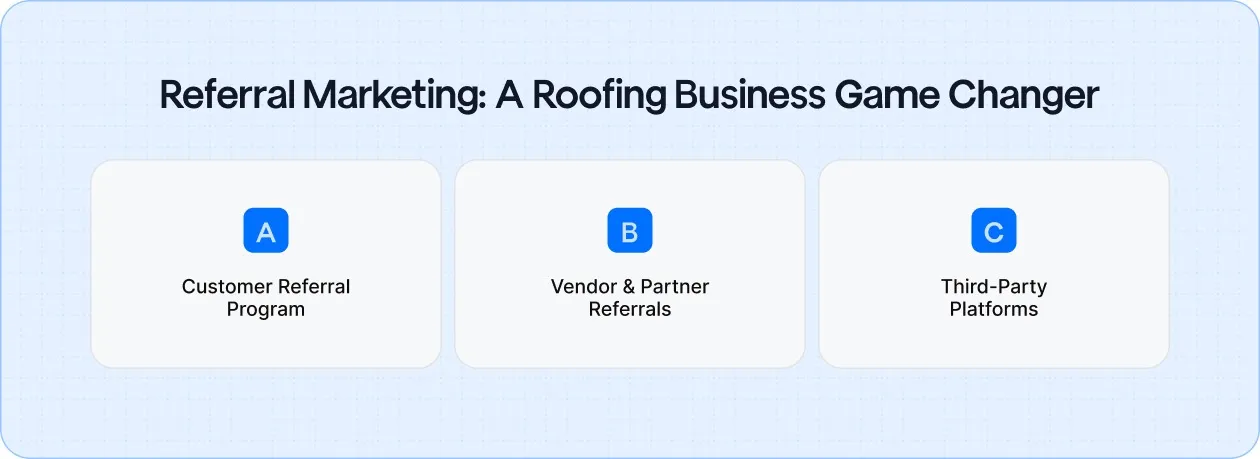
Referral Marketing: A Roofing Business Game Changer
Referral marketing is one of the most effective ways to grow your roofing business, turning satisfied customers into your best salespeople. By creating easy-to-use referral programs, partnering with local vendors, and tapping into third-party platforms, you can increase leads and expand your customer base without spending a fortune on advertising.
Here’s how to turn word-of-mouth into a powerful growth tool for your business.
a) Building an Effective Customer Referral Program
25. Offer discounts or free services for successful referrals (e.g., free roof inspection): Incentivize your customers to spread the word and reward them for their loyalty.
26. Automate referral requests via text or email once a job is complete: Streamline the process and make it easy for customers to refer others.
27. Make it easy for customers to refer friends by using a simple system: Keep your referral process simple so that clients can easily share.
b) Vendor & Partner Referrals
28. Partner with real estate agents for mutual referrals (e.g., roof inspections for homes on the market): Strengthen relationships with other local businesses for shared referrals.
29. Collaborate with insurance agents to get post-storm repair referrals: Insurance agents can be valuable partners for driving business after major weather events.
30. Work with other contractors (plumbers, electricians) to cross-promote services: Create win-win partnerships by referring customers to each other.
c) Third-party Referral Platforms
31. Get listed on platforms like Angi, Thumbtack, and Yelp to drive inbound leads: These platforms help you reach customers who are actively looking for roofing services.
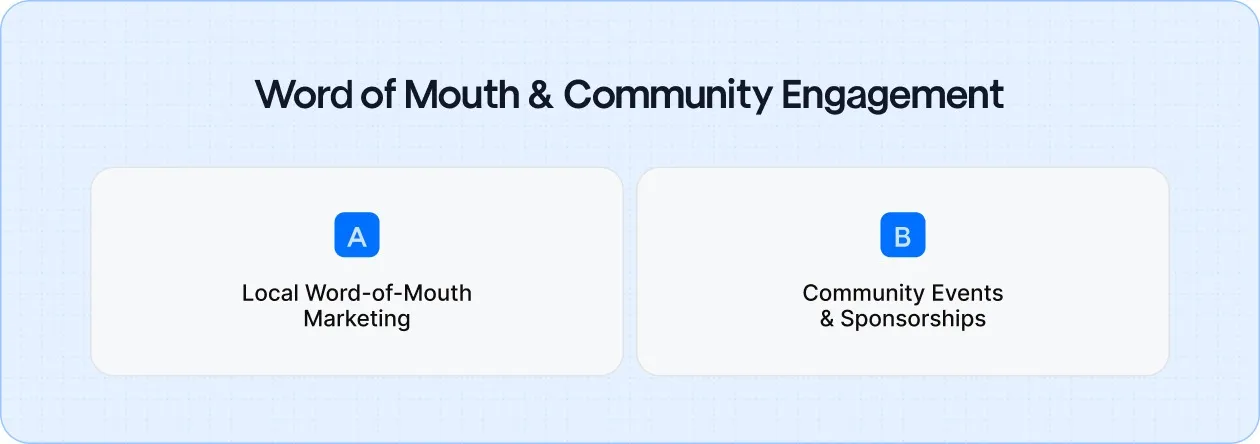
Word of Mouth & Community Engagement
Word of mouth and community engagement is one of the most authentic ways to generate new business. By tapping into local networks, sponsoring events, and offering personalized services, you can build strong connections and establish yourself as a trusted roofer in your community.
Here’s how to make the most of local marketing and community involvement to enhance your business.
a) Local Word-of-Mouth Marketing
32. Offer yard sign discounts to customers who let you place a sign on their property: A yard sign can advertise your business to neighbors and passersby.
33. Door-knock in neighborhoods that need roofing services (especially after a storm): Personalized outreach can make a significant impact, especially in post-storm areas.
34. Create a sales pitch that focuses on solving common roofing issues: Address the homeowner’s concerns directly to increase the likelihood of a conversion.
35. Attend local networking events to meet potential customers: Get involved in your community to increase your reach and build trust.
36. Use your vehicle as a mobile billboard with wraps or magnetic signs: Turn every trip into an opportunity to advertise your roofing services.
b) Community Events & Sponsorships
37. Sponsor local sports teams or school events to improve brand recognition: Show support for your community while marketing your services.
38. Host roof maintenance workshops or informational sessions at community centers: Provide value and educate homeowners while showcasing your expertise.
39. Participate in charity events and contribute to local causes to build goodwill: Demonstrate your commitment to the community while indirectly marketing your business.
Email Marketing & Customer Retention
Email marketing is a powerful tool for staying connected with your customers and keeping them engaged throughout their roofing journey.
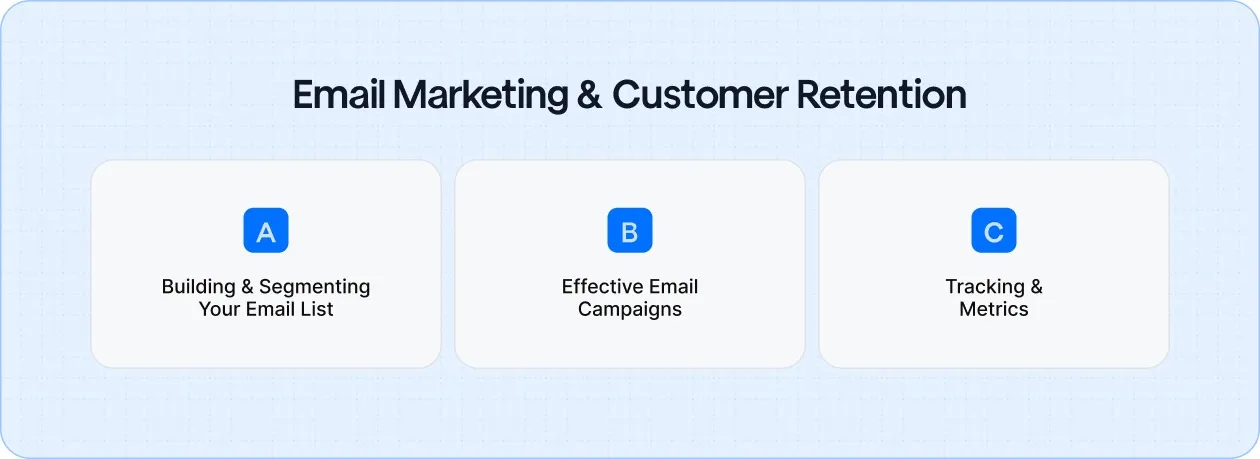
Here’s how to effectively incorporate email to retain customers and improve your marketing efforts.
a) Building & Segmenting Your Email List
40. Collect emails through website sign-ups and after-job consultations: Build your list early and keep customers informed about your services.
41. Incentivize sign-ups with discounts, free guides, or valuable content: Entice potential customers to subscribe with something valuable.
42. Segment your email list by customer stage (leads, completed projects, repeat clients): Personalize your content to where your customer is in their journey.
b) Effective Email Campaigns
43. Send seasonal promotions, educational content, or roofing maintenance tips: Stay top-of-mind by offering timely and helpful emails.
44. Share customer success stories and project updates to keep clients engaged: People love real stories that showcase the work you've done and its impact.
45. Use automated email sequences to stay top-of-mind with previous customers: Automated campaigns help you nurture relationships and keep customers coming back.
c) Tracking & Metrics
46. Track open rates, click rates, and conversion rates to optimize email performance: Analyze performance and adjust strategies for better results.
Paid Advertising: PPC & Retargeting Strategies
Paid advertising and retargeting strategies are essential for reaching the right customers at the right time.
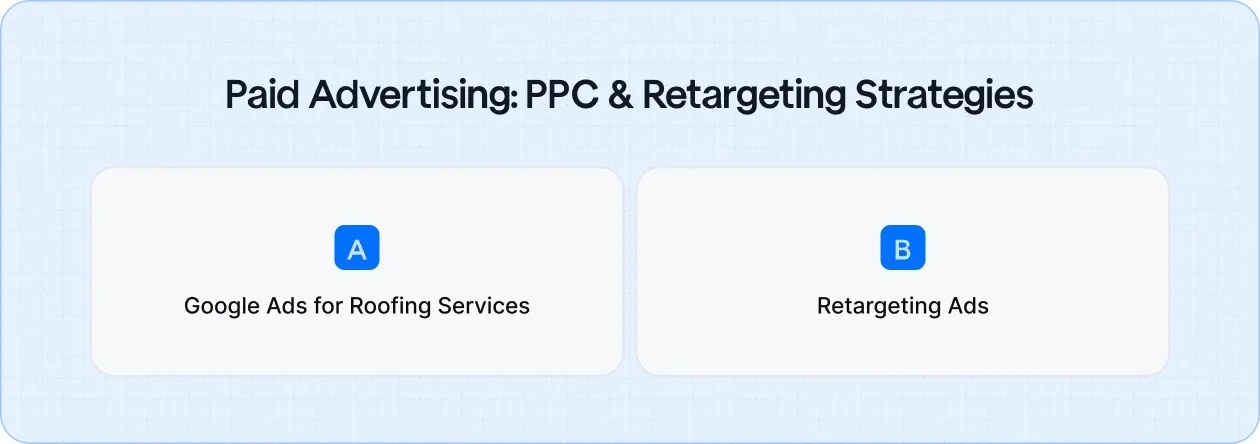
Here’s how to optimize your PPC and retargeting campaigns for the best results.
a) Google Ads for Roofing Services
47. Use PPC ads targeting high-conversion keywords like “roof replacement near me” to capture customers actively searching for your services.
48. Use location-based targeting to focus ads on specific neighborhoods and ZIP codes: Narrow down on your service area to make sure your ads are reaching the right people.
49. Create separate campaigns for emergency roof repairs and routine maintenance: Segment your campaigns to ensure the right message reaches the right audience.
50. Monitor ad performance and adjust bids and copy for better ROI: Continuously improve your campaigns to maximize the return on your investment.
b) Retargeting Ads
51. Set up retargeting ads to bring back website visitors who didn’t convert: Recapture interested visitors and turn them into customers.
52. Use dynamic retargeting to show personalized roofing service ads based on their previous actions: Display ads personalized to each individual’s interactions with your site.
Seasonal Roofing Marketing Ideas
Seasonal promotions and timely content can set your roofing business apart during key times of the year. By targeting specific needs like storm damage or seasonal maintenance, you position yourself as the trusted expert when customers need you most.
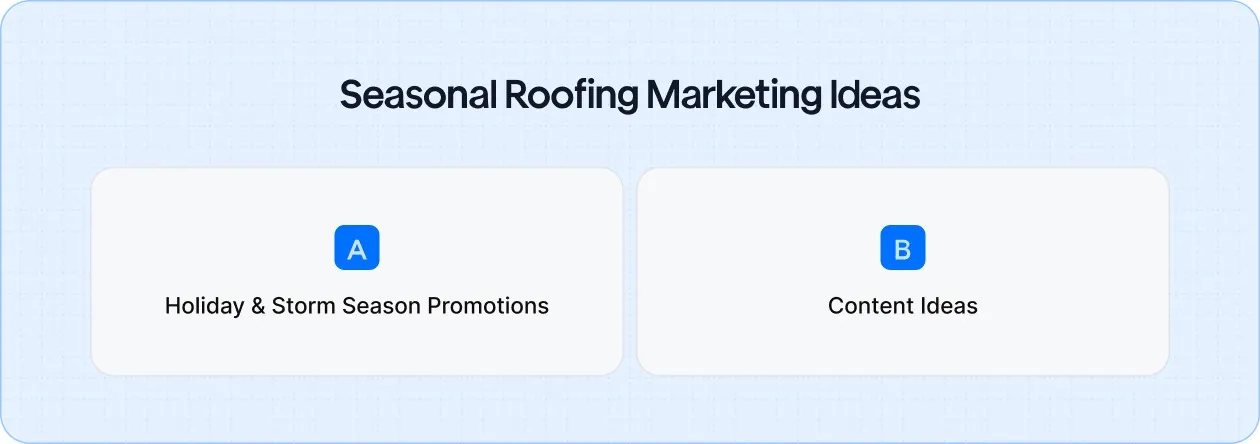
Here’s how to capitalize on these opportunities and keep your business top-of-mind all year round.
a) Holiday & Storm Season Promotions
53. Offer a limited-time discount for roof inspections during the winter season: Attract customers who are preparing for the colder months.
54. Promote storm damage repairs immediately after major weather events: Be quick to respond to storm-related inquiries and position yourself as the go-to roofer in the area.
55. Run seasonal offers to encourage customers to book services before peak seasons: Create urgency with seasonal promotions to fill your schedule.
b) Content Ideas
56. Share roof care tips specific to each season (e.g., how to prepare for winter storms): Help homeowners protect their roofs by providing seasonally relevant tips.
Must Read: Stop Running After Leads, Start Attracting Them: 10 Easy Roofing Tips
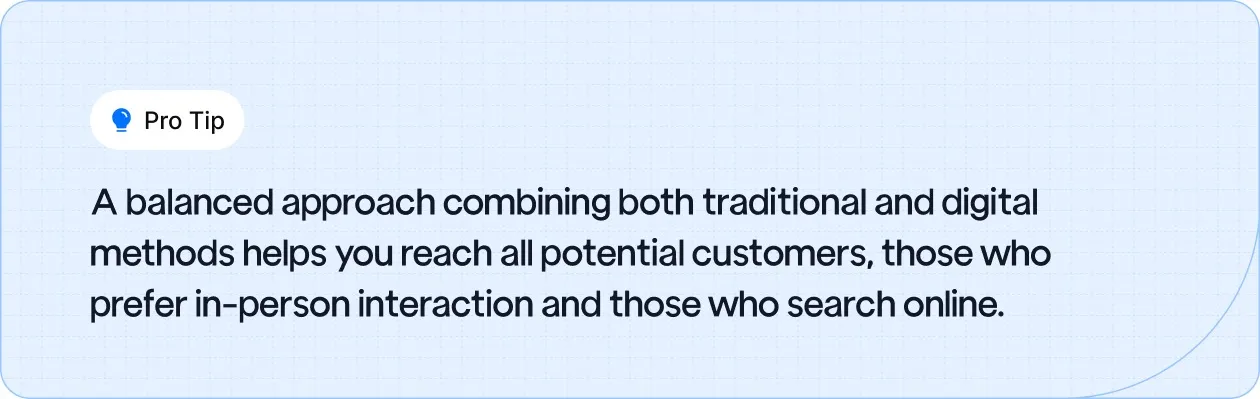
Types of Roofing Marketing: Traditional vs. Digital
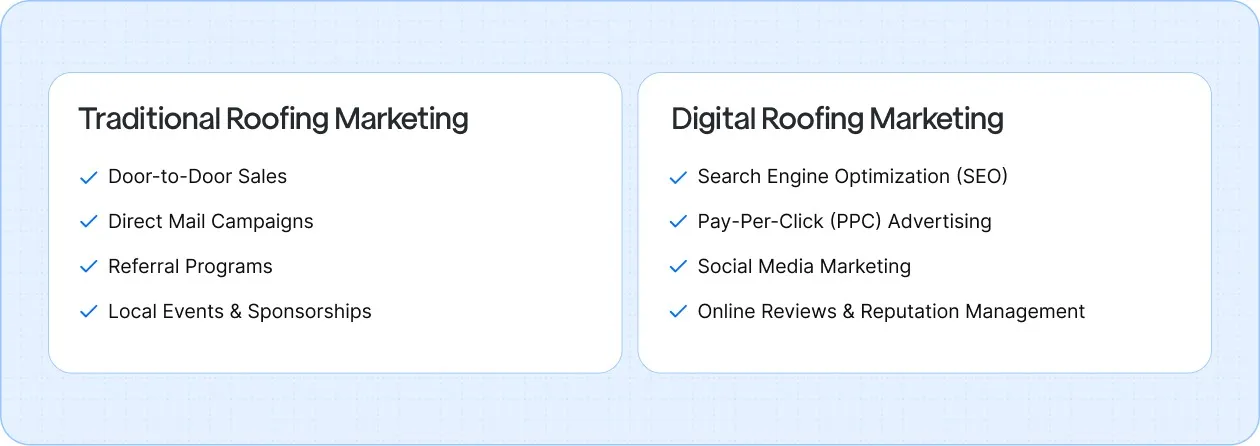
Traditional and digital marketing each offer unique ways to connect with potential customers and grow your roofing business. Here’s how you can use both strategies effectively in 2026.
Traditional Roofing Marketing
- Door-to-Door Sales: Establish face-to-face relationships, especially after storms, and directly engage with homeowners who need roofing services.
- Direct Mail Campaigns: Target local neighborhoods with postcards or flyers, ensuring your services are visible when homeowners need them most.
- Referral Programs: Leverage satisfied customers to spread the word. A referral from a neighbor or friend is powerful, especially in tight-knit communities.
- Local Events & Sponsorships: Sponsor sports teams or community events to increase brand recognition and build trust with homeowners near you.
Digital Roofing Marketing
- Search Engine Optimization (SEO): Ensure your website appears when people search for roofers in your area, helping you capture high-intent leads.
- Pay-Per-Click (PPC) Advertising: Use targeted ads to reach people actively searching for roofing services. Pay for visibility on platforms like Google and social media.
- Social Media Marketing: Engage potential customers on Facebook, Instagram, and TikTok with project showcases, customer stories, and tips.
- Online Reviews & Reputation Management: Build trust by responding to reviews and maintaining a positive online presence. Positive feedback is essential for your digital reputation.
Traditional vs. Digital Marketing: A Quick Comparison
Simplify Your Roofing Marketing with AI-Powered Platforms
AI is revolutionizing roofing marketing by automating tasks like content generation and SEO optimization, allowing you to target the right audience more effectively. With tools like lead scoring and predictive analytics, you can make smarter, data-driven decisions that maximize your ROI and streamline your efforts.
With the 56 roofing marketing ideas shared in this guide, you now have the tools to enhance visibility, generate leads, and build long-term relationships. Gushwork’s AI-powered SEO and content solutions simplify your marketing, so you can focus on growing your business.
Want your roofing services to be the obvious choice in your area?
Gushwork helps roofing companies stand out with SEO-backed content that explains value clearly, attracts the right enquiries, and builds trust with homeowners.
Book a Free SEO Consultation

Digital Marketing
Dec 10, 2025
5 mins
The 2026 Lead-Gen Tactics High-Growth Contractors Won’t Tell You About
Ishani Mitra
Some contractors think they have a marketing problem. Most actually have a visibility problem. People in your city are already searching for someone who does exactly what you do, at the exact moment you’re reading this. The real issue is simple. They’re finding someone else first.
Lead generation in 2026 is about showing up clearer, faster, and more credibly than the next contractor.
In this blog, you’ll learn the strategies that help contractors get chosen first, why old tactics fail, and how to build a lead flow you can rely on week after week.
What is the Importance of Contractor Lead Generation?
Contractors today face a very different market than they did even five years ago.
The basics haven’t changed: people want someone they trust, at a fair price, who will show up and do the job properly. What has changed is how they decide that.
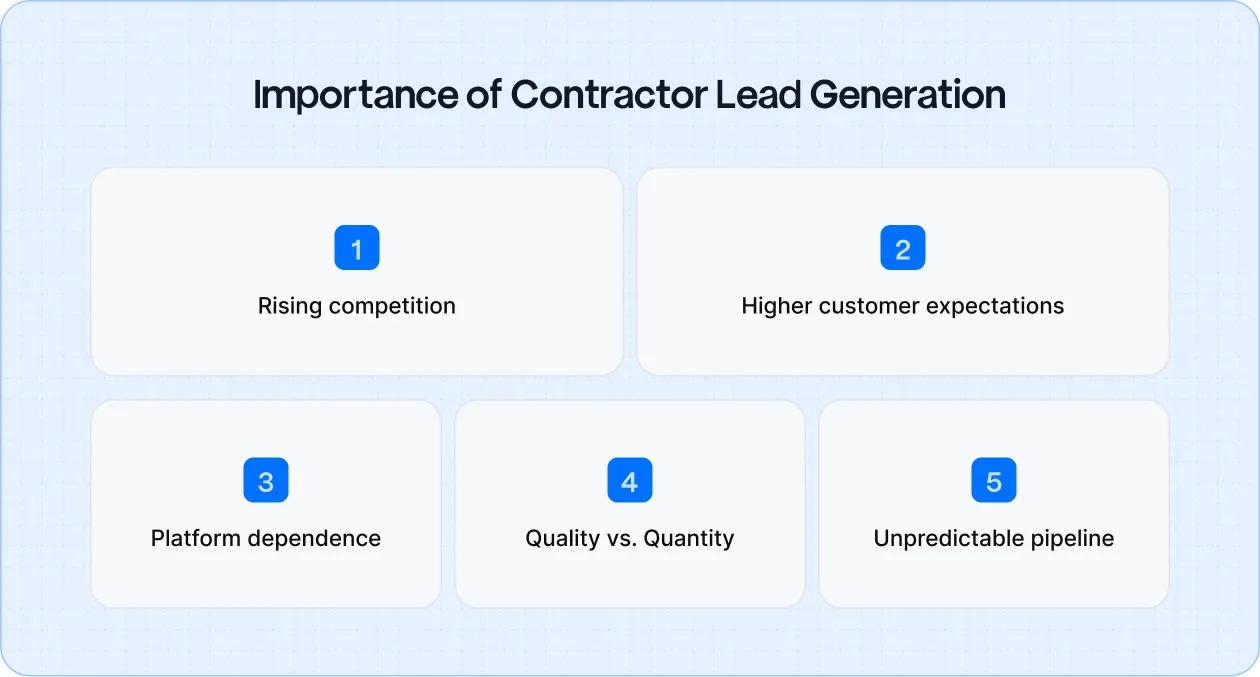
Here are the biggest challenges contractors face:
- Rising competition: Competition is intensifying across all trades. Roofing, remodeling, electrical, all now have more local providers running ads and chasing the same customers. Standing out requires more than just good work.
- Higher customer expectations: People want quick replies, clear pricing ranges, and confidence that you can actually solve their issue. If your digital presence feels outdated, they’ll move on instantly.
- Dependence on platforms: Google, Meta, Nextdoor, Yelp, Angi; these platforms control visibility. If your listing is weak, your pipeline slows down.
- Quality vs quantity problem: Many contractors get leads that are unfunded shoppers, one-off jobs, or completely outside their service area. A strong lead generation system filters out low-quality enquiries and brings in the right jobs.
- Slow seasons and unpredictable pipelines: Without consistent lead generation, contractors experience feast-or-famine cycles, making staffing and growth difficult.
Effective lead generation solves these challenges by helping the right customers find you, trust you, and choose you, before they ever speak to another contractor.
7 Best Lead Generation Platforms and Services for Contractors
There are hundreds of tools and lead vendors out there, but only a handful consistently help contractors turn marketing spend into booked work.
Below is a practical rundown of the best contractor SEO services for lead generation right now, what they’re good at, and when they make sense in your mix:
1. Gushwork
Gushwork is a hands-on marketing partner for contractors and industrial companies that want a proper pipeline. The focus is on building a system: website, SEO, PPC, GBP, tracking, and reporting that fits how you actually sell jobs.
Why Gushwork is the Top Choice?
- Deep market and keyword research: Gushwork analyzes the service area, competitors, homeowner demand, and pricing trends to uncover real opportunities contractors can win. Every campaign is built on data.
- Clear messaging and service positioning: Most contractors lose leads because their value isn’t obvious. Gushwork helps define services, refine offers, and create simple, trust-building messaging that converts faster.
- Conversion-focused websites: Gushwork builds or upgrades contractor websites so visitors quickly understand what the business does, where it operates, and how to get in touch. The focus is always on speed, clarity, and strong calls to action.
- High-intent Google Ads, LSAs, and paid social campaigns: Campaigns are built around real homeowner intent, strict keyword controls, accurate location targeting, and lead-focused landing pages. This reduces wasted spend and improves booked-job rates.
- Full local SEO management: Gushwork strengthens long-term visibility through Google Business Profile optimization, review systems, service-area pages, NAP clean-up, and local search improvements.
- Consistent trust-building content: From project photos and captions to FAQs and service descriptions, Gushwork produces content that builds familiarity and credibility before homeowners even call.
- Lead tracking tied to revenue: Every call, form, message, and booked job is tracked to its source, giving contractors clarity on which channels are driving real revenue and which need improvement.
- Continuous optimization: Strategies, pages, ads, and local profiles are updated regularly based on performance, competition, and seasonality. The system keeps improving rather than fading over time.
How it helps with contractor lead generation:
- Built for real homeowner behavior: Contractor leads behave differently in urgent and non-urgent situations. Gushwork structures campaigns, landing pages, and call flows based on how homeowners make decisions in the moment, so contractors don’t lose jobs to faster competitors.
- A setup that reduces lead leakage at every step: Many contractors lose leads after the click because of slow responses, missing information, or unclear next steps. Gushwork strengthens intake systems, improves call handling, and sets up automation so every inquiry receives an immediate, reassuring follow-up. Fewer leads slip away.
- Better budget control for contractors who can’t afford waste: Instead of spreading money across every channel, Gushwork prioritizes the exact service lines and neighborhoods that produce the highest ROI. This keeps marketing spend efficient and focused on booked revenue, not vanity metrics.
- Systems that grow with the business: Whether a contractor wants to expand to new zip codes, add more trucks, or shift the service mix seasonally, the marketing engine adjusts with them. Nothing is rigid. The strategy evolves as the business grows.
- Visibility that compounds over time: Paid ads work fast. Local SEO works steadily. Brand authority works long-term. Gushwork builds all three together so contractors stop relying on a single channel and start generating predictable leads year-round.
- A partner focused on outcomes, not tasks: Instead of checking boxes, Gushwork measures success by booked jobs, quality of leads, and long-term growth. Every update to pages, ads, and local profiles is tied to real performance, not abstract marketing activity.
Show Up When People Search for Your Services
Strengthen your website and service pages so search engines understand what you do and who you serve.
Boost Your SEO
2. Scorpion
Scorpion is a large marketing platform that focuses heavily on home services contractors (roofing, HVAC, plumbing, law, etc.). They offer websites, SEO, paid ads, chat, and basic CRM tools under one roof.
What Scorpion offers
- Industry-specific website designs and content libraries for common contractor services.
- Central dashboard to manage SEO, PPC, LSAs, and reviews in one place.
- Call tracking and reporting to connect ad spend to incoming leads.
Scorpion’s strength is scale and packaged solutions. That can be helpful if you want “most of it handled” quickly, but it may feel less flexible for contractors who want more tailored strategies or smaller, experimental campaigns.
3. Blue Corona
Blue Corona works mainly with home service companies (HVAC, plumbing, electrical, remodeling), with a strong emphasis on tracking and analytics.
What Blue Corona offers
- SEO, PPC, and LSA management are designed specifically for trades.
- Detailed call tracking and attribution so you can see which channels produce real leads.
- Reporting is built around cost per lead and booked job metrics rather than unverifiable data.
They tend to work best with contractors ready to invest consistently in marketing and who care about detailed reports and long-term compounding gains.
4. WebFX
WebFX is a large digital marketing agency that serves many industries, including contractors and home services. They’re known for a wide service menu and strong technical SEO capabilities.
What WebFX offers
- SEO, content, link building, and paid advertising campaigns.
- Conversion-focused landing pages and A/B testing for lead forms.
- CRM and analytics integrations so marketing data doesn’t live in a silo.
WebFX is a good option if you want a broad digital program (SEO + content + paid) and you’re comfortable working with a larger, systematised agency rather than a niche trade-only shop.
5. Contractor Dynamics
Contractor Dynamics focuses heavily on roofing and some exterior trades. They combine training, coaching, and done-with-you marketing to help instead of acting as a pure “done-for-you” agency.
What Contractor Dynamics offers
- Training programs to help contractors understand Facebook/Meta ads, content, and brand positioning.
- Support to build in-house marketing capabilities so you’re not fully dependent on an agency forever.
- Strategy around local contractor SEO, video content, and consistent lead flow.
This is a good fit if you want to build internal marketing muscle and keep more control, rather than fully outsourcing all lead generation.
6. RYNO Strategic Solutions
RYNO works mainly with HVAC, plumbing, and related home services. They position themselves as a performance-oriented agency that understands seasonality, call volume swings, and service-area constraints.
What RYNO offers
- SEO, PPC, and LSA campaigns tuned for urgent home-service needs.
- Call listening and coaching to improve booking rates from existing leads.
- Strong focus on revenue-linked reporting rather than just traffic.
RYNO tends to work with contractors who already have some scale and are ready to push harder on growth with performance expectations.
7. Thrive / Other Home-Services Agencies
There are also mid-sized agencies like Thrive and other regional firms that focus on contractors in specific geographies or niches.
What these agencies offer
- Core services: website builds, SEO, Google Ads, social ads, and GBP optimisation.
- More flexible retainers or project-based work compared to very large agencies.
- Local market insight if they’re based in or familiar with your region.
Quality and fit can vary a lot at this tier. It’s worth asking for examples in your trade and region, plus clear reporting on cost per lead and booked jobs before you commit.
15 Ways to Generate Contractor Leads
Here’s a simple, modern playbook that works across roofing, remodeling, plumbing, HVAC, electrical, landscaping, and other local trades:
Get Listed on the Sites Homeowners Already Use
Local listing sites (HomeAdvisor, Yelp, Angi, Thumbtack, Nextdoor, Houzz) still play a role because homeowners use them as discovery platforms. Being present gives you additional visibility beyond Google.
How to do it:
- Claim and complete your profiles with photos, services, service areas, and business hours.
- Add real project photos and encourage happy clients to leave platform-specific reviews.
- Turn off or cap any “pay-per-lead” features until you understand the cost per booked job.
Strengthen Your Google Business Profile (GBP)
Your GBP is your single most important digital asset. It influences map-pack rankings, call volume, and local trust.
How to optimise it:
- Complete every field: categories, services, service areas, FAQs, and business description.
- Add weekly photos and project posts.
- Ask for reviews immediately after each job and reply to every one.
- Keep NAP details consistent across all directories.
Make Your Business Easy to Find
Optimise your Google Business Profile so local customers see clear services, real photos, and fast ways to contact you.
Improve Your GBP
Explore Google Local Services Ads (LSAs)
LSAs place you at the very top of Google for high-intent searches (“contractor near me,” “roof repair,” “kitchen remodel”). You pay per lead, not per click, making it one of the most reliable contractor lead channels.
How to get the most from LSAs:
- Complete the background checks and insurance verification early.
- Set specific job types you want to receive leads for.
- Improve your ranking by increasing review count and response speed.
Build High-Intent Search Ad Campaigns
Google Ads still generate some of the best contractor leads, if you avoid wasted clicks.
What works:
- Target exact, service-specific keywords (“bathroom remodeling contractor,” “emergency water heater repair”).
- Use call-only ads on mobile to capture urgent jobs.
- Launch dedicated landing pages for each service for higher conversion.
- Schedule ads around demand spikes (evenings for plumbing/HVAC calls).
Create a Simple Referral Program
Contractors win big when happy customers do the selling. A good referral program turns past jobs into future revenue.
How to set it up:
- Offer a small reward (gift card, future discount, free maintenance check).
- Automate a “referral request” email 7–10 days after job completion.
- Give clients a direct link to share with friends.
Adopt AI-Assisted Communication
AI-enhanced systems help contractors respond faster and keep conversations alive even when you’re on a jobsite.
What to use:
- AI chat on your website to answer common questions 24/7.
- Automated booking confirmations and follow-ups.
- Lead scoring to filter low-quality inquiries and highlight good ones.
Publish Helpful Lead Magnet Content
Homeowners trust the contractor who educates instead of hard-sells. Lead magnets work because they filter serious buyers from browsers.
Ideas that convert:
- “Repair vs Replace” guides
- Cost calculators
- Material comparison sheets
- Seasonal checklists for roofing, HVAC, plumbing, or remodeling
- Local project case studies: Share these behind a simple email form to capture warm leads.
Share Content That Builds Instant Trust
Create clear service pages, project snapshots and simple guides that help customers choose you faster.
Improve Your Content
Stay Visible in Your Community
Offline presence still matters in trades. People trust contractors they see in familiar spaces.
What to do:
- Sponsor youth sports teams or community events.
- Keep branded yard signs at every project site (with permission).
- Maintain a clean, branded truck. It becomes rolling advertising.
Use Direct Mail for Neighbourhood Wins
Direct mail is still powerful for contractors who work geographically. It’s tangible, hyper-local, and pairs well with digital follow-up.
Best use cases:
- Postcards to neighbourhoods you recently worked in
- Mailers after storms or seasonal events
- “We’re working nearby” announcements combine with QR codes that lead to a simple quote form.
Build “Price Ranges” Pages for Every Service
Homeowners search for cost clarity before anything else.
Pages like “Cost to Install a New Deck in [City]” or “Bathroom Remodel Cost Breakdown for 2025” consistently attract high-intent visitors who are actively budgeting.
Most contractors avoid these pages, which is why they work so well.
Offer a “Check My Quote” Service
Homeowners often collect multiple bids and get overwhelmed.
Create a simple offer: “Upload your existing quote, we’ll review it for free to make sure it’s fair.”
This positions you as a trusted expert, which frequently leads to winning the project.
Create Mini-Case Studies for Every Job
Not long PDFs — simple 150-word snapshots:
- Problem
- What you did
- Timeline
- Final result
These build enormous trust and give homeowners a real sense of what you can deliver. Post them on your website, GBP, and social media.
Use an Automated Missed-Call Text Back
Contractors lose tons of business simply by missing calls while on the job.
A missed-call text system replies automatically: “Hey, this is John — sorry I missed your call. How can I help?”
This saves dozens of leads per month, especially during peak season.
Launch a Rolling “Project of the Week” Spotlight
Choose a single job each week and create:
- A story
- Photos
- Pricing range
- Homeowner testimonial
Use it across email, GBP, and social to stay memorable.
Bid on Competitor Brand Names With a Helpful, Ethical Angle
Homeowners often search a competitor’s name when they’re close to making a decision. Bidding on those terms gives you a chance to appear beside that competitor without being negative or misleading. The goal is simple: offer clarity, not confrontation.
Instead of trying to “steal” customers, position your ad as a helpful checkpoint before they commit.
Why this angle works: It meets homeowners at a natural point in their research, when they want reassurance they’re making the right choice. You’re not undermining the competitor. You’re giving the homeowner a reason to double-check, which often turns into a conversation you wouldn’t have gotten otherwise.
12 Factors to Choose a Lead Generation Service
Finding the right contractor lead generation service can feel overwhelming, especially when every platform promises “high-quality leads” and “instant results.” But not all lead providers understand how projects actually move: slow bids, long approval chains, multiple stakeholders, and high job costs.
Use the checklist below to evaluate any lead generation company before signing up:
1. Lead Quality: Do they filter by project type, budget, location, and timeline? Are leads exclusive?
2. Exclusivity & Territory Protection: How many contractors receive the same lead? Do they cap competition in your area?
3. Industry Specialization: Do they understand your trade and match you with the right job categories?
4. Transparent Lead Sources: Are leads from SEO, PPC, LSAs, or resold third-party lists?
5. Lead Verification: Do they validate phone numbers, emails, locations, and readiness?
6. Cost Structure & ROI: Is pricing per lead, per month, or per booked job? Is ROI easy to measure?
7. CRM Integration: Do they plug into Jobber, ServiceTitan, HubSpot, or your follow-up systems?
8. Support & Dispute Handling: Do they credit bad leads quickly and respond to issues fast?
9. Reputation & Proof: Are there real contractor reviews and case studies showing revenue outcomes?
10. Scalability: Can you add zip codes, pause volume, or expand as your crews grow?
11. Data Ownership: Do you own the customer list, and can you export it anytime?
12. Job-Type Alignment: Do they send leads that fit your capabilities, crew size, and service offerings?
Reach Homeowners in Your Exact Service Area
Build local signals that help you rank in the neighbourhoods where your best jobs come from.
Strengthen Local Visibility
Wrapping Up
Your next step is simple: put one strong system in place at a time. Every improvement, better visibility, stronger messaging, faster responses, brings you closer to a business that runs on consistency rather than chance.
If you’re ready to turn “hope the phone rings” into a genuine growth engine, now is the time to act. Let’s build a lead generation system that supports your business every single day.
Ready to Build a Lead System You Can Rely On
Get expert guidance on creating a clear, consistent pipeline for your contracting business.
Book A Consultation

Digital Marketing
Dec 10, 2025
5 mins
Lead Form That Top Laser Cutting Businesses Use to Capture Profitable Work
Ishani Mitra
If you run a laser cutting business, you know how crucial all the small details are. One wrong measurement, one slightly incorrect setting, and the whole project is ruined.
So why is it that so many laser cutting shops still use a super simple "Name, Email, Tell Us Everything" form? When a potential customer visits your site, they want a quote for a specific job, they know their material, their thickness, and they have a file.
If your form doesn’t ask for the right requirements up front, strong prospects slip away and your team loses time sorting through incomplete or unusable submissions.
In this blog, we’re going to talk about how to fix that. We'll show you how to build a smart, simple lead form that asks the right questions in the right way.
What Is a Laser Cutting Lead Generation Form?
A laser cutting lead generation form is the page or pop-up on your website where potential customers submit project details so you can quote or follow up. It’s usually the bridge between “I’m browsing” and “I’m ready to talk about a part or project.”
For a laser cutting or fabrication shop, this form serves as a part intake form, a sales filter, and a quoting shortcut.
What It Does For Your Business?
- Captures real project info: The form collects material, thickness, quantities, file uploads (DXF, DWG, STEP, etc.), delivery needs, and sometimes tolerances or finishing requirements. That means your estimators start with context instead of chasing details in five follow-up emails.
- Filters out poor-fit or “shopping around” requests: By asking a few smart qualifying questions (e.g., “Are you a one-time buyer or an ongoing production partner?” or “Estimated annual volume?”), you can quickly see which leads deserve immediate attention.
- Organizes leads for a long sales cycle: Industrial and manufacturing leads often involve multiple stakeholders and longer timelines than consumers. A structured form feeds clean data into your CRM so you can track, follow up, and close over weeks or months.
- Reduces quoting friction: When your form guides the customer to upload usable files, choose materials from a list, and specify quantities clearly, you cut down on back-and-forth and quote faster. Faster, accurate quotes win more jobs.
Ready to cut wasted time and quote only real jobs?
Upgrade your lead form and start receiving production-ready RFQs.
Talk to our team
How to Create Effective Laser Cutting Lead Generation Forms?
A high-performing laser cutting lead generation form filters, qualifies, and accelerates quoting. Optimize the experience, and your form becomes a revenue engine instead of a basic contact page.
1. Start Simple, Then Expand with Conditional Fields
Many buyers abandon forms because they’re overwhelmed at the first step. Instead of showing every question at once, use conditional logic to reveal details gradually.
How to execute this:
- Step 1: Basic contact fields (Name, Email, Phone)
- Step 2: Project details (Material, Thickness, Quantity)
- Step 3: Upload files only if they confirm they have drawings
- Step 4: Notes for advanced specs only if needed
This keeps serious engineers engaged and prevents casual requesters from quitting early.
2. Use Clear Material & Thickness Dropdowns
Leaving fields fully open-ended leads to vague submissions like “metal, 3-ish mm?” or “steel plate.” Structured dropdowns improve accuracy and speed.
How to execute this:
- Material dropdown: Mild Steel, Stainless, Aluminum, Brass, Copper, Acrylic, Polycarbonate, Other
- Thickness dropdown with predefined ranges
- Finish options: Raw, Powder-coat ready, Polished, Deburred, etc.
This minimizes clarification emails and supports faster quoting.
3. Make File Upload Effortless
If your upload tool is clunky, slow, or rejects standard part files, you’ll lose high-value leads instantly.
Best practices:
- Allow drag-and-drop and batch uploading
- Support DXF, DWG, STEP, IGES, PDF, and ZIP
- Show file size and file-type limits clearly
- Offer cloud upload support (Dropbox, Drive, OneDrive)
Add a clear line: “Don’t have CAD files? Upload photos or sketches and we’ll help evaluate options.” This keeps hobbyists and prototype customers from bouncing.
4. Use Pre-Qualification Questions to Prioritize Real Buyers
Not every form submission deserves the same response time. A few smart questions help your team rank leads.
Examples:
- Project type: Prototype / Short-run / Production
- Estimated timeline: ASAP / This week / This month / Just exploring
- Estimated volume: 1–10 / 10–100 / 100+
These inputs improve workload planning and help route enterprise accounts to sales instead of general support.
5. Add Microcopy that Reduces Hesitation
Short explanatory text near fields increases completions and decreases confusion.
Helpful microcopy examples:
- Next to upload box: “Upload drawings or images, any format is fine.”
- Near timeline: “If you’re unsure, pick your best guess.”
- Near CTA button: “We’ll respond within 24 hours.”
Small explanations reduce anxiety and increase trust.
6. Optimize for Mobile First
Engineers and purchasing teams often browse supplier options on their phones, even if they upload files later from desktop.
Checklist:
- Buttons large enough to tap easily
- Single-column layout
- Autofill enabled for fields like name, email, phone
- A fixed “Call Now” button for urgent jobs
If your form relies on desktop-only interaction, you’re losing leads daily.
7. Add Trust Elements Near the Form
People hesitate to share information when they aren’t sure who’s on the other end.
What to include nearby:
- Review snippets or star rating
- Logos of certifications or industries served
- Privacy reassurance (“We never share or sell your information”)
- Typical response time
Trust signals reduce bounce rate and improve submission rate.
8. Track Form Performance with Analytics
You can’t improve what you don’t measure. Reviewing how visitors interact with your form reveals exactly where friction occurs.
What to monitor:
- Abandonment rate per field
- Completion time
- Device type and conversion differences
- Drop-off on file upload or lengthy fields
Tools like Hotjar, Microsoft Clarity, and GA4 form events make this painless.
9. Always Send a Confirmation & Next-Step Message
The experience shouldn’t end at “Thank you.”
Send an automated email that includes:
- Confirmation of files received
- Expected response timeline
- Direct phone contact for urgent orders
- Optional link to portfolio or capabilities page
It prevents follow-up emails like “Did you get my files?” and reassures serious buyers.
10. Test Regularly
Forms degrade over time due to browser updates, plugin failures, and changing customer needs.
Quarterly checks should include:
- Test submissions across devices
- File uploads with large and unusual formats
- Simulated first-time user evaluation
- Speed and UX audits
A broken form can silently destroy your pipeline for weeks if unnoticed.
Laser Cutting Lead Form: Essential and Advanced Fields
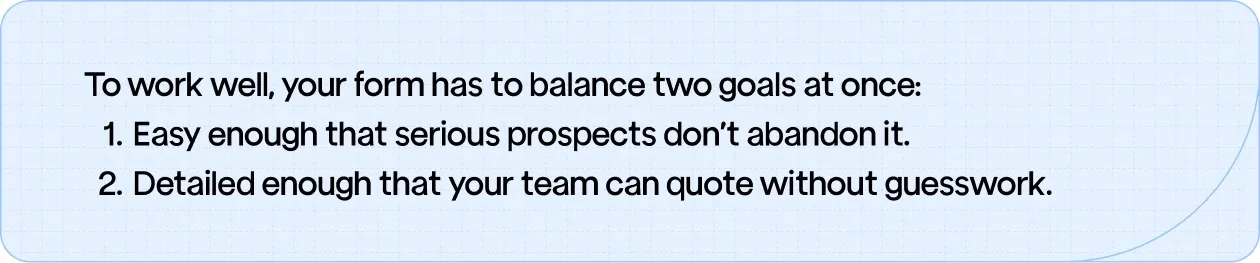
Here are the key building blocks.
Essential Elements Every Laser Cutting Lead Form Needs
A strong lead form gives you just enough information to respond quickly and understand what the prospect is trying to get done. These fields keep the form simple, reduce drop-offs, and still give you what you need to qualify the job from the first touch.
What to include:
- Name and Contact Details: You need a way to reach them, so keep it simple: name, email, and phone. No long personal info fields or unnecessary details.
- Project Description (Short Text Box): A brief summary helps you understand the nature of the request without overwhelming the user. Most prospects can explain their need in a sentence or two.
- Material Needed: This quickly tells you if the job aligns with what your shop cuts. Stainless, aluminum, acrylic, mild steel, simple dropdown options work well.
- Preferred Turnaround Time: This helps you judge urgency. It doesn’t have to be precise; simple choices like “ASAP,” “1–3 days,” or “Not urgent” work well.
These essentials make the form fast to complete while giving you the core information needed to reply confidently and assess whether the project is a good fit.
Optional Add-Ons That Improve Lead Quality and Save Time
Once the essentials are covered, advanced fields can give you deeper technical insight without overwhelming the user. These details help your team quote accurately, avoid feasibility issues, and understand the real scope of the job before a single email is exchanged.
High-value advanced fields to include:
- CAD File Upload (Native Formats): Allow uploads beyond DXF or PDF, such as STEP, IGES, or SolidWorks files. Native CAD models provide exact geometry, reduce interpretation errors, and help your team assess cut paths, kerf impact, and manufacturability with precision.
- Tolerance or Precision Requirements: A simple dropdown for “Standard,” “Tight,” or “Critical” tolerances, or a text box for specific notes. This prevents quoting errors and helps you spot jobs that require secondary processes or specialized setups.
- Intended Application: Optional field for use-case context (prototype, structural part, bracket, enclosure, decorative piece, etc.). Knowing how the part will function helps your team recommend better materials, thicknesses, and finishing options.
- Edge or Finish Expectations: Options like “clean cosmetic edge,” “standard cut,” “no discoloration,” or “ready for welding.” This guides machine settings and helps avoid mismatched expectations.
- Bending or Fabrication Notes: A checkbox paired with a text field for details. This is crucial when flat patterns require bend allowances, reliefs, or weld joints that your team needs to anticipate early.
- Upload Reference Images or Drawings: Let prospects attach supporting pictures, sketches, or sample parts. This often clarifies intent when CAD files are incomplete or when the user isn’t a trained designer.
- Material Substitution Options: A multi-select that shows whether they’re open to alternatives. This helps you recommend better sheet stock options you already carry, reducing delays and material waste.
- Prototype vs. Production Indicator: An optional selection lets you plan for the right workflow. Production-run leads often require nesting considerations, tooling decisions, or recurring schedule planning.
- Design Notes or Manufacturing Constraints: A free-text area specifically labeled for technical notes. This is where engineers often add bend radii, hole sizes, hardware details, or assembly constraints that otherwise get lost in email threads.
These advanced fields give you a more complete picture of engineering expectations before quoting begins.
Wrapping Up
A smarter lead form pays for itself. When you ask for the right details upfront, material, specs, and design files, you cut out the confusion and stop wasting hours on dead-end inquiries. Put these simple changes in place, and suddenly high-quality laser cutting leads feel less like a chase and more like a steady flow of real opportunities.
More clarity. More accuracy. More closed deals.
If you want better leads, build a better form.
Book a Consultation.

Digital Marketing
Dec 10, 2025
5 mins
Level Up Your Content: 11 Power-Packed Marketing Tips for Automotive SMBs in 2026
Batul Beawarwala
Running a small automotive business or a growing startup often means finding creative ways to stand out without a big marketing team.
Automotive content marketing allows you to share your story, like offering helpful car maintenance tips, introducing new products, or providing simple advice that makes car ownership easier. Connect with potential customers, build trust, and turn first-time visitors into loyal ones.
With the right content and a clear message, you can engage your audience and grow your presence without complicated strategies.
Why Content Marketing is Crucial for SMBs and Startups in the Automotive Industry?
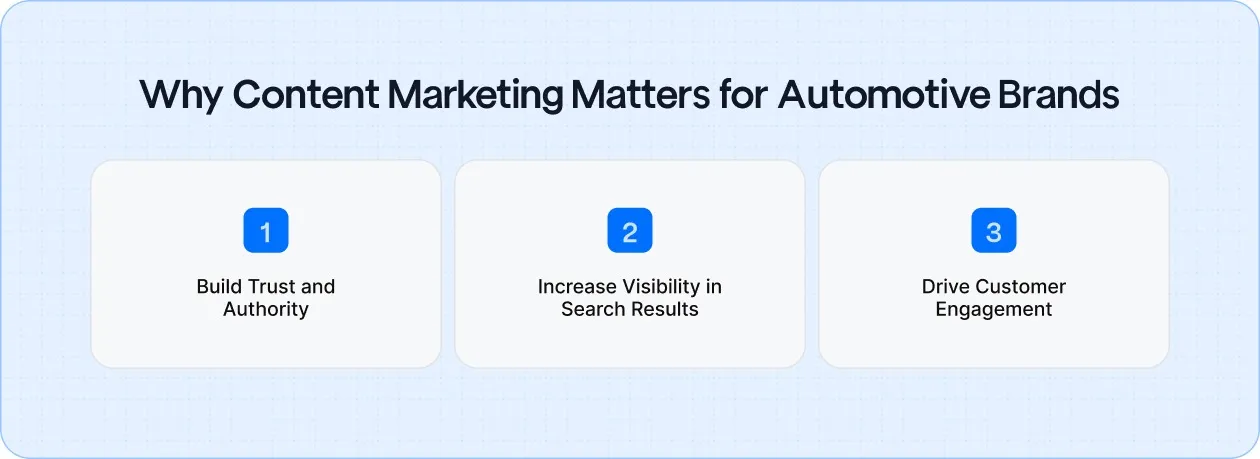
Content marketing can be a game-changer for small automotive businesses. It’s a powerful tool that helps you build connections, increase your reach, and gain trust, without needing a huge marketing budget. Here’s why it matters:
Build Trust and Authority
When you create and share useful content, you position your business as a trusted source of information. This helps potential customers feel confident in your brand and more likely to choose your products or services.
- Demonstrate your knowledge: Share helpful tips, car maintenance guides, or buying advice.
- Establish credibility: Consistently providing valuable insights makes you a go-to resource for customers.
Increase Visibility in Search Results
As people increasingly turn to search engines for car-related needs, content marketing ensures that your business shows up when it matters. Well-optimized content helps you attract the right audience and get noticed by potential customers.
- Target the right search terms: Create content around the most common queries your customers have.
- Strengthen local SEO: Use location-based content to attract customers in your area.
Drive Customer Engagement
Content marketing helps you build a relationship with your audience. When your content is useful and engaging, it encourages customers to interact with your brand and return for more.
- Encourage interaction: Invite customers to comment, share, or ask questions to build a community.
- Build loyalty: Offering helpful content that addresses their needs keeps customers coming back.
11 Actionable Automotive Content Marketing Strategies for SMBs and Startups
Content marketing allows you to build meaningful connections, establish trust, and gain visibility in the market. By consistently delivering valuable content personalized to your audience's needs, you can engage potential customers, build loyalty, and drive results.
Let's explore 11 practical strategies you can use to harness the full potential of content marketing for your automotive business.
1. Educational Blog Posts
Customers trust businesses that educate. By answering common questions or offering helpful tips, you show your expertise and build credibility.
How to Implement: Write content that answers your customers' most pressing concerns, whether it’s about car care, choosing the right model, or understanding auto services. Focus on long-tail keywords that target niche searches.
Practical Tip: Use seasonal topics like "How to Prepare Your Car for Winter" to keep your content relevant year-round.
Looking to get more from your content?
With the right SEO strategies, you can increase your content’s visibility, ensuring it reaches the right audience and drives more engagement.
Optimize Your Content
2. Video Content for Demonstrations and Tutorials
Videos grab attention and are easy to consume. Demonstrating your products or services visually makes complex topics feel simple and approachable.
How to Implement: Shoot smartphone videos to demonstrate maintenance tips or highlight product features. High production value isn’t necessary; authenticity matters more.
Practical Tip: Share videos across social media platforms and your website to engage your audience where they're most active.
3. Collaborations with Influencers and Partners
Partnering with trusted influencers can expand your reach and add credibility to your brand. Their followers already trust their recommendations.
How to Implement: Focus on micro-influencers who have a highly engaged, niche following. Offer a free service or product for a review or feature.
Practical Tip: Prioritize authentic engagement over follower count. An influencer’s connection with their audience is more valuable than sheer numbers.
4. Customer Testimonials and Reviews
Social proof is incredibly powerful. When customers share their positive experiences, they help convince others that your brand is trustworthy.
How to Implement: Encourage happy customers to leave detailed reviews and feature them on your website and social media pages.
Practical Tip: Turn testimonials into stories, showcase before-and-after photos or detailed case studies to highlight the impact of your service.
5. Social Media Posts and Engagement
Social media is where the conversation happens. Engaging posts help keep your brand in the conversation and build long-term relationships with your audience.
How to Implement: Regularly post behind-the-scenes content, customer stories, or helpful tips. Instagram, Facebook, TikTok and LinkedIn are great places to share car tips or service highlights.
Practical Tip: Reply quickly to comments or direct messages to show your audience you care and are actively listening.
6. Interactive Quizzes and Polls
Interactive content encourages participation and creates a deeper connection with your audience. It also provides valuable insights into their needs.
How to Implement: Create engaging quizzes like “Which Car Suits Your Lifestyle?” or run polls about car preferences to spark conversations.
Practical Tip: Offer a small incentive like a discount code to motivate customers to participate and share their results.
7. Email Newsletters with Valuable Insights
Email provides a direct line to your customers. A well-created email keeps your brand top-of-mind and offers an easy way to share updates and valuable tips.
How to Implement: Send regular newsletters featuring maintenance tips, industry updates, or exclusive promotions for loyal subscribers.
Practical Tip: Use email automation tools to personalize content for different segments based on customer interests or past behavior.
8. Content Repurposing for Efficiency
Repurposing content helps you get maximum value from each piece you create, saving time and effort while reaching new audiences.
How to Implement: Turn a popular blog post into a video, infographic, or social media carousel to repurpose across multiple platforms.
Practical Tip: Keep a content library that you can revisit and refresh, ensuring consistent messaging without starting from scratch.
9. Local SEO for Increased Visibility
Local SEO ensures you show up when customers in your area are looking for your services, helping you attract relevant leads and increase foot traffic.
How to Implement: Optimize your site for local keywords, and make sure your Google My Business profile is fully updated.
Practical Tip: Encourage customer reviews on Google to improve your local ranking and build credibility.
Must Read: If Your Automotive Content Isn’t Selling, You’re Doing It Wrong. Here Are 6 SEO Fixes
10. User-Generated Content (UGC) Campaigns
UGC helps create an authentic connection with your audience, as customers love to see their own stories featured by brands they trust.
How to Implement: Encourage customers to share photos or videos of your products in use, and feature them on your website or social media.
Practical Tip: Launch a hashtag campaign to help users easily participate and share their experiences with your brand.
11. Hybrid Content for Both Buyers and Enthusiasts
By targeting both buyers and enthusiasts, you reach a wider audience. Buyers want practical advice, while enthusiasts seek inspiration and passion-driven content.
How to Implement:
- For buyers, offer decision-making content like “How to Choose the Right Car for Your Needs” or comparison guides.
- For enthusiasts, share customization ideas, performance tips, or car culture stories to spark their interest.
Practical Tip: Use social media segmentation to ensure content resonates with each group. Create personalized landing pages or blog sections to keep the content relevant.
Best Practices for Automotive Content Marketing on a Budget
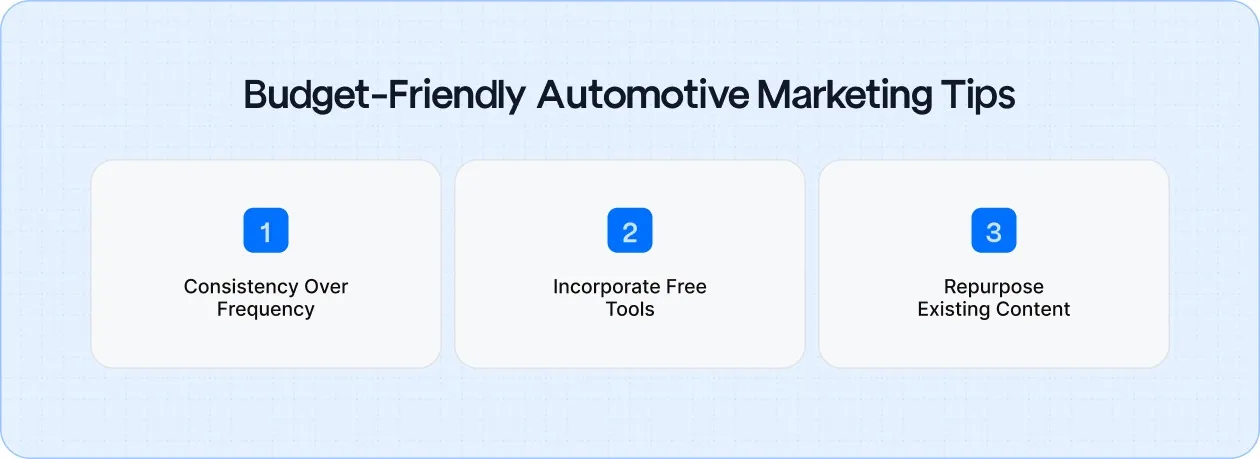
Content marketing doesn’t have to drain your resources. Even with a limited budget, there are smart strategies to make your efforts more impactful and keep your audience engaged. Here are a few cost-effective practices to help your automotive business succeed:
1. Consistency Over Frequency
You don’t need to flood your audience with content every day. The key is to be consistent, not necessarily frequent. Regularly publishing valuable content, even if it’s less often, builds long-term engagement.
- Focus on a realistic posting schedule that you can stick to, whether it’s weekly or bi-weekly.
- Keep your brand’s voice consistent across all content to build trust with your audience.
2. Incorporate Free Tools
You don’t need expensive software to create high-quality content. Many free tools offer all you need to make your content stand out.
- Use Canva for easy-to-create, professional-looking graphics, social media posts, or infographics.
- Tap into Google Trends to spot trending topics and align your content with what’s buzzing in the automotive world.
3. Repurpose Existing Content
Recycling content allows you to get more value from each piece you create. Repurposing saves time and helps you reach wider audiences across different platforms.
- Convert blog posts into videos or infographics to reach different types of viewers.
- Share content in bite-sized formats, such as social media carousels or quote graphics, to extend its reach.
Measuring Content Marketing Success
Tracking the right metrics is essential to understanding how well your content is performing and where adjustments are needed. By focusing on key areas, you can stay on top of what works and what doesn’t, making it easier to refine your strategy.
a) Key Metrics to Track
- Website Engagement: Look at how much time visitors spend on your site and what pages they interact with the most.
- Lead Generation: Track actions like sign-ups or inquiries that directly result from your content.
- Social Media Interaction: Keep an eye on likes, shares, comments, and overall engagement to gauge interest.
- Email Campaign Effectiveness: Open rates and click-through rates tell you how well your audience is connecting with your content.
b) Tools for Tracking
- Google Analytics: Ideal for tracking website behavior and pinpointing which content drives the most value.
- Social Media Insights: Platforms like Instagram and Facebook offer built-in tools to monitor engagement and audience response.
While these tools provide a good start, the real impact comes when you have a strategy that adapts to the data. The right content can resonate more deeply with your audience when it's continuously fine-tuned and optimized based on real-time insights. With the right guidance, you'll get more from every piece of content you create.
Turning Content into Connections for Your Automotive Business with SEO
For automotive SMBs and startups, content marketing is a pathway to meaningful connections and sustainable growth.
By focusing on educational content, video marketing, and building genuine customer relationships, you can drive engagement and attract the right audience without the need for a huge budget.
Even small, strategic efforts can lead to significant, long-lasting results.
Looking for a long-term content strategy that delivers results?
With Gushwork’s expertise in SEO-driven content strategies, we can help your automotive business grow, increase visibility, and engage the right audience.
Book a Free Content Consultation

Digital Marketing
Dec 9, 2025
5 mins
If I Am Relaunching My Lawn Care Business, This Cost Plan Would Be the First Step to Profitable Growth
Ishani Mitra
If you’ve been thinking about starting a lawn care business, the first question that usually hits is, “How much is this actually going to cost me?”
It’s a fair question. The numbers online can feel all over the place, and it’s hard to know what you truly need on day one versus what can wait until you have steady clients.
You can start small and grow steadily, as long as you understand where your money goes and why.
In this blog, you’ll learn exactly what makes up the start-up cost for lawn care business, how much to budget for each part, practical cost scenarios and simple ways to keep your expenses under control.
Types of Lawn Care Businesses and Their Cost Impacts
Your costs depend heavily on the type of operation you want to build. Some owners start small to keep things manageable. Others plan for a full-time route or a multi-crew setup from day one.
Understanding these business types helps you choose the path that fits your goals and budget without overspending:
1. Solo Mowing Service
This is the simplest and most affordable way to enter the industry. You focus only on mowing, trimming and basic cleanups.
Cost impact:
- Lowest equipment investment with only core tools needed
- Minimal insurance requirements
- No chemical storage or compliance obligations
- Works with a personal vehicle or small trailer
- Limited need for storage space beyond a garage or shed
This setup fits anyone starting part-time or wanting to test the market with low risk.
2. Full-Service Lawn Care
This includes mowing plus add-ons like edging, debris cleanup, mulch installation and small landscape touch-ups.
Cost impact:
- Higher equipment spend for added tools and attachments
- Increased fuel and maintenance costs
- More storage space for tools and seasonal materials
- Slightly higher insurance coverage
- Stronger marketing needs to support a broader service range
This path creates higher earning potential but still keeps costs manageable.
3. Fertilization and Treatment Focused
Businesses that offer weed control, fertilization or pest treatments need special chemical-handling licenses and safety gear.
Cost impact:
- State certifications and chemical-handling licenses
- Higher insurance due to liability risks
- Dedicated chemical storage area that meets safety standards
- Secure ventilation and spill containment requirements
- Personal protective equipment (PPE) for staff
- Cost of chemicals, sprayers, and labeling compliance
- Proper disposal procedures for hazardous waste
This model earns well but has more upfront requirements.
4. Premium or Commercial Lawn Care
These businesses target commercial properties, large estates or HOAs that need regular, high-volume service.
Cost impact:
- Commercial-grade mowers and heavy-duty equipment
- Larger trucks or trailers for transport
- Increased fuel, repair, and maintenance expenses
- Higher insurance and bonding requirements
- Storage yard or facility for equipment and supplies
- Scheduling and job management software
- Working capital to handle delayed commercial payments
This setup costs more but offers stable recurring contracts that can scale fast.
5. Multi-Crew or Growth-Ready Lawn Care
Designed for owners who plan to hire and manage multiple workers.
Cost impact:
- Multiple equipment sets per crew
- Additional vehicles and trailers
- Larger storage or warehouse space
- Higher insurance, payroll, and workers' compensation
- HR systems, scheduling software, and admin tools
- Supervisor or operations management costs
- Increased licensing, compliance, and record-keeping needs
This approach requires more investment but creates the highest earning ceiling.
Gushwork helps you build clear content and choose the right keywords so homeowners discover your business the moment they start searching.
Lawn Care Start-Up Cost Breakdown
Starting a lawn care business can feel overwhelming when you first look at the numbers, but once you break the costs into simple parts, it becomes much easier to plan.
Here’s what each part costs, why it matters and how to decide what level of expense makes sense for your goals:
Equipment Costs
Your equipment is what determines how many lawns you can handle in a day and how reliable your work will be. It’s also the category where most new owners overspend or under-spend.
What you truly need to start:
- A mower that fits the type of lawns you’ll service
- A trimmer for edges and tight spots
- A blower for clean-ups
- Hand tools like rakes, shears and a spreader
What the cost looks like:
How to choose: Start with equipment that matches the number of lawns you realistically expect to service per day. If you plan on handling 6–12 lawns daily, invest in commercial-grade tools. If you plan to keep it to a handful per week, start small and upgrade once money comes in.
Transport Costs
Your tools need a safe, reliable way to move from one lawn care job to the next. This is a cost that surprises many new owners.
Your main choices:
- Use your personal car with a small trailer
- Buy a used pickup or van
- Invest in a new commercial truck
Cost ranges:
How to choose: Think about how far you’ll drive, how heavy your gear is and whether you plan to hire help. A simple trailer and personal vehicle hack works surprisingly well for early stages and keeps costs low.
Licensing and Insurance Costs
This part isn’t exciting, but it’s what keeps you safe legally and financially.
What you need at minimum:
- A basic business license
- General liability insurance
- Commercial auto insurance (if using a truck for business)
Cost ranges:
- Business license: $50–$300 depending on your city
- General liability insurance: $350–$1,200/year
- Commercial auto insurance: $1,000–$3,000+/year
- Chemical application license (if offering fertilizing): $50–$500
Marketing and Local Visibility
Even the best lawn care setup won’t help you if nobody knows you exist. Marketing doesn’t need to be expensive, but it does need to be clear and consistent.
Where your early marketing money goes:
- Google Business Profile setup
- A simple website
- Business cards, yard signs, door hangers
- Small ad budget to get your first customers
Cost ranges:
- GBP: $100+
- Website: $300–$1,200
- Business cards & signs: $100–$500
- Starter ads: $100–$500/month
How to choose: Get your Google Business Profile done first. This alone brings in steady local calls once it’s set up correctly. A simple website is your next best investment.
Get Your Lawn Care Business Seen Locally
Gushwork helps you build a clean Google Business Profile and a simple website so customers can find you right when they need lawn care.
Let's talk
Software and Administrative Costs
You’ll need a way to schedule jobs, send invoices and track payments. Keeping this simple in the beginning saves time and stress.
Cost ranges:
- Scheduling/invoicing tool: $0–$50/month
- Accounting tool: $10–$30/month
Working Capital and Emergency Buffer
This is the money that keeps things running when your mower breaks, your truck needs gas or a week of rain slows everything down.
Cost ranges:
- Fuel and parts (first month): $200–$800
- Repairs: Plan for small replacements like blades, oil and filters
- Emergency buffer: Your first 2–4 weeks of expenses
7 Best Tips on Managing Lawn Care Start-Up Cost
Starting a lawn care business doesn’t have to drain your savings. With the right choices, you can launch confidently while keeping your spending under control. These tips help you avoid common money traps and focus on the things that actually matter when you’re just getting started.
- Choose Neighbourhood Clusters Over Scattered Jobs: Concentrating jobs within the same area cuts fuel costs, drive time, and vehicle wear. Fewer miles between lawns quietly saves more money than most owners expect.
- Borrow or Rent Before You Buy Specialised Equipment: Instead of buying aerators or dethatchers early, rent or borrow them until demand proves consistent. This keeps your storage space and cash flow flexible.
- Delay Branding Spend Until You Understand Your Market: Expensive logos, wraps, and uniforms can wait. Focus first on simple, clean visibility that gets the job done while you refine your service offering and pricing.
- Set Clear Job Minimums: Taking on tiny, low-paying jobs across long distances drains time and fuel. Minimum pricing protects your margins and keeps costs predictable.
- Build a Simple Repair Fund From Day One: Rather than reacting to repairs, set aside a fixed amount from every job. This turns breakdowns into planned expenses instead of financial stress.
- Know Your Break-Even Point: Calculate exactly how many lawns per week cover your fixed costs. This clarity helps you make smarter decisions about pricing and workload.
- Avoid Scaling Too Fast: Hiring early feels like progress but can sink cash flow. Let demand stabilise before adding crew or a second set of equipment.
Wrapping Up
When you approach your startup cost with clarity, you give yourself room to grow at your own pace. Some people begin with the basics and build slowly. Others choose a stronger setup from day one so they can take on more work. Both paths work as long as the decisions match your goals, your budget and the kind of business you want to run.
Over time, steady customers, recurring routes and smarter equipment choices will shape the business into something stronger than where you started.
With a clear plan and a grounded understanding of your true costs, you’re already ahead of most new owners stepping into this industry.
Build a Strong Lawn Care Presence From Day One
Gushwork can help you create a clear website, strong content, and a Google Business Profile that brings in local work.
Book a Consultation

SEO
Dec 9, 2025
5 mins
Furniture SEO: 8 Strategic Moves to Help Your Store Rule 2026!
Batul Beawarwala
When people search for furniture, they often start online, looking for everything from the perfect sofa and a stylish chair to a cozy bed, a sleek dining table, or a practical storage solution. To make sure your store catches their attention, your website needs to stand out in those search results.
Furniture SEO helps your store appear when potential customers are looking for the products you offer. By optimizing your website with the right details, you can make it easier for search engines to recognize your products and for shoppers to find exactly what they need.
With a few simple strategies, your store can be right there when customers are ready to make a choice.
What is Search Intent and Why Does It Matter for Furniture SEO?
Before someone walks into a showroom or shortlists a product, they go through a quiet decision process online. Understanding why they search helps you show the right content at the right moment.
Furniture buying rarely happens in one step. Some people are still exploring ideas. Others want store details. A few are close to choosing a product.
Search intent helps you recognize these stages so your content matches what the shopper expects to see, instead of pushing information too early or too late.
The 3 Search Patterns Furniture Buyers Follow
- Exploration searches: People looking for ideas, comparisons, or inspiration are common in early sofa and chair searches.
- Direction searches: People trying to find a specific store, brand, or location, often tied to local SEO.
- Decision searches: People check sizes, materials, prices, or availability before choosing.
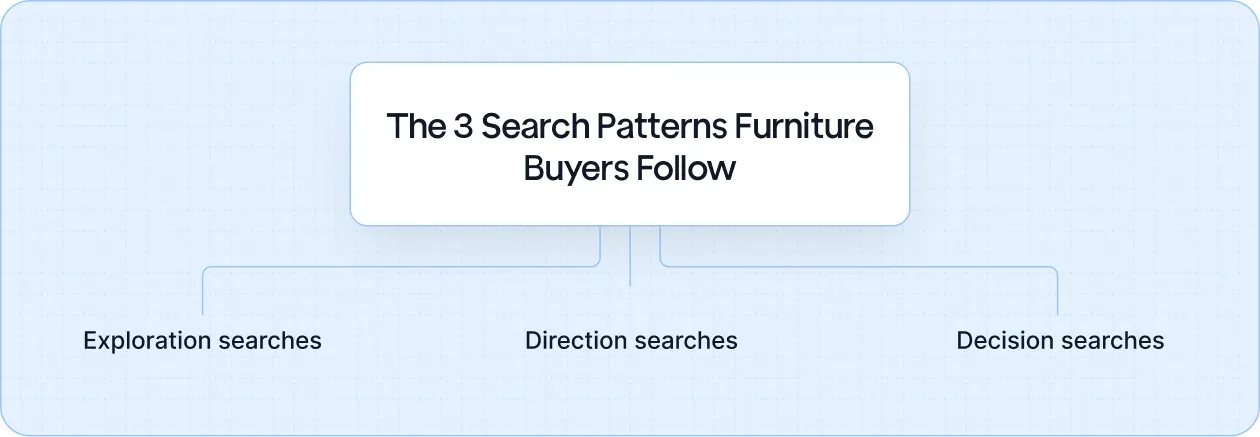
Each pattern needs a different type of page. Treating them the same is where many furniture websites lose attention.
Shape Content Around Buyer Intent
Good furniture SEO places the right content in front of the shopper’s current mindset.
- Guides and blog posts support exploration.
- Store and category pages support direction.
- Product pages support decision-making.
When intent and content match, shoppers stay longer, understand faster, and feel more confident moving forward, without forcing anything.
Still unsure what your customers expect to see when they search?
Clear intent-based content helps furniture brands show up with the right message at the right moment, without sounding salesy.
Improve Content Fit
1. Structure Your Website So Shoppers Never Feel Lost
A furniture website should feel like a well-laid-out showroom. When visitors can move smoothly from one section to another, they explore more, understand faster, and trust the store. Site structure plays that role online.
a) Design Pages Around How Furniture Is Browsed
People don’t browse furniture randomly. They move by room, purpose, and size. Sofa website optimization and chair website optimization work best when categories follow natural shopping paths, not internal business logic.
For example, shoppers expect:
- Seating is grouped clearly, not scattered across multiple menus
- Dining items are separated from the living room furniture
- Office and bedroom furniture is easy to spot without digging
When structure matches browsing behavior, fewer clicks are needed to reach the right product.
b) Build Categories That Support Real Exploration
Strong furniture categories act like clear aisles in a store. Each category should answer one simple question: “What will I find here?”
Good structure keeps:
- Sofas grouped by type, not mixed with unrelated items
- Chairs separated by use
- Dining furniture easy to scan without overlap
This clarity helps both visitors and search systems understand the purpose of each section without confusion.
c) Why Simple URLs Work Better Than Fancy Ones?
URLs act like labels on shelves. Short, readable paths show exactly where a page sits within your store.
Clean URLs:
- Reflect the category hierarchy clearly
- Avoid unnecessary words or symbols
- Make it easier to move between sections
When every page has a clear place, search systems move through your site more smoothly and index pages with fewer misses. If your showroom sales depend on local visibility, this companion guide helps.
2. Build Product Pages That Answer Questions Before They’re Asked
A product page replaces the in-store experience. Shoppers can’t touch, sit, or test the furniture, so every detail on the page has to reduce hesitation and remove doubt. Strong furniture SEO starts when a product page feels complete, clear, and trustworthy at a glance.
a) Write Product Copy That Feels Human, Not Catalog-Like
Effective sofa SEO writing and furniture SEO writing sound less like a spec sheet and more like a calm walkthrough. Instead of listing features blindly, guide the shopper through what matters first.
Good product copy:
- Explains what the product is used for before listing details
- Highlights comfort, size, and fit in simple language
- Avoids repeating the same phrases across similar products
Each product should feel individually explained, even when items are similar.
b) Structure Titles and Descriptions for Easy Scanning
Most shoppers skim before they read. Product titles and descriptions should help them decide quickly if the item fits their needs.
A strong structure:
- Puts the product type and key detail first
- Keeps descriptions broken into short, readable sections
- Uses consistent patterns across sofas, chairs, and tables
When information is easy to scan, people stay longer and understand faster.
c) Show the Product Clearly Through Images and Video
Furniture is visual by nature. One flat image rarely answers all questions. High-quality photos and furniture video SEO help show scale, texture, and real-world use.
Effective visuals include:
- Multiple angles and close-ups
- One lifestyle image to show placement
- Short videos showing size, seating depth, or movement
These elements reduce uncertainty and keep shoppers engaged on the page.
d) Help Search Systems Read Your Product Pages Better
Search systems rely on clear signals to understand what a product page represents. Product schema markup adds structure to that understanding by clearly labeling details like price, availability, and reviews.
When product data is clearly defined:
- Pages are easier to interpret
- Listings appear more complete
- Product information stays consistent across platforms
This helps your product pages stand out without adding extra text.
Product pages shouldn’t leave shoppers guessing.
Clear structure, sharp copy, and the right visuals can turn everyday product pages into pages people trust and act on.
Refine Product Pages
3. Make Your Store Easy to Find Nearby
Furniture shopping often starts close to home. People want to know where a store is, what it carries, and if it’s worth the visit. Local SEO helps your store appear with the right details at the exact moment someone nearby is searching.
a) Set Up Your Local Store Presence the Right Way
Your local listings act like a digital storefront window. Google Business Profile and Apple Business Connect help shoppers quickly understand who you are, where you are, and what to expect before they visit.
A strong setup includes:
- Accurate store details that match everywhere
- Clear photos of your showroom and products
- Updated hours, directions, and contact options
When this information is consistent and complete, local shoppers feel more confident choosing your store.
b) Connect Regional Searches to the Right Furniture Pages
Sofa local SEO and chair local SEO work best when regional searches lead to relevant pages. Shoppers searching by area expect to see furniture that’s available nearby, along with practical details like pickup options or delivery coverage.
Local relevance improves when:
- Categories mention service areas naturally
- Product availability reflects regional demand
- Store information supports nearby searches without sounding forced
This alignment helps local searches feel useful instead of generic.
c) Create Pages That Support Store Visits
Location-specific pages act as a bridge between online research and in-store visits. These pages give shoppers clarity before they step out.
Effective location pages include:
- Store address and nearby landmarks
- What types of furniture are available at that location
- Parking, delivery, or assembly details
When shoppers know what to expect, visits feel intentional rather than uncertain.
Local searches should lead people straight to your store.
Clear local pages and accurate listings help nearby shoppers find the right place without confusion.
Strengthen Local Presence
4. Build Authority Through Content People Actually Save and Revisit
Furniture buying takes time. People return to the same guides, compare notes, and revisit ideas before deciding. Advanced content strategies focus on creating pieces that stay useful long after they’re published, so your brand becomes a reference point, not a one-time read.
a) Create Deep Content That Helps Buyers Decide
Long-form content works when it answers real questions in one place. Buying guides, comparison pieces, and room-based inspiration give readers clarity without pushing them toward a choice too early.
Strong furniture blog post optimization starts with:
- Guides that explain trade-offs clearly
- Style content that shows how pieces work together
- Practical advice that applies to real homes, not trends
When a guide feels complete, readers don’t need to search again.
b) Use Blogs to Support Product Discovery Naturally
Blog content should quietly support product discovery without turning into a sales page. Sofa blog post optimization works best when articles link ideas to real examples, helping readers move from learning to shortlisting at their own pace.
This approach works when:
- Blog posts reference product types, not product pushes
- Examples match common living spaces and needs
- Articles stay focused on helping, not persuading
The result feels informative, not promotional.
c) Add Regional Context Without Diluting Value
Localized content doesn’t mean repeating city names. It means addressing region-specific needs, preferences, or living styles naturally. Integrating sofa local SEO into content works best when location adds context, not clutter.
Examples include:
- Guides written for apartment living vs suburban homes
- Climate-aware care tips
- Region-specific delivery or sizing considerations
This keeps content relevant across locations without rewriting everything.
Your content should earn attention.
Well-researched guides and thoughtful articles help furniture brands become trusted sources people return to.
Improve Content Strategy
5. Make Your Website Feel Fast, Stable, and Trustworthy
Once a shopper lands on your site, small technical issues can quietly push them away. Pages that load slowly, layouts that jump, or buttons that don’t respond properly create friction. Technical SEO focuses on removing these silent blockers so browsing feels smooth and predictable.
a) Why Mobile Experience Shapes How Long Visitors Stay?
Most furniture browsing happens on phones, even if purchases happen later. Sofa website optimization on mobile ensures pages feel usable without zooming, pinching, or waiting.
Strong mobile setups:
- Keep text readable without adjustments
- Ensure images resize cleanly
- Make menus and filters easy to tap
When mobile pages behave well, people explore more without frustration.
b) Speed, Security, and Stability Shape User Trust
Furniture pages are image-heavy by nature. Without control, they slow everything down. Improving speed means making sure pages load in a steady, reliable way across devices.
Key improvements include:
- Compressing large images without losing detail
- Reducing unnecessary scripts
- Using secure connections so visitors feel safe browsing
These steps support sofa SEO tracking and furniture SEO tracking by ensuring pages load consistently when measured and reviewed.
c) Help Search Systems Read Your Site Without Confusion
Structured data and schema markup help label your pages clearly. Instead of guessing, search systems can identify products, prices, availability, and reviews with accuracy.
At the same time, fixing site errors prevents dead ends:
- Broken links disrupt navigation
- Missing pages weaken site reliability
- Incorrect redirects confuse page relationships
A technically clean site allows every strong page you’ve built to be fully understood and retained.
Must Read: 15 Smart Marketing Moves to Drive Growth for Your Home Services Business
6. Earn Mentions That Signal Real-World Credibility
When other trusted sites mention your furniture brand, it sends a clear signal that your business exists beyond its own website. Backlinks work best when they come from genuine relationships and useful collaborations.
a) Why Furniture Mentions Signal Real Credibility?
Furniture link building works differently from other industries. A few relevant mentions from the right places often carry more weight than dozens of generic links.
Strong signals usually come from:
- Design-focused websites
- Home improvement platforms
- Retail partners and suppliers
These mentions help search systems understand where your brand fits within the furniture space.
b) Partner with Local Designers and Creators
Local designers, architects, and home stylists often share recommendations online. Building real relationships with them supports sofa local SEO in a natural way.
This works best when:
- Your furniture appears in real projects
- Collaborators credit your brand clearly
- Mentions link back to relevant category or product pages
These links feel earned because they reflect real usage, not promotion.
c) Use Thoughtful Contributions to Earn Editorial Links
Guest articles and content syndication create visibility through expertise rather than selling. Writing for furniture, home, or lifestyle platforms allows your brand to be referenced as a source, not an advertiser.
Effective contributions:
- Share practical insights, not product pitches
- Link back only where context fits naturally
- Appear on sites that already speak to your audience
Over time, these editorial links build a steady foundation of credibility.
7. Track What’s Working So You Know What to Adjust Next
SEO improves in small, steady steps. Tracking helps you understand which pages earn attention, which ones get ignored, and where small changes can make a real difference. The goal is learning what your website is quietly telling you.
a) Choose Signals That Actually Mean Something
Furniture SEO tracking works best when you focus on signals tied to real actions, not vanity numbers. These signals show interest, clarity, and intent.
Useful things to track include:
- Which product and category pages do people land on first
- Pages that keep visitors engaged longer
- Pages people leave quickly, signaling confusion or a mismatch
These patterns highlight where your site feels helpful, and where it doesn’t.
b) Use Search Console to Understand Visibility and Reach
Google Search Console acts like a diagnostic panel for your website. It shows how pages appear in searches and how often people choose them.
For sofa SEO tracking and chair-related pages, Search Console helps you:
- See which queries bring attention to specific products
- Spot pages that appear often but get ignored
- Identify location-based visibility changes over time
This insight helps refine pages without guessing what needs improvement.
c) Set Direction and Review Progress Over Time
Tracking works best when tied to clear goals. Instead of chasing quick changes, review patterns monthly to see what’s improving and what’s stalled.
A steady review process helps you:
- Compare older pages against newer ones
- Spot which content formats perform better
- Decide where updates are more valuable than new pages
Over time, this keeps your SEO strategy focused, measured, and grounded in reality.
8. Use Paid Ads to Support What SEO Builds Over Time
SEO creates a steady foundation, but furniture buying doesn’t always follow a straight line. Some shoppers need reminders. Others need visual confirmation. Paid ads work best when they reinforce pages and products that already exist, instead of pushing new messages from scratch.
a) How Paid Ads Strengthen Global Visibility
Sofa global SEO and furniture global SEO benefit when paid ads highlight pages that are already clear, detailed, and helpful. Ads help surface these pages to people who are still comparing options or returning after their first visit.
This approach works well when:
- Ads point to strong category or product pages
- Messaging matches what the page already explains
- Ads focus on availability, styles, or use cases
Paid visibility becomes an extension of your organic presence, not a separate effort.
b) Bring Back Interested Shoppers Thoughtfully
Many furniture buyers don’t decide in one visit. Retargeting helps keep your store visible to people who have already explored your site.
Effective retargeting:
- Shows the same products or categories viewed earlier
- Uses simple visuals instead of long messages
- Reminds without overwhelming
This keeps your brand familiar while shoppers take time to decide.
c) Use Product-Focused Ads to Show What You Actually Sell
Furniture shopping is visual. Product-based ads allow people to see styles, pricing ranges, and options upfront before clicking.
These ads work best when:
- Product details are accurate and updated
- Images match what appears on the website
- Listings reflect real availability
When ads and product pages stay aligned, shoppers feel continuity rather than friction.
How Furniture SEO Fits Into Your Long-Term Growth
Furniture SEO works when every part of your site supports the same goal. Clear structure makes browsing easy. Product pages reduce uncertainty. Local signals help nearby shoppers find you. Content builds familiarity. A solid technical base keeps everything running smoothly. Each piece strengthens the next.
Progress comes from consistency, not big changes. Small, deliberate improvements across pages and listings add up over time. Regularly reviewing what feels clear and fixing what doesn’t helps your site stay useful as buying habits change.
The next step is simple: improve one area fully, then move on. That steady rhythm is what keeps a furniture website relevant long after it goes live.
Strong SEO comes from doing the right things consistently.
Gushwork helps furniture brands build clarity-led SEO and content systems that grow steadily without guesswork or noise.
Book a Free Consultation

SEO
Dec 9, 2025
5 mins
Foundation Repair SEO: 8 Power Moves to Get Noticed Locally in 2026
Batul Beawarwala
When homeowners start noticing cracks in their walls or uneven floors, they want answers, and they want them fast.
To provide those answers, your foundation repair business needs to be easy to find when they're searching for help. Foundation repair SEO ensures that your business shows up at the exact moment a homeowner needs assistance.
By optimizing your website and online presence, you make sure your business is visible when it matters most, helping homeowners see you as the trusted expert they can count on.
Key Components of Foundation Repair SEO
Foundation repair SEO works when search systems clearly understand three core signals about your business. These signals shape how often your company appears and how confident homeowners feel when they see your name.
Local SEO for Foundation Repair Contractors
Foundation issues are tied to place. Search systems look for signs that your business truly serves specific areas and understands local conditions.
Local SEO focuses on:
- Clear service area signals tied to cities and nearby towns
- Consistent business details across local listings
- Strong geographic relevance linked to real homes and neighborhoods
When these signals are aligned, your business appears more connected to nearby homeowners searching for foundation help.
Foundation Specialist Website Optimization
Your website sets the tone for trust and clarity. It shows how well your business explains problems and guides homeowners toward the next step.
Website optimization centers on:
- Clear service explanations based on real foundation concerns
- Logical page structure that’s easy to scan and understand
- Smooth paths from problem awareness to contacting your team
A well-optimized site reduces hesitation by answering questions without overwhelming the reader.
Foundation Specialist SEO
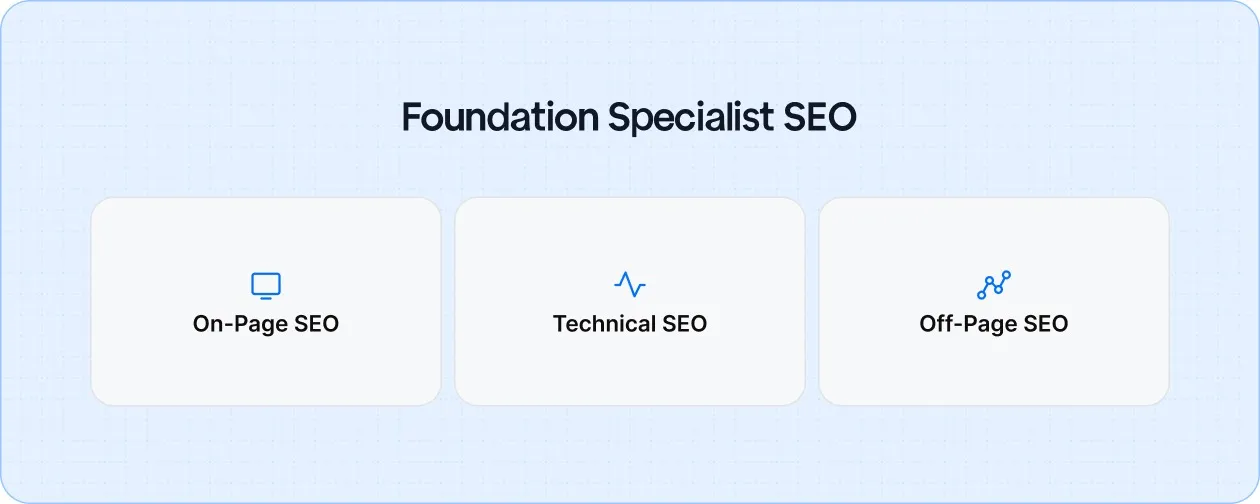
SEO brings structure to how your business is interpreted online. Each part supports a different layer of credibility.
- On-page SEO clarifies what each service covers
- Technical SEO ensures pages load smoothly and work well on all devices
- Off-page SEO reflects how often and where your business is referenced elsewhere online
When these layers support one another, search systems gain confidence in showing your business to homeowners who need foundation repair.
Suggested Read: Grow Your Drywall Business with Mobile Marketing: The Fast Track to More Projects and Bigger Profits!
Top 8 Foundation Repair SEO Strategies That Homeowners Respond To
Foundation repair SEO works best when it reflects how homeowners search, evaluate, and decide during moments of concern. These strategies focus on building clarity and trust across every touchpoint, from first discovery to final decision. When aligned correctly, they help your business feel present, reliable, and relevant in the areas you serve.
1. How to Optimize Your Google Business Profile and Apple Business Connect for Maximum Impact
For many homeowners, your business profile is their first real interaction with your company. Before they visit your website or call, they scan your business details to decide one simple thing: Does this company feel reliable for a serious foundation issue?
Google Business Profile and Apple Business Connect shape that decision.
a) Why These Profiles Influence First Decisions?
These platforms act as verification layers. They confirm that your business is active, local, and prepared to help homeowners nearby.
They influence:
- How confidently your business appears for local foundation-related searches
- How complete and current does your business information feel at a glance
- How quickly homeowners understand what you do and where you operate
When both profiles are accurate and consistently updated, your business appears more established and dependable before anyone clicks through.
b) How to Set Up Both Profiles the Right Way
Optimization here is less about tricks and more about clarity and consistency.
Focus on:
- Accurate business details: Name, phone number, service areas, and hours should match everywhere
- Clear service descriptions: Explain what foundation problems you handle in plain language
- Real photos: Work in progress, completed jobs, equipment, and team presence
- Ongoing updates: Small changes over time signal that your business is active and attentive
Each update reinforces trust and helps search platforms understand that your foundation repair business is current and responsive.
c) Consistency Between Platforms
Homeowners may see your business on different devices and apps. Google Business Profile and Apple Business Connect should tell the same story.
That means:
- Matching service areas and categories
- Similar wording around your services
- Consistent contact details
When both profiles align, your business feels steady and intentional, qualities homeowners look for when dealing with structural concerns.
2. Effective Keyword Research for Foundation Repair SEO
Keyword research for foundation repair starts with listening, not tools. Homeowners rarely search using technical terms. They search using what they see, feel, and worry about inside their homes.
Effective keyword research captures those exact moments.
a) How Homeowners Actually Search for Foundation Help
Most searches begin with a symptom, not a service name. Cracks, uneven floors, doors that won’t close, or water showing up where it shouldn’t, these phrases reveal intent long before a homeowner decides whom to call.
Strong keyword research focuses on:
- Problem-based phrases tied to visible signs
- Location-specific wording that homeowners naturally include
- Simple language that reflects concern, not expertise
When your content mirrors how homeowners describe their situation, your business feels immediately relevant.
b) Turn Search Language Into Clarity
Long-tail keywords work because they reflect specific situations, not broad ideas. These phrases help your content align with what homeowners want to understand next.
Use keyword research to:
- Separate urgent concerns from general questions
- Identify patterns in how people describe foundation issues
- Match services to real homeowner language
This creates a stronger connection between what someone searches and what your page explains.
c) Tools That Help Spot Real Search Patterns
Tools like Google Keyword Planner and SEMrush help confirm how often certain phrases appear and how variations differ by location. They support decisions, but they don’t replace judgment.
Use tools to:
- Validate common problem phrases
- Compare similar terms homeowners use interchangeably
- Spot local wording differences across service areas
Clear language brings the right homeowners to the right pages.
Finding the phrases homeowners already use helps your content feel familiar and trustworthy before the first call.
Get My Keywords
3. Create Service Pages That Directly Address Homeowner Problems
Service pages work best when they mirror how a homeowner thinks the moment they land on your site. At that point, they are not comparing companies. They are trying to confirm one thing: Is this page talking about what I’m seeing in my home?
a) Why One Page Per Problem Matters?
Foundation issues show up in very different ways. A homeowner with stair-step cracks is asking different questions than someone noticing sloping floors or moisture in a crawl space. Combining everything into one page blurs that clarity.
Dedicated service pages help by:
- Matching one visible problem to one clear explanation
- Reducing confusion about which repair applies
- Making it easier for homeowners to stay and read instead of bouncing back
Each page should feel like it was written for a single concern, not a general service list.
b) What Makes a Strong Foundation Repair Service Page?
Effective service pages follow a simple logic that reassures homeowners without overwhelming them.
Each page should clearly cover:
- What the problem looks like: Common signs homeowners notice first
- Why it happens: Simple causes explained without technical overload
- How it’s usually fixed: A clear overview of the repair approach
- What happens next: Inspection, evaluation, and follow-up steps
This structure helps homeowners move from concern to confidence.
c) Writing That Feels Clear
Service page writing should explain, not persuade. The goal is understanding.
Good SEO writing here focuses on:
- Short paragraphs that are easy to scan
- Plain language that avoids industry-heavy terms
- Natural use of problem-based phrases that homeowners already recognize
When a page feels calm and specific, it builds trust without trying to push a decision.
One page rarely answers every concern.
Well-structured service pages guide homeowners from what they notice at home to what they need to understand next.
Plan My Pages
4. Use Schema Markup to Enhance Local SEO
Search systems don’t read a page the way people do. They scan for structure, labels, and signals that confirm what a business actually does. Schema markup helps remove ambiguity by clearly defining your foundation repair business in a language that search platforms understand.
a) What Schema Markup Really Does?
Schema markup is structured information added behind the scenes. It does not change how your site looks, but it changes how clearly your business is interpreted.
Schema helps search systems:
- Confirm your business type and services
- Understand where you operate and how homeowners can contact you
- Connect service pages to real-world foundation repair work
When this information is clearly defined, your business appears more reliable and consistent across local results.
b) Where Schema Makes the Biggest Difference?
Schema works best when it reinforces what already exists on your site and profiles.
Focus on:
- LocalBusiness schema: Defines your business name, location, service areas, and contact details
- Service schema: Clarifies the specific foundation problems you handle
- Review signals: Helps surface trust indicators tied to real customer experiences
These elements give search systems confidence in presenting your business for relevant local searches.
c) Keep It Simple and Accurate
Schema is not about adding more data. It’s about adding the right data once and keeping it consistent.
Best practices:
- Match schema details with your website and business profiles
- Avoid overloading pages with unnecessary markup
- Update schema when services or service areas change
Structure supports clarity.
When content, pages, and business details follow a clear system, search platforms interpret your work with fewer gaps or mixed signals.
Align My Content
5. Build Trust Through Customer Reviews and Local Citations
For foundation repair, trust is rarely built through promises. It’s built through what others say about you and how consistently your business shows up across the web. Reviews and citations work together to quietly confirm that your business is real, active, and dependable.
a) Customer Reviews as Proof of Real Work
Reviews matter because they reflect lived experiences, not marketing claims. Homeowners dealing with structural issues look for reassurance that others with similar concerns felt confident after choosing your business.
Strong review signals come from:
- Recent feedback that shows ongoing work
- Reviews that mention specific problems or outcomes
- Responses that show you acknowledge and address concerns
Search platforms also read this activity as a sign that your business is trusted locally. Reviews tied to your Google Business Profile and Apple Business Connect strengthen that trust further by linking feedback directly to your verified listings.
b) Local Citations and Business Consistency
Citations are mentions of your business details across local directories, industry listings, and mapping platforms. Their role is simple but critical: confirming your identity everywhere your business appears.
Citations support clarity by:
- Reinforcing your business name, phone number, and service location
- Reducing confusion caused by outdated or mismatched details
- Helping search systems connect your website, profiles, and listings
Consistency is more valuable than volume. A smaller number of accurate listings carries more weight than dozens of conflicting ones.
c) Why Reviews and Citations Work Best Together?
Reviews show how people feel about your work. Citations confirm who you are and where you operate. Together, they create a stable foundation of trust that supports local visibility without relying on tactics or trends.
6. Optimize Your Website for Mobile Devices and Fast Load Times
Most homeowners look for foundation help on their phones, often while standing inside the problem area itself. At that moment, patience is limited. A slow or awkward website quietly pushes them away before they ever read a single line.
a) Why Mobile Experience Shapes First Impressions?
A mobile-friendly site requires making sure information is easy to access when someone needs it quickly.
Mobile optimization ensures:
- Text is readable without zooming
- Buttons are easy to tap with one hand
- Phone numbers and contact options are visible right away
When a site feels simple on a phone, homeowners are more likely to stay long enough to understand your services.
b) Why Load Speed Shapes First Impressions?
Speed sets the tone for trust. A slow-loading page can feel unreliable, especially for a service tied to safety and structure.
Fast load times help by:
- Letting pages open without delay
- Keeping attention focused on the content, not the wait
- Making your site feel steady and professional
Search systems also favor sites that load smoothly, especially on mobile devices, because they signal a better overall experience.
c) Keep It Lightweight and Focused
Speed improves when a site avoids unnecessary clutter.
Simple fixes include:
- Compressing large images
- Limiting heavy animations or scripts
- Keeping page layouts clean and consistent
7. Advanced Local SEO Strategies for Foundation Repair
Once the basics are in place, local SEO grows through depth. This means showing clear relevance to specific areas you serve and earning recognition from trusted local sources that already matter in those communities.
a) Location-Specific Pages That Reflect Real Local Conditions
Location pages work best when they explain why foundation problems show up differently in different places. These pages are not copies with a city name swapped in. They exist to show local understanding.
Strong location pages usually include:
- Common foundation concerns seen in that area
- Soil, drainage, or weather patterns that affect homes locally
- A brief example of work completed nearby
- Clear confirmation that inspections are available in that location
When pages reflect real local conditions, they feel grounded and credible instead of generic.
b) Local Backlinks That Reinforce Community Presence
Local backlinks act as third-party confirmation that your business is known and referenced beyond its own website. These links don’t need to come from large national sites to matter.
Useful local sources include:
- Home inspectors, realtors, and property managers
- Local business associations or trade groups
- Regional home services directories
- Community publications or contractor listings
Each mention helps reinforce your place within the local home services network.
c) Why These Signals Matter Together?
Location pages show where you work and what you see on the ground. Local backlinks confirm that others in the area recognize your business. Together, they strengthen your connection to the places homeowners care about most.
Local relevance grows through repetition.
Building location pages and earning local recognition works best when content follows a clear structure across every area you serve.
Plan Local Expansion
8. How to Tell If Your Foundation Repair SEO Is Actually Working
SEO for foundation repair should create clear signs that your business is becoming easier to find, easier to understand, and easier to trust. Tracking success is less about chasing numbers and more about confirming that the right signals are strengthening over time.
a) Signals That Show Your SEO Is Moving in the Right Direction
Instead of watching isolated numbers, focus on patterns that reflect homeowner behavior and search system confidence.
Look for signs such as:
- More visits are arriving on the service and location pages
- Homeowners are spending time reading problem-specific pages instead of leaving quickly
- Increased activity on your business profiles, such as calls, direction requests, or photo views
- Service pages are being surfaced for a wider range of foundation-related searches
These shifts indicate that your content and local signals are aligning with real search intent.
b) Pages and Profiles That Deserve the Most Attention
Not every page needs equal tracking. The most useful insights come from monitoring areas where homeowners make decisions.
Pay close attention to:
- Individual service pages tied to specific foundation problems
- Location pages connected to nearby cities or neighborhoods
- Google Business Profile and Apple Business Connect interactions
- Pages that receive repeat visits before contact
When these areas improve steadily, it’s a sign your SEO foundation is holding up.
c) Tools That Help You Spot Trends Without Overthinking
Tools like Google Analytics and Google Search Console are helpful when used to observe direction.
Use them to:
- Compare month-over-month growth in key pages
- Identify which pages are being shown for new search terms
- Spot technical issues that interrupt page access or loading
- Confirm that search systems are regularly crawling and indexing your site
Must Read: Home Improvement SEO Strategies That Will Get Your Phone Ringing Nonstop
Furniture Page Quality Checklist
Strong furniture SEO often comes down to page quality. When key pages feel clear and complete, shoppers move with confidence and search systems understand your site without extra effort. Use this checklist as a quick way to spot gaps before moving on.
Category Pages
- Clearly explain what the category includes
- Group products by how people browse, not internal naming
- Use simple filters that match real shopping needs
- Keep URLs short and easy to follow
- Link naturally to related subcategories or guides
Product Pages
- State the product type and key detail upfront
- Explain usage and fit before listing specifications
- Show multiple images that clarify scale and placement
- Add short videos where depth or movement matters
- Keep layout consistent across similar products
- Include structured data for price and availability
Location Pages
- Display the full address with nearby landmarks
- Clarify which furniture types are available locally
- Include visit details like parking or delivery
- Use the original copy written for that area
- Link to relevant categories or collections
Build a Sustainable SEO Strategy for Long-Term Growth
Foundation repair SEO works when everything aligns around one goal: helping homeowners feel confident choosing your business at the moment they need help. Clear local signals, well-structured service pages, consistent business profiles, real-world proof, and steady improvements all work together to create that confidence.
None of these elements works in isolation, and none require shortcuts. The businesses that see lasting results are the ones that stay consistent, clear, and grounded in how homeowners actually search and decide.
When done right, SEO becomes part of your daily presence rather than a one-time effort. Small refinements over time, clearer explanations, stronger local relevance, and better visibility where homeowners look, add up to steady progress you can rely on.
Steady visibility comes from steady execution.
Gushwork helps foundation repair businesses build durable SEO systems rooted in clear content, local understanding, and long-term consistency.
Book a Free Consultation

