


Home

Resources
Blogs
Blog
Get insights on AI, productivity, and the future of work.


Thank you! Your submission has been received!
Oops! Something went wrong while submitting the form.

Industrial Sales
Dec 10, 2025
5 mins
What Top Manufacturers Know About Industrial Sales Lead Flow That Others Learn Too Late
Ishani Mitra
Industrial sales leads disappear because buyers make up their minds without you.
By the time someone reaches out, they’ve already compared suppliers, checked credibility, and quietly ruled out the ones that felt vague, outdated, or hard to trust. No calls. No emails. Just silent elimination.
That’s the uncomfortable truth of how industrial buying works today.
Winning industrial sales leads now means showing up before the first conversation, in the places buyers use to sanity-check decisions. It’s about answering the questions they hesitate to ask, showing proof that feels real, and making it easy to move with conviction.
In this blog, we break down how industrial sales leads are actually formed, where most companies lose them, and what to fix if you want fewer dead ends and more serious enquiries.
What Is Lead Generation in an Industrial Context?
Lead generation in the industrial world involves identifying companies that genuinely need a new supplier or have an upcoming project. These buyers move slower than consumers and usually involve several people in the decision. They care about your capabilities, certifications, tolerances, and whether you can support them long term.
In this space, a lead is a buyer with a real technical need, a timeline, and the authority to move a project forward. Effective lead generation helps these buyers discover your capabilities early, understand what you can handle, and trust you enough to start a conversation or issue.
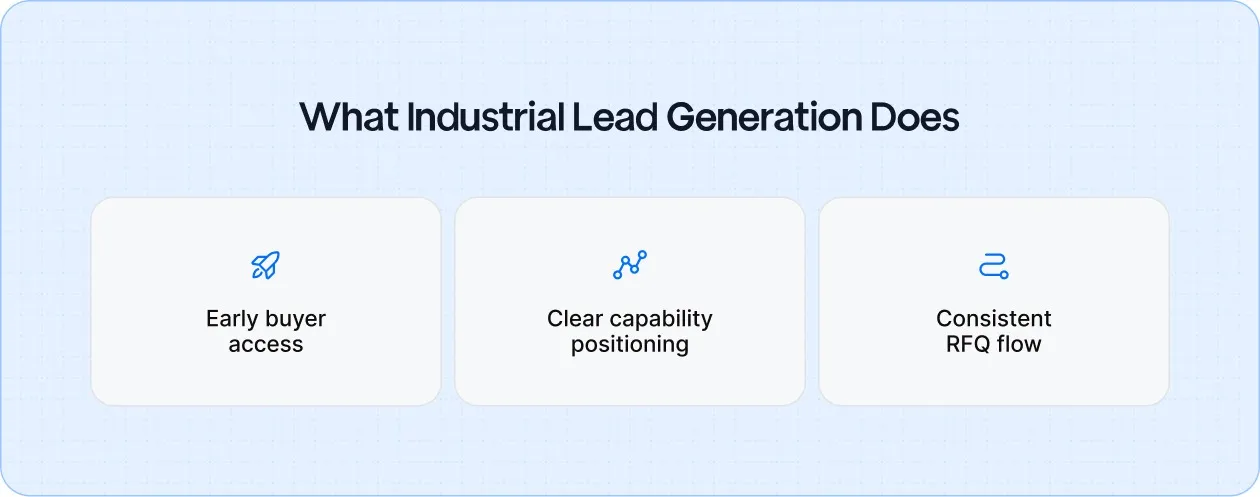
Industrial lead generation does three things for you:
- Gets you in front of buyers before competitors do, especially when sourcing cycles reopen or new programs begin.
- Position your technical capabilities clearly, so buyers know whether you can meet their tolerances, volumes, materials, and compliance requirements.
- Builds a steady, predictable flow of RFQs, helping you reduce dependency on word-of-mouth or seasonal demand swings.
Reach the Right Industrial Buyers
Build an ICP and keyword plan that aligns with the capabilities, applications and industries you serve best.
Refine Your Targeting


12 Practical Ways to Generate Qualified Industrial Sales Leads
Below are the methods that consistently attract the right kind of leads, the ones with defined needs and a high chance of becoming repeat customers.
1. Turn Your Product Pages Into Lead Drivers
Most industrial companies already have a product catalog or capabilities brochure. The problem is that it often sits as a static PDF, buried three clicks deep on the website.
To make your catalog generate leads:
- Put it online in a searchable, filterable format so visitors can find parts by material, size, tolerance, or application.
- Add simple calls to action next to each product or family: “Request quote,” “Ask an engineer,” or “Check stock.”
- Offer gated access to CAD models, STEP files, or spec sheets in exchange for basic details like company, role, and project type.
- Track which products and families are viewed most, and pass these signals into your CRM so sales can prioritize follow-up.
When your catalog is easy to search and tied to RFQ or enquiry forms, it becomes a continuous source of qualified industrial sales leads, not just a reference document.
2. Make Your Website a Buyer’s Research Hub
Industrial buyers and engineers spend a lot of time researching before they ever speak to sales. Your website should help them do that work.
Useful content that supports lead generation:
- Application notes that show how your components or assemblies work in specific end uses.
- Design guides that explain acceptable tolerances, materials, finishes, and design-for-manufacture guidelines.
- Case studies that connect your capabilities to cost savings, reliability, or faster launches for customers like them.
The more your website answers real technical questions, the more often you’ll earn contact from serious buyers.
Want a quick health check on your website? Drop it into our AI Analyzer and get instant insights to help turn more visitors into paying customers.
3. Use Video to Reach Technical Buyers
Video remains underused in manufacturing, yet engineers and buyers watch videos to understand processes, compare suppliers, and validate capabilities.
What to create:
- Short process walkthroughs (machining, fabrication, finishing, QA steps).
- Engineering explainers (tolerances, materials, manufacturability guidance).
- “Inside the factory” videos that demonstrate equipment, certifications, and capacity.
- Customer success stories with real ROI or performance improvements.
Video builds trust faster than text. Seeing your machines, people, and process reduces perceived risk, especially for buyers sourcing a new supplier.
4. Create Enquiry Forms That Qualify Leads
A generic “Contact us” form attracts everything from students to one-off prototype requests. Quotation forms and project enquiry forms let you qualify leads earlier.
To make forms work for you:
- Ask for the few details that really matter: part type, annual volume band, required certifications, target timeline, and whether drawings are available.
- Add simple dropdowns that flag poor fit early (for example, volume ranges below your minimum).
- Route form submissions directly into your CRM with tags for process, material, or product family.
A focused prospect form helps your team decide which leads to call first and which to park or decline politely.
5. Target Engineers Where They Research
Industrial buyers rarely start on social media. They start on channels built for engineering and sourcing. Your job is to show up there with clear, technical information.
Places to consider:
- Industry directories and sourcing platforms that your ideal customers already use.
- Engineering communities where CAD models, reference designs, or application notes are shared.
- Niche trade portals for your specific sector (electronics, fabricated metals, plastics, process equipment, etc.)
If you invest time or budget in these channels, make sure your listings:
- Show your core capabilities and certifications accurately.
- Link back to your best-performing pages and RFQ forms.
- Include clear contact options for both engineering and purchasing.
Treat each platform as a feeder into your own website and sales process, not as a disconnected listing.
6. Keep Your Google Business Profile Updated
GBP is one of the most overlooked sources of high-intent industrial sales leads, especially for regional manufacturers, fabrication shops, job shops, and machining companies.
What to do:
- Add photos of equipment, facility, and sample parts.
- Update service descriptions with specific processes (e.g., 5-axis machining, TIG welding, PCB assembly).
- Post updates monthly: certifications, new machines, project highlights.
- Collect reviews from long-term customers who can speak to quality, communication, and on-time delivery.
A strong GBP helps you appear when local engineers and buyers search things like “metal fabrication near me”, “precision machining supplier”, or “custom PCB assembly shop”.
Make Your Plant Easy to Find Locally
Optimise your Google Business Profile so engineers and buyers see your capabilities, photos and contact details clearly.
Improve Your GBP
7. Use Email for Focused Technical Outreach
Email still works in manufacturing, as long as it respects the receiver’s time and context.
Two main use cases:
- Nurturing existing contacts: share application notes, new capabilities, or design tips tied to their industry and past enquiries.
- Targeted outreach: carefully researched messages to specific accounts with a clear reason for contact (for example, capacity in a process they are known to outsource).
To keep email effective:
- Segment by industry, role, and past behaviour (quotations or contact, downloads, webinars).
- Focus on one useful topic per email, with a clear next step (“Send your drawing,” “Reply with your current supplier challenges,” etc.)
- Avoid generic newsletters that try to speak to everyone; industrial recipients tune those out quickly.
Email becomes a lead generation tool when each message connects a real problem to a specific capability you can offer.
8. Align Sales and Marketing on Target Accounts
In manufacturing, a single account can represent years of revenue. That makes account-based thinking more practical than chasing random leads.
To align around key accounts:
- Agree on a short list of priority companies in each segment and region.
- Map who is involved in decisions (engineering, procurement, quality, plant operations).
- Coordinate touches across channels: digital marketing, email, LinkedIn outreach, invites to facility tours or webinars.
- Track activity for these accounts in your CRM to see when interest is building.
The goal is not just more names in the database, but deeper engagement inside the companies that matter most to your growth.
9. Run Technical Events and Webinars for Leads
Trade shows and webinars are expensive if they only deliver business cards. They are valuable if they feed into a structured follow-up process.
To make events generate industrial sales leads:
- Design session topics around specific production problems or design challenges your ideal clients face.
- Collect meaningful information during registration (industry, role, primary process interest).
- Offer post-event resources like slide decks, calculators, or checklists in exchange for permission to follow up.
- Within a few days, pass the attendee list through a simple qualification filter and prioritize outreach to those who match your ICP.
Think of events as concentrated lead generation moments. The real value is harvested in the weeks after, not only during the trade show marketing.
10. Enable Distributors with Lead-Ready Materials
If you sell through distributors, reps, or integrators, they are also a source of industrial sales leads. But they need more than a logo and a price list.
Give partners tools that directly support lead generation:
- Co-branded datasheets and landing pages so buyers see a unified offer.
- Short technical training sessions so reps can spot where your product is a better fit.
- Simple checklists to qualify opportunities before they reach you (volume, application, regulatory requirements).
When partners are equipped to explain where you fit best, you receive cleaner, better-qualified opportunities instead of mismatched requests.
11. Adopt a Multi-Channel Outreach Strategy
Industrial purchasing rarely depends on one person. Engineers, procurement, quality, and operations all influence decisions. A multi-channel approach ensures your brand shows up at different stages of their process, even when they’re researching quietly.
How to use it effectively:
- Combine search (SEO + PPC), email outreach, industry directories, LinkedIn, and trade media placements.
- Repurpose the same technical insight across channels to stay consistent while reducing workload.
- Track which channels bring the most engaged companies and shift budget accordingly.
Multi-channel doesn’t mean “be everywhere.” It means showing up where your specific buyers already look for suppliers.
Be Found for the Capabilities You Want to Sell
Strengthen your SEO so buyers searching by process, material or tolerance can find you when it matters.
Boost Your SEO
12. Measure Performance with Analytics
Without measurement, it’s easy to over-invest in channels that generate “activity” rather than revenue.
At a basic level, track:
- Which pages and resources are most viewed before forms are submitted.
- Which channels (search, directories, email, events) lead to qualified opportunities in your CRM.
- How long it takes for different types of leads to become quotes and orders.
You don’t need a complex dashboard to start; a simple monthly review with sales is enough to see what is bringing in leads worth quoting and what is not.
How to Spot a Qualified Industrial Sales Lead?
Not every enquiry deserves the same amount of time. Clear qualification criteria help your team focus on leads that can become profitable, repeat business.
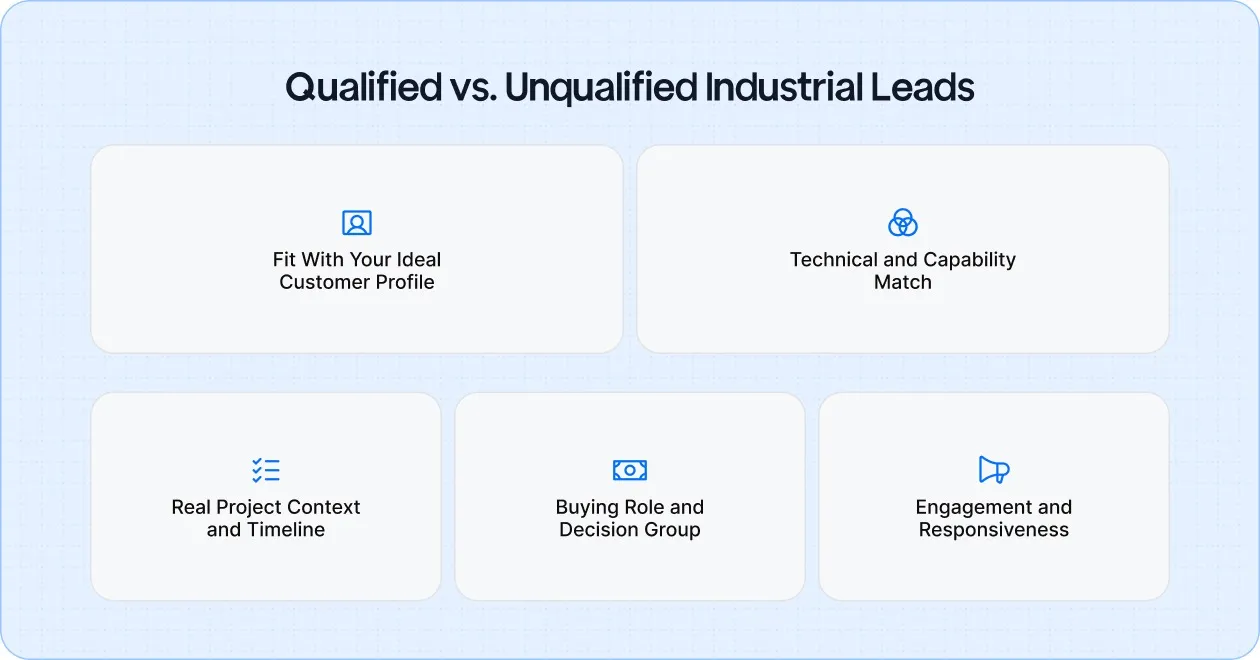
1. Match to Your Ideal Customer Profile (ICP)
A qualified lead usually:
- Operates in industries you understand and can support.
- Orders at volumes and frequencies that suit your equipment and capacity.
- Is located in regions you can ship to reliably and competitively.
Non-qualified leads often sit outside your target sectors or require project sizes that are too small (or occasionally too large) for you to serve well.
2. Technical Fit and Capability Alignment
Check whether:
- The required materials, tolerances, and processes are ones you already run successfully.
- The product type fits with your existing tooling, certifications, and quality systems.
- There are special compliance or regulatory needs you can meet.
If a lead needs something you have never done, or that would disrupt your core production, it may be better to decline or refer.
3. Clear Project Need, Timeline, and Budget Signals
Qualified industrial sales leads usually come with a clear context:
- A defined project or program, even if early-stage.
- A rough timeline for sampling, validation, and production.
- A sense of annual volume or spend.
Red flags include vague timing (“sometime next year”), no clear use case, or a request that appears purely exploratory with no identified project behind it.
4. Correct Stakeholders and Buying Authority
In B2B manufacturing, the person who contacts you may be:
- A design engineer exploring options.
- A buyer comparing suppliers.
- A project manager gathering information.
All can be valuable, but a qualified lead usually has visibility into the broader decision group or is willing to involve others. If a contact cannot explain who approves suppliers, who signs off on specs, or how sourcing decisions are made, treat it as early-stage until that clarity is gained.
5. Engagement Level and Response Quality
Lead quality also shows up in behaviour:
- Do they respond promptly to clarifying questions?
- Do they share drawings, specs, and constraints when asked?
- Are they open about what they are trying to solve?
If a prospect goes silent for weeks, refuses to share basic information, or only asks for “your best price” without dialogue, they may be more interested in price shopping than true partnership.
Get Industrial Sales Leads That Are Quote-Ready
Most industrial companies have a problem with lead quality and clarity.
Sales chases, engineering gets pulled in too early, and good-fit deals get slowed down by the same avoidable back-and-forth.
Gushwork fixes that by building a full lead system. We help manufacturers show up for the right searches, explain capability in a way technical buyers trust, and turn the website into a qualification layer that makes enquiries cleaner and easier to close.
What You Get With Gushwork?
1) Lead-Intent SEO That Pulls Buyers In
- We target searches tied to real industrial demand, such as process capability, material and tolerance needs, compliance requirements, and service-area intent.
- We build pages that win “shortlist” keywords, not just early research terms.
- We structure internal linking so buyers naturally move from problem → capability → proof → enquiry without dropping off.
2) Content That Qualifies Leads Before Your Team Even Replies
- Capability pages that explain what you do, what you don’t, and what “fit” looks like in plain technical language.
- Application content that answers the exact questions buyers use to vet suppliers (without sounding like fluff).
- Comparison and decision-support assets that reduce “shopping-around” behaviour and push serious prospects closer to RFQ.
3) A Website Built to Convert Industrial Leads With Context
- Clear conversion paths for different intents: RFQ, technical consultation, drawing uploads, urgent turnaround enquiries.
- Forms designed to screen for fit (materials, volumes, timelines, certifications) without feeling like a barrier.
- Trust signals placed where they matter: near service pages and enquiry points, not buried on an “About” page.
4) Ongoing Execution Without Internal Bottlenecks
- Publishing cadence that keeps your site fresh and your visibility rising, without you having to constantly coordinate freelancers.
- Content production and optimization that align with real-world review workflows and engineering teams.
- Regular improvements across SEO, structure, conversion, and clarity so your lead system compounds over time.
What Changes When This Is Done Right?
- Leads come in with a clear project intent.
- Your sales team gets fewer dead-end calls and more serious industrial leads ready for quoting.
- Engineering spends less time re-explaining basics and more time supporting real opportunities.
- Your website starts functioning like a quiet, always-on pre-sales rep.
Conclusion
The companies that grow steadily are the ones that make it easy for the right buyers to understand what they do, see proof that it works, and start a focused conversation.
If you turn your catalog into a working asset, build flows that filter instead of flood, show up in the channels your buyers already use, and agree internally on what “qualified” really means, lead generation stops being guesswork. It becomes another well-run process in your operation, measured, improvable, and tied directly to the kind of business you want more of.
If you want that system built properly, Gushwork can help. We create the content, SEO, and conversion structure that attracts better-fit industrial sales leads and turns your website into a real enquiry engine.
Ready to Bring In More Qualified Industrial Leads?
Get guidance on building a lead system that attracts the right projects and filters early.
Book A Consultation

SEO
Dec 15, 2025
5 mins
How Cabinet Installers Win More Local Projects with 7 Proven SEO Strategies
Ishani Mitra
Here’s something most cabinet businesses don’t realize. Homeowners don’t start their search by asking, “Who installs the best cabinets?” They start by asking, “Who looks competent enough that I won’t regret hiring them?”
And the place they make that judgment isn’t your workshop, gallery, or referral network. It’s your search results.
Before someone ever steps into your showroom or books a consultation, Google is already shaping their opinion of your business.
This is where strong cabinet installation SEO pays off.
In this blog, you’ll learn the complete SEO framework that helps cabinet installers to attract better clients, win higher-value jobs and appear as the most trustworthy choice the moment someone searches.
What Is Cabinet Installation SEO?
Cabinet installation SEO is the process of improving your online presence so homeowners can find your business when they search for services. It helps search engines understand what you do, the styles you offer and the areas you serve so you show up in the exact moments buyers are ready to compare, shortlist and request quotes.
Why SEO Matters for Cabinet Dealers?
SEO directly affects how many people discover your business and how many of them turn into real projects. Here’s why it matters:
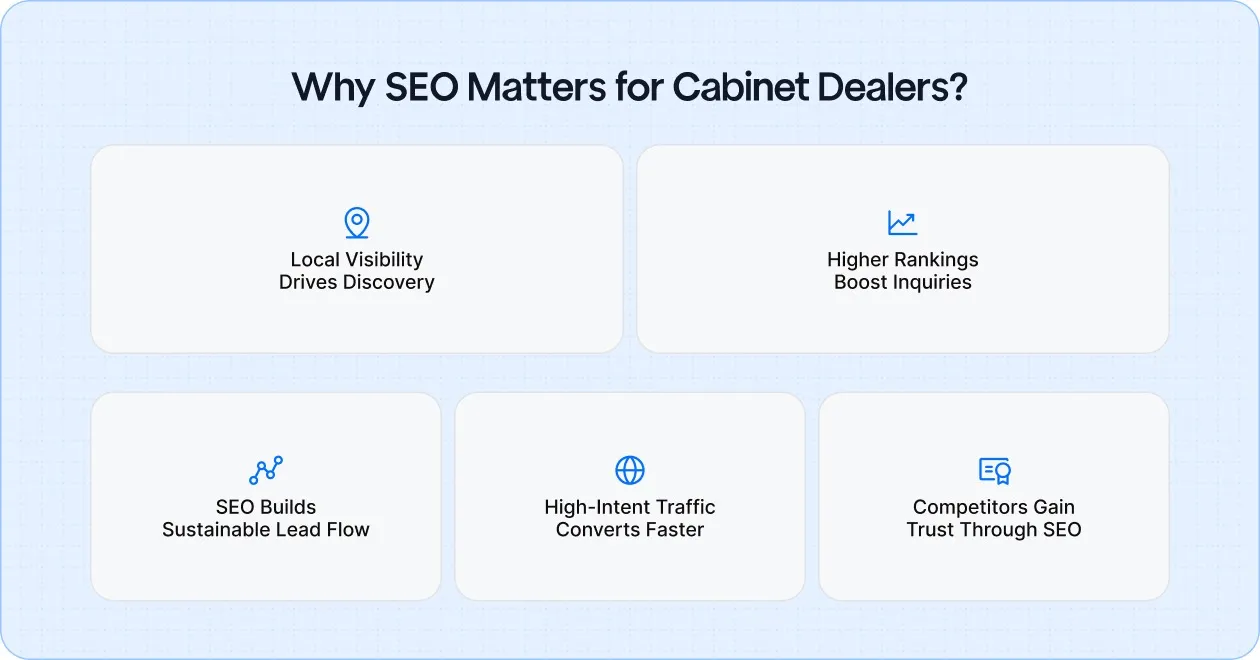
- Most buyers begin their cabinet search on Google or Bing. If you don’t show up locally, they won’t find you.
- Strong rankings bring more quote requests, showroom visits, calls and catalog downloads.
- SEO delivers steady leads without the constant cost of paid ads once your foundation is set.
- Searchers comparing cabinet styles, installers and pricing are already close to buying, so SEO attracts high-intent traffic.
- Competing showrooms invest in SEO because it gives them an edge. If you skip it, they look more established and win the trust you could have earned.
SEO for Cabinet Makers: How to Increase Visibility, Traffic and High-Intent Leads
This section breaks down the core elements that help cabinet installers, makers and dealers get found by qualified buyers.
1. Know Your Ideal Client Before You Optimize
Before you touch keywords or service pages, you need to understand who you actually want to attract. A homeowner planning a kitchen makeover has very different expectations from a contractor looking for a reliable installation partner. When you get clear on each group, your SEO becomes sharper, more relevant and far more profitable:
Your Main Customer Groups
These are the audiences most cabinet businesses work with. Each one searches differently, compares differently and has different priorities.
- Homeowners: Usually searching for kitchen or bathroom upgrades, cabinet refacing, full replacements or custom builds. They want clarity on style, price range, timeline and trust.
- Contractors and builders: Looking for reliable installation partners who can handle consistent work, meet deadlines and maintain quality. They often search locally and prefer straightforward service pages.
- Interior designers: Interested in custom cabinetry, modern styles, unique finishes and craftsmanship details. They want portfolios and case-study style content.
Map Their Buying Behaviour
Each type of buyer enters SEO at a different point.
- Remodeling customers: Often researching styles, timelines and pricing ranges before calling anyone. They respond well to educational guides and galleries.
- Refacing and refinishing customers: Want fast answers and price clarity. They search for problem-specific terms like “cabinet refacing cost” or “cabinet repainting near me.”
- New cabinet customers: Often replacing old layouts entirely. They want installation details, before/after photos and material explanations.
- Custom build customers: Want inspiration galleries, craftsmanship details and deeper explanations about materials and construction.
Get Clear On Who You Want To Attract
Build a keyword and buyer strategy that brings the right projects, not random traffic.
Sharpen My Targeting
2. Build a Cabinet-Focused Keyword Strategy
Cabinet buyers search with clear intent. They know their style, their budget and the type of work they need. Your job is to match your pages to those specific searches so Google can pair you with real, ready-to-buy customers.
Long-Tail Keywords That Capture Real Buyer Intent
Long-tail keywords are longer, more specific search phrases like “modern shaker cabinet installation in Austin.” They bring far better leads than broad terms because they reveal what the customer actually wants. Each category below aligns with a real buyer decision, which makes them incredibly valuable for cabinet businesses.
1. Style-based keywords
These attract homeowners who already have a look in mind.
- Shaker cabinets
- Modern cabinets
- Rustic or farmhouse cabinets
- Custom-built cabinetry
These searches signal high intent because people searching by style are often close to making a design decision.
2. Service-based keywords
These bring in people who know the exact type of work they need.
- Cabinet installation
- Cabinet refacing
- Cabinet refinishing
- Custom cabinet building
Service terms match bottom-of-funnel intent, meaning buyers are ready to talk to someone soon.
3. Location-based keywords
Cabinet installation is a local service. Using city or neighborhood terms helps you show up for local searches.
- “cabinet installer in [City]”
- “custom cabinets [Neighborhood]”
- “cabinet refacing near me”
These improve map rankings and help you appear for high-intent local jobs.
4. High-converting bottom-of-funnel terms
These are the searches people make when they’re almost ready to hire.
- “kitchen cabinet installer cost”
- “cabinet refacing quote”
- “best cabinet installer in [City]”
- “custom cabinet maker near me”
These keywords bring the most profitable leads because the customer is close to making a decision.
How to Use Google Search Console to Identify Keyword Gaps
Search Console is one of the simplest ways to see which keywords you’re already showing up for and where you’re losing potential traffic. It helps you spot pages that need improvement so you can climb into the top results where the calls actually happen.
Check Impressions, CTR and Average Position
Look at the keywords getting impressions but low clicks. This means you're being seen but not chosen.
- Low CTR usually means your titles or descriptions need rewriting.
- A position of 8–20 means you're almost ranking well but need refinement.
Identify Underperforming Pages
Search Console shows which service or location pages appear on page 2 or 3.
- These are your fastest wins.
- Small updates can move them into page 1.
Fix Title and Description Mismatches
Sometimes your page ranks for something you never optimized for.
- Rewrite titles and meta descriptions to match the keyword people are using.
- Make them simple, clear and action-driven.
Rewrite Underperforming Pages Stuck on Google Page 2 & 3
Pages already indexed for the right keywords just need better content.
- Add 150–300 words addressing real buyer questions.
- Improve clarity, structure and visuals.
- Add internal links from related pages.
This alone can move rankings quickly because Google already considers your page relevant.
3. Local SEO Strategies
Cabinet installation is a location-based home service. Homeowners rarely hire outside their immediate area, which means Google Maps, local search signals and nearby credibility matter more than anything else.
These work together to build strong local visibility.
Google Business Profile (GBP)
Your Google Business Profile is often the first place customers see your business. When optimized well, it brings in a steady flow of calls without paying for ads.
What to focus on:
- Complete your profile fully. Add business hours, service areas, a clear description and a full list of cabinet services.
- Upload real project photos. Before/after shots, style close-ups and installed cabinets build trust immediately.
- Use the Services section. Add terms like cabinet installation, refacing, refinishing, custom cabinets, etc.
- Post updates weekly. Share small project highlights or FAQs (“How long does cabinet refacing take?”).
- Keep details consistent. Your name, address and phone must match your website exactly.
Fix Your GBP So More Local Buyers Choose You
Make your GBP work harder with clearer details, better photos and consistent updates that attract ready-to-book homeowners.
Create My GBP
Apple Business Connect
Many homeowners search from iPhones, which means Apple Maps plays a bigger role than most cabinet businesses realize. If your listing isn’t claimed or updated, you miss out on high-intent local traffic.
What to focus on:
- Claim and verify your listing. This ensures your business shows up correctly across Apple Maps, Siri voice searches and iOS navigation results.
- Match your details to your website and GBP. Keep your name, address and phone identical to avoid mixed signals.
- Add your core cabinet services. Include installation, refacing, refinishing and custom cabinetry so Apple can match you with the right searches.
- Upload real photos. Crisp project shots boost credibility, especially for users checking visuals before calling.
- Keep hours and service areas updated. Apple heavily weighs accuracy, so timely updates help you appear more often.
A polished Apple listing strengthens your local presence and captures buyers who never check Google but rely entirely on their iPhone for nearby services.
4. On-Page SEO
On-page SEO is everything you adjust on your website to help Google understand your services and help homeowners understand why they should choose you.
Below are the most important on-page practices for cabinet installers, dealers and makers:
Optimize Your Website
A strong cabinet website speaks to two audiences at once: homeowners and Google. The key is clarity. The easier it is for both to understand what you offer, where you work and why you're the right choice, the better your results.
What to do:
- Use short, clear explanations. Homeowners shouldn’t have to guess what services you provide.
- Put your main services in the navigation. Installation, refacing, refinishing, custom cabinets.
- Include your service areas directly on your pages. Google uses this to match you with local searches.
- Create simple calls to action. Buttons like “Request a Quote” or “Book a Visit” guide visitors easily.
A clean, straightforward site builds trust quickly and strengthens your rankings at the same time.
Want to improve your site but don’t know where to start? Let our AI Analyzer review it and show you the changes that matter most.
Landing Pages That Convert
Landing pages are built for one purpose: turning visitors into leads. They remove distractions and highlight the one action you want people to take. For cabinet businesses, strong landing pages can drastically increase quote requests.
What to include:
- Clear CTAs: Quote requests, catalog downloads, showroom visits, design consultations.
- Short process explanation: Outline how installation or refacing works in simple steps.
- Before/after galleries: These instantly show craftsmanship and build trust faster than any paragraph.
- Social proof: Add a few specific reviews related to cabinet installations.
Good landing pages help turn ad clicks, email traffic and SEO visitors into actual customers.
Turn Your Website Into A Lead Engine
Make every page clear, fast and built to convert real cabinet installation buyers.
Improve My Website
Write Useful, Engaging Content
Helpful content attracts qualified traffic and positions you as an expert. Homeowners search for answers before they commit to a project. If your website provides those answers first, you win the lead.
Content types that work best:
- Homeowner guides: “How to Choose the Right Cabinet Style” or “Installation vs Refacing.”
- Transformation showcases: Before/after write-ups with photos and a short overview of the project.
- FAQs: Simple explanations for common questions like timelines, costs, materials and maintenance.
- Style inspiration articles: Modern vs traditional, shaker vs slab, color choices, layout tips.
The goal is to educate, not oversell. When you teach well, buyers trust you naturally.
Essential On-Page Elements
These are the technical pieces that tell search engines what your page is about. They might sound complex, but they’re easy once you know what to do.
What to include:
- Clean H1s: One clear headline per page.
- Strong metadata: Titles and descriptions that match what the page is really about.
- Schema markup: Add structured data for your services, reviews and business info so Google can read your site more accurately.
- Internal links: Connect related pages so your site structure is clear and easy to crawl.
These elements help your pages appear for the right searches and improve ranking stability.
Optimize Images for Search
Cabinet projects rely heavily on visuals. Google also uses images to understand your work and match you with style-based searches. Proper optimization improves both rankings and conversions.
How to optimize:
- Rename image files clearly: “shaker-cabinet-installation-boston.jpg” instead of “IMG_239.”
- Write simple alt text: Describe what the photo shows in plain language.
- Compress image sizes: Smaller files load faster, which improves user experience and SEO.
- Use before/after galleries: These signal transformation quality and attract high-intent traffic.
Images are some of your strongest SEO assets. Optimizing them helps homeowners trust your work instantly.
Publish Content Buyers Trust
Share guides, galleries and proof that help homeowners choose you with confidence.
Build My Content Plan
5. Technical SEO for Cabinet Websites
Technical SEO is the behind-the-scenes work that helps your website load fast, stay accessible and get properly indexed by search engines. Homeowners won’t see these elements directly, but they absolutely affect whether your pages rank and whether visitors stay long enough to contact you.
Improve Page Speed and Core Web Vitals
A slow website costs you leads. Homeowners leave quickly if pages take too long to load, especially on mobile. Google also prioritizes sites that feel fast and stable.
What to do:
- Compress images: Cabinet project photos are large, so reducing file size helps dramatically.
- Use modern formats: WebP or AVIF load faster without losing quality.
- Limit heavy scripts: Remove unnecessary plugins or widgets that slow the page.
- Test your speed: Use PageSpeed Insights to see what needs improvement.
Fast websites convert more visitors and signal professionalism.
Ensure Full Mobile Compatibility
Most homeowners search for cabinet installers on their phones, especially during remodeling research. If your site doesn’t look clean and simple on mobile, they leave instantly.
What to do:
- Use large, readable text and buttons. Your call button should be visible without scrolling.
- Test every page on mobile. Make sure forms, photo galleries and menus work smoothly.
- Avoid horizontal scrolling. Layouts should fit cleanly on any screen size.
A mobile-ready site helps you capture traffic from people browsing on the go.
Fix Indexing Errors and Broken Links
Indexing means Google can successfully read and list your pages. If important pages aren’t indexed or links are broken, your rankings suffer and customers may hit dead ends.
What to check regularly:
- 404 monitoring: Remove or redirect pages that no longer exist.
- Redirects for high-volume errors: If lots of users hit the wrong URL, create a redirect to the right page.
- Robots.txt checks: Ensure you’re not accidentally blocking important service pages.
- Sitemap health: Keep your XML sitemap updated and submitted in Google Search Console.
Track Performance With GA4 and Google Search Console
SEO only improves when you know what’s working. GA4 and Google Search Console (GSC) give you clear insights into traffic, engagement and ranking performance.
What to monitor:
- Traffic acquisition: See where visitors come from (Google, social media, ads).
- Engagement metrics: Track which pages people stay on and which they leave quickly.
- Page-level analysis: Identify pages that bring the most leads and the ones that need improvement.
- Bounce rate insights: High bounce rate on a service page may mean unclear messaging or slow load times.
Regular tracking helps you make better decisions and spot issues before they become bigger problems.
6. Off-Page SEO and Local Credibility
Off-page SEO includes all the signals that live outside your website but help search engines and homeowners see you as a credible, established cabinet installation business.
Link Building
Quality backlinks tell Google that reputable sites trust your business.
What works best:
- Local partners: Contractors, remodelers, designers and builders often link to trusted installers they collaborate with.
- Home improvement blogs: Offer expert tips or before/after stories; they frequently accept guest content.
- Showcase transformations: Publishing project features increases your chance of earning organic links.
- Supplier mentions: Many cabinet material suppliers maintain partner directories.
These links help you appear more authoritative in your niche and improve local rankings significantly.
Customer Reviews as Ranking Power
Reviews are one of the strongest trust signals for cabinet installation. Search engines reward businesses that collect steady, authentic feedback.
How to make reviews work for you:
- Ask at the right moment: After installation or a reveal walk-through works best.
- Showcase reviews on service pages: Add them next to related projects.
- Respond to every review: It shows customers that you care and improves trust signals.
A steady flow of recent reviews boosts both conversions and local map rankings.
Pair SEO With Other High-ROI Marketing Channels
SEO becomes even stronger when supported by complementary channels that build visibility and trust over time. These channels capture homeowners who are comparing options, browsing for ideas or planning remodels months in advance:
Paid Ads
Paid ads like Google PPC and Local Service Ads are useful when you want fast visibility or want to target high-value areas.
Why they help:
- PPC captures people actively searching for installation or cabinet upgrades.
- Local Services Ads show the Google Guarantee badge, which boosts trust.
- You can target specific cities or neighborhoods with strong demand.
Paid ads work best when paired with strong landing pages and a solid SEO foundation.
Social Media for Visual Proof
Cabinet installation is a highly visual service. Your transformations often sell the service better than words.
Where to focus:
- Instagram for before/after showcases.
- Facebook for local reach and neighborhood visibility.
- Pinterest for design inspiration and remodel planning.
- YouTube or TikTok for short transformation videos.
Each platform helps different types of buyers discover your work early in their research.
Email Marketing and Lead Nurturing Systems
Many homeowners take weeks or months to decide on cabinets. Email helps you stay top-of-mind during this decision window.
How it helps:
- Share project highlights, remodeling tips or pricing guidance.
- Send catalogs or style guides to build inspiration.
- Follow up with leads who asked for quotes but haven’t booked yet.
Email nurtures slow-moving leads that SEO brings in.
Choosing the Right SEO Agency
When you’re investing in SEO for a cabinet installation business, the right agency should make growth feel simpler, not more confusing. You need a partner who understands home improvement buyers, local search and how homeowners actually choose cabinet installers.
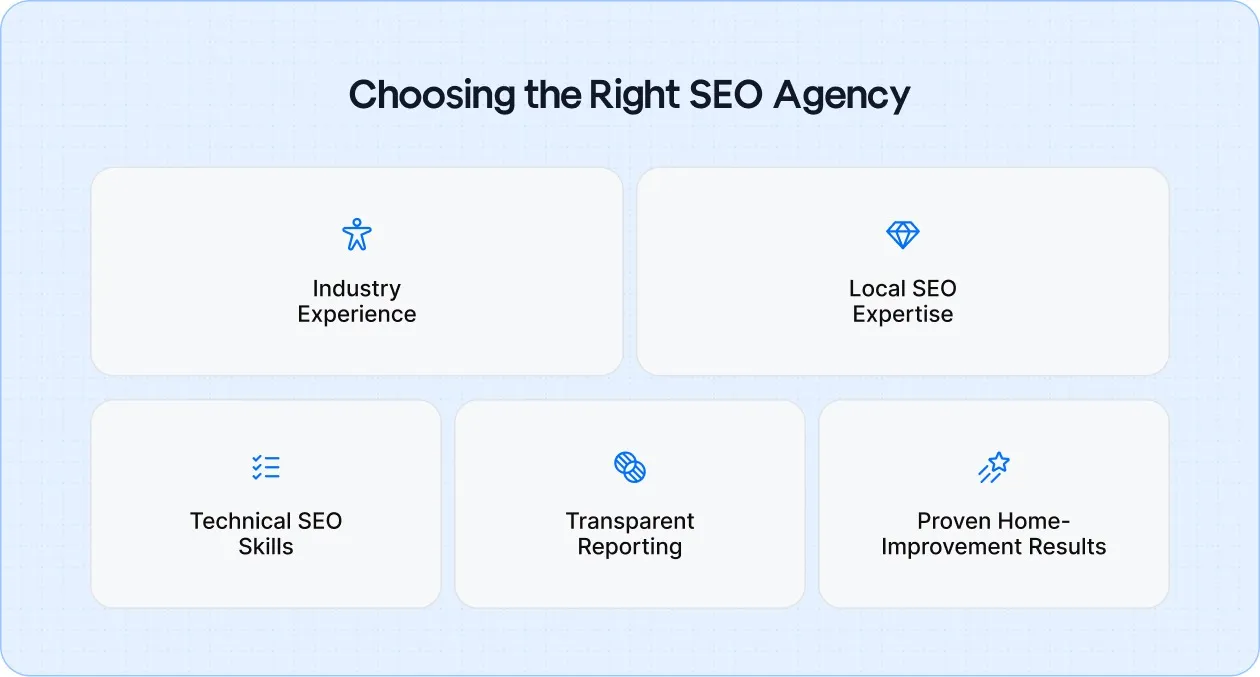
Here are the qualities that matter most in an SEO agency:
- Industry Experience: Pick an agency that has worked with contractors, remodelers or home-service brands. They’ll already understand service pages, local SEO and visual proof, which speeds up results.
- Strong Local SEO Skills: Cabinet installation depends heavily on appearing in Maps and local searches. Your agency should know how to optimize GBP, build location pages and generate consistent local visibility.
- Technical SEO Knowledge: Slow websites, indexing issues and poor mobile performance hurt rankings. A good agency should handle these quietly in the background and explain them simply when needed.
- Clear Reporting and Communication: You should receive reports that show what’s improving and how it affects leads. No vague promises. Just traffic, rankings, calls and booked jobs.
- Proven Work in Home-Improvement SEO: Look for case studies, before/after SEO results or references in related industries. Agencies that have built growth for service-based companies will have a stronger playbook for your needs.
Heading: Strengthen Your Local Visibility
Subheading: Boost rankings with better structure, speed, GBP optimisation and clear service pages.
Button Text: Fix My SEO
Conclusion
Strong SEO doesn’t just help people find your business. It helps them understand what makes your craftsmanship worth choosing. When your pages answer real questions, your service details are organized and your location signals are clear, homeowners feel more certain about moving forward.
Over time, this creates steadier inquiries, higher-value project opportunities and a reputation that grows beyond word of mouth. SEO becomes the structure that supports your marketing, your sales process and the way homeowners perceive your brand long after that first search.
Ready To Grow Your Cabinet Business?
Get a tailored SEO and marketing plan built around your services and ideal clients.
Book A Consultation

SEO
Dec 15, 2025
5 mins
8-Step B2B SEO for Agricultural Suppliers that Puts You Ahead of Every Local Competitor
Ishani Mitra
If you work in agricultural manufacturing or supply, you already know the challenge isn’t making a good product. It’s making sure the right buyers ever see it.
The market is packed with long-standing brands, regional dealers, emerging tech, and copycat competitors who all promise the same things: durability, efficiency and better yield. In this environment, even strong products get buried if your online presence doesn’t signal authority from the start.
That’s where B2B SEO becomes a real advantage. Instead of hoping they discover you, SEO helps you show up where their research actually happens.
In this blog, you’ll learn how B2B SEO works for agricultural suppliers, the strategies that attract qualified manufacturing and distribution leads, and the best practices that help your brand rise above competitors in a crowded, fast-evolving industry.
A Complete B2B SEO Framework for Agricultural Suppliers and Manufacturers
A good SEO strategy helps you get discovered early in their research process, answer the questions they care about and position your company as a trustworthy, proven solution.
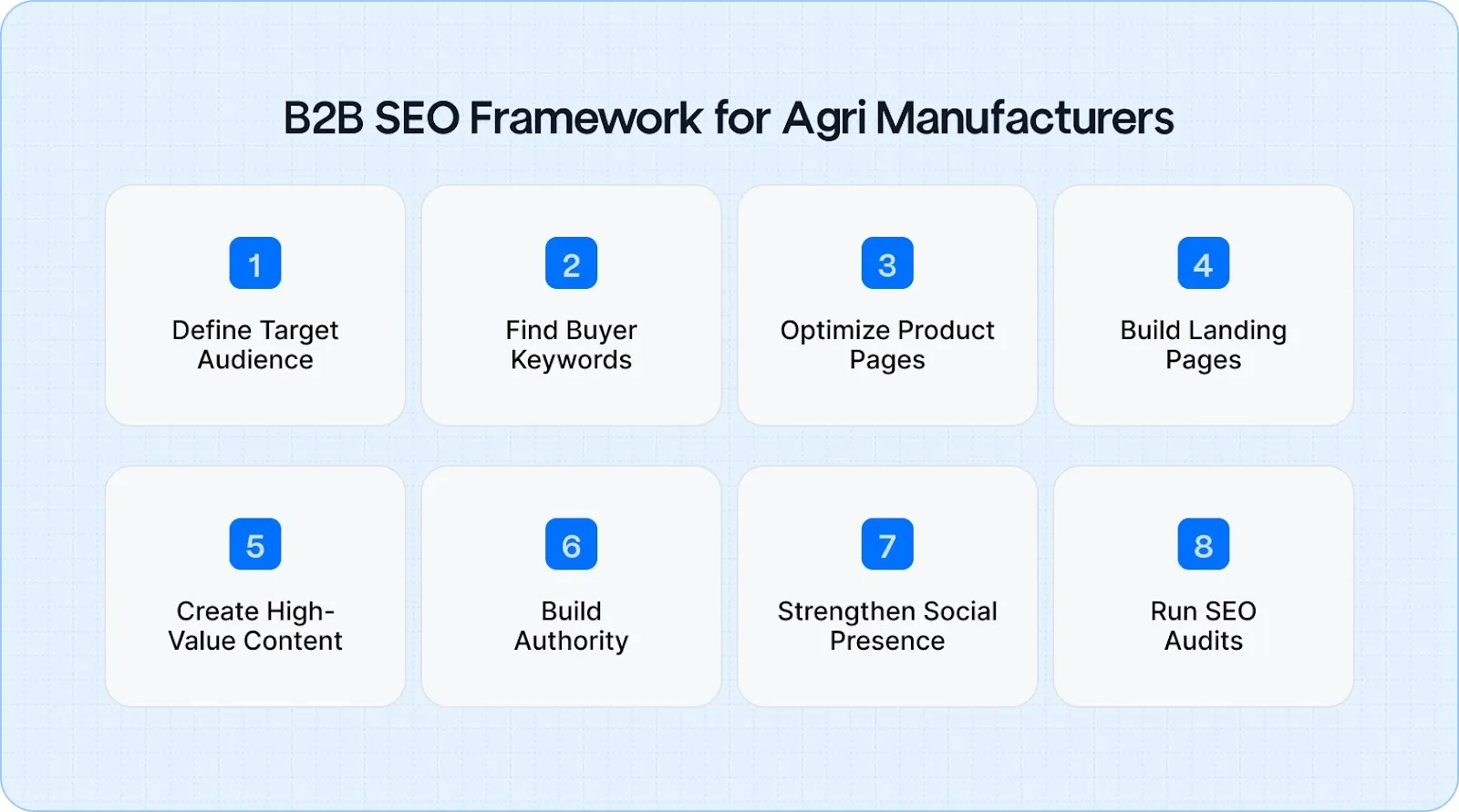
The steps below break down what today’s most effective agricultural manufacturers are doing to grow high-quality traffic and leads online:
Step 1: Know Who You Want to Attract (Target Audience Research)
This is the foundation of every successful B2B agricultural marketing strategy. If you don’t clearly understand who you want to reach, your SEO won’t match the right search intent and you’ll attract the wrong buyers.
What to clarify:
- Understand Your Product Fit: Identify which companies benefit the most from your equipment, parts, inputs or technology.
- Define Target Companies: These may include OEMs, dealers, large farms, food processors, distributors, agritech startups or government buyers.
- Filter by Demographics: Industry type, operation size, acreage, revenue, geography, fleet size and level of mechanization all influence whether a company is a viable buyer.
- Create Buyer Personas: Agricultural purchases involve several people. Build clear profiles for each:
- Decision maker: C-suite, plant managers, directors of operations. They approve the final spend.
- Influencer: Managers who will run or integrate your product. They care about reliability, efficiency and downtime.
- Researcher: The person comparing specs, pricing and vendors. Often techs, engineers or admin staff.
Start with 3–5 personas so your content and keywords have real direction.
Step 2: Identify the Keywords Your Buyers Actually Use
Agricultural buyers search based on the problem they want solved, the machine they operate or the technical feature they need.
Breaking your keyword research into buyer-journey stages makes everything more accurate:
Awareness Stage
Buyers focus on understanding a problem or finding general guidance. Use broad pain points and helpful educational topics rather than product-heavy terms.
Target, pain-point keywords like “reduce feed waste,” and “automated grain handling,” or how-to searches like “how to automate fertilizer application,” and “how grain dryers work.”
Interest Stage
They shift toward exploring possible solution types. Highlight features, benefits, and categories so they can compare approaches without diving into brand specifics yet.
For example, “precision ag software benefits” and “automated sprayer systems.”
Consideration Stage
Buyers start shortlisting vendors. Focus on comparison content, proof points, and search terms that show a clear intent to evaluate suppliers.
For example, comparison terms like best grain auger supplier,” “top fertilizer pump manufacturers,” or vendor-intent keywords like “bulk order agricultural sprayers,” “OEM tractor attachments supplier.”
Target the Right Buyers
Build a search strategy that speaks to the customers who matter most.
Refine My Targeting
Step 3: Build and Optimize Product and Service Pages
Product pages are where real B2B purchasing decisions happen. Buyers care about specs, performance data, ROI, safety, compatibility and supporting documentation.
Best practices:
Target Bottom-of-Funnel Keywords
These reflect high buying intent: model numbers, equipment features, capacity, application type.
How to get the best results
- Add BOF terms naturally to product titles, first paragraphs, and spec tables.
- Include common variations buyers use.
- Add your industry application because buyers often search this way.
Broader Keywords Strategy
Some agricultural machinery keywords are too broad to rank a single product page. These phrases belong on your homepage, which acts as your main brand positioning page.
How to get the best results
- Optimize your homepage for broad terms.
- Create feature pages or solution pages for narrower terms.
- Support these with blog content targeting use cases, comparisons, and productivity benefits.
On-Page SEO Essentials
This is about helping both search engines and buyers clearly understand what each page is about. If the details are missing or unclear, Google won’t rank the page and buyers won’t convert.
Below is how to optimize each element cleanly and accurately:
- H1 Tags: Your H1 should clearly describe what the page covers. Avoid vague titles.
- Title Tag & Meta Description: These appear in Google search results, so they strongly influence click-through rates.
- Image Names & Alt Text: Search engines cannot “see” images. Rename images before uploading. Write alt text that explains the image in plain language.
- Body Copy: This is where you explain the equipment in simple, useful terms. Use short sentences and bullet points so busy buyers can skim quickly.
- Download Buttons or CTAs: Buyers often want spec sheets, brochures, performance data or pricing conversations. Make sure downloads include your most updated specs; outdated PDFs kill trust fast.
Improve Your Search Ranking
Make sure the right buyers find you before they find a competitor.
Strengthen My SEO
Your product pages must answer every question a buyer might ask before speaking with sales.
Step 4: Build High-Converting Landing Pages
Landing pages convert traffic into actual leads. The more aligned they are with your call-to-action, the higher your conversion rate.
Types of landing pages:
- Demo requests: A demo page lets buyers request a live or virtual demonstration of your equipment.
- Quote requests: This page gives buyers a simple form to ask for pricing based on their farm size, needs or equipment configuration.
- Distributor applications: This page helps potential dealers apply to carry your products.
- Whitepapers and technical guides: This page offers downloadable resources, such as engineering summaries, performance tests or comparison reports, in exchange for contact information.
- Case studies: This page showcases real results from other farms or agribusinesses.
- Free trials (for tools or products): If your product includes digital tools, integrations or monitoring systems, a free trial landing page lets users test them before committing.
Agricultural buyers often share landing page content across departments. A precise, clear landing page reduces confusion and speeds up the internal approval process.
Step 5: Start Producing High-Value Content
Content is the engine of B2B agricultural SEO. Buyers do a lot of research before reaching out, especially for expensive machinery or high-volume supply contracts.
Below are the types of content that work best and how to use each one effectively.
Educational Blogging
Educational blogs explain problems, solutions and everyday challenges in simple language. These posts attract buyers who are researching long before they reach out.
Tips to get the best results
- Write about the issues your customers ask about in real life.
- Keep posts practical, not promotional. Focus on helping, not selling.
Technical Explainers
Technical explainers break down the engineering, features or performance benefits behind your products. These help buyers understand why your equipment works the way it does.
Tips to get the best results
- Use short diagrams or bullet points instead of dense paragraphs.
- Highlight the real-world impact: less downtime, better yield, lower fuel use.
Video Content
Videos, like field demos, comparison tests and operator walk-throughs, help buyers see your product in action. This makes complex machinery easier to evaluate.
Tips to get the best results
- Keep videos short and focused on one point at a time.
- Include clips showing operation, safety, maintenance and performance.
Repurposing Content
Repurposing means taking one piece of content and turning it into multiple formats. This lets you get more reach without creating everything from scratch.
Tips to get the best results
- Turn strong blog posts into short videos or diagrams.
- Convert videos into step-by-step guides for your website or newsletters.
These are the ways the right SEO strategy supports food and agricultural businesses.
Publish Content Buyers Rely On
Show expertise with resources that support their research and decisions.
Build My Content Plan
Avoid talking only about yourself. Your audience searches for solutions and expertise, not promotions.
Step 6: Build Online Authority Through Backlinks and Partnerships
Content alone won’t rank. You need authority signals. How to build authority:
- Backlinks: From agriculture publications, associations, universities, industry blogs and partners.
- Promotion: Share your best content everywhere your buyers spend time.
- Guest Features: Podcasts, industry sites and event panels.
- Partner Linking: Dealers, distributors, OEMs and suppliers can cross-link resources.
Step 7: Create a Strategic Social Media Presence
A steady presence helps you stay visible during long buying cycles.
Below is what matters most and how each part supports your marketing.
- Active social profiles signal that your business is engaged and legitimate. Regular updates and product info help build trust.
- Strong posts can drive traffic to your site and increase the engagement signals that support SEO.
- Content distribution on social reaches everyone involved in agricultural purchases, including operators, managers, finance teams and dealers.
- LinkedIn, YouTube and Facebook are the most effective platforms because they reach decision-makers, researchers and frontline operators.
LinkedIn, YouTube and Facebook remain the best platforms for agricultural audiences.
Step 8: Conduct Regular B2B SEO Audits
A fast, error-free, technically solid website ranks better and converts better.
Areas to audit:
- Mobile performance
- Page load speed (Core Web Vitals)
- Broken links and redirect errors
- Duplicate content
- eta tags & keyword alignment
- Internal linking
- Security and indexing issues
Review monthly in the first six months, then quarterly.
Checking your site’s performance is easy. Put your URL into our AI Analyzer and get straightforward suggestions that help you win more jobs.
How to Choose the Right B2B SEO Partner for Agricultural Suppliers
Agricultural SEO requires technical product knowledge and industry context.
What to look for in your SEO partner agency:
- Understanding of ag-equipment buyers
- Strong local SEO and dealer-network expertise
- Proven technical SEO and content frameworks
- Ability to produce educational content
- Competence with mobile-first optimization
- Review and reputation management skills
The right partner will know how to speak to buyers in a way that creates trust and action.
Challenges in Agricultural Machinery Marketing and How to Solve Them
Below are the most common challenges, with simple solutions:
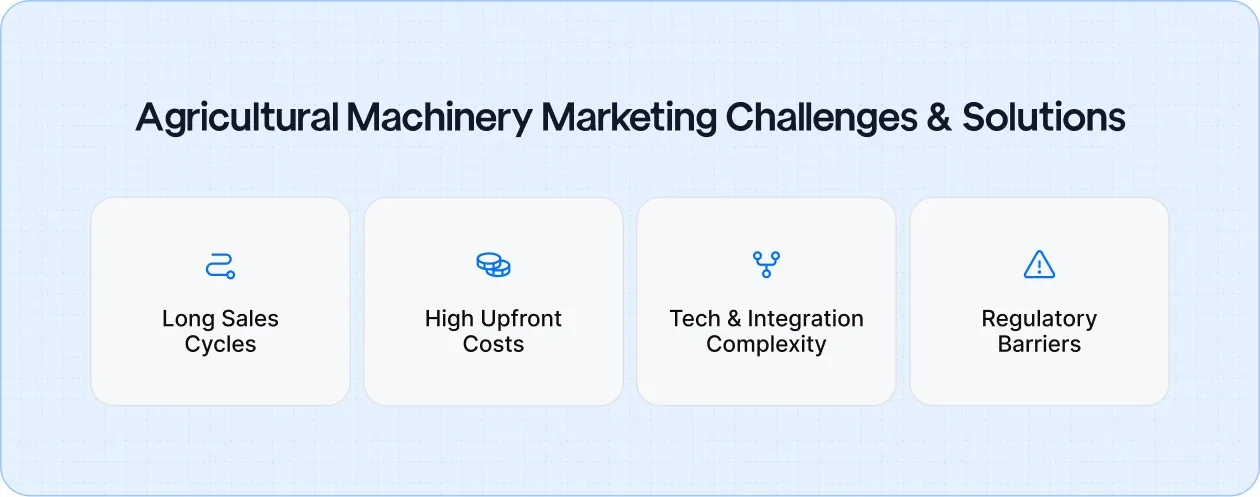
Long Sales Cycles
Agricultural machinery purchases rarely happen fast. Buyers compare brands, debate options internally and wait for the right season or budget cycle. This means you must stay visible and helpful throughout the entire decision process.
How to solve it
- Use nurturing sequences: Send helpful emails that answer questions buyers normally ask over months, not days.
- Run retargeting ads: Stay in front of people who visited your pages but didn’t convert yet.
- Publish educational content: Guides, comparisons and demos help buyers feel prepared and confident.
High Upfront Costs
Big-ticket machinery creates hesitation, even when buyers see the value. Many simply want help understanding how the investment pays off in the long run.
How to solve it
- Use cost-of-ownership messaging: Break down fuel savings, durability benefits and reduced downtime.
- Offer financing options: Clear monthly payment examples make decision-making easier.
- Provide simple calculators: ROI tools let buyers estimate savings or payback periods themselves.
Technology and Integration Complexity
Modern agricultural equipment often includes software, sensors, telematics or automation features. Buyers worry about learning curves, compatibility and usability.
How to solve it
- Offer training and onboarding support: Clear walkthroughs reduce hesitation.
- Create transparent documentation: Simple manuals, comparison sheets and troubleshooting steps remove confusion.
- Show real-world implementation examples: Case studies prove that similar farms or buyers succeeded with your tech.
Regulatory and Trade Barriers
Different regions have unique safety rules, emissions standards, warranty expectations and import/export restrictions. This slows purchasing and confuses buyers.
How to solve it
- Create region-specific compliance resources: Provide simple summaries so buyers know exactly what applies to them.
- Use clear, direct messaging: Highlight certifications or standards your products already meet.
- Keep dealers updated: Make sure your distributor network always has the latest compliance info.
What Other Marketing Works for Agricultural Manufacturers Beyond SEO?
SEO is only one part of how agricultural buyers discover and evaluate suppliers. That means your marketing needs more than rankings. It requires a presence everywhere your buyers spend time learning, comparing and validating.
Below are the most effective marketing channels agricultural manufacturers use today, and why each one still matters:
Digital Channels That Support SEO and Lead Generation
Digital marketing plays a major role because buyers start their research online long before speaking to sales. These channels help you stay visible early in the buying cycle.
- Content Marketing: Teach buyers what matters so your brand becomes the trusted expert.
- Video Marketing: Show machinery in action to simplify complex decisions fast.
- Webinars & Virtual Demos: Explain advanced tech clearly without requiring on-site visits.
- PPC and Paid Media: Reach specific buyers and support launches while SEO builds momentum.
- AI & Data Outreach: Identify high-value accounts and speed up buyer targeting.
Digital channels feed awareness and education, helping you get noticed before your competitors do.
Dealer and Distributor Marketing Partnerships
Agricultural equipment is often sold through dealer networks, so strong partnerships amplify your reach.
- Co-Branded Kits: Ready-to-use brochures, videos and product sheets dealers can share instantly.
- Dealer Portals: Central access to updated specs, pricing, manuals and marketing assets.
- Co-Op Advertising: Shared ad campaigns that expand local reach without heavy spend.
- Territory Lead Sharing: A clear handoff system that routes the right buyer to the right dealer.
Dealers are often the closest to the buyer. Supporting them strengthens your visibility and sales pipeline across multiple regions.
Traditional Channels That Still Work in Agriculture
Despite digital growth, agriculture remains a relationship-driven industry. Face-to-face trust still matters a lot.
- Trade Shows & Exhibitions: Still top lead sources because buyers want to see equipment in person and talk directly with experts.
- Printed Catalogs & Product Sheets: Buyers keep printed guides on hand, making them one of the few print tools that still convert well.
- Farm Visits & On-Site Demos: Real-world demonstrations build trust fast and show true performance.
- Ag Associations & Industry Networks: Memberships and sponsorships keep your brand in front of serious buyers consistently.
Traditional channels create the personal credibility and confidence that digital marketing alone cannot match.
Conclusion
Strong B2B SEO doesn’t replace your dealer network, trade shows or long-term relationships. It strengthens all of them. It brings in better-fit prospects, shortens conversations and positions your company as the supplier that understands the industry and its challenges.
Build your presence now, and you’ll stay ahead of competitors. In agricultural manufacturing, trust is currency and visibility is leverage. SEO gives you both.
Ready To Turn Visibility Into Real Leads?
Let’s build a clear, reliable marketing system that brings in better drain cleaning jobs consistently.
Book A Consultation

Digital Marketing
Dec 15, 2025
5 mins
10 Packaging Marketing Strategies Every Brand Should Steal in 2026
Ishani Mitra
Walk into any store, and you'll see shelves filled with products, each fighting for attention. But some packaging makes you stop and look.
It's not just the product that draws you in; it’s how it’s presented, the design, the colors, and the message it sends. For small businesses, getting noticed can be tough. That’s where a packaging marketing strategy comes into play. It’s about using your packaging to tell your brand’s story and connect with customers.
A simple shift in how your product is presented can turn a casual shopper into a loyal buyer. Let’s take a closer look at how you can use packaging to make a real impact on your brand’s success.
The Critical Role of Packaging in Modern Marketing
Packaging has transformed from a simple container to a core marketing tool. It’s about telling your brand's story, differentiating from competitors, and influencing customer behavior.
Why Packaging Matters in Your Marketing Strategy?
Packaging is the first thing your customers see. It’s your initial touchpoint and a silent salesperson that communicates your brand identity before the product is even opened.
Use your packaging as a vehicle for communication. Packaging reflects what your brand stands for, be it sustainability, luxury, or simplicity. The marketing happens in those subtle design choices that communicate your brand’s core values.
Stand Out with Unique Packaging
In a crowded market, packaging offers an immediate way to stand out. Think about the brands you recognize instantly, and it's the unique design that catches your eye first.
Practical Example: Packaging companies, like John Maye, a top manufacturer in the industry, have seen the clear benefits of a strategic marketing approach. By implementing an AI-powered SEO strategy, John Maye generated 25 qualified leads in just 30 days, dramatically boosting their online presence and transforming their customer engagement.
This shift from cold outreach to connecting with high-intent prospects found organically online highlights the power of aligning your packaging marketing strategy with AI-optimized content to elevate your visibility and deliver tangible business results.
Using Psychology in Packaging to Connect with Consumers
People buy feelings. Packaging plays a psychological role by triggering emotions like trust, excitement, or nostalgia. Colors, textures, and design all convey a message that goes beyond functionality.
Well-created packaging helps to build loyalty. When customers associate positive feelings with your packaging, they feel more connected to your brand.
Example: Apple’s minimalist design communicates sophistication, simplicity, and quality, core values that resonate with their audience.
Must Read: These 11 Marketing Strategies Will Build Your Small Manufacturing Business in the Future
Packaging is the first connection your brand makes with customers.
Smart content that aligns with your packaging marketing strategy is key to driving customer engagement and visibility.
Optimize Your Content
10 Unique Packaging Marketing Strategies to Stand Out
In a world where products compete for attention, packaging is about telling your brand’s story and creating a lasting connection with customers.
By using packaging strategically, you can set your product apart, increase customer loyalty, and build a memorable brand experience.
1. Create Packaging That Reflects Your Brand’s Story
Consumers connect with stories. Packaging that reflects your brand's mission and values creates an emotional connection that goes beyond the product itself.
Think about your brand narrative. Are you about sustainability? Innovation? Or perhaps community? Use your packaging to tell that story consistently.
Example: SmashBrand has driven measurable packaging‑led business growth for consumer packaged goods (CPG) clients, reflecting how strategic design directly impacts market reception and revenue.
2. Add Interactive Features for Engagement
Packaging with interactive elements like QR codes or AR experiences engages customers and makes the product more fun and memorable.
Consider adding a QR code linking to exclusive content or discounts, or augmented reality features that provide extra value.
Example: PepsiCo added QR codes on its snack packaging, giving customers access to special recipes and limited-time promotions, which enhanced customer engagement beyond the product.
3. Innovate with Multi-Functional Packaging
Packaging that serves a secondary purpose after the product is consumed adds value for customers, reducing waste and increasing customer loyalty.
Design packaging that can be reused. Find ways to give your customers more value, like using a storage container or a travel-friendly bag.
Example: Blueland offers refillable cleaning products with minimalist packaging that customers can reuse, making them a more sustainable choice while reducing packaging waste.
4. Emphasize Convenience with Smart Packaging
Functional packaging that’s easy to open, store, and use improves customer satisfaction, leading to higher chances of repeat purchases.
Focus on ergonomics, resealable pouches, spill-proof caps, or easy-to-pour spouts can make your product more accessible and convenient for customers.
Example: Keurig’s coffee pods come in easy-to-use, single-serve packaging that fits perfectly in the machine, offering a seamless and quick brewing experience for busy consumers.
5. Use Personalization to Build Customer Loyalty
Personalized packaging creates a sense of intimacy and connection, making customers feel special and more likely to return.
Add a personal touch to packaging, from customized labels to handwritten notes or exclusive designs.
Example: M&M’s personalizes packaging with names or messages, creating an emotional bond with customers and driving brand affinity.
6. Design for Limited Editions to Create Urgency
Limited-edition packaging creates a sense of exclusivity and urgency, making customers feel like they need to act fast to get their hands on something unique.
Launch seasonal packaging or event-based editions that can only be purchased for a limited time.
Example: Chobani releases limited-edition flavors with unique designs, creating a sense of urgency that gets customers to act quickly before the product disappears.
7. Focus on High-Quality, Aesthetic Design
Premium packaging signals quality and exclusivity, aligning with higher-end products and providing a sophisticated look that attracts customers.
Invest in luxurious finishes like foil stamping or raised textures to communicate quality and make your product stand out on the shelf.
Example: Tiffany & Co.’s signature blue box is instantly recognized as a symbol of luxury and elegance, reinforcing the brand’s premium image.
8. Incorporate Sustainability Without Compromising Design
Eco-friendly packaging meets the growing demand for sustainability while still maintaining design appeal. It can strengthen your brand reputation and attract eco-conscious consumers.
Use recyclable materials, reduce packaging waste, and ensure your design aligns with your brand’s environmental goals.
Example: Lush Cosmetics uses minimal packaging made from 100% recycled materials and biodegradable options, which align with their sustainability efforts and resonate with their audience.
9. Create Memorable Unboxing Experiences
Unboxing is an opportunity to delight customers and encourage them to share the experience on social media, amplifying your brand reach.
Make the unboxing process feel like a gift. Use creative packing techniques, include thank-you notes, or surprise the customer with a bonus.
Example: Glossier’s packaging is intentionally designed to make every unboxing feel like a special event. From the simple, yet chic tissue paper to the personalized touches, customers love sharing the experience on social media.
10. Experiment with Packaging Shapes and Sizes
Unconventional packaging shapes and sizes can make your product stand out and become more memorable, even before customers use it.
Go beyond the standard box or bottle. Use unique shapes and distinctive sizes to create something that draws attention and stands out in-store or online.
Example: Pringles uses a cylindrical can, a unique shape that distinguishes it from other chip brands, making it instantly recognizable and easily stored.
Make your packaging strategy more than just a design decision.
Integrating AI-assisted content strategies can elevate your packaging marketing approach.
Enhance Your Strategy
5 Packaging Functions Every Brand Should Focus On
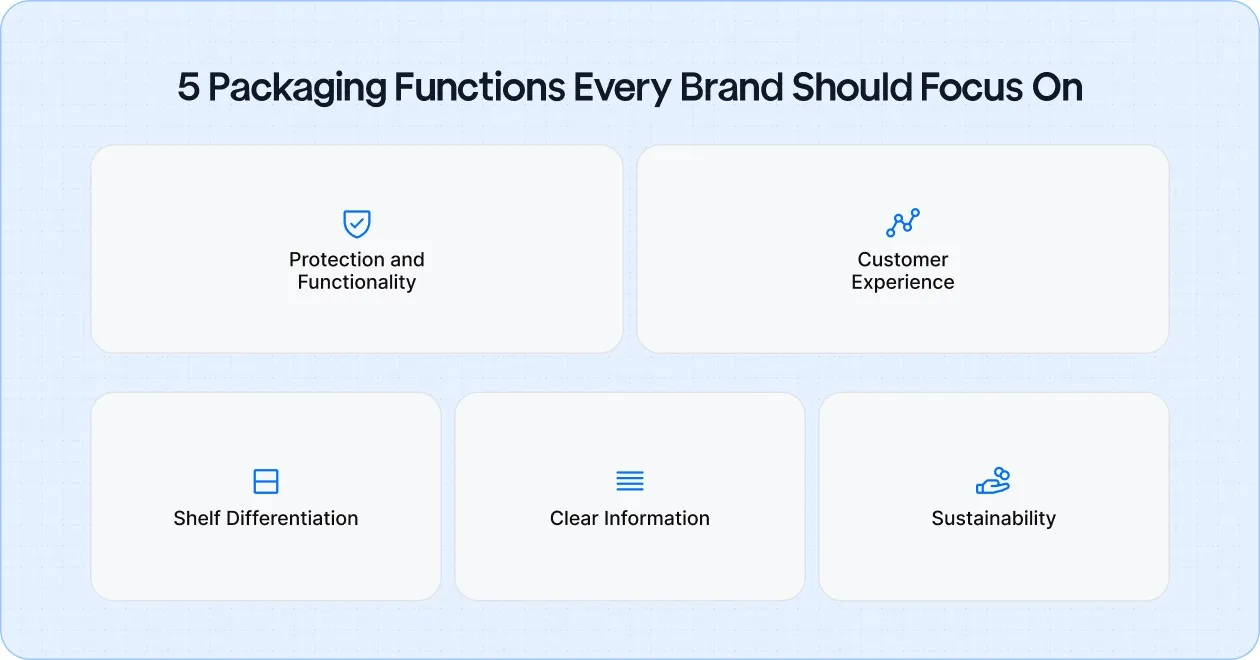
Packaging plays a crucial role in your marketing strategy and can directly impact brand recognition, customer loyalty, and sales.
1. Protection and Functionality
At its core, packaging must ensure your product arrives intact and is easy to handle. Packaging must also be functional in the customer's daily life.
Choose materials that protect without being cumbersome. Lightweight, compact, and sturdy packaging protects your product and makes it easier for customers to use and store.
Real-World Example: Nestlé's Ready-to-Drink Coffee uses a sleek, compact, and protective aluminum can. The packaging is lightweight, easy to store in the fridge, and designed to keep the product fresh while being convenient for consumers on the go.
2. Enhance the Customer Experience
Packaging shapes the entire customer experience. The easier it is for your customer to use the product, the more satisfied they will be. If your packaging is clunky or difficult to open, it can affect the entire perception of your brand.
Incorporate ergonomic features such as resealable pouches, easy-to-open seals, or functional handles. Simple changes like these make the customer’s interaction with your product easier and more enjoyable.
Real-World Example: Nespresso revolutionized the coffee pod market with its coffee and with its sleek, easy-to-use packaging that allows customers to store pods efficiently and enjoy a seamless experience every time.
3. Differentiation on the Shelf to Stand Out from the Crowd
Packaging is one of the quickest ways to make your product stand out on a shelf or in an online marketplace. A strong packaging strategy helps create instant recognition and positions your product as unique.
Use bold colors, distinct shapes, and innovative designs to break through the clutter. Packaging that is easily identifiable, even from a distance, can significantly impact how your product is perceived.
Real-World Example: Method Cleaning products use vibrant, non-traditional shapes and bold colors. Their packaging communicates cleanliness and reinforces their brand’s fun, eco-conscious identity. This allows their products to be easily spotted and recognized in a crowded category.
4. Deliver Information Clearly to Communicate with Purpose
Clear and concise information is essential. Customers shouldn’t have to search for key details like ingredients, usage instructions, or product benefits. Good packaging communicates everything clearly and at a glance.
Prioritize simplicity. Keep your labeling straightforward and easy to read, with minimal text and iconography where applicable. Organize product information to help customers make informed decisions quickly.
Real-World Example: Honest Company keeps its ingredient list and product benefits clear and easy to find on its packaging. This transparency builds trust and brand credibility, especially among health-conscious consumers.
5. Sustainability to Meet the Modern Consumer’s Expectations
Today’s consumers are increasingly environmentally conscious. Packaging that is eco-friendly or recyclable can strengthen your brand’s reputation and attract a dedicated customer base.
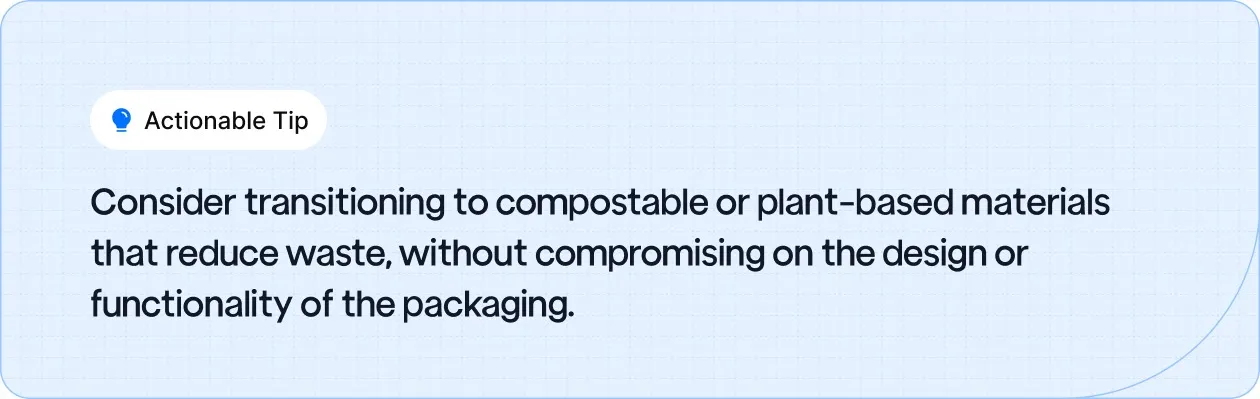
Incorporate sustainable materials or reduce excess packaging to align with consumer values. Even small changes, like using recyclable or compostable packaging, can have a big impact.
Real-World Example: Ranpak deploys AI‑assisted systems that optimize box packing and reduce waste, driving operational efficiencies for large clients, including Amazon and IKEA.
Must Read: SEO for Packaging Companies: Make Product Pages Rank or Stay Invisible In Search
Great marketing starts with smart content.
Aligning your packaging design with targeted, SEO-optimized content helps ensure your brand message is clear, consistent, and impactful.
Optimize Packaging with Content
Emerging Trends in Packaging Marketing for 2026
As the packaging industry evolves, staying ahead of emerging trends is essential for keeping your brand relevant and competitive. By aligning with these shifts, you can enhance customer engagement and ensure your packaging continues to stand out in the market.
1. Sustainability: Eco-Friendly Packaging Takes Center Stage
Consumers are increasingly drawn to brands that align with their environmental values. Sustainable packaging solutions meet customer expectations and enhance your brand’s reputation and long-term growth.
The global sustainable packaging market was valued at an estimated $272.93 billion in 2023 and is projected to reach approximately $448.53 billion by 2030, growing at a CAGR of 7.6% as demand for eco‑friendly solutions rises worldwide.
There’s a noticeable rise in the demand for biodegradable, recyclable, and dissolvable materials. Consumers want packaging that reduces environmental impact, and your brand can cater to that demand.
2. Digital Integration: Bridging the Gap Between Physical and Digital Worlds
Consumers spend more time online, and integrating digital experiences into your packaging can make your brand more engaging and interactive.
QR codes and augmented reality (AR) are revolutionizing how customers interact with packaging, offering an opportunity for deeper engagement through exclusive content, promotions, or behind-the-scenes brand experiences.
3. Minimalism: Simplicity Meets Functionality
With a growing demand for transparency and simplicity, minimalist packaging is on the rise. This trend helps reduce waste, costs, and production time, while also appealing to consumers who value clean, efficient designs.
Minimalism is moving beyond just aesthetics to include reduced material use and streamlined design that communicates both sustainability and quality.
Why These Trends Matter for Your Business?
Staying ahead of these emerging trends ensures your packHow does packaging impact customer perception?How does packaging impact customer perception?aging remains relevant in the competitive landscape of 2026. Prioritizing sustainability, digital features, or minimalist design will help you keep your packaging fresh, engaging, and aligned with consumer expectations.
Create Your Packaging Strategy for 2026
A carefully created packaging strategy is a powerful marketing tool that sets your brand apart. By tapping into trends like sustainability, digital integration, and minimalist design, you can connect with your customers on a deeper level, increase brand loyalty, and stand out in a crowded market.
Your packaging is an extension of your brand’s story and values, and when done right, it drives both engagement and sales.
Ready to see results with your packaging marketing strategy?
With Gushwork’s AI-assisted SEO strategies, the right content can elevate your packaging strategy and improve brand engagement.
Book Your Free Consultation

Digital Marketing
Dec 15, 2025
5 mins
Generative AI in Manufacturing: 6 Big Wins SMBs Are Seeing Right Now
Batul Beawarwala
Manufacturing teams are sitting on years of production data, maintenance logs, design files, and operational notes, yet most of it never shapes daily decisions. Design changes still take weeks, machine issues surface after downtime begins, and critical insights remain scattered across disconnected systems.
Generative AI changes this reality by turning existing operational data into usable outputs. For small and medium manufacturers, this matters because meaningful AI adoption no longer depends on large engineering teams or long deployment cycles.
This article breaks down where generative AI is delivering measurable value for manufacturers right now, with real use cases and examples that map directly to day-to-day operations.
What is Generative AI and Why is It So Important for Manufacturers?
Generative AI helps produce drafts, recommendations, summaries, and design options that teams can act on directly. Data like machine logs, maintenance records, drawings, and planning notes often sit unused across systems. Generative AI connects these inputs and converts them into clear, execution-ready outputs.
In manufacturing environments, generative AI is commonly used to:
- Create and refine product designs by evaluating material, cost, and performance constraints early
- Support production workflows by summarizing operational signals and suggesting adjustments
- Improve decision clarity by condensing large data sets into action-ready summaries
- Automate documentation such as work instructions, service manuals, and technical explanations
Large language models (LLMs) and natural language processing (NLP) enable these systems to work with the same technical language that manufacturers already use. This reduces interpretation effort and helps teams move faster without changing how they work.
Generative AI is not a replacement for core manufacturing systems, engineering judgment, or operator expertise. Its value lies in summarizing information, prioritizing actions, and supporting execution, not in taking control away from people or systems.
Must Read: How Generative Optimization Enhances AI Search Visibility
Financial Potential for SMBs
Generative AI delivers financial impact in manufacturing well before large-scale automation or capital-heavy upgrades come into play. For SMBs, the most immediate gains come from reducing inefficiencies that quietly drain time, budget, and attention across daily operations.
On the operational side, AI reduces avoidable costs by automating work that traditionally relies on manual intervention:
- Lower operational waste by identifying inefficiencies in production workflows and material usage earlier.
- Fewer unplanned expenses through predictive maintenance and early fault detection.
- Reduced manual overhead in documentation, reporting, and technical communication.
Beyond operations, AI improves decision quality by turning production data, maintenance logs, and planning inputs into clear, actionable summaries. Teams spend less time interpreting information and more time acting on it, reducing delays and costly missteps.
Yet much of the financial leakage for SMB manufacturers occurs before production even starts. Poor content visibility, unclear buyer intent, and manual marketing execution often result in missed opportunities or underqualified inquiries, pulling sales teams into low-value work.
AI-assisted content and search systems help align inbound demand with operational capacity, cutting wasted effort across sales, marketing, and leadership.
Most manufacturers lose time and money before production even starts.
See where AI can reduce effort fastest in your business.
See Where AI Fits First
Top 6 High-ROI Use Cases for Generative AI in Manufacturing
Generative AI in manufacturing use cases are producing ROI because they turn existing data into actions teams can use immediately. For SMBs, these wins show up without major system changes or large internal teams.
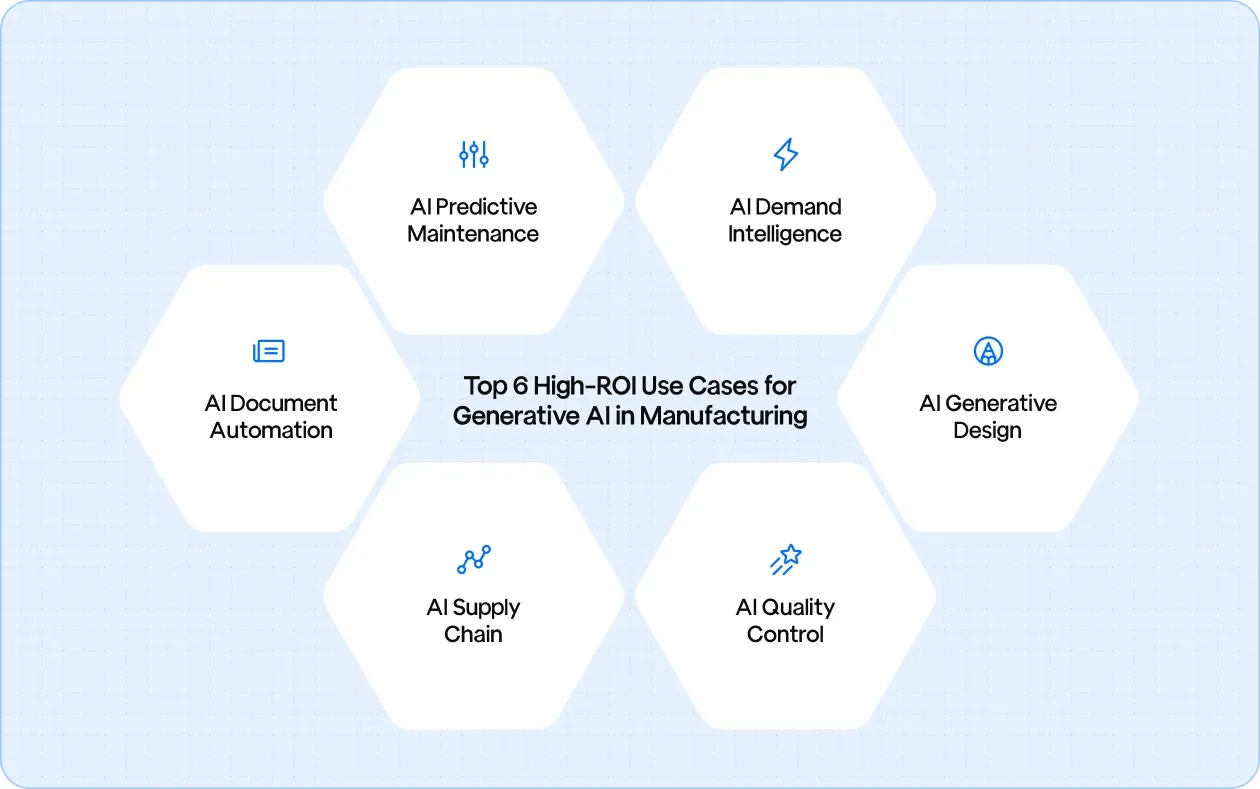
Here are the high-ROI use cases reshaping the industry.
1. Predictive Maintenance
Traditional maintenance models depend on fixed schedules or reactive repairs after failures occur. This often results in over-servicing healthy equipment or dealing with sudden breakdowns that disrupt production.
Generative AI changes this approach by evaluating multiple data sources together and surfacing issues earlier, with clearer context.
How generative AI improves maintenance planning
- Analyzes historical maintenance records alongside live sensor data and operating conditions
- Identifies emerging failure patterns before performance drops or breakdowns occur
- Generates plain-language summaries that explain risk, cause, and urgency instead of raw alerts
Rather than flooding teams with disconnected warnings, generative models help maintenance teams quickly understand which machines need attention, what is driving the risk, and how soon intervention is required.
Why does this matter for SMB manufacturers?
- Maintenance teams can focus their efforts where they are actually needed
- Unplanned downtime is reduced without increasing inspection frequency
- Equipment lifespan improves through timely, targeted intervention
- Production schedules remain more stable without adding maintenance headcount
Over time, predictive maintenance powered by generative AI leads to lower repair costs, better asset utilization, and more predictable operations.
2. AI-Assisted Content & Demand Intelligence
Generative AI is increasingly being used beyond the factory floor to understand how manufacturing buyers research and make decisions.
Manufacturing purchases involve long, technical evaluation cycles. Buyers search for specifications, applications, comparisons, and implementation details long before contacting sales. When manufacturers fail to appear during this research phase, demand quietly shifts elsewhere.
What generative AI enables?
- Analyzes buyer search behavior and recurring technical queries
- Identifies high-intent topics across different buying stages
- Generates technically accurate, buyer-aligned content instead of generic messaging
Rather than producing broad marketing material, manufacturers can use generative AI to create application-specific pages, technical explainers, and comparison content that matches how engineers and procurement teams actually search.
Why does this matter for SMB manufacturers?
- Brings higher-intent prospects into the pipeline earlier
- Reduces reliance on outbound and trade-show-only demand
- Improves sales conversations by pre-educating buyers
- Builds long-term visibility without adding sales headcount
No visibility during research means fewer sales conversations.
See where your content is missing and how AI can close the gaps.
Check Content Gaps
3. Generative Design
Traditional design cycles in manufacturing are slow and constrained by limited iterations. Engineers often settle on workable designs early because exploring alternatives takes time, tooling, and coordination.
Generative AI changes this by rapidly producing multiple design options based on defined constraints such as strength, material limits, cost, and manufacturing feasibility. Instead of starting from scratch each time, teams review AI-generated options that already meet core requirements.
What changes in practice?
- Faster design iteration without increasing engineering workload
- Reduced material usage through optimized geometries
- Shorter time between concept and manufacturable design
For SMB manufacturers, this means better designs without expanding design teams or extending development timelines.
4. AI-Powered Quality Control
Manual inspection and rule-based quality checks struggle to keep up with production speed and variation. Subtle defects are easy to miss, and inconsistencies often surface only after products reach customers.
Generative AI-supported quality systems analyze images, sensor outputs, and historical defect data together. Instead of flagging isolated anomalies, they summarize patterns and surface likely defect causes early.
What changes in practice?
- More consistent defect detection without increasing inspection staff
- Earlier intervention before defects propagate downstream
- Fewer rework cycles and customer-facing quality issues
For SMBs, this improves quality and reliability without slowing production or adding inspection layers.
5. Supply Chain Optimization
Supply chain decisions are often made using fragmented data: historical demand in one system, supplier lead times in another, and planning assumptions stored manually. This leads to overstocking, shortages, or reactive purchasing.
Generative AI brings these inputs together and produces summarized demand and procurement guidance. Instead of raw forecasts, teams receive clearer signals on where risk is rising and where adjustments are needed.
What changes in practice?
- Better inventory balance without constant manual recalculation
- Fewer surprises from demand swings or supplier delays
- More confident procurement decisions with limited planning staff
For SMB manufacturers, this reduces working capital strain while keeping production schedules stable.
6. Document Synthesis
Technical documentation is essential in manufacturing, but producing it manually is slow and error-prone. Quotes, service manuals, and work instructions often rely on copying information across systems, increasing risk and rework.
Generative AI automates document creation by pulling from existing specifications, historical documents, and structured data. Instead of starting from blank pages, teams review ready drafts aligned with current products and processes.
What changes in practice?
- Faster turnaround for customer quotes and internal documentation
- More consistent technical accuracy across documents
- Less time spent on repetitive writing tasks
For SMBs, this frees skilled teams to focus on production and customer decisions instead of paperwork.
AI solutions are key to improving your operations.
Use AI-assisted content systems to bring in inquiries that match your real capacity.
Map Content to Demand
Key Generative AI Trends That Are Shaping Modern Manufacturing
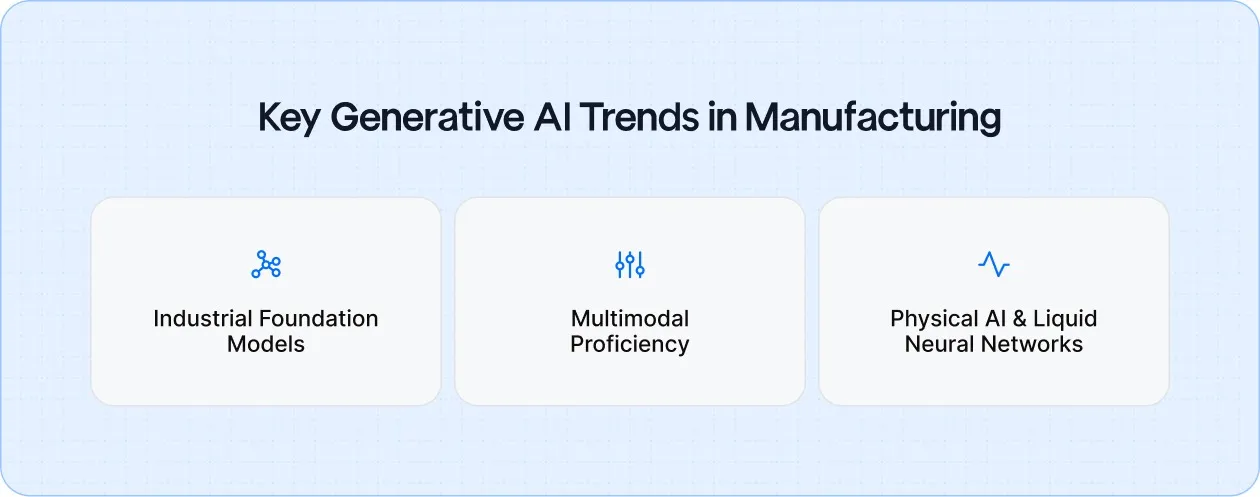
New tools do not define the future of smart production, but by how quickly insights turn into action. The trends below show where generative AI is reducing lag between data, decisions, and execution. Here are key trends transforming the industry:
Industrial Foundation Models (IFMs)
Industrial Foundation Models (IFMs), trained on manufacturing-specific data, prioritize actionable insights over additional dashboards. They reduce cognitive load by surfacing execution-ready recommendations, allowing teams to act faster without adding overhead.
Example: A model that reads downtime logs and suggests the next three maintenance checks.
Multimodal Proficiency
Multimodal AI connects diverse data sources (logs, images, sensor readings) to provide summarized, actionable insights automatically, eliminating manual data stitching and speeding decision-making.
Example: AI correlates vibration, thermal images, and alarm history to predict bearing failure.
Physical AI & Liquid Neural Networks
Physical AI adapts to real-time conditions, optimizing production by adjusting processes based on immediate feedback. Liquid neural networks support this adaptability by continuously adjusting systems without manual intervention.
Example: Adaptive tuning in robotics when material properties vary.
Real-Life Examples of Generative AI in Action
These manufacturing generative AI case studies highlight how manufacturers are using AI beyond the factory floor to improve visibility, inbound demand quality, and sales efficiency, without adding headcount or reworking internal systems.
Rather than focusing only on production gains, these companies applied AI where buying decisions start: research, discovery, and early intent signals.
Medium and Small-Scale Manufacturers
Small and mid-sized manufacturers are already using AI-driven execution to influence demand earlier in the buying cycle.
Here’s how smaller manufacturers are making AI work for them:
- John Maye: John Maye, a packaging equipment manufacturer with over 40 years in the industry, struggled with limited online visibility despite strong operational expertise. By applying AI-driven SEO and content execution, the company secured 17 qualified inbound inquiries within 30 days.
The shift reduced dependence on cold outreach and replaced it with demand already aligned to their product and capacity. Sales conversations started further down the funnel, with buyers arriving informed and intent-driven.
This kind of outcome is increasingly driven by AI-assisted SEO and content execution that aligns buyer intent with operational reality.
- Paniflex: Paniflex, a closet door distributor, faced a similar challenge: strong offerings but minimal discoverability. By using AI to expand technical content coverage and align it with buyer search behavior, Paniflex began appearing in more than 2,700 buyer searches within 6 months.
This resulted in 113 new buyers without expanding the sales team or increasing outbound activity. Visibility scaled, but execution overhead did not.
These results are increasingly tied to AI-assisted content systems that convert search behavior into consistent inbound demand.
Large-Scale Manufacturing Leaders
Global manufacturers are already incorporating Generative AI technologies to gain a competitive edge by optimizing efficiency, improving quality, and scaling operations. Here's how the biggest names in manufacturing are incorporating AI into their processes:
- BMW: BMW has implemented AI-driven quality control systems that use machine learning to detect defects earlier in the production process. This helps them reduce rework, maintain consistency, and enhance overall product quality.
- Rolls-Royce: In the aerospace sector, Rolls-Royce uses predictive maintenance powered by AI to monitor the health of aircraft engines. By analyzing real-time data from sensors, the AI predicts when an engine part might fail, allowing for proactive repairs.
- Hyundai: Hyundai has integrated AI-based factory automation to streamline its production lines. This AI technology helps optimize robot coordination, manage production schedules, and enhance workflow efficiency.
- General Electric: GE has incorporated AI in its supply chain management systems to enhance forecasting, inventory management, and raw material planning. By using AI to predict demand more accurately and ensure the right materials are available at the right time, GE has improved its delivery reliability and reduced shortages.
By adopting AI, manufacturers of all sizes can enhance their operations and create more efficient, scalable processes, driving growth and staying competitive.
How SMB Manufacturers Can Start Using Generative AI
For small and mid-sized manufacturers, the biggest mistake with generative AI is trying to “start everywhere.”
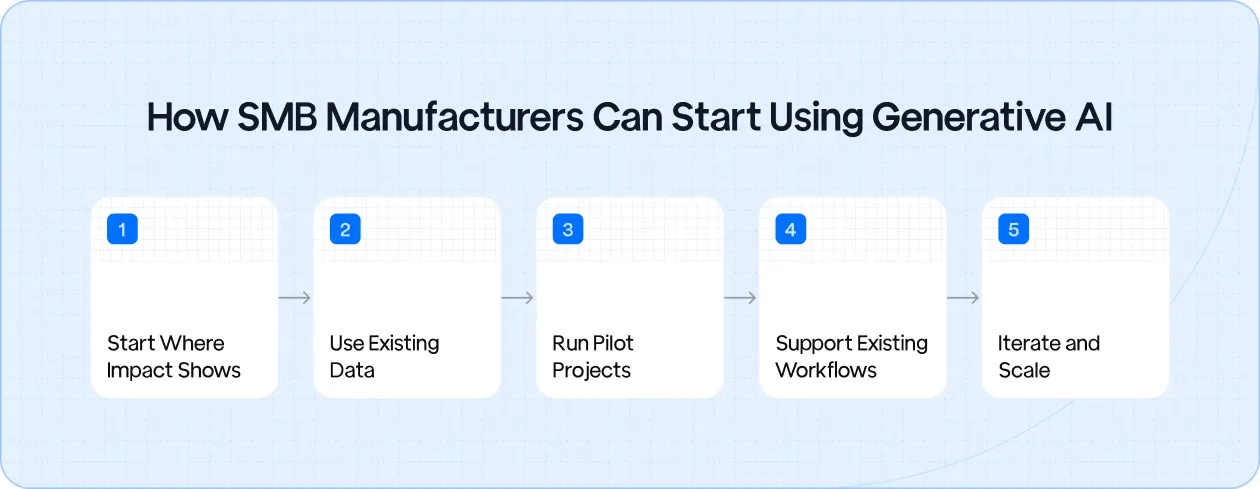
Here’s a practical way to approach adoption without adding internal strain.
Step 1: Start Where Impact Shows Up First
Many SMBs begin by applying AI outside the plant floor. Improving inbound demand quality, technical content coverage, and search visibility often delivers earlier signals than deeper operational AI initiatives. These areas are closer to revenue, easier to measure, and faster to adjust.
Generative AI can be used to:
- Identify high-intent buyer queries
- Expand technical content coverage aligned to real searches
- Improve how manufacturers show up during early research stages
This creates immediate visibility into whether AI is contributing to pipeline quality, not just internal efficiency.
Why does this work?
- No dependency on production systems
- Clear before-and-after metrics
- Faster feedback loops
Early wins here build confidence and internal buy-in for broader AI adoption later.
Step 2: Activate Data You Already Have Access To
Production data often requires cleanup, integration, and governance before AI can be applied meaningfully. Content and demand data do not.
Search queries, page performance, and buyer behavior are already structured signals. Generative AI can analyze this data to generate content that aligns with how manufacturing buyers actually research solutions.
AI-assisted content systems can:
- Turn search demand into technical content priorities
- Close coverage gaps across products, applications, and industries
- Maintain consistency without manual effort
This allows SMBs to extract value from AI early, without waiting on data engineering or system upgrades.
Step 3: Run Pilot Projects
Once early momentum is established, manufacturers can test AI in targeted operational areas such as maintenance summaries, documentation support, or planning insights.
The goal here is validation, not scale.
- Keep pilots narrow
- Measure outcomes clearly
- Maintain human oversight
This reduces risk while building internal confidence.
Step 4: Support Teams Without Changing Their Workflow
Successful adoption avoids asking teams to “learn AI.”
Instead, AI outputs should arrive as:
- Clear summaries
- Actionable recommendations
- Ready-to-use drafts
When AI fits into existing workflows, adoption happens naturally.
Step 5: Iterate and Expand
Start small, but think big. Once your team is comfortable with AI tools, start expanding them into other areas like quality control or design optimization. This iterative approach ensures that each new tool integrates smoothly without overwhelming your team.
Continuous support and expert insights will help refine the process, ensuring that the AI adoption journey evolves with your business needs.
Getting started with AI does not have to be expensive and complicated.
Focus on improving your content strategy first, and see immediate results.
See What to Publish Next
3 Key Challenges When Implementing Generative AI in Manufacturing
While the potential of Generative AI in manufacturing is vast, its implementation comes with its own set of challenges. SMBs looking to employ this technology must be prepared to address common obstacles that could hinder smooth adoption.
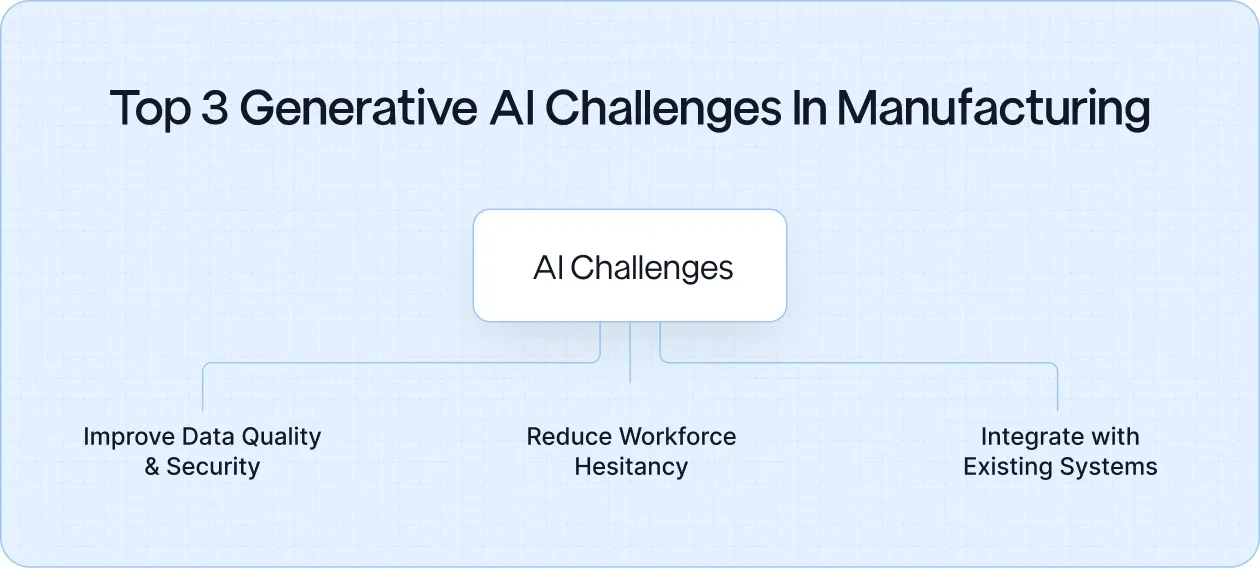
Here’s a look at some of these challenges and how to overcome them effectively.
1. Address Data Quality and Security Risks
Many manufacturers assume they need massive, perfectly structured datasets before AI can deliver value. In reality, most already sit on years of usable data across production logs, machine reports, documents, and customer interactions.
AI performs best when it works on:
- Curated, purpose-specific datasets
- Clearly defined inputs and outputs
- Guardrails that prevent hallucinated or unsafe responses
What works in practice?
- Start with narrow, high-confidence data sources instead of “everything at once.”
- Use AI systems that reference existing documents and operational records, rather than generating answers blindly
- Apply access controls so sensitive data stays protected
By grounding AI outputs in verified internal data, manufacturers reduce risk while improving trust in results. This makes AI usable for real decisions, not just experimentation.
Outcome: AI becomes a reliable support system instead of an unpredictable black box.
2. Overcome Workforce Hesitancy Without Adding Complexity
For many SMB manufacturers, AI hesitation has less to do with fear of job loss and more to do with bandwidth. Teams are already stretched across production, operations, sales, and customer support.
The practical solution is not asking internal teams to become AI experts. Instead, successful SMBs adopt AI through guided systems and managed execution models that deliver outcomes.
What works in practice?
- AI outputs are delivered in familiar formats like summaries, recommendations, or ready-to-use content
- Clear guardrails that prevent incorrect or misaligned AI usage
- Human-in-the-loop review to ensure accuracy and relevance
- Execution handled externally while internal teams focus on decision-making
By separating AI capability from AI execution, manufacturers gain the benefits of AI without forcing teams to change how they work day-to-day.
Outcome: Reduces resistance, shortens adoption timelines, and prevents common pitfalls like tool sprawl, misuse, or low-quality outputs.
3. Integrate AI with Existing Systems
Legacy systems are common in manufacturing. ERP platforms, MES tools, and documentation systems were not built with generative AI in mind. Full system overhauls are expensive and risky, especially for SMBs.
What works in practice?
- Introduce AI in isolated workflows where outputs are easy to validate
- Keep AI advisory at first, not fully autonomous
- Expand only after the value is proven
For example, AI can generate maintenance summaries, draft technical documents, or surface operational insights without touching core systems initially. This avoids disruption while building confidence.
Outcome: AI adoption progresses steadily without breaking existing operations.
AI adoption is way easier with the right help.
Let experts guide you in integrating AI into your content and workflow efficiently.
Get Expert Help
Long-Term Impact of Generative AI on the Manufacturing Industry
Generative AI requires creating smarter, more sustainable ways to operate and ensuring that manufacturers can meet future demands in a rapidly evolving world.
The Role of Generative AI in Sustainability
Sustainability is becoming a top priority for manufacturers, and AI is here to help in a big way. Here’s how:
- Reducing Waste: Generative AI helps manufacturers design products that use fewer materials while maintaining performance. By optimizing production schedules and workflows, it also ensures that resources are used efficiently, reducing waste.
- Energy Efficiency: Manufacturing can be energy-intensive, but AI can help manage energy use in real time. By predicting energy needs and adjusting production schedules, AI ensures that factories use only what they need, reducing both energy consumption and costs.
- Sustainable Practices: With Generative AI, manufacturers can simulate the environmental impact of different production methods and make decisions that help reduce their carbon footprint. AI helps businesses align with sustainability goals while driving operational efficiency.
Generative AI is helping to make manufacturers greener, contributing to a more sustainable future.
How AI Will Shape the Future of Manufacturing Operations
The future of manufacturing looks a lot smarter, thanks to AI. Here’s what to expect:
- Smarter Operations: Generative AI will optimize production lines in real time. Instead of waiting for problems to occur, AI will predict and solve issues before they happen, making manufacturing processes smoother and more reliable.
- Automating with Intelligence: Automation is getting smarter. AI learns, adapts, and optimizes. This means machines will figure out how to improve processes as they go along.
- The Digital Factory: AI is the backbone of the digital factory, where everything is interconnected. Imagine having digital twins, AI models, and IoT devices all working together to simulate and optimize production.
This interconnected system will give manufacturers deep insights, making it easier to improve every part of their operation.
- The Changing Workforce: As more tasks become automated, human workers will take on more strategic roles, working alongside AI to solve complex problems and make key decisions. AI will make workers more valuable, allowing them to focus on creativity, innovation, and problem-solving.
Generative AI is going to make manufacturing more agile, sustainable, and efficient, creating a future where companies are leading the way in innovation and sustainability.
How Generative AI Delivers ROI for Manufacturing Businesses
Generative AI delivers value when it helps manufacturers make better decisions, reduce wasted effort, and focus teams on work that actually moves the business forward.
On the factory floor, this shows up as fewer surprises, clearer maintenance priorities, and steadier output. Outside the plant, it shows up as better visibility, clearer technical messaging, and inquiries that match real production capacity. For SMB manufacturers, these gains matter more than adopting advanced systems all at once.
The most effective way to start is where results appear early, and risk stays low. Improving how buyers find you, understand your capabilities, and reach out with clear intent often delivers faster impact than deeper operational AI projects.
For manufacturers taking this approach, Gushwork provides a practical entry point. It helps manufacturers use AI-assisted SEO and content systems to attract qualified demand consistently, without expanding internal teams or changing how work gets done.
Generative AI delivers ROI when it reduces wasted effort and improves execution.
With Gushwork’s AI-assisted SEO solutions, you can optimize your content strategy and improve your digital footprint 10x.
Book Your Free Consultation

Digital Marketing
Dec 12, 2025
5 mins
Laundry Services Grow Faster When the Brand Marketing is Clear, And Here Are 8 Ways to Do It Right
Ishani Mitra
Laundry services sell something people use often but think about very little. That’s the challenge. When a service feels ordinary, customers default to whatever name they notice first or whatever option seems simplest. Marketing becomes the tool that lifts your business out of that blur. It shows people what makes your service worth choosing, even when they aren’t actively comparing providers.
Marketing also shapes expectations. It tells customers what quality looks like, what convenience should feel like and what level of care they can expect from a professional service. Without it, every provider seems the same, which pushes buyers to choose based on confusion.
In this blog, you’ll learn how laundry service marketing actually works today, what drives customers to choose one provider over another and the practical strategies that help your business stay top-of-mind when people need help the most.
What Is Laundry Service Marketing?
Laundry service marketing is the process of attracting more customers to your pickup-and-delivery or in-store service by improving your visibility, building trust, and consistently communicating your value across online and offline channels.
Unlike traditional retail, laundry relies heavily on:
- Local visibility: Customers search “laundry service near me” or rely on quick-access listings.
- Recurring behavior: Once a customer trusts you, they stick for months or years.
- Service reliability: Your communication and turnaround time shape your reputation.
Marketing for laundry services focuses on showing up in local searches, creating a smooth digital experience, building credibility through reviews, and using well-timed promotions to turn first-time users into loyal weekly customers.
Laundry Service Business Marketing Strategies
Marketing a laundry service is about being visible where your customers already are: on their phones, in their apartment buildings, at local businesses, and in their inboxes. These strategies work best when you use them together:
1. Digital Marketing Basics
Digital marketing is how your laundry business appears online: your website, your content, your online ads, and the words people use to find you (keywords). For a local laundry, this is often the first impression someone gets before they ever see your shop or van.
What your setup should include:
Website
Your website should explain your service clearly and make booking simple. Most customers skim, so clarity matters more than design trends. A good website removes confusion and reduces the number of questions you’re answering over the phone.
What to include:
- Pricing or “starting from” rates so people know what to expect.
- A clear primary CTA like “Schedule Pickup” or “Book Now.”
- FAQs about turnaround time, stains, delicates, lost items, and pickup windows.
- Mobile-friendly layout since most customers book from their phones.
Content
Good content helps customers understand how your service works and reduces uncertainty for first-time users. It also builds authority with Google, helping you rank for the terms people search.
Useful content ideas:
- “How pickup and delivery laundry works (step-by-step)”
- “What to expect in your first order”
- “Laundry care tips for apartment residents”
- “Dry cleaning vs. wash-and-fold: which do you need?”
How to present it:
- Use short paragraphs, clear headings, and simple examples.
- Focus on practical questions customers already ask you on WhatsApp or calls.
Create Content That Builds Trust Fast
Explain your process clearly, answer real customer questions, and turn first-time visitors into confident first-time users.
Improve My Content
Keywords
Keywords are the terms customers type into Google when they need laundry services. Using them naturally on your website helps search engines understand what you offer and where you serve.
Keywords to target:
- “laundry pickup and delivery [city]”
- “wash and fold near me”
- “dry cleaning [neighborhood]”
- “same-day laundry service [city]”
Where to place keywords:
- Page titles
- Headings (H1, H2)
- Service descriptions
- Meta descriptions
- Google Business Profile posts
Use them naturally, never force them.
Know Exactly Who You’re Trying to Reach
Get clarity on your ideal customer and the search terms they use so your marketing attracts the right people from day one.
Refine My Targeting
PPC
PPC (Pay-Per-Click ads) puts your business in front of people who need laundry service right now, especially useful for urgent, same-day, or pickup-focused searches. It’s the quickest way to get bookings while your SEO is still growing.
How to run effective PPC:
- Target urgent, high-intent terms:
- “same day laundry [city]”
- “laundry delivery near me”
- “wash and fold pickup”
- Send traffic to a focused landing page with:
- A short service explanation
- A simple form or a “Book via WhatsApp / Call” button
- A clear offer (e.g., “First bag 20% off”)
- Track cost per booking and pause keywords that attract price shoppers or low-value orders.
Digital marketing is your “always on” engine, even when your shop is closed, your website and ads can still bring you new customers.
2. SEO For Laundry Services
SEO (search engine optimisation) is about making sure Google understands:
- Who you serve (families, students, offices, hotels)
- Where you serve (specific neighbourhoods)
- What you offer (pickup, delivery, wash & fold, dry cleaning, commercial accounts)
So when someone searches, you show up without paying for every click.
Local SEO: Be Found Locally
You need the following to speed things up:
Google Business Profile (GBP)
- Claim and verify your profile.
- Add:
- Accurate name, address, phone
- Service areas or delivery radius
- Services such as wash and fold, ironing, subscription plans and commercial
- Real photos of your shop, vans and staff
- Post updates: seasonal offers, holiday hours, new services.
Citations and directories
Ensure your business details are identical on:
- Maps
- Local directory sites
- Apartment community boards
- Local business listings
Consistency helps Google trust your information.
On-Page SEO
Make your site easy to understand by:
- Have separate pages for:
- Residential laundry
- Commercial / B2B
- Pickup & delivery
- Add your city/neighbourhood names in:
- Titles
- Paragraphs
- Image alt text (e.g., “pickup laundry van in [Area]”)
Off-Page SEO
Build trust outside your site:
- Get links and mentions from:
- Local blogs or news sites
- Apartment communities
- Co-working spaces
- Local influencers or micro-creators
- Partner content like:
- “Local services that save busy families time”
- “Best convenience services for students”
This combination tells Google: “We are the laundry service people here actually use.”
Show Up When Customers Need You Most
Strengthen your search visibility with SEO that highlights your services, service areas, and reliability.
Fix My SEO
3. Local Physical Branding
Local physical branding is everything people see in the real world: your bags, your vans, your storefront, your flyers. It helps people connect the online brand they saw on their phone with a real, trustworthy business.
What to focus on:
- Branded laundry bags
Branded laundry bags give your business visibility wherever customers carry them. Adding your logo, contact details and a simple prompt like “Scan to schedule your next pickup” turns every bag into a quiet ad that moves through apartments, offices and shared spaces.
- Vehicle branding
Vehicle branding works the same way. Even simple magnetic signs help people associate your name with pickup and delivery. Keep the message clean with your brand name, service type, service area and a quick way to contact you. Parking in areas where your ideal customers live or work reinforces that recognition.
- Storefront clarity
Your storefront should communicate your services at a glance. Clear lines such as “Pickup and Delivery Available” or “Wash and Fold by [time]” make it easy for people to understand what you offer. Clean windows, readable signage and visible hours help passersby trust and remember you.
- Physical touchpoints
Physical touchpoints extend your visibility further. Door hangers in approved buildings, flyers in gyms or co-working spaces and partner placements in student housing or serviced apartments all keep your name in front of people who are likely to use a laundry service.
Good physical branding backs up your digital efforts and builds familiarity: “I’ve seen that name before.”
4. Social Media And Paid Social Ads
Social media for laundry is about being visible and trustworthy, where your customers scroll daily. Paid social ads (Facebook, Instagram) help you target people in your exact service area.
What to post
- Short, simple content:
- “Day in the life” of your pickup route.
- Before/after basket shots.
- “Laundry tips for tiny apartments.”
- Clear explanations: “How our pickup and delivery service works in 3 steps.”
- Customer stories (with permission):
- A busy family that saves time
- Student who uses weekly plan
- Small business that relies on you
How to use paid social?
Paid social works best when you keep the targeting simple and rooted in location. Focus on ZIP codes, a radius around your shop or specific audience segments if they make sense for your market such as students, young professionals or families.
Your ads should highlight offers that are easy to understand. Intro discounts, new area launches or subscription plans tend to perform well because customers can act on them without much thought.
Make sure every ad sends people somewhere that reduces friction. A straightforward landing page works well, but direct options like messaging, WhatsApp or click-to-call often convert faster for local services.
Social media builds familiarity. Paid ads turn that familiarity into first orders.
5. Email And SMS Marketing
Email and SMS marketing help you stay in touch with people who already know you. For laundry services, retention is everything, it’s more valuable to keep a weekly customer than to chase new people every day.
How to use it:
- Welcome sequence
Email and SMS work best when they guide customers through simple steps. A welcome sequence after the first order sets the tone. Thank them, show them how to schedule their next pickup and share a brief note about how you care for their clothes. This creates confidence and makes repeat use easier.
- Reminders
Reminders help maintain momentum without feeling pushy. Short messages like “It’s been two weeks since your last pickup, want us to swing by?” or “Spots open for tomorrow’s route in [Neighbourhood]” keep your service top of mind and make it easy for customers to act with one tap.
Keep messages short, friendly, and clear. People check their phones quickly. Do not overload.
6. Make Customer Service Part Of Your Marketing
Every interaction, WhatsApp message, phone call, pickup, delivery, shapes how people talk about your business. Good communication becomes free marketing; poor communication destroys it.
What you need to setup:
- Clear expectations upfront
- Tell people:
- When you’ll arrive (pickup window)
- When they’ll get their laundry back
- How you handle stains, delicate items, or damage
- Consistent communication
- Confirm bookings.
- Notify when driver is on the way.
- Inform if there are delays.
- Simple, human language
- Avoid jargon.
- Use direct, polite messages:
- “Hi [Name], your laundry is on its way and should arrive by [time].”
When customers feel informed and respected, they’re far more likely to stay, refer, and forgive small mistakes.
7. Reviews, Loyalty, Referrals, And Offers
Your existing customers are your best marketers. Reviews build online trust. Loyalty rewards keep people from drifting to competitors. Referrals bring you similar, high-quality customers.
What to do
- Ask for reviews as a habit
- Send review links:
- After the second successful order (once they’ve experienced consistency).
- Provide a direct link to Google or key platforms.
- Send review links:
- Simple loyalty programs
- Punch card or digital equivalent:
- “Every 10th bag is free” or “after X pickups, you earn Y.”
- Make it automatic through your system where possible.
- Punch card or digital equivalent:
- Referral rewards
- “Give 10%, get 10%” style offers.
- Reward both the referrer and the new customer.
- Introductory/seasonal offers
- “Back to school laundry plan”
- “Holiday season wash & fold special”
- Limit them by time, so people act instead of waiting.
These levers help you move from one-off jobs to predictable, repeat revenue.
8. Use Tech To Run A Market Smarter
Technology doesn’t replace good service; it supports it. The right tools make it easier for customers to book, and for you to track what’s working.
Useful tools
- Booking and route tools
- Online booking forms
- Route planning apps
- Driver apps with status updates
- Customer management (CRM)
- Track:
- Who orders weekly
- Who hasn’t ordered in a while
- Who might be ready for a subscription plan
- Use this to send targeted offers instead of generic blasts.
- Track:
- Analytics
- See:
- Which areas order most
- Which campaigns bring the best customers
- Which channels bring long-term, repeat users
- See:
Even simple tools (Google Sheets + a basic CRM or booking app) can give you enough data to decide where to spend your time and money.
Building a Laundry Service Marketing Plan in 6 Steps
A marketing plan for a laundry business doesn’t need to be complicated. It should simply tell you what you’re trying to achieve, who you’re targeting, where you’ll focus, and how you’ll measure progress:
1. Define Your Core Objectives
Before you choose channels or tactics, you need to know what “success” looks like. Clear objectives stop you from chasing random ideas and help you decide where to invest time and money.
- Decide your main goals for the next 3, 6, and 12 months (e.g., new customers, recurring orders, new area launch).
- Set simple, measurable targets such as “X new customers per month” or “Y% of orders from repeat customers.”
- Prioritise 1–2 main goals at a time so you know what to say “yes” and “no” to.
2. Identify Your Ideal Customer And Service Radius
Not everyone is your customer. A clear picture of who you serve and where they live makes all of your marketing more focused and cost-effective.
- List your top customer types: busy professionals, families, students, senior communities, or local businesses.
- Map where these people actually are: key neighbourhoods, apartment complexes, offices, or campuses.
- Start with a tight, realistic service radius you can serve reliably before expanding.
3. Set Service Area Rules And Expansion Logic
If your routes are too wide or random, your costs will affect your profits. Service rules keep operations efficient while you grow.
- Define which postcodes or neighbourhoods you will serve and which you will not (at least for now).
- Set minimum order values or specific pickup days for areas that are further away.
- Create a simple rule for testing new areas (e.g., “we test an area for 60–90 days and keep it only if it reaches X orders per route”).
4. Budget Your Marketing Spend And Time
Your marketing budget should reflect your goals and what you can realistically manage each month.
- Decide how much you can invest monthly in marketing without stressing your cash flow.
- Reserve a base amount for essentials: website, Google Business Profile content, and basic local ads or flyers.
- Set aside a small test budget for trying new ideas (e.g., social ads, partnerships, door hangers in a new building).
- Block specific time each week for marketing tasks: posting, asking for reviews, replying to messages, and checking results.
5. Plan For Reviews And Reputation Management
For laundry services, reviews and word-of-mouth are often more powerful than any advert. Making reviews part of your process keeps trust growing steadily.
- Decide when you’ll ask for reviews (for example, after the second or third successful order).
- Make it easy by using a template message with a direct link to your review page.
- Regularly read reviews to spot patterns in complaints and compliments, then adjust your service accordingly.
- Highlight your best reviews on your website, booking pages, and physical materials.
6. Build A Simple, Trackable Reporting System
You just need a small set of numbers you track consistently so you can see what’s working.
- Choose a simple tool: a spreadsheet, basic CRM, or booking system reports.
- Review these numbers at the same time each month and adjust your plan based on what actually brings profitable, repeat business.
5 Consequences of Ignoring Laundry Service Marketing
Here’s are some challenges you face in marketing, when they are not part of your daily process:
You Lose Customers To Competitors Who Show Up First
People search “laundry near me” or “pickup and delivery laundry” and click the top three results. If competitors invest in SEO, ads, and Google Business Profile updates, they appear instantly, while your listing stays buried. Over time, you stop being an option, even for customers right in your service area.
Your Orders Become Unpredictable And Seasonal
Without ongoing marketing, you rely on walk-ins, occasional referrals, or random demand spikes. This leads to:
- Slow weeks with low pickup volume
- Difficulty forecasting staff and route planning
- Stress during off-peak seasons Strong marketing creates steady, repeatable demand instead of hoping people remember you.
Your Cost Per Customer Becomes Higher
When you ignore marketing, every customer feels “hard-earned.” You may spend more on discounts or last-minute promotions because you’re not building long-term visibility. Businesses with consistent online presence enjoy lower acquisition costs because customers find them organically over time.
You Miss Out On High-Value Recurring Customers
Laundry services thrive on repeat customers, weekly, bi-weekly, or monthly. When marketing is absent:
- You attract mostly one-time or emergency orders
- You struggle to build long-term subscription-like revenue
- Your lifetime customer value drops
Marketing ensures customers stay engaged, come back consistently, and refer others.
Operational Improvements Become Harder
Without consistent demand, it’s difficult to:
- Add new staff or delivery routes
- Test new pricing or service bundles
- Invest in better equipment Growth depends on reliable order flow, something only strong marketing provides.
Conclusion
Laundry is one of those services people rarely plan for, yet rely on constantly.
Marketing for your laundry service puts you top of mind the moment someone needs a pickup. Build that clarity. Build that trust. And your laundry service becomes the first choice, not the backup option.
Your next loyal customer might be one busy day away. Let your marketing make that decision simple.
Ready To Build a Marketing System That Works Daily?
Let’s shape a plan that brings you steady orders, consistent visibility, and loyal customers.
Book A Consultation

Digital Marketing
Dec 10, 2025
5 mins
15+ Proven Ways to Get More Drain Cleaning Leads. No Fancy Ads Required!
Ishani Mitra
As a plumbing business owner, you know that drain cleaning services are always in demand. Be it a sudden sewer backup or a scheduled maintenance call.
The challenge lies in connecting with the right customers who need these services at the right time. With more people relying on fast, efficient solutions, there’s a real opportunity to attract more drain cleaning jobs without a huge marketing budget.
This guide explores practical strategies to help you target the right clients and make sure your phone keeps ringing for drain cleaning services.
Why Drain Cleaning Services Are Vital for Your Plumbing Business?
Drain cleaning is a high-demand solution that keeps your business essential to both homeowners and businesses. Offering drain cleaning and sewer line services ensures steady work and positions you to tap into a growing market of specialized, high-margin opportunities.
High Demand for Drain Cleaning and Sewer Line Services
- Urgent need: Clogged drains and sewer backups require immediate attention, making drain cleaning an essential service.
- Emergency situations: People look for reliable plumbers when faced with issues like slow kitchen drains or sewer line blockages.
- Increasing demand: As cities grow and plumbing systems age, the need for specialized services like sewer line maintenance is on the rise.
This creates an opportunity for plumbers to stand out by offering these specialized services to a growing customer base.
Revenue Potential
- Low material costs, high margins: Drain cleaning services require minimal materials, such as drain snakes or hydro-jetting systems, which leads to strong profit margins.
- Long-term client relationships: Regular maintenance services for repeat customers keep revenue flowing without much effort.
- Lead qualification for profitability: Focusing on the right customers, who need ongoing or emergency services, ensures you’re working with high-value, profitable leads.
Must Read: Want More Drain Cleaning Calls? Try These Powerful SEO Hacks Today
a) Quick Wins to Start Attracting More Drain Cleaning Inquiries
When it comes to growing your drain cleaning business, a few simple changes can make a big impact. This section will walk through easy-to-implement strategies like optimizing your online profiles, setting up a referral program, and networking with local businesses to bring in more customers without complicated marketing tactics.
1. Optimize Your Google Business Profile and Apple Business Connect
The first step in getting noticed locally is optimizing your online presence. Google Business Profile and Apple Business Connect are your digital storefronts, so it’s essential to set them up right.
- Fill out every detail: Make sure your profile is 100% complete, business hours, contact details, and a list of specific services like "drain cleaning" and "sewer line repairs" should all be visible.
- Add high-quality photos: Customers want to see who they’re hiring. Share images of your team in action, before-and-after shots of completed jobs, and your branded vehicles to build trust.
- Leverage reviews: Reviews are your social proof. Encourage your satisfied clients to leave positive feedback. The more 5-star reviews you have, the more visible and trustworthy you appear to new clients.
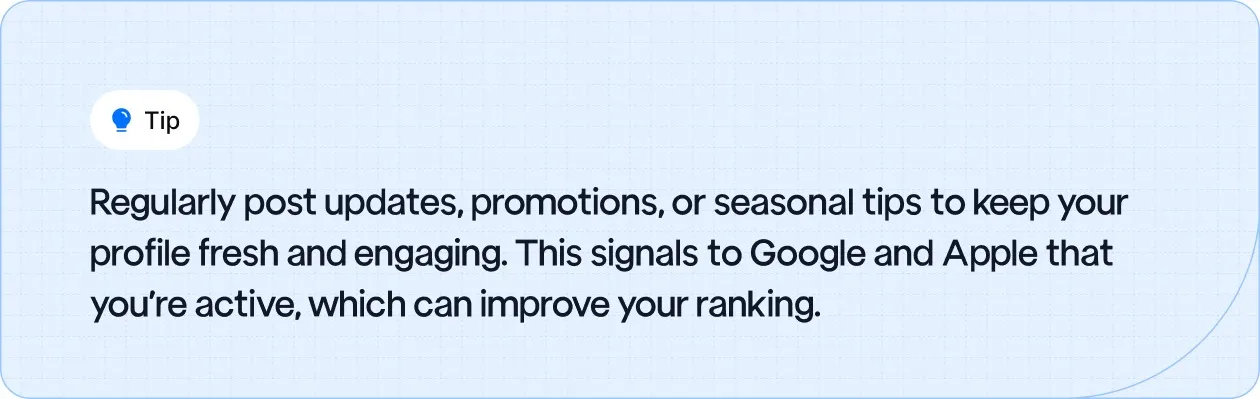
These platforms are crucial for local SEO, and optimizing them correctly will ensure your business shows up when potential customers search for drain cleaning or plumbing services nearby.
Want more calls from local clients?
The right profile optimization can put you in front of customers exactly when they need you.
Get More Calls Today
2. Referral Program
A simple referral program is a low-cost, highly effective way to attract new customers. Word of mouth is powerful, but when you encourage it, you’re amplifying the impact.
- Offer a reward: Give your existing clients a reason to refer others, such as a discount on their next service or a small cash incentive.
- Easy for customers: Make sure the process is simple, provide them with a referral card or a quick online form they can pass along to friends or family.
- Why it works: People trust their friends and family more than any advertisement, and referrals often result in higher-quality, ready-to-convert customers.
A well-executed referral program can generate a steady stream of drain cleaning jobs while fostering trust in your business.
3. Network with Local Businesses
Building strong relationships with other local businesses can open the door to a wealth of new clients. Property managers, real estate agents, and even other plumbing companies can be valuable sources of referrals.
- Real Estate Agents: They often have clients who need home inspections and may encounter plumbing issues like slow drains during property showings.
- Property Managers: These professionals regularly manage multiple units, which means they deal with recurring plumbing issues, including drain cleaning.
- Contractors: Plumbing issues are often discovered during renovations. Partnering with contractors who don't specialize in drain cleaning can create mutually beneficial relationships.
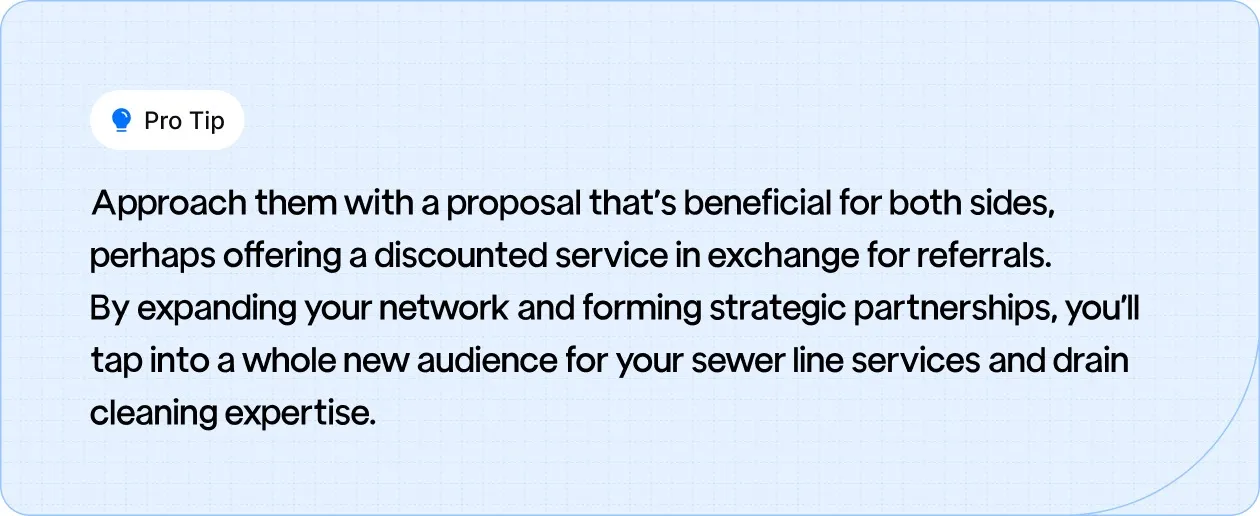
b) Master Local Search for Drain Cleaning Clients
To attract more local drain cleaning clients, mastering local search is crucial. By focusing on location-specific keywords, optimizing business listings, and managing customer reviews, you’ll increase your visibility and ensure the right clients can find you when they need your services most.
4. Location-Specific Keywords
Local SEO is your best friend when it comes to attracting drain cleaning clients. Many people look for emergency plumbing services like drain cleaning and sewer line repairs in their immediate area, which is why optimizing for location-specific keywords is essential.
Start by using terms like "drain cleaning services Boston" or "sewer line services New York City". These search terms are often used by customers who need help right away, and they’ll help you show up when it matters most.
- Tip: Create dedicated pages for each service area you serve. By doing this, you can better target local clients and ensure they find you when they need plumbing services nearby.
- For example, if you serve multiple neighborhoods or cities, make sure you have separate pages like "Drain Cleaning in Chicago" and "Emergency Sewer Line Repairs in San Francisco" to capture more localized searches.
5. Claim and Optimize Listings
Claiming and optimizing your business listings on trusted platforms like Yelp, Angie’s List, and other local directories is a must for building credibility and improving your local SEO.
These platforms act as important citations that tell search engines you’re a legitimate business with a strong local presence.
- Tip: Make sure your business name, address, and phone number (NAP) are consistent across all listings. This helps build trust with search engines like Google and Apple, which reward consistency with higher rankings.
- Additionally, synchronize your Google Business Profile and Apple Business Connect information. Ensuring these details match across all platforms will help improve your visibility in local search results and on maps, making it easier for customers to find you quickly.
6. Leverage Reviews for Lead Qualification
Online reviews are a powerful tool for lead qualification. Positive reviews improve your local ranking and build trust with potential clients who are researching service providers.
Studies show that 92% of consumers read online reviews before making a decision, especially for services like plumbing.
- Tip: After completing a job, reach out to your satisfied clients and ask for a review. Provide them with an easy link to your review page and encourage them to share their experience.
- Bonus Tip: Respond to all reviews, positive or negative. Your response shows potential clients that you’re committed to customer satisfaction, which improves your chances of being hired.
By mastering local search optimization, claiming listings, and strategically leveraging reviews, you’ll be well on your way to attracting more drain cleaning clients and establishing your business as the go-to provider in your area.
Must Read: SEO Strategies for Plumbing Businesses to Rank Locally
c) Build Referral Partnerships for Steady Client Acquisition
Referral partnerships are a powerful way to generate consistent business without relying on costly ads. By connecting with trusted professionals like home inspectors and property managers, you can tap into a steady stream of clients in need of drain cleaning and sewer line services.
This section will explore how to build strong, mutually beneficial relationships that keep your business growing.
7. Identify Key Partners
Forming strategic partnerships with home inspectors, contractors, and property managers can be a game-changer for your plumbing business. These professionals regularly come across clients who need drain cleaning and sewer line services, making them ideal partners for referrals.
- Home Inspectors: Often spot plumbing issues during property inspections and can easily recommend a trusted plumber for drain cleaning services.
- Contractors: While handling home or commercial renovations, contractors might find plumbing issues like clogged drains or damaged pipes that need immediate attention.
- Property Managers: Managing multiple rental properties often involves regular plumbing maintenance, and these professionals need reliable plumbers for frequent drain cleaning and sewer line maintenance.
These referral partnerships create a steady flow of potential clients who are already in need of your services, especially when they have ongoing maintenance needs.
8. Engaging with Partners
Building strong, lasting relationships with your referral partners doesn’t happen overnight, but with the right approach, you can cultivate a reliable referral pipeline. Here’s how to get started:
- Direct Outreach: Start by reaching out via personalized emails, calls, or even in-person visits. Introduce your services, explain how you can help their clients, and highlight your specialization in drain cleaning and sewer line services.
- Offer Value: Make the partnership beneficial for both sides. Consider offering exclusive discounts or priority service to your partners’ clients in exchange for referrals. This creates a win-win situation.
- Qualify Your Partners: Not every potential partner will refer high-quality clients. Use lead qualification strategies to assess which partners consistently provide the best referrals. Track the leads from different sources and adjust your outreach accordingly to focus on the most productive partnerships.
By nurturing these partnerships, you’re establishing your business as a go-to expert in your community for drain cleaning and sewer line services. These ongoing relationships can be the cornerstone of a steady client acquisition strategy that keeps your schedule full.
d) Create Content that Draws Clients to Your Drain Cleaning Services
Engaging content is key to attracting the right clients. By creating service-specific blog posts, offering useful lead magnets, and showcasing your expertise through educational videos, you can build trust and establish your business as the go-to solution for drain cleaning and sewer line issues.
These strategies provide value to potential clients and turn your website into a powerful tool for lead generation.
9. Service-Specific Blog Content
To attract clients who need your services, your website should speak directly to their needs. Instead of generic blog posts, focus on creating detailed, service-specific content that addresses common problems people face. Think about writing posts that go beyond the basics, such as:
- "How to Prevent Clogged Drains in Your Home"
- "Why Sewer Backups Happen and How to Avoid Them"
- "5 Essential Tips for Maintaining Your Sewer Lines"
Each post should offer real value by helping clients understand their plumbing issues while subtly highlighting your expertise. By using keywords like "clogged drain solutions" or "prevent sewer line backups," you ensure that your blog is a resource that draws in clients actively searching for solutions.
10. Lead Magnets for Drain Cleaning
Transform your website into a lead-generating machine by offering free downloadable resources in exchange for client contact information. Think about creating lead magnets like:
- Drain Cleaning Checklist: A simple guide that helps homeowners identify early signs of drain issues.
- Sewer Line Maintenance Guide: An in-depth resource that educates customers on regular sewer care, positioning you as the trusted expert.
These valuable tools educate your audience and help you build a contact list of people who are likely to need your services in the near future. You can follow up with them about services, special offers, or helpful tips.
11. Incorporating Videos
Videos are a powerful way to connect with potential clients and show them exactly how you work. Create educational videos showcasing your drain cleaning equipment, demonstrating the hydro-jetting process, or explaining common plumbing problems.
These videos can be shared across your website and social media platforms like YouTube, Instagram, and Facebook.
Must Read: 15 Smart Marketing Moves to Drive Growth for Your Home Services Business
Attract more clients with valuable content.
High-quality blog posts, lead magnets, and videos not only educate your audience but also improve your visibility.
Turn Content Into Clients
e) Social Media Strategies for Local Drain Cleaning Services
Social media is a powerful tool for building local visibility and trust with potential clients. By showcasing your work on platforms like Facebook, Instagram, and TikTok, engaging in community groups, and running targeted ads, you can connect with customers in need of drain cleaning services and position your business as their go-to solution.
These strategies help grow your business organically and keep it top-of-mind when emergencies arise.
12. Leverage the Power of Facebook, Instagram, and TikTok
Social media is a powerful tool for growing your drain cleaning business. Use these platforms to showcase your expertise and build relationships with potential clients. Here's how:
- Facebook & Instagram: These platforms are ideal for connecting with local clients. Share before-and-after photos, showcasing the quality of your work.
Post seasonal promotions, like special deals for fall drain cleaning, or run client testimonials that highlight your professionalism and reliability.
- TikTok: Don’t underestimate the power of TikTok’s short-form videos. This platform’s audience is younger, often first-time homeowners or renters who need help with plumbing issues.
Create fun, engaging videos that show you in action, from clearing a tough blockage to explaining how your equipment works. TikTok is perfect for offering quick tips or answering common plumbing questions in a way that grabs attention.
13. Join Local Community Groups
Facebook and Nextdoor are great places to engage with your local community. By participating in local groups, you position yourself as a trusted neighbor who understands the area’s plumbing needs.
- Share plumbing tips or offer quick advice on minor drain issues to engage potential clients.
- Use these platforms to promote your services when you’re offering specials or available for emergency drain cleaning. Active participation builds trust and makes your business visible to people in need of immediate assistance.
14. Targeted Ads to Reach Local Customers
Running targeted ads on Facebook, Instagram, and TikTok can help you reach people who are actively searching for drain cleaning services in your area.
- Facebook & Instagram Ads: These ads can be set up to target local homeowners who are experiencing plumbing problems. You can narrow down your audience based on location, age, and interests (e.g., homeownership or DIY plumbing) to ensure you’re reaching the most relevant people.
- TikTok Ads: Leverage TikTok’s ad format to reach younger homeowners or renters who may not know they need professional plumbing help until they see your tips or services.
With social media marketing, you can create a consistent presence that keeps your services top of mind for local customers. Sharing helpful content, engaging in community groups, and running targeted ads are all strategies that will help your drain cleaning business grow organically.
f) Track and Improve Your Drain Cleaning Client Acquisition Strategy
Tracking the effectiveness of your marketing efforts is crucial to attracting the right clients for your drain cleaning services. By using the right tools and regularly adjusting your strategies, you can focus your resources on what works and improve your client acquisition over time.
15. Track Lead Sources
To optimize your marketing strategies, you first need to know where your leads are coming from. Tools like Google Analytics and call tracking help you monitor performance across various channels, such as SEO, social media, and paid ads.
- Call Tracking: Set up unique tracking numbers for different sources (website, ads, social media) to know exactly which marketing effort drives the most calls.
- Google Analytics: Monitor website traffic and identify which pages and keywords bring in the most relevant visitors.
16. Improve Lead Qualification
By evaluating which sources deliver the most qualified leads, you can adjust your marketing to target the clients most likely to convert. Understanding which inquiries need immediate attention will save you time and resources.
- Lead Qualification Forms: Use short forms with key questions (e.g., severity of the plumbing issue) to help qualify leads quickly.
- Conversion Tracking: Identify which sources lead to high conversions so you can focus your energy there.
17. Data-Driven Adjustments
Regularly analyzing your data helps you identify underperforming strategies and adjust your efforts to stay on track. Adjust ad spend, change tactics, or refine your lead generation forms based on performance insights.
- Test and Adapt: Run test campaigns to see what resonates with your audience, and adjust your strategy as needed.
- Review Performance Regularly: Continually assess your ROI to ensure you’re investing in the best-performing channels.
Ready to Attract More Clients and Grow Your Plumbing Business?
By now, you’ve gathered the tools and strategies to drive more drain cleaning clients to your business.
Optimizing your Google Business Profile and Apple Business Connect, creating referral programs that tap into your existing client base, and using local SEO and targeted ads are all key steps.
With these strategies, you now have a roadmap to ensure your plumbing services are visible and accessible to those who need them most. Implement these strategies consistently, and watch your client base grow.
Put these strategies into action and attract more clients.
Gushwork helps optimize your SEO strategy by ensuring your plumbing business stands out in local search results.
Book Your Consultation Now

Digital Marketing
Dec 10, 2025
5 mins
These 8 Marketing Metric Groups Are the Key to More Manufacturing Sales. Are You Tracking Them?
Ishani Mitra
Have you ever looked at your marketing reports and thought, “This tells me a lot, but none of it helps me understand if we’re actually getting good prospects”?
Most manufacturers are stuck there. But just like production, marketing only works when you’re measuring the right things. That’s why tracking meaningful KPIs is critical.
In this guide, we’ll break down the marketing KPIs that matter most for manufacturing companies.
Understanding Marketing Metrics in a Manufacturing Context
Marketing metrics in manufacturing exist for a very different reason than they do in faster, digital-first industries. Here, buying decisions are slow, technical, and tied closely to operations. A spike in leads or traffic rarely translates directly into revenue, and short-term performance often hides long-term risk.
In this context, metrics are a way to understand whether marketing is aligned with how the business actually sells, produces, and delivers.
The most useful metrics help teams see cause and effect: how demand behaves upstream, where it breaks down, and whether growth is strengthening the business or quietly straining it.
Before deciding what to track, it is important to be clear about what different measurements are meant to do.
Metrics vs KPIs vs Key Results in Manufacturing Marketing
Marketing Metrics for Manufacturing That Actually Hold Up in a Leadership Review
Manufacturing teams track a lot of numbers for a reason. In this industry, demand only becomes “good demand” when it can be produced profitably, delivered reliably, and repeated. That means marketing metrics (leads, CAC, ROI) only tell the truth when you read them alongside the manufacturing signals that shape customer experience, margins, and capacity.
This section gives you a practical way to do that.
Lead, Funnel, and Demand Quality Metrics
Early-stage marketing activity almost always looks healthier than it actually is. Website visits, form fills, and inquiries tend to spike long before there is any real indication of technical fit, budget readiness, or delivery feasibility. These metrics exist to prevent teams from mistaking interest for intent.
Lead and funnel metrics in manufacturing are about understanding whether marketing is sourcing demand that the business can realistically convert, deliver, and profit from:
- Marketing Qualified Leads (MQLs)
An MQL in manufacturing should reflect fit, not curiosity. Engagement alone is not enough. Industry, application, geography, expected order size, and basic feasibility matter more than clicks or downloads. When MQL numbers rise but downstream movement stalls, it usually means marketing is attracting attention without intent.
- Sales Qualified Leads (SQLs)
SQLs represent leads sales is willing to spend time on. Tracking them alongside MQLs shows whether marketing’s idea of “qualified” matches reality. A widening gap between MQLs and SQLs almost always points to targeting or positioning issues upstream.
- MQL-to-SQL Acceptance Rate
This metric reveals alignment across marketing and sales better than any dashboard summary.
Formula: MQL-to-SQL Acceptance Rate (%) = (SQLs ÷ MQLs) × 100
A declining rate typically signals ICP drift, overstated capabilities, or demand that operations cannot realistically support.
- Opportunity Creation Rate
This measures how many SQLs survive technical review, pricing discussions, and delivery checks to become real opportunities. Strong acceptance with weak opportunity creation suggests early qualification is still too shallow.
- Revenue per MQL
Manufacturing deals vary widely in size, making lead volume misleading.
Formula: Revenue per MQL = Total Revenue Attributed to MQLs ÷ Total MQLs
This metric shows whether marketing is sourcing meaningful work or low-value enquiries that drain sales time.
- Revenue per Opportunity
Tracking revenue at the opportunity level highlights which campaigns bring in strategic, repeatable projects versus one-off or low-margin jobs.
- Sales Cycle Length
Long cycles are normal in manufacturing, but increases over time deserve attention. Rising sales cycle length often reflects friction between promise and execution, such as unclear specifications or underestimated lead times.
- Projected Customer Demand
Demand forecasting helps marketing pace activity against real capacity. Generating demand that the business cannot fulfil may inflate short-term metrics, but it weakens trust and future conversion.
Production Efficiency and Capacity Metrics
In manufacturing, marketing credibility is built long before a campaign launches. It is shaped by how consistently the factory performs when demand shows up. These metrics help marketing teams understand the real ceiling of growth, so promises made upstream do not collapse downstream.
- Production Volume
Production volume reflects how much output the business can deliver over a given period under normal conditions. From a marketing perspective, this metric defines the outer boundary of safe demand generation.
When marketing activity pushes demand beyond sustainable volume, the result is rarely faster growth. It is backlog, missed dates, and damaged trust. Stable volume trends give marketing room to scale. Volatile or constrained volume calls for restraint and prioritisation.
- Production Attainment
Production attainment measures how closely actual output matches planned output.
Formula: Production Attainment (%) = (Actual Output ÷ Planned Output) × 100
Consistently low attainment signals execution instability. In these conditions, aggressive campaigns amplify delivery risk rather than revenue. Marketing should treat poor attainment as a warning to slow demand or tighten targeting.
- Capacity Utilization
Capacity utilization shows how much of the factory’s theoretical output is being used.
Formula: Capacity Utilization (%) = (Actual Output ÷ Maximum Possible Output) × 100
High utilization suggests the business is operating near its limits, where marketing should focus on margin quality, pricing power, or selective demand. Low utilization, on the other hand, may indicate room for expansion-focused campaigns.
- Throughput
Throughput measures how many units move through production in a given timeframe. Unlike volume, it highlights flow rather than totals. For marketing, throughput constrains lead-time promises. Campaigns that promote speed or responsiveness must reflect actual throughput, not theoretical capacity.
- Cycle Time
Cycle time tracks how long it takes to convert raw inputs into finished output. Rising cycle times weaken claims around responsiveness and flexibility. When cycle time increases, marketing messaging should shift away from speed and toward reliability, planning, or quality to stay credible.
- Work in Process (WIP)
WIP represents inventory currently tied up in production. Elevated WIP often indicates bottlenecks, scheduling issues, or uneven demand.
From a marketing standpoint, high WIP is a signal to avoid promoting quick turnarounds or custom flexibility, as execution risk is already elevated.
- Schedule or Production Attainment
This metric measures how closely production adheres to planned schedules. Deviations increase risk when marketing commitments are time-sensitive, such as seasonal demand or customer deadlines. Strong schedule adherence gives marketing confidence to make firm delivery claims.
- Takt Time
Takt time represents the pace at which production must operate to meet customer demand.
Formula: Takt Time = Available Production Time ÷ Customer Demand
Understanding takt time helps marketing align demand generation with operational rhythm. When marketing pushes demand faster than takt time allows, stress accumulates across the system.
Equipment and Operations Effectiveness Metrics
Reliability is one of the hardest things for marketing to claim and one of the easiest things for customers to verify.
In manufacturing, buyers remember missed dates, inconsistent output, and production slowdowns far longer than they remember campaigns. These metrics exist to show whether the business can consistently do what marketing says it can.
- Overall Equipment Effectiveness (OEE)
OEE measures how effectively equipment produces saleable output when it is scheduled to run. It combines availability, performance, and quality into a single indicator of operational stability.
Formula: OEE = Availability × Performance × Quality Low
OEE increases downtime, slows throughput, and raises quality risk. When OEE is unstable, marketing claims around reliability, speed, or consistency become difficult to defend, even if demand exists.
- Overall Operations Effectiveness (OOE)
OOE extends OEE by factoring in planned downtime, offering a more realistic view of how operations perform across real-world conditions. This metric helps marketing teams understand true scalability. A plant may look efficient during scheduled runs, but frequent planned stoppages reduce the ability to absorb demand spikes without disruption.
- Total Effective Equipment Performance (TEEP)
TEEP measures how much output equipment generates relative to total available time, not just scheduled production hours. This makes it particularly useful for long-term growth planning. From a marketing perspective, TEEP reveals whether additional demand can be absorbed through better utilisation or whether capacity expansion is required before scaling campaigns.
- Machine Downtime Rate
This metric tracks how often and how severely equipment becomes unavailable. Downtime directly erodes delivery reliability and increases lead time variability. High downtime rates should immediately temper marketing promises around turnaround speed, flexibility, or just-in-time delivery.
- Downtime as a Proportion of Operating Time
Looking at downtime as a percentage of operating time helps quantify reliability risk. Even modest downtime percentages can have outsized effects in high-utilisation environments, where small disruptions cascade into missed commitments. Marketing should account for this when positioning uptime or consistency as differentiators.
- Changeover Time
Changeover time measures how long it takes to switch equipment from one job to another. Long changeovers reduce flexibility and make short runs, custom work, or mixed production schedules more expensive and slower. When changeover times are high, marketing should avoid promoting agility or rapid customisation without clear qualification.
- Asset Utilization
Asset utilization shows how effectively capital-intensive equipment is being used over time. Low utilisation may signal room for growth, while high utilisation suggests that marketing-led volume increases could strain reliability. Understanding this balance helps marketing align growth ambitions with operational reality.
Quality and Reliability Metrics That Shape Brand Trust
In manufacturing, brand trust is built on consistency. Buyers may be persuaded by capability on the first order, but they stay, refer, and pay premiums based on how reliably a supplier delivers to spec. Quality metrics are where marketing promises meet operational reality, and where trust is either reinforced quietly or lost very quickly.
- First Time Right (FTR)
FTR measures how often production meets specifications on the first attempt, without rework or correction. High FTR indicates process maturity and consistency, both of which support repeat orders and long-term customer confidence. When FTR is low, marketing-driven growth often amplifies hidden costs and delivery delays rather than revenue.
- First Pass Yield (FPY)
FPY tracks the percentage of units that pass through a process without defects or rework. Declining FPY increases cost leakage and extends lead times, even when output volume remains stable. From a marketing perspective, weak FPY undermines claims around efficiency and reliability.
- Yield and Total Yield
Yield compares good output to total output at specific stages, while total yield reflects cumulative performance across the full production process. Gaps between stage-level yield and total yield often point to systemic quality issues that surface downstream, where they are far more expensive to fix and harder to explain to customers.
- Defect Density
Defect density measures the number of defects per unit or per batch. Rising defect density signals declining process control. Even when defects are caught internally, persistent increases weaken marketing credibility because they tend to show up later as delays, pricing pressure, or customer dissatisfaction.
- Scrap Rate and Scrap Material Value
Scrap rate measures the proportion of materials discarded due to defects, while scrap material value quantifies the financial impact. High scrap erodes margins on marketing-driven growth and limits pricing flexibility, especially in cost-sensitive or competitive markets.
- Rework Rate
Rework rate captures how often products must be corrected before shipment. Rework inflates cost, slows throughput, and increases variability in delivery times. Marketing teams should be cautious about promoting speed or flexibility when rework rates are elevated.
- Cost of Poor Quality (COPQ)
COPQ aggregates the total financial impact of quality failures across the business.
Formula: COPQ = Internal Failure Costs + External Failure Costs
Internal failures include scrap and rework, while external failures include returns, warranty claims, and field fixes. COPQ directly connects quality performance to margin erosion and brand damage.
- Customer Reject Rate and Return Merchandise Authorizations (RMAs)
These metrics capture quality failures that reach the customer. Rising reject rates and RMAs are early indicators of churn risk and negative word-of-mouth, particularly damaging in industrial markets where trust and long-term relationships drive growth.
Delivery, Responsiveness, and Customer Experience Metrics
Customers rarely judge you by what you say. They judge you by what shows up at their dock, and when. A late shipment, a partial delivery, or a last-minute change often outweighs months of good communication.
These metrics capture that moment of truth. They show whether the expectations set by marketing and sales survive contact with reality, and whether customers come back because the experience matched what they were told to expect.
- On-Time Delivery (OTD)
OTD measures how often orders are delivered on or before the agreed date.
Formula: OTD (%) = (Orders Delivered On Time ÷ Total Orders) × 100
In B2B manufacturing, OTD is one of the strongest predictors of repeat orders. Consistent performance reinforces trust, while missed deliveries are remembered far longer than successful campaigns.
- On-Time Delivery to Commit
This metric goes a step further by measuring adherence to the specific dates promised to customers. High performance here indicates alignment between sales commitments, production planning, and marketing messaging. Poor performance often signals over-promising during demand generation.
- Lead Time
Lead time tracks the total duration from order placement to delivery. Longer lead times reduce competitiveness, especially in markets where buyers compare suppliers on responsiveness. Marketing should align positioning around speed or flexibility with actual lead time performance, not aspirational targets.
- Customer Fill Rate
Fill rate measures how completely customer orders are fulfilled from available stock or production capacity. Partial fulfilment erodes confidence and increases follow-up effort, even when deliveries are technically on time. High fill rates support marketing claims around reliability and readiness.
- Perfect Order Percentage
This metric captures orders delivered on time, in full, and without errors. Perfect order percentage is a direct measure of execution reliability and one of the clearest links between marketing promise and operational delivery.
- Customer Satisfaction (CSAT)
CSAT reflects immediate customer perception after delivery or service interaction. While influenced by many factors, sudden drops in CSAT often correlate with delivery or quality issues rather than marketing missteps.
- Net Promoter Score (NPS)
NPS measures long-term loyalty and willingness to recommend, making it more valuable for assessing sustainable growth than short-term campaign metrics. Strong NPS scores indicate that delivery and experience consistently support the brand story marketing tells.
Cost, Profitability, and Financial Impact Metrics
Revenue is easy to celebrate. Profit is harder to protect.
In manufacturing, growth that looks strong on the top line can quietly weaken the business if costs rise faster than pricing, or if new demand absorbs capacity without improving returns. These metrics exist to answer a simple but uncomfortable question: Is marketing bringing in work that actually strengthens the business?
- Manufacturing Cost per Unit (with and without materials)
This metric shows how much it truly costs to produce a single unit, separating material costs from labour, overhead, and energy where needed. For marketing, rising cost per unit reduces pricing flexibility and narrows the types of demand that remain profitable to pursue.
- Manufacturing Cost as a Percentage of Revenue
This ratio reveals how much of every revenue dollar is consumed by production. When this percentage climbs as revenue grows, it signals that marketing-driven growth may be eroding margins rather than strengthening them.
- Unit Cost
Unit cost represents the total cost required to manufacture one unit, including direct and indirect expenses. Accurate unit cost visibility is critical for pricing decisions, campaign profitability, and deciding which types of orders marketing should prioritise.
- Contribution Margin
Contribution margin measures how much revenue remains after covering variable costs.
Formula: Contribution Margin = Revenue − Variable Costs
This metric helps marketing teams understand whether new demand contributes meaningfully toward fixed costs and profit.
- Contribution Margin Ratio
Formula: Contribution Margin Ratio = Contribution Margin ÷ Revenue
This ratio allows comparisons across products, customers, or campaigns. Declining ratios often indicate that marketing is attracting price-sensitive or low-margin work.
- Return on Assets (ROA)
Formula: ROA = Net Income ÷ Total Assets
ROA shows how efficiently the business uses its assets to generate profit. Marketing growth that lowers ROA may increase revenue while weakening overall efficiency.
- Return on Net Assets (RONA)
Formula: RONA = Operating Profit ÷ Net Assets
RONA is particularly useful for capital-intensive manufacturers, highlighting whether growth improves returns on invested capital.
- EBITDA and Net Operating Profit
These metrics provide executive-level context for evaluating marketing’s financial contribution beyond campaign ROI. Sustained improvements here indicate that marketing activity is supporting healthier operations, not just pipeline growth.
- Cash-to-Cash Cycle Time
This metric measures how long cash is tied up from purchasing materials to receiving payment from customers. Shorter cycles improve liquidity and resilience, while longer cycles increase financial risk during growth phases.
- Energy Cost per Unit
Energy costs are increasingly significant in manufacturing cost structures. Rising energy cost per unit reduces pricing flexibility and can quickly erode margins on marketing-driven volume increases.
Maintenance, Compliance, and Risk Metrics
In manufacturing, stability is rarely visible when things are going well. It shows up when something goes wrong. Buyers, especially at the enterprise level, pay close attention to how suppliers manage risk, prevent disruption, and operate responsibly over time.
These metrics speak less to day-to-day output and more to how dependable the business is under pressure. For marketing teams, they matter because resilience, safety, and compliance increasingly influence supplier shortlists, contract renewals, and long-term partnerships.
- Mean Time Between Failure (MTBF)
MTBF measures the average operating time between equipment failures. Higher MTBF indicates stable, well-maintained operations and supports marketing claims around reliability and uptime. Declining MTBF often precedes delivery issues that customers notice long before internal dashboards do.
- Mean Time to Failure (MTTF)
MTTF estimates the expected operational lifespan of equipment before failure. Understanding MTTF helps set realistic expectations around equipment reliability and replacement planning, which indirectly affects service continuity and delivery commitments.
- Maintenance Cost per Unit
This metric tracks how much maintenance expense is incurred for each unit produced. Rising maintenance cost per unit often signals aging equipment or inefficient maintenance practices, both of which can undermine margin and delivery consistency as demand scales.
- Percentage Planned Maintenance (PMP)
PMP measures how much maintenance work is scheduled proactively rather than triggered by breakdowns.
Formula: PMP (%) = (Planned Maintenance Hours ÷ Total Maintenance Hours) × 100
Higher PMP reflects operational maturity. It reduces unexpected downtime and allows marketing teams to position reliability with greater confidence.
- Planned vs Emergency Maintenance Work Orders
The balance between planned and emergency work orders reveals whether the operation is in control or constantly reacting. A high share of emergency maintenance often leads to unpredictable delivery and weakened customer confidence.
- Health and Safety Incidence Rate
Safety performance is increasingly part of supplier evaluations, particularly for large manufacturers and regulated industries. Strong safety records signal disciplined operations, while poor performance can disqualify suppliers regardless of product quality or price.
- Environmental Incidents and Non-Compliance Events
Environmental performance now plays a direct role in procurement decisions and long-term contracts. Incidents or compliance failures can damage brand trust and limit eligibility for enterprise or sustainability-driven customers.
Workforce and Innovation Metrics That Influence Growth
These metrics sit at the intersection of capability and momentum. They reveal whether the organisation can absorb new demand without burning out teams or diluting quality.
For marketing, this category matters because every promise eventually runs through people and processes. When workforce capacity and innovation discipline are weak, even well-targeted growth becomes fragile.
- Revenue per Employee
This metric measures how much revenue the business generates for each employee. Rising revenue per employee often indicates healthy productivity as demand scales. Sharp increases or declines, however, can signal imbalance, either through overextension or underutilisation of the workforce.
- Profit per Employee
Profit per employee adds margin context to productivity. It helps distinguish between growth driven by efficiency and growth driven by volume alone. Marketing-led demand that lowers this metric may be expanding activity without strengthening the business.
- Overall Labor Effectiveness (OLE)
OLE applies the logic of equipment effectiveness to labour performance, combining availability, performance, and quality. Low OLE suggests that labour constraints, skills gaps, or scheduling issues will limit how much demand the organisation can handle reliably.
- Overtime Rate
Overtime measures how often employees work beyond standard hours to meet demand. Short-term spikes can be manageable, but sustained high overtime signals capacity strain, increased error rates, and rising turnover risk, all of which undermine delivery and customer experience.
- Employee Turnover Rate
Turnover captures how frequently employees leave the organisation. High turnover disrupts process knowledge, weakens consistency, and erodes customer relationships, especially in specialised or technical manufacturing environments.
- Rate of New Product Introduction (NPI)
NPI measures how frequently new products or variants are successfully brought to market. A strong NPI rate supports marketing differentiation and relevance, while stagnation limits how effectively marketing can respond to changing customer needs.
- Engineering Change Order (ECO) Cycle Time
ECO cycle time tracks how quickly engineering changes move from request to implementation. Long cycle times reduce responsiveness to customer feedback and market shifts, making it harder for marketing to position flexibility or customisation credibly.
- Process Innovation Implementation Rate
This metric measures how quickly process improvements are adopted across operations. Slow implementation often signals organisational friction that constrains scalability and consistency.
- Return on Innovation Investment (ROII)
ROII evaluates whether spending on innovation translates into measurable business impact. It helps determine whether innovation efforts are creating real market advantage that marketing can confidently promote, or simply adding complexity without return.
Conclusion
Good marketing metrics do not exist to prove effort. They exist to create alignment.
For manufacturing companies, the most valuable metrics are the ones that connect demand to reality. They show when growth is sustainable, when it is risky, and when it is quietly eroding margins or trust. They help teams slow down when needed, push harder when the system can handle it, and focus on the kind of work that actually strengthens the business.
The goal is not to track everything. It is to track what changes decisions.

Digital Marketing
Dec 22, 2025
5 mins
What Worked For Junk Removal Marketing Last Year Is Already Outdated. Here’s The 2026 Playbook
Ishani Mitra
Ever look at other junk removal companies and wonder how they stay busy all week while you’re waiting for the next call? Most of the time, it’s because customers notice them first. People search, pick the business that looks solid, and move on with their day.
That’s why your marketing matters. You need to know and implement the basics that help people see what you do, trust it, and contact you without thinking twice.
In this blog, you’ll learn what junk removal marketing actually is, why it matters even if you’ve been doing this for years, and the simple steps that bring in steady, good-quality jobs.
How Do You Market A Junk Removal Business?
Junk removal marketing is the practice of promoting your junk removal services to attract more clients, build a solid reputation, and increase job bookings. As a junk removal business, your goal is to ensure that your services are easy to find when potential customers search for solutions to their clutter problems.
Effective marketing for junk removal businesses involves a combination of strategies that target local customers, highlight your unique value, and build trust in your community.
Here’s why it matters:
You Need People To Find You Fast
When someone needs junk removal, they don’t plan it days ahead. They search on their phone and pick the first business that looks real, available, and reliable. If your business isn’t visible online, they won’t even know you exist.
It Shows The Value You Offer
Many people will choose the cheapest-looking option if they can’t tell the difference. A clear online presence shows your pricing, photos, reviews, and services, so customers see the value you offer.
It Brings You Better-Quality Jobs
A strong marketing setup helps filter out low-value calls and attracts people who actually need full cleanouts, appliance removal, or recurring work. When your message is clear, the right customers come in.
It Builds Trust Before You Even Show Up
People don’t want strangers showing up at their home without knowing who they are. Good marketing shows real photos, honest reviews, and clear details about your work. That trust makes customers comfortable to book.
A strong marketing strategy helps people find you, trust you, and choose you. Without it, you’re relying on chance in a business where people decide quickly and move on even faster.
11 Essential Junk Removal Marketing Strategies
These strategies help your junk removal business get found, trusted, and chosen:
1. Strengthen Your Local Basics with Advanced Local SEO
Local visibility is the core of any junk removal marketing strategy. When customers need junk removal services, they’re looking for the nearest and most reliable options. Ensuring your business shows up in local search results is crucial.
- Google Business Profile (GBP):
- Verify your profile and add essential details like business hours, contact information, and service areas.
- Upload real photos of your trucks, team, and past jobs to build trust.
- Post weekly updates (special offers, job highlights, or helpful tips) to keep your business active.
Pro Tip: Respond to all reviews (both positive and negative) within 48 hours to show you care and increase trust.
- Apple Business Connect: Many customers use Apple Maps and Siri. Ensure your business is listed on Apple Business Connect for better reach on Apple devices.
- Local Backlinks: Get listed in local directories like Yelp, BBB, and local Chamber of Commerce. Collaborate with other businesses like real estate agents and property managers to earn backlinks and boost local SEO.
Pro Tip: Optimize your GBP and include service schema to boost local SEO visibility. This makes your business stand out in local searches and increases your chances of being chosen.
Get Found Faster on Google Maps
A strong Google Business Profile brings in the easiest, highest-intent leads. We optimize your profile so locals see you first and choose you over competitors.
Book Your Consultation
2. Structure Your Website for Conversion Optimization (CRO)
Once a potential customer lands on your website, they need to quickly find what they’re looking for. A clear and user-friendly structure that speaks to their intent is key to conversion optimization.
- Service Pages: Create dedicated pages for each junk removal service (e.g., construction debris removal, furniture disposal). Each page should clearly explain the service, pricing, and benefits.
- Location Pages: If you cover multiple areas, create location-specific pages (e.g., “Junk Removal in Brooklyn”). This helps both search engines and customers understand your service coverage.
Conversion-focused structure tips
- One service per page
- Clear headline with service + location
- Simple price cue if possible
- 3–5 bullets explaining what’s included
- Before-and-after photos
- Short FAQ section
- Click-to-call and booking buttons visible on mobile
- Internal Linking: Link related pages (e.g., "Furniture Removal" → "Garage Cleanouts" → "Pricing") to guide visitors through your site and help search engines understand your structure.
- Mobile Optimization: Since many customers search for services on mobile devices, make sure your website is mobile-responsive and loads fast. Ensure your call-to-action buttons are easy to click.
- Page Speed Optimization: Ensure your website is fast. Use tools like Google PageSpeed Insights to compress images, use AMP (Accelerated Mobile Pages) for mobile optimization, and improve loading speeds.
- A/B Testing: Test different versions of your landing pages and CTAs to see which performs better. This can include testing headline text, image placement, or CTA wording.
Pro Tip: Use A/B testing to optimize your service and landing pages based on customer behavior. Test variations and keep refining until you get the best conversions.
Boost Your Junk Removal Business with SEO
Get your website ranking high on search engines and start attracting more local clients. Let’s optimize your online presence!
Boost My SEO
3. Use Structured Data and Technical SEO to Win Local Search
Technical SEO is often ignored in junk removal marketing, but it plays a major role in how search engines understand your business.
Structured data helps search engines read your site more accurately.
Key schema types to implement:
- LocalBusiness schema to mark up your business info, which helps search engines understand your business better and show it in rich snippets
- Service schema to mark up specific junk removal services (e.g., furniture removal, garage cleanouts), making it easier for customers to find exactly what they need
- Review schema to support review visibility in search results
Simple steps to add schema:
- Identify your business details and services
- Use Google’s Structured Data Markup Helper or a schema generator
- Add the code to your site’s header or via Google Tag Manager
- Test with Google’s Rich Results Test
- Monitor errors in Google Search Console
4. Leverage Paid Advertising & Retargeting Campaigns
Paid ads help drive immediate leads, but successful campaigns require strategic targeting and retargeting.
- Google Ads:
- Run Google Search Ads for high-intent keywords such as “junk removal near me” or “construction debris removal.” These ads help capture customers ready to make a decision.
- Use LSAs (Local Services Ads) to be at the top of local search results when someone searches for junk removal services in your area.
- Facebook Ads:
- Use Facebook Ads for both brand awareness and direct lead generation. You can target specific demographics and geographic areas, and create custom campaigns for seasonal promotions.
- Retargeting Ads: Use retargeting campaigns via Google Display Ads or Facebook to stay in front of people who have visited your site but didn’t convert. Show them reminders or relevant offers.
- YouTube Ads: Consider YouTube video ads to promote customer testimonials or show your team in action during junk removal jobs. These can drive brand awareness and build trust.
Pro Tip: Use retargeting ads to bring back potential customers who are familiar with your business but haven’t booked yet. This can significantly increase your conversion rate.
5. Create Clear, Useful On-Page Content
Good SEO content explains what you do in plain language. It doesn’t overteach or oversell.
What works for junk removal SEO:
- Use the same wording customers search for
- Explain what the service includes and how it works
- Use real photos with descriptive captions
- Keep paragraphs short and skimmable
On-page SEO basics that still matter:
- One main keyword per page
- Natural use in headings and opening paragraph
- Short, direct meta titles
- Meta descriptions that answer why someone should click
- Descriptive alt text for every image
6. Use Video Marketing to Boost Visibility and Trust
Video content is a powerful tool for increasing brand awareness and trust. Use videos to demonstrate your services and build credibility.
- YouTube Marketing: Create how-to videos, before-and-after transformations, or customer testimonial videos showcasing your services in action.
Pro Tip: Add SEO-friendly titles and descriptions to YouTube videos to help them rank higher in search results.
- Social Media Videos: Share short videos to showcase your team in action, highlighting successful projects, or sharing quick tips on decluttering.
Video ideas that build trust:
- Before-and-after cleanouts
- Time-lapse job videos
- Short customer testimonials
- Decluttering or disposal tips
Platforms to focus on:
- YouTube for long-term visibility
- Instagram and Facebook for short-form updates
- Stories and reels for quick engagement
- Engage with Customers: Use Facebook Live or Instagram Live to engage with your audience in real-time. Answer questions, demonstrate the junk removal process, and build direct connections with your community.
Pro Tip: Use social media and YouTube videos to show behind-the-scenes footage and customer success stories to foster trust and build an emotional connection with your audience.
7. Build Local Authority Through Networking & Community Engagement
Networking with local businesses and engaging in community activities can greatly enhance your local authority and visibility.
- Partnerships with Local Businesses: Collaborate with real estate agents, property managers, or contractors to offer junk removal services for homes being sold, renovated, or cleaned out.
- Sponsorships: Sponsor local events or charitable causes. Not only does this get your business name in front of the community, but it also earns you local recognition and potential backlinks to improve your local SEO.
- Networking with Local Groups: Participate in local Facebook Groups or Nextdoor to offer helpful advice and services in your community. These platforms help you build trust and make your business more visible.
Pro Tip: Partner with local businesses for joint promotions and sponsorships, which can lead to long-term visibility and organic mentions in your community.
8. Optimize the Customer Journey for Maximum Conversions
To truly capitalize on your marketing efforts, it’s crucial to optimize the entire customer journey — from the moment they land on your site to when they book your services.
- Simplify Contact Forms: Keep forms short and easy to complete, with fields for only essential information (e.g., name, phone number, service needed).
- Clear Call-to-Action (CTA): Place clear CTAs like “Book Now”, “Get a Free Quote”, or “Schedule Pickup” on every page. Make them stand out and ensure they’re mobile-friendly.
- Booking System: Use an online booking system that allows customers to schedule junk removal jobs instantly.
Pro Tip: Use A/B testing for CTAs to see what language works best for your customers. Test phrases like “Schedule a Pickup” vs. “Get a Free Quote.”
9. Build Your Brand with a Strong USP (Unique Selling Proposition)
A strong USP will help your business stand out in a crowded market.
- Identify Your Competitive Advantage: Is your USP eco-friendly disposal? Or same-day service? Whatever sets you apart, make sure it’s clear on your website, social media, and marketing materials.
- Highlight Your USP: Your USP should be front and center on your website and Google Business Profile, especially in your service descriptions, ads, and social media posts.
Pro Tip: Ensure your USP aligns with your customers’ pain points and needs. Promote it consistently across all marketing channels.
10. Use Offline and Guerrilla Marketing to Reinforce Local Recognition
Junk removal is a highly local service, which makes offline visibility more powerful than many businesses realize.
The goal is not volume. It’s familiarity.
Offline tactics that work well for junk removal:
- Vehicle wraps: Branded trucks act as moving billboards. When they appear repeatedly in the same areas, they build recognition faster than one-time ads.
- Yard signs after completed jobs: Placing signs where work was just done creates immediate relevance and social proof within the neighborhood.
- Door hangers in targeted areas: Door hangers work best when distributed selectively, such as near recent jobs or in high-density residential zones.
- Community cleanup days: Offering free or discounted cleanup events builds goodwill, generates local mentions, and creates content for both social and local listings.
- Local pop-up events or sponsorships: Participating in neighborhood events keeps your brand visible outside search results and strengthens local trust.
When used consistently, these tactics increase recognition, support local SEO signals, and improve response rates across digital channels without requiring large budgets.
11. Track the Metrics That Matter for Junk Removal Marketing
Marketing only improves when it’s measured against real business outcomes. For junk removal companies, that means tracking performance beyond clicks and impressions.
The focus should be on how marketing turns into booked jobs and revenue.
Key metrics to track:
- Calls to bookings conversion rate: Shows how many inbound calls turn into scheduled jobs.
- Lead to job conversion rate: Helps identify gaps between marketing and follow-through.
- Average job value: Reveals the true quality of leads coming from each channel.
- Cost per booked job: More meaningful than cost per lead when evaluating spend.
- Return on ad spend (ROAS): Measures how effectively paid campaigns generate revenue.
Tools that make tracking easier:
- Google Analytics for traffic and on-site behavior
- Google Search Console for search visibility and performance
- Google Keyword Planner for keyword demand and cost insights
- SEMrush or Ahrefs for rankings, competitors, and SEO gaps
- Call tracking software to connect calls to ads and pages
Regular reviews with these marketing and SEO tools help identify what’s working, what’s underperforming, and where budget should be shifted. Even simple monthly check-ins can reveal trends that improve efficiency.
Common Mistakes to Look Out for in Junk Removal Marketing
Here are the most common issues that slow down growth and how to avoid them.
1. Missing or incomplete online listings: If your Google Business Profile or Apple Business Connect is half-filled or outdated, customers will skip you. Missing hours, no photos, or old phone numbers make your business look inactive.
2. Using unclear or confusing service descriptions: Calling yourself “full-service removal” isn’t enough. Customers need to see clear wording like “garage cleanouts,” “mattress removal,” or “appliance hauling.” Vague language makes people leave your page and pick someone else.
3. Forgetting to ask for reviews: Reviews are the biggest trust factor in this industry. If you finish jobs without asking for a review, you’re missing out on the easiest way to stand out and rank higher.
4. Having a slow or outdated website: If your site takes too long to load or doesn’t work well on phones, people won’t wait. A slow site suggests slow service, even if you’re great at the job.
5. No pricing cues anywhere: Customers hate guessing. When you don’t share starting prices or simple cost ranges, people assume you’re expensive or unreliable.
6. Posting only once in a while: Irregular posting makes your business look inactive. Weekly updates on Google, Apple, or social platforms keep you visible and relevant in your area.
7. Trying too many marketing tactics at once: Many junk removal owners jump from ads to flyers to SEO without giving anything time to work. Marketing gets easier when you focus on a few basics: GBP, a clear website, good photos, and reviews.
Get Seen. Get Bookings.
By understanding your audience, creating a strong online presence, gathering reviews, forming partnerships and tracking your results, you position your business for sustainable growth.
At Gushwork, we specialize in:
- Building SEO‑structured content that convert visitors into job bookings.
- Setting up and optimizing Google Business Profiles to help you show up in local search and attract high‑intent clients.
Ready to Grow Your Junk Removal Business?
If you want clearer visibility, steady calls, and a setup that works even on slow weeks, we can build that foundation for you.
Book Your Consultation

