


Home

Resources
Blogs
Blog
Get insights on AI, productivity, and the future of work.


Thank you! Your submission has been received!
Oops! Something went wrong while submitting the form.

Digital Marketing
Dec 22, 2025
5 mins
HVAC PPC Is Bleeding Your Margins? Here’s A Simple System That Fixes It
Ishani Mitra
You fix comfort problems fast. Your marketing should do the same. HVAC PPC (pay-per-click) connects you with people at the exact moment they need help.
In moments of emergencies, they’re not browsing, they’re ready to call.
PPC puts your name at the top of search instantly. And when your ad message and landing page align with what people are looking for, that click can quickly turn into a booked job.
In this blog, we’ll break down how HVAC PPC works, the types of PPC ads that deliver the best results, and how it fits within your overall digital strategy to help you generate more leads and get a stronger return on every ad dollar spent.
What Is HVAC PPC?
HVAC PPC (Pay-Per-Click) is a digital advertising model that helps heating, ventilation, and air conditioning companies appear at the top of search results when homeowners need quick service. Instead of waiting for organic rankings, PPC lets you pay for visibility. You’re charged only when someone clicks your ad.
A strong HVAC PPC strategy focuses on matching your ads to high-intent searches, people who are ready to book a repair, replacement, or tune-up right now. By using the right keywords, ad copy, and landing pages, PPC campaigns can turn a single search into a real lead.
It’s especially powerful for local service businesses because it targets your exact service area, filters out unqualified traffic, and puts your company in front of homeowners at the moment they’re looking for help.
How Does PPC Work?
Let's learn how it works:
1. Keywords, Bidding, and the Ad Auction
PPC begins with keywords. These are the search terms people type into Google, such as “AC repair near me” or “furnace replacement cost.”
When someone runs one of these searches, Google instantly runs an ad auction. Every advertiser bidding on that keyword enters the auction at that moment.
Your ads can appear across different placements depending on the campaign type, be it Google Search Ads, Google Local Services Ads (LSAs), Microsoft (Bing) Ads or Retargeting ads (Display and YouTube).
Winning the auction does not depend on budget alone. Google evaluates who provides the most relevant and useful experience for the searcher.
2. You Pay for Engagement and Not Exposure
With PPC, you don’t pay for showing up. You pay when someone clicks.
This model ensures your budget is spent on people who actively engage with your ad. You can control daily budgets, campaign limits, and bid strategies, which makes PPC flexible for both small HVAC companies and larger multi-location providers.
However, clicks alone don’t equal success. What happens after the click matters more.
3. Quality Score Determines Cost and Visibility
Quality Score is one of the most important concepts in PPC, yet one of the least understood.
Google assigns each keyword a Quality Score based on three factors:
- Keyword relevance: How closely your keyword matches the search intent. Tightly grouped keywords and service-specific targeting improve relevance.
- Ad relevance and expected CTR: How well your ad copy aligns with the keyword and whether users are likely to click it. Ads that clearly match the search perform better.
- Landing page experience: How useful, fast, and relevant your landing page is once someone clicks.
Higher Quality Scores lead to:
- Lower cost per click
- Better ad positions
- More consistent visibility
Poor Quality Scores force you to overpay just to stay competitive.
4. Improving Keyword and Ad Relevance
Relevance starts with structure.
Strong HVAC PPC campaigns use:
- One core service per ad group
- Closely related keywords grouped together
- Ads that mirror the exact language of the search
For example, “emergency AC repair” should lead to an ad and landing page focused entirely on emergency AC repair, not general HVAC services.
This alignment improves Quality Score and conversion rates at the same time.
5. Landing Pages Turn Clicks Into Leads
Once someone clicks your ad, Google steps back and your website takes over.
Landing pages play a critical role in PPC performance. Google evaluates them, and customers judge them even faster.
Effective HVAC landing pages:
- Load quickly on mobile
- Match the promise made in the ad
- Focus on one service and one action
- Make phone numbers and booking options obvious
- Show trust signals early, such as reviews or guarantees
A weak landing page can undo even the best keyword and ad strategy.
6. From Click to Conversion
A conversion is the action you want someone to take, usually a phone call, form submission, or booking request.
PPC campaigns should track:
- Calls from ads and landing pages
- Form submissions
- Click-to-call actions on mobile
This data allows you to see which keywords and ads actually drive real conversations, not just traffic.
7. Data, Learning, and Continuous Optimization
Every click feeds data back into the system.
Over time, PPC reveals:
- Which keywords drive calls versus low-quality inquiries
- Which services perform best by location
- Which ads convert under pressure
- Where budget is being wasted
This data is what makes PPC powerful. Campaigns improve not because of one-time setup, but because decisions are refined using real performance insights.
When managed correctly, PPC becomes a feedback loop. The more you run it, the smarter and more efficient it gets.
Over time, you can adjust your targeting, keywords, and bids to get higher-quality leads at lower costs.
Put these pieces in place, and your HVAC PPC stops being “paid traffic” and starts acting like a reliable booking engine.
10 Steps to Succeed with HVAC PPC
Running a PPC campaign for an HVAC business isn’t just about throwing money into Google Ads and hoping calls come in. It’s about knowing who you want to reach, what they’re searching for, and how to make them pick up the phone when they see your ad.
Here’s a complete, beginner-friendly breakdown of how to plan, launch, and manage a PPC campaign that actually gets you paying customers.
1. Define Who You Want Calling Before You Spend
PPC gives HVAC businesses control over who sees their ads, but that control is often underused. Many campaigns fail because they try to attract every possible customer at once.
Before launching ads, decide which types of jobs matter most to your business right now.
Common focus areas include:
- Emergency AC or furnace repair
- Full system replacement or installation
- Seasonal tune-ups and maintenance plans
- Commercial or property management contracts
Each of these audiences searches differently, has different urgency levels, and converts at different rates. Ads, keywords, and landing pages should be built around one clear intent at a time.
When messaging is vague or mixed, clicks increase but bookings do not.
2. Choose the Right PPC Platform for Your HVAC Business
Every PPC platform drives a different type of lead. HVAC campaigns perform best when platforms are selected based on the kind of work you’re trying to book, not convenience or popularity.
Instead of trying to be everywhere, focus on the channels that match your service mix and response capacity.
Google Search Ads: These are the standard paid listings you see at the top of Google results. You bid on keywords (like “furnace repair Denver”), and you pay when someone clicks your ad. They’re ideal for:
- Immediate service leads (repairs, replacements, tune-ups)
- Seasonal promotions
- High-intent buyers already comparing providers
Google Local Services Ads (LSAs): These appear above regular search ads with the “Google Guaranteed” badge. You only pay when a lead actually calls or messages you. They’re great if:
- You have verified licensing, insurance, and background checks
- You can answer calls quickly
- You want leads that are ready to book now
Microsoft Ads (Bing): Bing often has less competition and lower cost per click than Google. It tends to perform well with older demographics and desktop users, making it a useful secondary channel once Google campaigns are producing consistent results.
Most HVAC companies see the best results by starting with Google Search or LSAs, then expanding into additional platforms only after performance data supports the move.
3. Build Keyword Lists Around Booking Intent
High-performing HVAC campaigns prioritize keywords that show someone is ready to take action. These searches usually include urgency, location, or cost signals, which indicate the person is closer to booking a service.
Examples of high-intent searches include:
- “AC repair near me”
- “furnace replacement cost”
- “emergency HVAC service”
These terms may not always have the highest search volume, but they consistently produce better calls and more booked jobs.
Use structured tools to find terms your audience is actually typing and uncover opportunities you might miss otherwise:
- Google Keyword Planner for search volume and keyword suggestions
- Search term reports in Google Ads to see what people actually typed to trigger your ads
- Competitor research tools, like SEMrush to find gaps in your keyword mix
4. Set a Budget That Matches Your Market
A realistic budget is what keeps your PPC running long enough to collect useful data.
Here’s a simple way to think about it:
- Smaller towns: start around $1,000/month
- Mid-size cities: $2,000–$3,000/month
- Big metros: $3,000–$5,000/month or more
HVAC clicks average around $25–$35 per click depending on your area. But those clicks often turn into real jobs if your ad and landing page are set up right.
In the beginning, your goal is to learn which keywords convert. Once you see patterns, shift budget toward what’s working and pause what isn’t.
Pro tip: Set a daily limit in Google Ads to avoid overspending. Even $40–$50/day can generate data to work with in smaller markets.
5. Create Ads That Match Real Customer Needs
Good HVAC ads need clarity and confidence. People searching for HVAC help are often stressed, hot, or freezing. Speak directly to that urgency.
Here’s a simple structure:
- Headline 1: “Same-Day AC Repair in Albany”
- Headline 2: “Licensed & Insured Technicians”
- Headline 3: “Call Now for a Free Quote”
- Description: “Fast, reliable HVAC service. Repair and replacement available today. Local technicians ready 24/7.”
Then, add call extensions and location extensions so people can click to call or get directions right from the ad.
Pro tip: Always test two ad versions per service (like one focused on “speed” and one on “quality”). After a week, keep the better-performing one and test again.
6. Build a Landing Page That Does One Job
When someone clicks your ad, don’t send them to your homepage, that’s one of the biggest beginner mistakes. Send them to a dedicated landing page that’s built for conversions.
Your landing page should:
- Have your phone number big and visible at the top
- Mention your service area in the headline (e.g., “HVAC Repair in Dallas”)
- Show quick trust signals: reviews, ratings, licenses, or “Google Guaranteed”
- Include a short contact form (name, number, issue)
- Load fast, especially on mobile (over 60% of HVAC clicks come from phones)
You only have a few seconds before a visitor clicks “back”, make it count.
Pro tip: Keep it human. A real project photo or a short testimonial works better than stock photos every time.
7. Track Every Call, Form, and Click
A reliable HVAC PPC setup connects user actions back to the ads and keywords that triggered them.
At a minimum, this includes:
- Call tracking for each campaign: Unique tracking numbers allow you to see which ads and keywords generate phone calls. This helps separate high-intent searches from clicks that never turn into conversations.
- Form tracking using Google Tag Manager: Google Tag Manager lets you track form submissions, button clicks, and phone link taps without modifying your website every time. This ensures no meaningful action goes unrecorded.
- Google Ads conversion tracking: Conversion tracking links calls and form submissions directly back to keywords and ads. Without it, Google Ads cannot optimize bidding or delivery effectively.
While Google Ads shows what triggered a conversion, Google Analytics explains what happened in between.
Analytics helps you understand:
- How visitors move through your site
- Where they drop off before contacting you
- Which landing pages hold attention and which don’t
- Differences between mobile and desktop behavior
This context helps identify friction points that affect conversion rates, even when ads are driving traffic successfully.
8. Maintain and Optimize Weekly
The best PPC results come from small, steady improvements.
Each week:
- Check your search term report and add new negative keywords
- Pause ad groups or keywords with high cost and no conversions
- Review call recordings. See what kind of calls you’re getting and how well they’re handled
- Look at which ad headlines got the most clicks and update your underperforming ones
Each month:
- Test one new landing page headline or layout
- Adjust bids for devices, mobile users usually convert faster
- Revisit your budget to double down on profitable areas
9. Combine PPC with Local SEO for Compounding Results
PPC drives quick leads, but SEO builds long-term momentum. When both are active, they strengthen each other. Your PPC ads bring immediate calls, and your local SEO ensures people can still find you organically later.
If someone sees your ad today and your Google Business Profile tomorrow, they’re twice as likely to trust you.
Pro tip: Always link your website and Google Business Profile in ads. When people check your reviews before calling, it boosts your credibility instantly.
10. Use Automation and AI Tools
Automation works best once a campaign has clean data and a clear structure. With enough conversion history, AI systems can identify patterns faster than manual review alone.
Common areas where automation helps include:
- Automated bidding strategies: Google Ads offers options like Maximize Conversions or Target CPA, which adjust bids in real time based on the likelihood of a conversion. These strategies work best after accurate conversion tracking is in place and performance has stabilized.
- Smart Campaigns for coverage and support: Google Smart Campaigns simplify targeting and ad delivery. While they offer less control, they can be useful for expanding reach or supporting smaller markets once core campaigns are performing reliably.
- Rules and alerts: Automated rules can pause ads with poor performance, limit overspending, or flag sudden changes. This prevents small issues from turning into costly problems.
What Automation Should Not Replace?
Automation is not a shortcut for poor setup. Without strong keyword structure, accurate tracking, and clear conversion goals, AI tools optimize toward the wrong outcomes.
Automation should not replace:
- Keyword research and intent analysis
- Landing page testing and improvement
- Review of call quality and booking rates
- Strategic budget decisions
Human oversight remains essential to ensure the system is optimizing toward real business results.
Get Seen First, Book More Jobs
Make sure your HVAC business shows up when it matters most. Target the right searches and outshine competitors.
Boost My Visibility


Types of PPC Ads for HVAC
For HVAC, you have several ad formats that work together to capture urgent repair calls, installation quotes, and maintenance plans.
Here’s a clear rundown of the main HVAC PPC options, what they’re best for, and quick setup tips:
1) Google Local Services Ads (LSAs)
These are pay-per-lead ads that appear at the very top of Google when homeowners search for local services. You pay when a lead calls or messages you.
Best for: Emergency repair, same-day service, high-intent local jobs.
Tips:
- Complete all verification steps; pick accurate categories (e.g., HVAC contractor).
- Set service areas and hours; push reviews weekly.
- Mark spam/invalid leads and optimize your bidding per lead quality.
2) Google Search Ads
Text ads triggered by keywords. You bid on keywords and your ad shows when someone searches. You pay when they click.
Best for: Capturing intent across repair, maintenance, installs, ductless, IAQ, and commercial.
Tips:
- Split campaigns by job type and urgency (e.g., “Emergency AC Repair,” “Furnace Install”).
- Use exact/phrase for money terms; add strong negatives (DIY, jobs you don’t do).
- Send traffic to matching landing pages with tap-to-call and short forms.
3) Call-Only / Call Ads
Ads optimized for mobile that focus on calling directly from the ad. The “click” often becomes a phone call.
Best for: Business hours, after-hours emergencies, teams ready to answer.
Tips:
- Show during staffed times; use call extensions elsewhere.
- Track calls ≥60s as conversions to gauge real lead quality.
4) Google Performance Max (PMax)
A meta-campaign type that uses Search + Display + YouTube + Maps in one. Google uses your assets and goals to serve ads broadly.
Best for: Filling volume when Search is capped; promoting installs/maintenance across the funnel.
Tips:
- Feed quality assets (service photos, short video, offers), precise locations, and real conversion goals.
- Add account-level negatives; watch lead sources and quality.
5) YouTube Ads
Video ads (skippable, bumper, in-stream) that play on YouTube or partner sites.
Best for: Seasonal promos (tune-ups), brand building, retargeting site visitors who didn’t book.
Tips:
- Keep videos 15–30s; hook in 5s; add clear CTA (“Book a tune-up”).
- Layer geographic targeting and custom segments (people searching HVAC terms).
6) Retargeting Ads
Retargeting focuses on people who have already interacted with your website or ads. These users are more familiar with your brand, which makes follow-up messaging more effective than reaching cold audiences.
Retargeting ads are shown to users who have taken specific actions, such as:
- Visiting a service or repair page
- Clicking an ad without calling
- Spending time on replacement or installation pages
- Visiting your site during peak seasons
Different ad formats serve different purposes.
- Display ads reinforce brand visibility across websites and apps
- YouTube ads support awareness and explanation through short videos
- Service-specific retargeting highlights the exact service a visitor viewed
Simple, consistent messaging performs better than aggressive promotions.
7) Microsoft (Bing) Ads
Similar to Google Search ads, but on Bing/Yahoo/partner networks. Often, there is less competition and a lower CPC.
Best for: Extra coverage in metro areas with older desktop audiences and B2B/commercial searches.
Tips:
- Import your best Google campaigns; keep bids lower; watch CPL, often cheaper traffic.
8) Local Campaigns / Demand Gen
Image/video ads that promote local presence across Google surfaces.
Best for: Promoting showrooms, seasonal tune-ups, or new-market launches.
Tips:
- Use strong visuals (crews, trucks, before/after), location extensions, and clear offers.
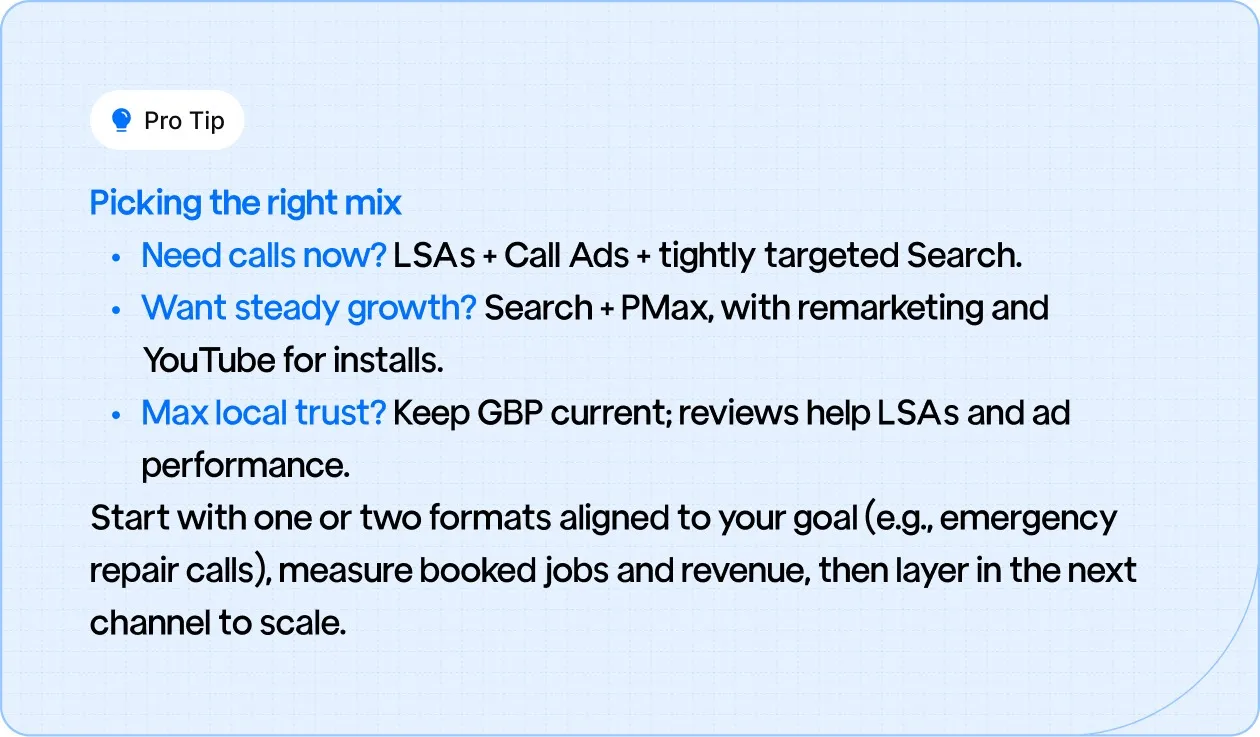
How HVAC PPC Works With SEO and Google Business Profile (GBP)
The best results come when your HVAC PPC, SEO, and Google Business Profile (GBP) support each other.
PPC brings quick wins and data; SEO builds durable rankings; GBP earns trust in the map-pack. Together, they help you show up more often and convert more searches into booked jobs.
PPC + SEO
- Own more real estate on Google. Ads plus organic results increase total clicks and reduce room for competitors.
- Let PPC data guide SEO. Top-converting PPC queries (e.g., “ac not cooling” + city) become targets for new service pages and blogs.
- Bridge the ramp-up. Run PPC for new services/locations while SEO pages climb; taper ad spend as organic traffic grows.
- Match intent by season. Push “repair” terms during heat waves/cold snaps; build evergreen SEO around maintenance and “how much” guides.
PPC + GBP
- Show up where calls start. Many local clicks go to the map-pack. A complete GBP (photos, services, hours, service areas) raises map visibility; PPC captures the rest of the demand.
- Reviews lift both. Ask for Google reviews after every job. Better star ratings improve GBP rank and ad performance (extensions, LSAs).
- Consistent NAP = fewer lost leads. Keep name, address, phone consistent across GBP, site, and ads to avoid confusion and call leakage.
- Use call features. Add call assets in PPC and “Call now” on GBP; route to tracked numbers so you can see which channel booked the job.
- Stack with LSAs. If you run Local Services Ads, keep GBP spotless: categories, reviews, and hours influence LSA rank and lead quality.
A simple channel playbook
- Now (immediate leads): PPC + LSAs with call-heavy ads and emergency keywords.
- Soon (compounding wins): Build/refresh SEO pages for top PPC terms and key cities you serve.
- Always (trust + coverage): Keep GBP current: new photos, Posts, Q&A, and steady review requests.
Turn Every Click Into a Customer
From SEO and Google Business Profiles to PPC setups that bring real leads, Gushwork helps your HVAC business get found and booked faster.
Build My Growth
Bring Your HVAC Business to the Top
When your ads are relevant, your landing pages are clear, and your message is consistent, every click becomes an opportunity. Keep refining, keep testing, and let data guide your decisions.
Because at the end of the day, HVAC PPC is about creating visibility that keeps your phones ringing and your schedule full.
Grow Your HVAC Business with Gushwork
At Gushwork, we help service-based businesses turn digital traffic into real leads. From PPC setup to SEO-ready websites and Google Business optimization, we make sure your marketing brings measurable results.
Talk to Gushwork Experts

SEO
Dec 3, 2025
5 mins
Fill Your Schedule with These 5 Must-Know SEO Tips for Chimney Sweeps
Batul Beawarwala
When homeowners need chimney cleaning, they’re looking for trusted professionals who can handle the job. By improving your online presence, you can make sure your business is the first one they find.
With just a few simple changes, you can attract more local clients and keep your schedule filled with work.
This approach will help you stand out in your community and build the trust needed to grow your business.
What’s Chimney Sweep SEO All About?
SEO, or Search Engine Optimization, helps your chimney sweep business show up when customers in your area are looking for services.
It ensures that search engines can find and understand your website, making it easy for them to recommend your business to the right people at the right time.
Why SEO Matters:
- Increased Visibility: When your website is optimized for local search, it appears at the top of search results when potential customers need your services.
- Steady Flow of Work: Once your site is set up with the right SEO strategies, it continues to attract customers without the need for ongoing advertising costs.
- Long-Term Benefits: SEO is a one-time investment that keeps bringing in new business as long as your website stays optimized and relevant.
How SEO Helps Your Chimney Sweep Business Grow
To stand out in a crowded market, your chimney sweep business needs to be easily found by those who need it most. These SEO strategies will help you attract more local customers, build trust, and keep your schedule full.
Let’s dive into the steps that will make your business the first choice for homeowners in your area.
1. Optimize Your Google Business Profile & Apple Business Connect for Local SEO
When potential customers search for “chimney cleaning near me,” you want your business to be the first one they see. An optimized Google Business Profile (GBP) and Apple Business Connect can make that happen, showing you right when people need help.
Steps:
- Update Your Business Info: Make sure your phone number, services, and hours are correct and complete.
- Add Photos and Videos: Show off your work with high-quality visuals that help build trust.
- Collect Reviews: Happy customers can leave reviews that improve your reputation and make you stand out.
Make it easy for local customers to find your business when they search nearby.
Setting up your Google Business Profile and Apple Business Connect ensures your business appears at the top of local searches for chimney services.
Get Found Locally
2. Optimize Your Website Content for the Right Keywords
When customers search for chimney services, your website needs to show them exactly what they’re looking for. Using the right keywords will make sure your site is visible and easy to understand for both search engines and potential customers.
Steps:
- Keyword Research: Discover what words your customers are typing in when searching for services (e.g., “chimney inspection near me”).
- Clear Headings: Organize your content with easy-to-read headings, so both visitors and search engines know what to expect.
- Meta Tags: Write catchy titles and descriptions that include important keywords and make people want to click.
Make sure your website shows up when people search for chimney services.
Optimizing your site with the right keywords and a clear content structure helps search engines match you with the right customers.
Create SEO-Friendly Content
3. Improve Website Speed and Make Sure It’s Mobile-Friendly
No one likes waiting for a slow website to load, and most people will leave if your site isn’t mobile-friendly. Fast load times and easy navigation on mobile devices are essential to keep customers engaged.
Steps:
- Mobile-Friendly: Make sure your site is easy to navigate on smartphones, as most searches for chimney services are done on the go.
- Speed Up Your Site: Use tools like Google’s PageSpeed Insights to check your site’s loading times and make improvements.
- SSL Security: Make your website secure by adding HTTPS, which helps build trust with both visitors and search engines.
4. Build Trust and Authority with Off-Page SEO
Off-page SEO helps build your business’s reputation across the web by getting your name mentioned on trusted platforms and gaining valuable links to your site.
Steps:
- Citations: Ensure your business is listed consistently across trusted directories like Yelp or Angie’s List.
- Backlinks: Get other reputable websites to link back to your site. This tells search engines you’re trustworthy.
- Social Media: Stay active on platforms like Facebook, Instagram, and even TikTok to share customer success stories and build your reputation.
Get your business noticed across trusted platforms.
When people online talk about your work, it strengthens your credibility and helps more customers feel confident choosing your services.
Increase Your Authority
5. Use Content Marketing to Answer Customers' Questions and Rank for Long-Tail Keywords
Content marketing is your chance to show up in search results for specific queries customers have. Answering common questions about chimney care or providing helpful tips can drive more traffic to your site and improve your SEO.
Steps:
- Blogging: Share helpful articles about chimney maintenance or safety, and target specific questions people are asking.
- Video Content: Post short videos on platforms like TikTok, Instagram, or Facebook to showcase your expertise and services.
- Answer FAQs: Create a FAQ page to tackle common questions and make it easy for visitors to find the info they need.
Beat Competition with Ongoing SEO Efforts
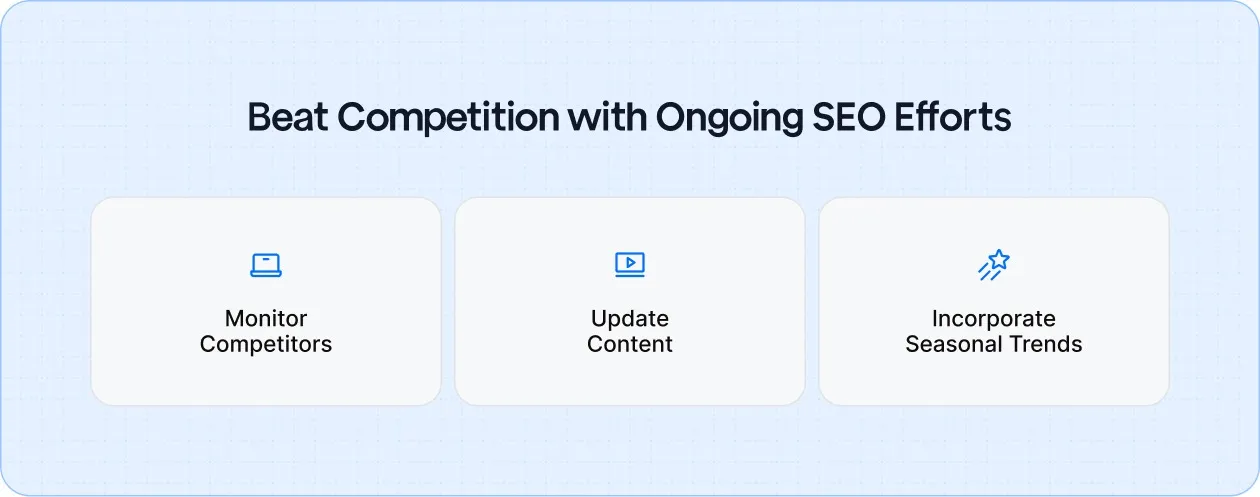
Staying ahead of the competition requires consistent effort. By regularly refining your SEO, you ensure your chimney sweep business remains visible and relevant. Here’s how to keep your edge.
- Monitor Competitors: Regularly check competitor websites to spot gaps in their SEO strategies, and use those insights to enhance your own approach.
- Update Content: Keep your website fresh by regularly refreshing content to match evolving search trends and customer needs.
- Incorporate Seasonal Trends: Align your content and services with seasonal needs (e.g., winter chimney inspections) to attract more customers at peak times.
6 Platforms/Resources to Help Your Chimney Sweep SEO Efforts
With the right platforms and resources, you can enhance your SEO strategy and build an online presence that brings in local customers consistently.
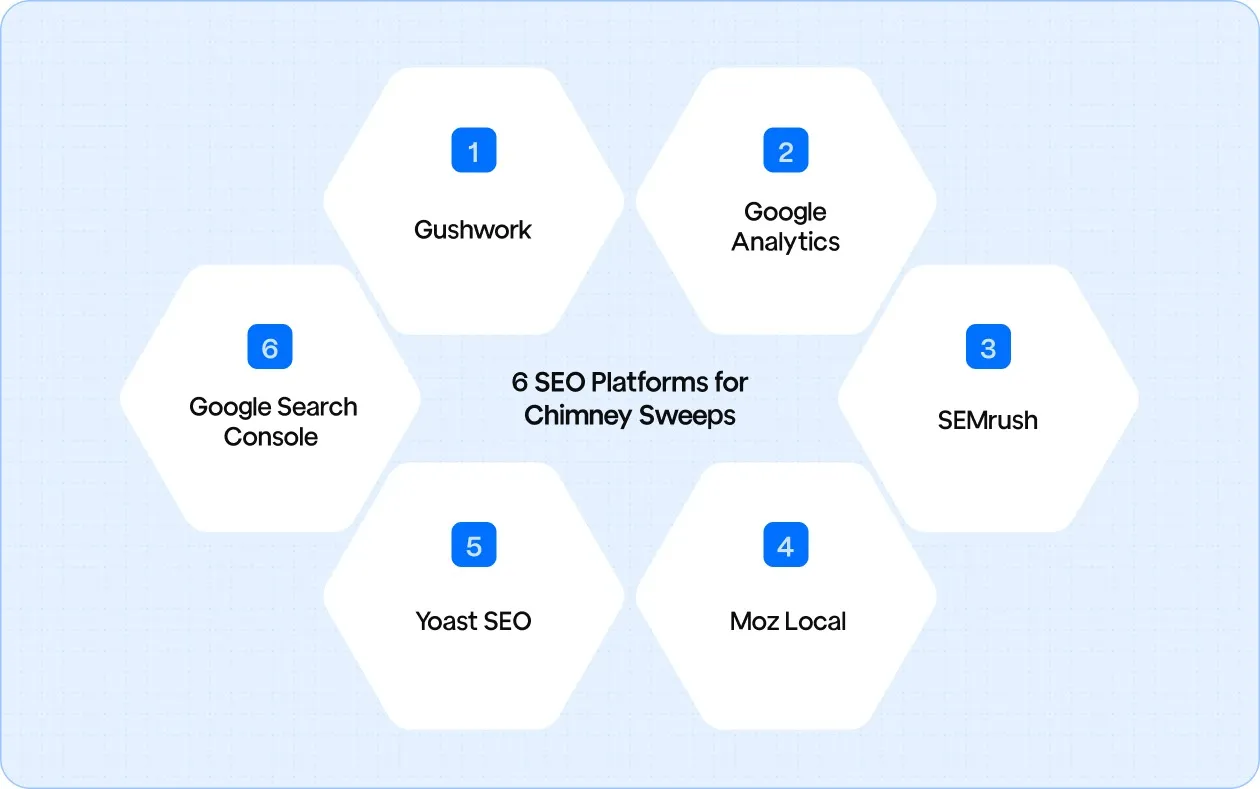
Here's a breakdown of the platforms and resources that can streamline your SEO efforts and put you in front of those searching for chimney sweep services.
1, Gushwork: With Gushwork, you can create keyword-rich, high-quality content that speaks directly to your customers’ needs while following SEO best practices.
By aligning your content with what people are searching for, you increase the chances of driving traffic to your site and building trust with local customers.
2. Google Analytics: Use this powerful tool to track how visitors interact with your website. Understand what works, what doesn’t, and optimize your content accordingly. By keeping an eye on performance, you can make informed decisions to increase your site's effectiveness.
3. SEMrush: This platform is your go-to for deep keyword research. Can you find the best keywords for your chimney sweep services, and can you also track your competition’s strategies and adjust your approach to stay ahead of the game?
4. Moz Local: Managing local business listings can be a challenge, but Moz Local simplifies it. Ensure your business details are consistent across directories like Yelp and Angie’s List, which improve your local search rankings and build trust with potential customers.
5. Yoast SEO (for WordPress): Yoast makes on-page optimization easier by offering real-time feedback on your content’s structure and keyword use. It ensures that your website is optimized for search engines while staying user-friendly for your visitors.
6. Google Search Console: This tool gives you insight into how your site performs for specific search terms. It helps you identify any technical issues that might affect your ranking and provides data to improve your site's visibility in search results.
Take Your Chimney Sweep Business to the Next Level with SEO
SEO is your business’s long-term ticket to steady growth. By focusing on local SEO, optimizing your website, creating valuable content, and building trust, you’re setting yourself up for success.
Want to stand out and grow your business?
SEO is key to growth, and with Gushwork’s personalized strategies, your business will attract more local customers and build long-term success.
Book a Free SEO Consultation

Digital Marketing
Dec 2, 2025
5 mins
20+ Plumbing Lead Strategies That Get You Found, Booked, and Paid
Ishani Mitra
You might be providing reliable, honest plumbing work every day, yet the phone still isn’t ringing as often as it should. It’s not usually a problem with your service. It’s that people in your area aren’t finding you when they’re searching online for help.
When someone has a leak, a broken water heater, or a sudden plumbing issue, they search quickly for the first trusted business they can contact. If your business doesn’t show up in those local search results, the job goes to someone else before you even have a chance to talk to them. That gap between your quality of work and your online appearance can directly affect your bookings.
This guide focuses on closing that gap. We’ll walk through practical SEO steps that help your plumbing business show up locally, build trust faster, and make it simple for homeowners to reach you when they need help right away.
What Counts as Plumbing Leads?
When we talk about plumbing leads, we’re referring to people or businesses who have expressed interest in plumbing services and could become paying customers. These leads are potential clients who require drain cleaning, pipe repair, water heater installation, or any other plumbing service and are actively seeking someone to hire.
Here’s what defines good plumbing leads:
- They’re locally relevant: someone in your service area who needs plumbing work now or soon.
- They’re action‑ready: the searcher is looking for a solution, such as “emergency plumber near me” or “water heater repair [city]”.
- They’re contactable: you can receive a call, a form submission, or another concrete message from them.
By clearly understanding what plumbing lead generation is and what makes them good, you can refine your marketing efforts, tailor your messaging, and build systems that bring in leads that convert into real work.
Maximize Your Plumbing Leads Today
Start getting noticed by the right customers when they need you the most. Optimize your online presence and watch the leads flow in!
Get Started Now
20+ Proven Methods to Secure More Plumbing Leads in 2025
Generating high‑quality plumbing leads in 2025 means combining smart, modern tactics with consistent, well‑executed effort.
Given the average lead conversion rate of 10% to 12%, the goal is to achieve 20% or higher. This is because a high conversion rate means your cost per lead will be lower than that of competitors, even if they spend more.
Keeping that in mind, here are 20+ strategies plumbers can use to attract customers and convert interest into jobs:
1. Local SEO
Local SEO helps your plumbing business appear in searches from people in your service area. Since most plumbing jobs come from local, urgent searches, showing up in the map pack and local organic results directly increases calls, bookings, and high-intent leads.
How to implement it:
- Build city and service-area pages so each suburb or neighborhood you serve is clearly represented on your website.
- Add location-focused keywords to titles, headers, and content in a natural way (for example, “water heater repair in Austin”).
- Ensure NAP consistency across your website, directories, and social profiles.
- Add local schema markup that tells Google where you operate, what services you provide, and who you serve.
- Earn locally relevant backlinks from community sites, chambers of commerce, suppliers, or neighborhood blogs.
2. Keyword Optimization
Keyword optimization ensures your site aligns with real homeowner search behavior. Plumbing searches often revolve around symptoms (“water heater leaking”), problems (“burst pipe repair”), or urgency (“plumber near me”). Targeting the right terms helps Google understand your services and match them to demand.
How to implement it:
- Research intent-based keywords that match real homeowner problems like leaks, clogs, broken water heaters, sewer issues, or fixture installs.
- Optimize each service page around one primary keyword and supporting terms so Google clearly understands what you offer.
- Use long-tail phrases such as “why is my water heater making noise” or “same-day drain cleaning in Dallas” to capture specific, high-intent queries.
- Start with tight keyword matching in ads. Avoid Broad Match when running new campaigns since it often triggers irrelevant searches (jobs, schools, competitors). Use Phrase Match and Exact Match to reach people who are actually ready to hire.
- Maintain a growing negative keyword list. Continually block irrelevant terms to prevent wasted spend. Many high-performing campaigns rely on hundreds or even thousands of negatives to keep clicks focused and conversion rates high.
- Refresh older pages by updating keywords, headings, and descriptions so they remain relevant as search trends shift.
- Group keywords by problem type (emergency, repair, installation, maintenance) so each page and campaign stays focused and avoids keyword dilution.
3. Google Business Profile
Your Google Business Profile is often the first thing a homeowner sees when searching “plumber near me.” A well-optimized profile can generate calls even if your website rankings aren’t strong yet. Visibility here is especially important for emergency plumbing and same-day service searches.
How to implement it:
- Fill out every section: services, categories, description, service areas, hours, and contact details.
- Add job photos regularly to show recent work, equipment, and before-after results.
- Use GBP updates and offers to highlight promotions, seasonal services, or emergency availability.
- Collect and respond to reviews to improve ranking and build trust.
- Enable messaging or call tracking to monitor how many leads come through your profile.
4. On-Page SEO
On-page SEO helps search engines identify what your pages are about. When each page is focused and structured well, Google can match your site to the right plumbing searches with far less confusion.
How to implement it:
- Use clear headings that reflect actual search intent. Each heading should describe a problem or service so both users and Google immediately understand the topic.
- Write concise, service-specific page content. Keep pages tightly aligned with one topic instead of mixing multiple plumbing services into one section.
- Add internal links that guide users deeper into your site. Link related pages together so both visitors and search engines can navigate logically.
- Optimize meta titles and descriptions for clarity. Include your primary keyword and location without trying to overstuff or complicate the message.
- Use alt text on images to strengthen topic signals. Describe the service or situation shown; this helps Google interpret visual content correctly.
- Check readability and formatting regularly. Short paragraphs, scannable bullet points, and simple wording help users stay engaged and reduce bounce rate.
5. Technical SEO
Technical SEO ensures your website loads fast, functions correctly, and is easy for search engines to crawl. A technically sound site helps all other SEO efforts perform better and prevents ranking drops caused by avoidable errors.
How to implement it:
- Ensure your site loads quickly on all devices. Check speed using PageSpeed Insights and minimize slow-loading elements like large images or unnecessary scripts.
- Fix crawl errors and broken links. Regularly scan your site so search engines don’t encounter dead ends that decrease trust and visibility.
- Add structured data where appropriate. Include LocalBusiness and Service schema so Google can clearly understand your service offerings.
- Maintain a clean site architecture. Use a simple hierarchy that avoids buried pages, unnecessary redirects, or duplicate content issues.
- Keep plugins and CMS tools updated. Outdated systems create security risks and slow site performance, which hurts rankings.
- Make sure your website is fully mobile-optimized. A large share of plumbing searches happen on mobile, so the user experience must remain smooth and fast.
6. Off-Page SEO
Off-page SEO increases your credibility by earning signals from outside your site. For plumbers, this includes listings, local mentions, and backlinks that tell Google your business is legitimate and trusted in your area.
How to implement it:
- Secure links from relevant local or industry websites. Aim for directories, partnerships, supplier pages, or local community sites that validate your business.
- Keep your NAP information consistent. Make sure your business name, address, and phone number appear the same across every directory listing.
- Encourage local press mentions or community features. Sponsoring small events or sharing expert advice can help earn valuable local citations.
- List your business on reputable home-service platforms. Profiles on Houzz, Angi, Thumbtack, or similar platforms strengthen off-page authority.
- Monitor your backlink profile regularly. Remove spammy or irrelevant links that could harm your trust signals.
- Create content others naturally want to cite. Strong how-to guides or problem-solving articles often earn organic backlinks over time.
7. Service Pages and Landing Pages
Service and landing pages are where homeowners decide whether to contact you. When each page covers one problem or service clearly, conversions improve because visitors don’t need to search for information.
How to implement it:
- Create a dedicated page for each core plumbing service. Pages like leak repair, drain cleaning, water heater repair, and emergency plumbing should stand alone.
- Use direct, symptom-based language. Homeowners search based on problems, so frame each page around the issue and your solution.
- Add trust-building visuals like before-and-after photos. These visuals help homeowners understand the quality of your work at a glance.
- Place CTAs strategically throughout the page. Encourage action early and repeat it as the reader scrolls without overdoing it.
- Write benefit-focused introductions. Explain the problem, why it matters, and how you fix it in a way that reduces homeowner uncertainty.
- Localize pages for the areas you serve. This helps you rank geographically and shows visitors you actually serve their location.
8. Google Ads
Google Ads help you appear at the top of results, where people with immediate plumbing needs are ready to act.
How to implement it:
- Run Search campaigns targeting emergency and repair keywords. These terms bring the highest urgency and conversion potential from homeowners.
- Use LSAs to reach people who need help now. LSAs show above all other ads and rely heavily on reviews to rank, so keep your profile strong.
- Write clear, urgency-driven ad copy. Focus on fast service availability, local coverage, and trusted expertise without making unrealistic claims.
- Align landing pages with ad intent. Make sure the page matches the keyword so the visitor sees exactly what they expect.
- Set location targeting to your actual service zones. Avoid wasting budget on areas you don’t serve.
- Track conversions using call tracking and form tracking. This helps you measure which campaigns produce real jobs instead of empty clicks.
9. Social Media Ads
Social media ads help you reach people who may not be searching yet but are likely to need plumbing services soon. These platforms allow precise local targeting and strong visual storytelling.
How to implement it:
- Use Meta ads to promote repairs, seasonal offers, or maintenance services. These formats work well for attracting attention and driving inquiries.
- Run YouTube ads for educational or problem-focused messaging. Short, clear videos explaining common plumbing issues build trust and awareness.
- Segment audiences based on location and homeowner demographics. Avoid broad national audiences that waste budget.
- Test simple visual formats like before-and-after clips. These build credibility quickly and appeal to homeowners comparing options.
- Create retargeting campaigns for non-converted website visitors. Reminding them of your services increases the chance they contact you later.
- Keep ad messaging local and familiar. Mention neighborhoods or common regional plumbing problems to make ads feel relevant.
10. Email Marketing
Email helps you stay connected with homeowners who aren’t ready to hire yet. It builds familiarity, showcases expertise, and turns warm leads into paying customers over time.
How to implement it:
- Send segmented emails based on service interest. Group contacts by the issue they searched for so each message feels relevant.
- Use personalized subject lines. Simple personal touches increase open rates and help remind homeowners of past interactions.
- Offer seasonal discounts or maintenance reminders. These prompts often nudge homeowners into booking routine jobs before issues get worse.
- Create automated follow-up sequences. When someone requests a quote, ensure they receive a series of helpful, concise touchpoints.
- Share quick plumbing tips or common problem explanations. This builds authority and positions you as a trusted local expert.
- Keep emails short and action-focused. Clear messaging prevents overwhelm and improves click-through rates.
11. Online Reviews
For plumbers, reviews are often the deciding factor between you and a competitor. Strong ratings signal reliability, quality, and local trust — all of which influence both rankings and conversions.
How to implement it:
- Ask for reviews immediately after a completed job. Timely requests yield better response rates because the experience is fresh.
- Provide customers with direct, friction-free review links. Remove barriers so it only takes a few seconds for them to share feedback.
- Respond to all reviews, even negative ones. Professional replies show potential customers that you’re accountable and service-oriented.
- Showcase reviews across your site. Feature highlights in headers, service pages, and landing pages to reinforce credibility.
- Use review insights to improve service quality. Recurring feedback themes help identify both strengths and operational gaps.
- Include photos in your Google reviews if possible. Visual proof strengthens trust signals for new homeowners comparing providers.
12. Website Optimization
This focuses on improving overall user experience beyond local elements. Even if you rank well, a slow or confusing website can make visitors leave before contacting you.
How to implement it:
- Optimize site speed across all devices. Compress images, reduce heavy scripts, and streamline plugins that slow performance.
- Make navigation intuitive and minimal. Keep menus simple so homeowners can find the right service within a few seconds.
- Use clear visual hierarchy. Headings, spacing, and simple layouts help visitors understand your message quickly.
- Make all CTAs easy to find and consistent. Buttons should be placed at predictable points throughout the page.
- Use mobile-first design. Most plumbing searches happen on phones, so prioritize mobile experience over desktop.
- Review heatmaps and session recordings. These tools show how users interact with your site and reveal friction points.
13. Social Media Marketing
Organic social media helps homeowners get to know you long before they need a plumber. It builds recognition, showcases your work, and reinforces trust.
How to implement it:
- Share before-and-after job photos regularly. These posts show tangible results and help people understand your quality.
- Post short videos explaining simple plumbing issues. Homeowners appreciate clarity, and helpful content keeps you memorable.
- Engage with community groups. Answering questions in local chats positions you as the go-to local expert.
- Use consistent brand visuals. A clean look builds recognition across platforms.
- Post team photos or behind-the-scenes updates. This adds humanity and builds comfort with your brand.
- Keep captions short and relatable. Straightforward wording increases engagement without overwhelming the reader.
14. Content Marketing
Content helps you attract leads at every stage of their decision-making process. When homeowners find helpful information from you online, they trust you faster.
How to implement it:
- Create blogs answering common plumbing questions. These attract searchers who need guidance before booking.
- Publish cost guides or repair timelines. Transparent information boosts trust and reduces hesitation.
- Write service-area focused FAQ pages. These help capture local long-tail searches and build relevance.
- Use short videos to explain quick fixes or warning signs. These often outperform written content on social platforms.
- Build topic clusters around your key services. A structured content ecosystem strengthens rankings and authority.
- Update old posts regularly. Refreshing content maintains visibility and keeps information accurate.
15. Local Directories
Listing your business across authoritative local directories helps Google validate your location, services, and legitimacy.
How to implement it:
- Claim listings on top directories. Yelp, Angi, Thumbtack, BBB, Houzz, and local chambers of commerce.
- Ensure alignment between all listings. Keep your name, address, and phone number identical everywhere.
- Upload recent photos and service descriptions. Complete profiles attract more engagement and conversions.
- Monitor listings for misinformation. Sometimes platforms autofill details incorrectly, which hurts SEO.
- Add your website to relevant categories only. Staying focused prevents irrelevant traffic and confusion.
- Encourage happy clients to review you on multiple platforms. This diversifies your online reputation.
16. Referrals
Word-of-mouth is still one of the strongest plumbing lead sources. A structured referral system multiplies its impact.
How to implement it:
- Create a clear referral incentive. Offer small discounts or service perks for clients who refer new homeowners.
- Remind customers about the referral option post-job. Simple reminders spark more participation.
- Partner with complementary businesses. Electricians, HVAC companies, or property managers can exchange referrals.
- Use follow-up emails to encourage referral sharing. A friendly check-in increases the chance they recommend you.
- Share referral success stories. Social proof encourages more homeowner participation.
- Track referral performance monthly. Knowing which sources send quality jobs helps you refine the program.
17. Retargeting & Remarketing
Most homeowners don’t hire on their first visit. Retargeting nudges them back when they’re closer to making a decision.
How to implement it:
- Run remarketing ads on Google Display and Meta. These ads remind visitors of your services after they leave your site.
- Segment by page type. Someone who viewed “water heater repair” needs different messaging from someone who viewed “drain cleaning.”
- Keep the messaging simple and urgent. Offer a quick estimate or highlight trust factors like reviews.
- Cap frequency so ads don’t feel intrusive. A balanced approach keeps your brand top-of-mind without overwhelming users.
- Use abandoned-form retargeting. Follow up with users who started filling out a form but didn’t complete it.
- Refresh creatives periodically. New images and copy keep CTR stable and prevent ad fatigue.
18. Paid Ads
Plumbing PPC puts you in front of homeowners who are actively searching for a plumber right now. When set up with the right structure, they deliver fast, predictable leads and help you dominate your local market.
How to implement it:
- Set your campaign objective to Lead generation. This ensures Google optimizes for calls and form submissions instead of generic traffic.
- Use Search campaigns as your primary format. Search ads match active demand and connect you with people already looking for plumbing help.
- Start with Manual CPC bidding for tighter control. This lets you set your own max cost-per-click and avoid overspending. If you prefer less hands-on effort, use Maximize Conversions or Maximize Clicks as your automated fallback.
- Calculate budgets using a clear monthly formula. Divide your monthly ad budget by the number of days you’ll run ads. A starting minimum of around $1,500 per month helps you gather enough data to make decisions.
- Run ads only when someone is available to answer calls. Limit ad schedules to business hours or times when an actual person can respond fast. Missed calls mean wasted spend.
- Write intent-driven ad copy. Focus on urgent needs like leaks, clogged drains, and water heater issues to match search behavior.
19. Business Networking Through Partnerships & Promotions
Local relationships often lead to steady, high-quality plumbing referrals. Networking makes your reach bigger than your marketing budget.
How to implement it:
- Connect with property managers and realtors. These professionals often need reliable plumbers on call.
- Attend local business meetups or trade events. These environments create natural referral pathways.
- Collaborate with HVAC, electrical, or remodeling companies. Shared clients make cross-referrals common.
- Offer a simple partner incentive. A structured program motivates consistent referrals.
- Provide printed referral cards or digital share links. Make it easy for partners to send you leads.
- Stay in touch with partners regularly. Consistent communication keeps relationships active.
20. Lead Magnets
Lead magnets help you engage homeowners who are researching but not ready to book yet. These early-stage contacts often turn into high-value customers.
How to implement it:
- Offer downloadable checklists or quick-fix guides. Simple tools appeal to homeowners diagnosing issues.
- Create cost calculators for plumbing repairs. Transparency builds trust and encourages conversions.
- Offer seasonal maintenance schedules. These help homeowners plan ahead while keeping you top-of-mind.
- Use short explainer videos as gated content. Video guides attract homeowners looking for clarity.
- Place lead magnets on high-traffic pages. This increases sign-ups without disrupting user experience.
- Create separate lead magnets for different services. Tailored resources improve segmentation and follow-up relevance.
21. Tracking Through CRM
A CRM helps you track leads from initial contact to closed job. For plumbers, it creates organization, speed, and clarity that manual tracking can’t match.
How to implement it:
- Add every new inquiry into the CRM immediately. This prevents leads from being lost or forgotten.
- Create pipelines for different services. Each service type should have clearly defined stages.
- Track response times and conversion rates. These metrics show where bottlenecks exist.
- Use automated reminders for follow-ups. This keeps leads warm and reduces missed opportunities.
- Review CRM data weekly. Patterns often reveal the highest-ROI channels and most profitable job types.
- Integrate the CRM with your website and ads. Automating data flow saves time and reduces errors.
22. Bonus: Hiring an Agency
Why Gushwork Makes This Easier?
Managing SEO, ads, content, and lead nurturing can overwhelm even seasoned plumbing teams. A specialized agency ensures you’re not guessing with your marketing but following proven systems built for service businesses.
How Gushwork helps:
- We build a complete lead generation system and dashboard. That means long-term, steady lead flow.
- We optimize your Google Business Profile and local SEO with precision. Most plumbers underuse these channels, leaving money on the table.
- We write content that matches homeowner intent instead of generic fluff. This improves rankings and conversions.
- We manage your ads with strict keyword control and negative keyword lists. This cuts wasted spend and increases job-ready leads.
- We track performance across all channels so you always know what’s working. No guessing, no wasted budget, no blind spots.
- We tailor strategies to your exact service area and business goals. Local success comes from local-specific planning.
Boost Your Visibility and Book More Jobs
Plumbing leads are just a click away. With the right SEO strategies, you’ll get in front of homeowners who need your services.
Learn How to Get More Leads
Different Types of Plumbing Leads by Customer Need
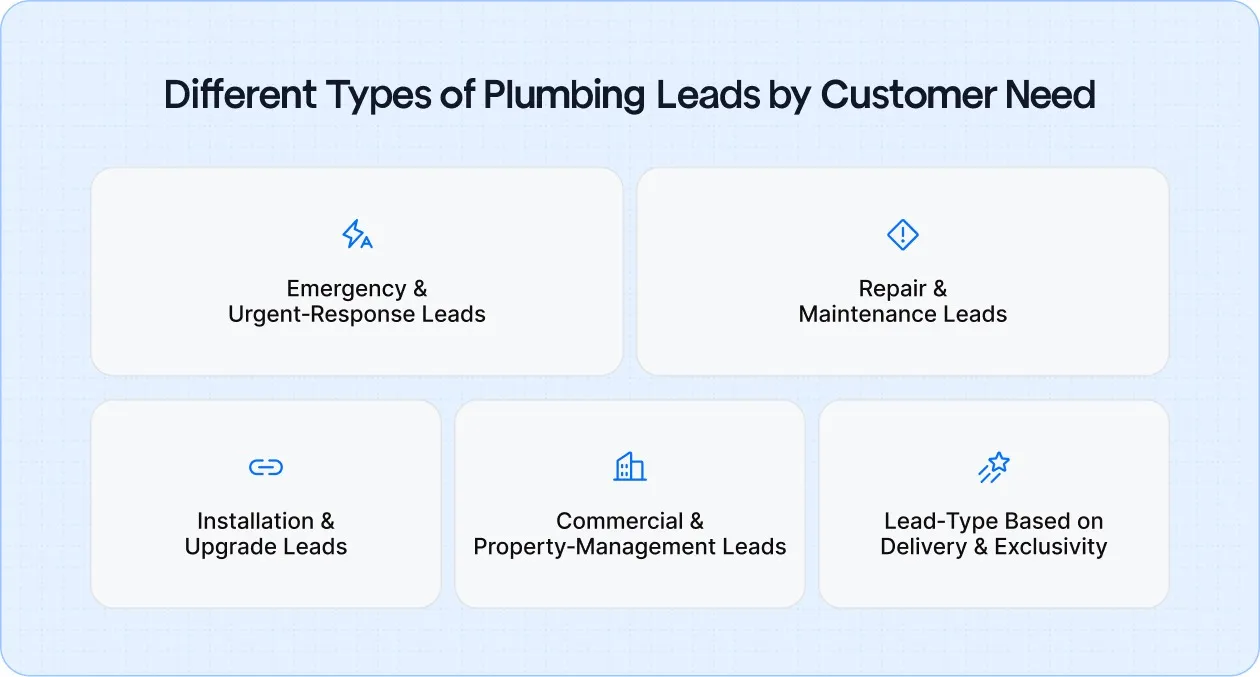
When you’re looking to attract plumbing leads, it’s important to recognise that not all leads are the same.
Let’s break down the main types of leads you’re likely to encounter:
1. Emergency & Urgent‑Response Leads
These are plumbing leads from homeowners who have an urgent issue: burst pipes, major leaks, non‑working water heaters, sewer backups. They’re ready to hire immediately.
2. Repair & Maintenance Leads
These plumbing leads come from homeowners needing a fix or tuning up of their plumbing system, not necessarily an emergency, but soon. Examples: clogged drains, dripping faucets, annual inspections.
Good marketing for these leads includes content showing you handle common problems, and offers of maintenance plans or inspections.
3. Installation & Upgrade Leads
These plumbing leads come from homeowners or property managers looking to add or upgrade plumbing systems: new bathrooms, kitchen remodels, pipe upgrades, smart plumbing installations.
These jobs often have higher ticket values and longer decision‑making cycles. To attract these leads, you’ll want to show project galleries, case studies, service pages for remodeling work, and strong trust signals.
4. Commercial & Property‑Management Leads
These plumbing leads originate from businesses, multi‑unit properties, or commercial buildings rather than individual homeowners. Their needs might include large‑scale plumbing installation, ongoing contract maintenance, or urgent commercial plumbing issues.
5. Lead‑Type Based on Delivery & Exclusivity
Beyond service need, plumbing leads also differ in how they’re acquired and shared: shared leads, exclusive leads, subscription lead‑services.
Understanding which type of leads you want (and can afford) is part of your lead generation strategy.
Turn Clicks into Clients
Ensure your plumbing business stands out in local searches. Let’s make your website work harder for you and attract more leads.
Optimize Your SEO
Why Knowing These Types Matters
By recognising the variety of plumbing leads, emergency, repair/maintenance, installation, commercial, and lead‑delivery types, you can:
- Create targeted marketing messages that match the intent behind each lead type.
- Budget and allocate marketing spend appropriately (for example, emergency leads cost more but convert higher).
- Develop follow‑up systems and service readiness aligned with lead urgency (e.g., quick response for emergencies, detailed quotes for installs).
- Set realistic expectations for conversion rates, job size, and lead‐acquisition cost depending on lead type.
Common Lead Generation Mistakes for Plumbers
Plumbers lose more opportunities than they realize, because of weaknesses in how leads are captured, handled, and qualified.
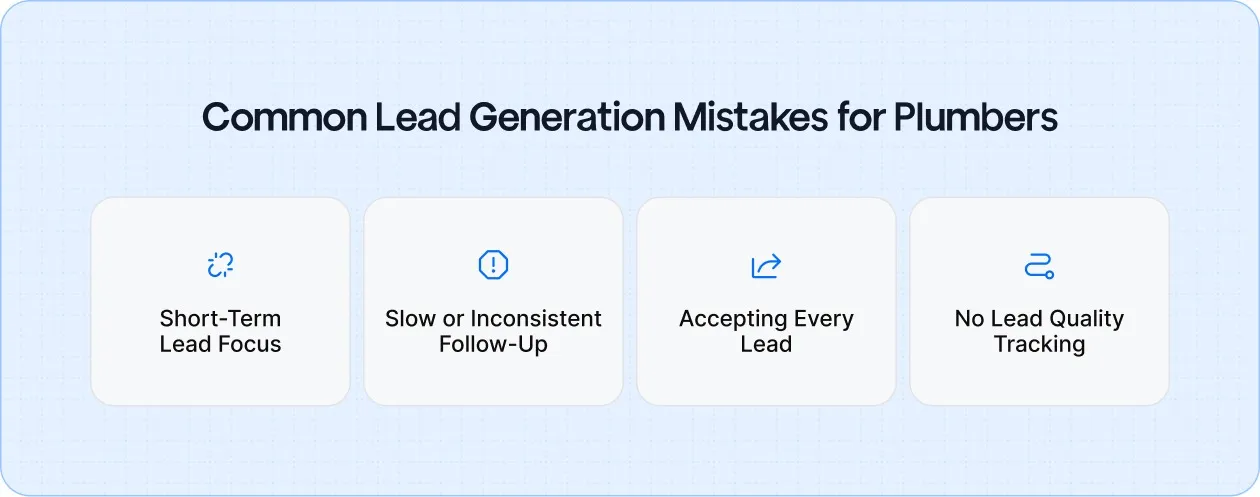
Below are the most common mistakes:
1) Treating Lead Generation Like Freelance Work
Many plumbers rely only on quick, short-term lead sources like paid directories or shared leads. This creates unstable demand and constant price chasing, leaving the business vulnerable when those channels dry up.
2) Slow or Inconsistent Follow-Up
Plumbing leads lose value fast, especially during emergencies. When calls or messages aren’t returned quickly, the prospect simply moves to the next plumber, leading to immediate revenue loss.
3) Accepting Every Lead Instead of the Right Leads
Chasing any inquiry, even for services you don’t offer, creates wasted time and frustration. Poor-fit leads crowd out genuine opportunities and lower your overall conversion rates.
4) No Clear Tracking of Lead Quality
Without knowing where your best leads come from, you can’t prioritize profitable channels. This leads to wasted budget and the false belief that “nothing works,” when the real issue is lack of visibility into performance.
Boost Your Plumbing Leads and Get Noticed Online
Attracting more plumbing leads isn’t just about being present; it’s about being found at the right time, in the right place. By applying the right strategies, you're setting your business up for sustainable growth and more clients.
It’s important to stay proactive and consistent with your approach to lead generation, but you don’t have to do it alone.
At Gushwork, we design to simplify the process of managing and growing your online presence, ensuring you stay visible to those who need your services. With the right strategy and support, you can drive more leads, build trust, and take your plumbing business to the next level. Let us help you get there!

SEO
Dec 2, 2025
5 mins
Home Improvement SEO Strategies That Will Get Your Phone Ringing Nonstop
Batul Beawarwala
Home improvement SEO is how your business gets found by homeowners looking for services like roof repairs, kitchen remodeling, plumbing, fence installation, window replacements, or even landscaping.
If you’re a small or bootstrapped business, SEO helps you grow your online presence without the need for a large marketing budget. The more your site shows up in search results, the more potential customers you’ll attract.
Driving traffic involves attracting people to your site through search, converting those visitors into real customers, and keeping costs low without relying on expensive ads or complicated strategies.
What Exactly is Home Improvement SEO?
SEO might sound like one of those complicated marketing terms that only big companies deal with. But it’s not. In fact, SEO is one of the most affordable and effective ways for small home improvement businesses, like yours, to stand out.
SEO, or Search Engine Optimization, is what helps your business get found online. This means that the people looking for your home improvement services can find you without you having to spend on ads.
The goal of SEO is simple: help people discover you, get them interested in what you do, and turn that interest into actual calls, emails, or bookings.
Home improvement SEO covers a wide range of services, including:
- Roofing Installation and Repair
- Plumbing Services
- HVAC Installation and Maintenance
- Electrical Services
- Home Remodeling and Renovation
- Garage Door Installation and Repair
- Pool Installation and Maintenance
- Handyman Services
- Painting and Decorating
By optimizing your website for these services, you increase the chances of being found by potential customers who are actively searching for your expertise.
Build a Home Improvement Website That Actually Works for SEO
A well-structured website is key to helping you get found online, capture inquiries, and keep visitors engaged, all while being optimized for search engines. Here’s how to make sure your site works for SEO and drives conversions:
a) Simple Site Structure for Better SEO
Your website doesn’t need to be complex to rank well. Keep things clear and organized for both users and search engines.
- Service Pages: Each service should have its own dedicated page, like "Roofing Services" or "Plumbing Repairs." Focus on one service per page to avoid overwhelming visitors.
- Location Pages: If you serve multiple areas, create a separate page for each one, such as “Roofing in Austin,” to help local customers find you.
- Mobile Optimization: Ensure your site loads quickly and looks good on mobile devices, as most searches now happen on phones.
b) Basic Technical SEO Tips
A few small technical improvements can greatly boost your site’s performance.
- Site Speed: Slow websites hurt your rankings. Use free tools to check and improve loading times.
- Secure Browsing: Add an SSL certificate to secure your website, which benefits both rankings and customer trust.
c) Turn Your Website Into a Conversion Machine
The goal is to convert visitors into clients. Simple changes can help make that happen:
- Clear CTAs: Use straightforward calls-to-action like “Get a Free Quote” or “Book a Consultation.”
- Before/After Images: Show off your work to build trust with potential customers.
- Social Proof: Display reviews and testimonials from past clients to build credibility.
Create a Keyword Strategy That Gets Results
Keywords are the bridge that connects your business to potential customers. A targeted keyword strategy helps your business show up in search results when people are actively looking for the services you offer.
This strategy is all about choosing the right terms that bring in high-intent customers while avoiding overly competitive keywords.
a) Keywords for Home Improvement
When it comes to SEO, keywords are what connect your business with the people who need you.
Here's how to choose the right ones:
- High-intent keywords: These are phrases like “emergency roof repair near me,” used by people who are ready to hire a professional right now.
- Long-tail keywords: Think more specific searches, like “affordable bathroom remodel near me.” These are often less competitive and easier to rank for.
- Local keywords: Adding your service areas to keywords, like “plumber near me,” helps your business get found by people searching nearby.
b) Keyword Tools for SMBs
You don’t need a fancy SEO tool suite to start. You can find useful keyword ideas without breaking the bank:
- Google Keyword Planner: A free tool to help you identify search terms related to your services.
- Ubersuggest: Another tool for discovering keyword ideas and getting an overview of keyword difficulty.
c) Optimizing for Voice Search
As more people use voice assistants, optimizing for voice search is becoming essential. Homeowners are asking questions like:
- “Where can I find a good roofer?”
- “Best plumbing services near me?”
Ensure your content answers these questions directly and conversationally to increase visibility in voice searches.
Picking the right keywords is crucial to SEO success.
Strategic adjustments to your content and setup can save you time and make your SEO efforts more effective.
Optimize Your Content Strategy
Quick Wins for On-Page SEO
On-page SEO gives you immediate control over how your website ranks. By optimizing your service pages, blog posts, and location-specific content, you can see quick improvements in your site’s performance and search rankings.
a) Service Page Optimization That Gets Results
One of the best ways to improve your SEO is by optimizing service pages. Each page should be:
- Clear and specific about the service offered.
- Focused on customer pain points, like “How to Know if You Need Roof Repair”.
- Actionable with a clear CTA, such as “Get Your Free Estimate Today!”
b) Blog Content That Drives Traffic
Blogs are a great way to connect with customers and improve your SEO. Start with these questions:
Here are some blog topic ideas to get you started:
- “How much does a bathroom remodel cost?”
- “What’s the difference between roof repair and replacement?”
These blog posts improve your search rankings by addressing common customer queries and including targeted keywords. The more relevant content you produce, the more chances your site has to show up in search results, driving more traffic.
SEO blogging can be simple and efficient with the right approach.
Streamline your content creation with SEO blog experts, delivering high-quality, optimized content without the hassle.
Get Expert SEO Blogs
c) Geo-Targeted Pages: How to Win Your City
If you serve multiple areas, create location-specific pages for each one. Example: “Roofing Services in Your Area”. These pages make it easier to find local searches, helping you grab more customers from your service area.
Win Local SEO Without a Big Budget
Local SEO is one of the most effective ways to attract customers without breaking the bank. Optimizing for local search means getting your business on the map (literally and figuratively), making it easy for homeowners in your area to find you when they need your services most.
a) Google Business Profile
You don’t need a big marketing budget to dominate Google Business Profile (GBP). Here’s how to optimize it:
- Fill out every section: Add services, working hours, and contact details.
- Post updates: Share promotions or new services to stay active.
- Collect and respond to reviews: Positive reviews increase trust and improve your ranking.
b) Apple Business Connect
In addition to GMB, make sure to claim and optimize your Apple Business Connect profile. Apple Maps is another powerful search tool for local customers looking for services near them.
By ensuring your business is listed and updated, you improve your chances of showing up when people search via Apple’s platform. This helps you reach a broader audience, especially those using Apple devices to find services.
c) Building Local Citations the Easy Way
Local citations, listings on trusted local directories, are a solid tool for SEO. Focus on getting listed in reputable platforms like Yelp, Houzz, BBB, and Apple Business Connect. The more places your business is listed, the better.
d) Getting Reviews the Smart Way
Ask happy customers to leave reviews on Google and Yelp, and make sure to respond. This shows potential clients you’re active and reliable.
Encouraging reviews on your Apple Business Connect profile is also a great way to build trust with local customers who are searching via Apple Maps.
Advanced SEO for Small Contractors: Answer Engine Optimization (AEO)
As AI-driven search engines become more prominent, Answer Engine Optimization (AEO) is critical for small contractors who want to show up in those valuable Answer Boxes at the top of search results.
AEO gives you the chance to be the answer customers are looking for, even before they click on your website.
AEO Best Practices
To rank in Answer Boxes (the little snippets that appear at the top of Google), follow these tips:
- Answer common questions directly: “How much does a roof repair cost?”
- Use structured data (schema markup) so search engines understand your content better.
- Focus on conversational queries that customers might ask using voice search.
You don't have to figure out SEO all on your own.
The right platform can help streamline the process, making it easier to stay on track with your content and SEO needs.
Streamline Your SEO Now
Link Building: The Low-Key Strategy for Big Gains
Link building is a powerful SEO tool for improving your website’s authority and search rankings.
But you don’t need to overcomplicate it, focus on the right partnerships and directories, and you’ll start seeing the benefits.
Link Building Best Practices
Link building is crucial for improving your SEO, but it doesn’t have to be complicated.
Here’s what you can do:
- Guest blog on local or industry sites to get backlinks.
- Partner with suppliers or other local businesses for mutual backlinks.
- Get listed in trusted local directories to improve your credibility and local SEO.
Content Marketing That Doesn’t Break the Bank
Content marketing is a great way to build trust, drive traffic, and improve your SEO, all without spending a fortune.
With the right approach, you can create valuable content that resonates with potential customers and helps you rank higher.
a) Simple Blog Ideas That Will Actually Bring in Customers
You don’t need complex topics to drive results. Start with these simple ideas:
- “How much does a roof replacement cost?”
- “5 things to know before hiring a contractor”
These blogs provide value to potential clients and help you rank better in search results.
b) Using Video to Rank Higher
Video content is a powerful SEO tool. Try recording:
- Before-and-after project videos
- Customer testimonials
Make sure to optimize these videos for YouTube and embed them on your site for better engagement.
Your 12-Month SEO Plan (Step-by-Step)
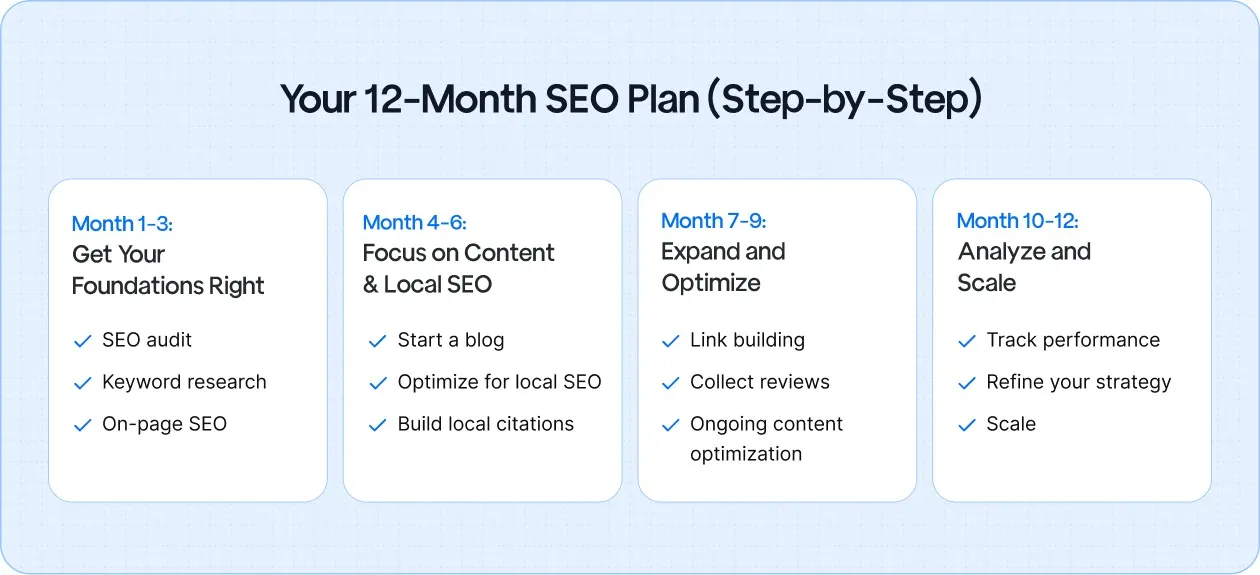
SEO is a long-term effort that builds momentum over time, and while it’s possible to get started on your own, the right tools and support can help accelerate your growth.
Here’s a step-by-step guide to take your SEO from the ground up.
Month 1-3: Get Your Foundations Right
The first step is to get your website in shape. Without the right foundation, even the best content won’t help you rank.
- SEO audit: Start by identifying and fixing any technical issues on your site, like slow loading speeds or broken links. You can perform basic audits with free tools, but ongoing checks are necessary to stay ahead.
- Keyword research: Identify the right keywords that will attract the customers you want. Aim for a balance between high-intent and local keywords, terms your audience is already searching for.
- On-page SEO: Update your page titles, meta descriptions, and headers with your target keywords to help search engines understand what each page is about.
While these tasks can be done manually, using tools and getting expert advice can streamline the process, helping you avoid missing crucial details.
Month 4-6: Focus on Content and Local SEO
Once your foundation is solid, it’s time to create valuable content and optimize for local search.
- Start a blog: Provide helpful content that answers common questions. This positions you as an authority in your field and helps improve rankings.
- Optimize for local SEO: Add geo-specific keywords and create location pages to target nearby customers. Make sure your Google Business Profile and Apple Business Connect are updated and complete.
- Build local citations: Get listed in relevant local directories (e.g., Yelp, Houzz) to improve your local visibility.
At this stage, consistency is key, and you may need tools to track performance and adjust your content strategy for maximum impact.
Month 7-9: Expand and Optimize
As you start to attract more visitors, the next step is to expand your reach and optimize your content.
- Link building: Start acquiring backlinks from reputable sites within your industry. Backlinks help improve your website’s credibility, but they need to come from trusted sources.
- Collect reviews: Encourage customers to leave positive reviews on Google and other platforms. Respond to reviews to show you care and to improve your local rankings.
- Ongoing content optimization: SEO isn’t a set-it-and-forget-it process. Update your existing content and focus on keeping your site relevant to search engines.
At this stage, things can get complex, and having the right tools to track your backlink profile and optimize on-page elements will keep your efforts focused.
Month 10-12: Analyze & Scale
With a solid strategy in place, it’s time to analyze your progress and scale your efforts.
- Track performance: Use tools like Google Analytics and Google Search Console to measure your SEO success. Track key metrics like organic traffic, keyword rankings, and conversions to see what’s working.
- Refine your strategy: Based on the data, adjust your strategy. Double down on what’s driving the most traffic and inquiries.
- Scale: Once you’ve identified your most successful strategies, scale them with more content, additional backlinks, or by targeting more locations.
Scaling your SEO strategy requires a systematic approach and tools that will help you stay on top of the changes and refine your tactics for even greater success.
Home Improvement SEO for Long-Term Success
Home improvement SEO is one of the most cost-effective ways for small businesses to grow.
By following the steps outlined above, you’ll enhance your website’s visibility, attract more qualified inquiries, and start climbing higher in search results.
SEO keeps working for you around the clock, constantly bringing in fresh opportunities for growth. The more effort you invest now, the bigger the rewards down the road.
Power up your SEO with solutions designed for success
Gushwork makes scaling your SEO strategy effortless, providing smart solutions that streamline content management and help your business grow.
Book Your Free SEO Consultation
SEO
Dec 2, 2025
5 mins
Stop Being Invisible! Local SEO Will Get Your Remodeling Business the Recognition It Deserves
Batul Beawarwala
As a remodeling contractor, you know that referrals and word of mouth are vital for your business. But today, being easily found online is just as important.
If your business isn’t showing up in local searches, you’re likely losing out on valuable opportunities. Local SEO ensures that when people in your area search for remodeling services, your business is right there, ready to be discovered.
This blog will explain how local SEO can help you stand out, attract more clients, and grow your business.
What Does Local SEO Mean for Remodeling Contractors?
Local SEO ensures your business is visible to people searching for services in your area. For remodeling contractors, this means appearing when potential clients search for services like home renovations or remodeling projects.
Why It Matters?
Homeowners today rely on online searches to find local contractors. Without strong local SEO, your business risks being invisible to these potential clients. Local SEO ensures that when homeowners search for services like yours, they'll find your business instead of your competitors. This is especially crucial because:
- Most homeowners prefer local contractors when making a decision.
- Online searches are often the first step in hiring a contractor.
- If your business doesn’t appear in local search results, you miss out on these valuable opportunities.
Let’s dive into the practical steps you can take to ensure your business stands out and gets found when it matters most.
Step 1: Own Your Google Business Profile (GBP) and Apple Business Connect
Your GBP and Apple Business Connect profiles are the first places potential clients will encounter your business. These platforms are critical for local visibility, and setting them up correctly lays the foundation for your entire online presence.
- Claim Your Profiles: If your business isn’t listed on Google and Apple, it’s like you’re invisible. These profiles are the first place potential clients will look. Take control and make sure your business is visible, complete, and up-to-date.
- Complete Your Profile Like a Pro: Fill in every detail, your name, address, phone number (NAP), hours, and service areas.
This is crucial because consistency across online platforms helps Google trust that you’re a real, reliable business.
- Show Off Your Work: Photos, before-and-after shots, and project videos speak louder than words. Your profile should showcase your best work. This is your opportunity to make a first impression that resonates with potential clients.
- Post Regular Updates: Keep your profile fresh with weekly updates. Share photos of your latest projects, any seasonal offers, or even little tips about remodeling.
Regular posts tell Google you’re active and relevant, which means you’re more likely to appear in local searches.
Reviews Are Your New Best Friend: Ask for reviews, respond to them, and show potential clients that you care about their feedback. Positive reviews build trust, and Google rewards businesses with good reviews by giving them higher visibility.
Struggling to set up your Google Business Profile?
Managing and optimizing your GBP can be time-consuming. We will simplify the process and ensure your business stands out online.
Optimize Your GBP Now
Step 2: Geo-Targeted Keywords - Get Specific About What Your Clients Are Searching For
Understanding the exact terms your potential clients use to search for remodeling services in their area is key to driving local traffic. Geo-targeted keywords ensure that your business appears when it matters most, right in front of local homeowners looking for help.
- What Are Geo-Targeted Keywords?: Geo-targeted keywords combine your services with location-specific terms. For instance, instead of using general terms like “remodeling contractor,” focus on phrases like “kitchen remodel near me” or “bathroom renovation in the area.”
These targeted keywords help your business show up in local searches, making it easier for nearby clients to find you.
- Keyword Research Tools: Tools like Google Keyword Planner and Ubersuggest help uncover what people in your area are searching for. This is the foundation of your SEO strategy.
When you target the right keywords, your business will show up exactly when people are looking for your services.
- Target Keywords Through Your Content: Once you’ve got your list of local keywords, strategically place them across your website.
Use them in service pages, blog posts, and meta descriptions. This helps both Google and potential clients know exactly what you do and where you do it.
Keyword research can feel overwhelming without the right expertise.
Let’s experts simplify the process, ensuring the right terms target your local audience.
Let’s Find Your Keywords
Step 3: Build and Manage Customer Reviews - Get Them, Love Them, Incorporate Them
Reviews provide social proof and play a critical role in improving your local SEO ranking. The more you build and manage your reviews, the stronger your online presence becomes.
- Why Reviews Matter More Than You Think: Reviews are a key component of your local SEO. Google takes note of what clients say about you, and a collection of glowing reviews can put your business in front of more potential customers.
- How to Get More Reviews: Don’t wait for clients to leave reviews on their own. After finishing a project, send them a simple, direct link where they can leave their feedback. Make it easy, and they’ll be more likely to do it.
- Responding to Reviews Like a Pro: Engaging with reviews is important. Respond to each review, positive or constructive. This shows you care about feedback and helps build your reputation as a responsive business.
- The Power of Niche Review Sites: Platforms like Houzz, Angi, and Yelp give your business an additional layer of credibility. Make sure you’re listed and active on these sites to improve your local rankings.
Step 4: Tidy Up Your Mobile and Technical SEO for a Smooth User Experience
User experience plays a crucial role in both client satisfaction and SEO. A fast, mobile-friendly website is essential for keeping visitors engaged and improving your visibility in search results.
- Mobile Optimization: With more homeowners searching on their phones than ever before, your website must be mobile-friendly. If your website is slow or hard to navigate on a mobile device, potential clients will click away and move on to the next business.
- Speed Matters: A slow website is a deal-breaker. Google prioritizes fast, responsive sites because they improve user experience. Work on reducing image sizes, optimizing code, and using modern web tools to make your site faster.
- Technical SEO 101: It’s important to make sure Google can crawl and index your site correctly. Ensure that your LocalBusiness schema is set up properly, check for crawl errors, and optimize your site's structure so everything is easy to find.
Is your content working for you?
Content plays a huge role in site performance and SEO ranking. Let’s help you drive more traffic with SEO-optimized content that resonates with your clients.
Optimize Your Content Now
Step 5: Build Citations and Backlinks - Prove Your Local Authority
Citations and backlinks are signals to Google that you’re a credible, trustworthy business. The more mentions you have across reputable local sites, the better your chances of ranking higher in local search results.
- Where to List Your Business: Ensure your business is listed on key platforms like Yelp, Houzz, and your local Chamber of Commerce. The more places you’re mentioned, the better your chances of showing up in local search results.
- Building Backlinks That Matter: Backlinks are like votes of confidence from other websites. Reach out to local businesses, media outlets, and industry partners to get quality backlinks. The more trustworthy sites link to you, the more Google will see you as a credible, authoritative business.
Ready to get noticed?
Backlinks are crucial for proving your local authority. Let’s help you build strong, high-quality backlinks that increase your credibility and improve your rankings.
Build Your Backlinks Now
How Local SEO Can Drive Growth for Your Remodeling Business
Local SEO is a long-term game changer for your business. As you consistently optimize your online presence, you'll see your business grow in real, qualified inquiries.
Consistency Is Key: Staying on top of your profiles, content, and reviews is essential. It’s a continual process that ensures your business stays visible and competitive in your local market.
So, are you ready to elevate your SEO strategy? With the right approach and ongoing efforts, local SEO can turn your remodeling business into a go-to choice for homeowners. If you’re looking to optimize your process without the hassle, Gushwork can help create a custom SEO strategy personalized to your needs.
Let’s transform your online presence.
Connect with Gushwork today and start growing your remodeling business with SEO content that works!
Book Your Free Consultation
Digital Marketing
Dec 2, 2025
5 mins
Looking for More Locksmith Leads That Will Convert? Check Out These 16 Winning Strategies
Batul Beawarwala
As a small locksmith business, finding the right leads can feel like a never-ending challenge. It’s frustrating when your marketing efforts don’t seem to bring in the customers who need your services the most.
Generating quality leads doesn’t have to require a big team or a hefty budget. With the right strategies, you can start attracting more leads that convert, all while keeping things simple and cost-effective.
Want to grow your business with leads that actually stick? Let’s get into the strategies that can make it happen.
Why Lead Generation Matters for Your Locksmith Business?
Lead generation is crucial for keeping your locksmith business booming. Building a steady stream of customers who know and trust you for their security needs is important. Here’s why it’s so crucial:
Engage with the Right People
Lead generation is all about finding people who need your help, right when they need it. Lockouts, broken keys, and security upgrades. Generating the right leads means you're connecting with customers at their most critical moments.
It’s crucial to ensure they know you’re just a call away when they need urgent locksmith services.
Fuel Your Business Growth
With consistent lead generation, you can steadily attract new customers, helping your business grow over time. It's important to stay top-of-mind and make sure people know you're the go-to locksmith when they need help.
Strengthen Your Reputation
Consistent lead generation fills your calendar and helps you build lasting relationships with customers. By delivering great service, you’ll increase the chances they’ll return and recommend you to others.
16 Simple Lead Generation Strategies for Locksmiths
Generating quality locksmith leads doesn't have to be a daunting task. With the right approach, you can effectively attract potential customers who need your services.
Let’s explore some straightforward strategies that'll keep your lead generation efforts fresh, effective, and cost-efficient.
1. Local SEO: Make Sure People Can Find You
When someone needs a locksmith, they’re likely to search for services nearby. Local SEO ensures you’re visible when people search for locksmith services in their area.
Simple Actions to Improve Your Local SEO
- Update your Google Business Profile with accurate contact information and details about your services.
- Use location-based keywords across your website to improve your local relevance.
- Encourage satisfied customers to leave reviews on your Google Business Profile to increase your visibility in search results.
- Claim and optimize your Apple Business Connect profile to ensure visibility across Apple platforms like Apple Maps and Siri. This helps you reach customers who are using Apple devices to search for local services.
2. Content Marketing: Attract Leads with Helpful Information
Content marketing helps establish you as an expert and builds a relationship with potential customers. By offering valuable information, you make it easier for people to find and trust your locksmith services.
- Write Blogs that Answer Common Questions
Create valuable SEO-optimized blog content that answers questions customers often ask, like how to choose a locksmith or signs that it’s time to rekey your locks. Providing solutions to common problems helps potential customers find you when they’re searching for answers.
- Create Lead Magnets
Offer downloadable resources like a “Home Security Checklist” or “Discount Coupon” in exchange for contact details. These lead magnets help you build an email list and give you a chance to follow up with leads in the future.
Make Your Content Work for You
Expert SEO-driven content strategies help you create valuable blog posts and lead magnets that attract the right locksmith leads and build lasting trust.
Start Creating SEO Content
3. Paid Advertising: Get Found Fast
Paid advertising helps you get immediate visibility in front of customers searching for locksmiths, making it an ideal strategy to drive fast leads. These ads ensure you connect with high-intent customers who are actively seeking help.
- Google Ads
Google Ads is a highly effective tool to attract potential customers who are actively searching for locksmith services. You only pay when someone clicks on your ad, making it a cost-effective way to generate high-quality leads.
- Local Service Ads (LSAs)
LSAs appear at the top of search results when people are looking for locksmith services, connecting you directly with potential customers who need help immediately.
4. Social Media: Engage and Convert
Social media is a powerful way to connect with customers where they already spend time. With both ads and organic content, you can build trust, engage potential clients, and generate quality locksmith leads.
- Target with Facebook & Instagram Ads
Use social media platforms like Facebook and Instagram to target customers in your area who need locksmith services right now. With compelling ads showcasing your work and special offers, you can grab the attention of potential leads quickly.
- Build Trust with Organic Content
Beyond ads, use organic posts on platforms like Facebook, Instagram, and TikTok to share helpful tips and showcase your expertise. Content like home security advice, smart lock tips, or DIY solutions can position you as the go-to locksmith in your area.
5. Build Relationships with Local Businesses
Building relationships with local businesses and community members creates valuable referral channels. These partnerships help establish a steady stream of customers who trust you because of shared connections and community involvement.
- Networking for Referrals
Partnering with local businesses like real estate agents, hardware stores, and property managers helps generate consistent referrals.
By establishing relationships with businesses that interact with your target customers, you create a steady flow of leads.
- Community Engagement
Get involved in local events or sponsor community initiatives to raise your visibility and build trust. The more people see your business engaged in their community, the more likely they are to choose you when they need locksmith services.
6. Get More Reviews: Let Your Customers Do the Talking
Reviews play a critical role in earning customer trust. Encouraging positive feedback from satisfied customers can help build your reputation, while responding to negative reviews shows your commitment to improvement.
- The Power of Online Reviews
Online reviews are essential for building trust. Customers tend to trust the experiences of others, so encouraging your satisfied clients to share their feedback can significantly influence potential customers.
- How to Ask for Reviews
After every job, send a simple and polite review request to make it easy for customers to leave feedback. The simpler the process, the more likely they’ll take the time to do it.
- Handling Negative Reviews
It’s important to respond to negative reviews professionally and show that you’re committed to addressing any concerns. Handling reviews thoughtfully will help demonstrate your dedication to customer satisfaction.
8. Customer Education: Provide Value Beyond Services
Educating your customers positions you as an authority in your field. Hosting free webinars, tutorials, or sharing valuable content can build trust and turn casual browsers into loyal clients.
- Become the Trusted Expert
Share insights about lock maintenance, home security tips, and locksmith services to position yourself as an expert in the field.
- Build Long-Term Relationships
By offering helpful educational content, you create value for customers, leading to repeat business and word-of-mouth referrals.
9. Exclusive Offers for First-Time Clients
New customers are more likely to book when given a special incentive. Offering discounts, free consultations, or security assessments can attract clients who are hesitant to make the first move.
- Entice with Discounts
A limited-time offer or a discount on the first service can push potential customers to take action.
- Add Value with Freebies
Offer free consultations or security audits for new customers to show them the value of your services, increasing conversion rates.
10. Interactive Lead Capture: Engage Visitors with Instant Quotes
Instead of static contact forms, use interactive tools like a "Get an Instant Quote" button on your website. This feature can grab potential leads instantly by providing them with a quick price estimate.
- Instant Engagement
An "Instant Quote" feature allows visitors to get the ball rolling on their locksmith needs, prompting immediate action.
- Increase Conversion Rates
By providing a quick price estimate, you reduce the friction for visitors, encouraging them to book your services.
11. SMS Marketing: Reach Customers Directly
SMS marketing boasts high open rates, making it an effective tool for sending reminders, special offers, or discounts directly to your customer base.
- Stay Top of Mind
With instant delivery, SMS marketing ensures you're there when your leads need you most, with no delay.
- Increase Conversion Rates
SMS is a direct and personal way to follow up on inquiries, keep potential customers engaged, and encourage them to book your services.
12. Content Syndication: Increase Your Reach with Third-Party Sites
Republishing your blog posts or articles on well-known third-party platforms like Medium or LinkedIn can help you reach a wider audience and increase traffic back to your website.
- Expand Your Audience
Syndicating content on popular platforms boosts your reach, allowing you to attract customers who may not have found you otherwise.
- Drive More Traffic
Republished content creates more backlinks to your site, helping you improve your SEO rankings while driving additional traffic to your business.
13. Interactive Online Tools: Engage Leads with DIY Resources
Offering interactive resources like a “Home Security Assessment” or “Lock Maintenance Checklist” can help visitors evaluate their needs while capturing their contact details for future follow-ups.
- Engage and Capture Leads
Provide tools that help visitors assess their needs, like a DIY checklist, while collecting their contact details for follow-ups.
- Offer Value through Interaction
Interactive tools not only help capture leads but also provide customers with actionable insights they can use, building trust in your expertise.
14. Flyers and Door Hangers
Flyers and door hangers are tried-and-true methods for putting your business in front of people right in your local area. They're a great way to stay top of mind, especially when someone’s searching for a locksmith in a pinch.
Plus, they’re a cost-effective way to ensure your name is in front of potential clients.
- Target high-traffic areas: Distribute in areas with lots of foot traffic or high-density housing to increase visibility.
- Focus on urgency: Highlight emergency services and quick response times to attract leads who need immediate assistance.
- Include clear contact details: Make it easy for people to reach you, either by phone or online.
15. Branded Vehicles
Your vehicle is a rolling billboard for your business. A branded vehicle makes it easy for locals to spot your service while you're on the move, and it acts as free advertising wherever you drive.
- Wrap your vehicle with your business name, logo, and contact info. Make it stand out with eye-catching colors and a professional design.
- Park strategically: Leave your vehicle in high-visibility locations, especially near busy shopping centers or residential areas.
- Maximize the impact: A simple, professional wrap can catch the eye of drivers, pedestrians, and anyone near your service area.
16. Word-of-Mouth
The best form of advertising is often the one that costs you nothing: recommendations from happy customers. When customers are satisfied with your work, they’re more likely to tell friends, family, and colleagues about your services.
- Encourage referrals: Ask satisfied clients to share their positive experience with others. A simple reminder goes a long way.
- Create a referral program: Offer incentives like discounts or freebies for customers who refer new clients. This can turn happy clients into long-term advocates.
- Leverage testimonials: Ask your best customers for short testimonials or reviews that you can use in marketing materials.
Convert Inquiries into Customers
The real challenge is transforming the initial interest of the inquiry into a long-term customer. It's important to move quickly, stay engaged, and offer a smooth, hassle-free experience for your potential customers.
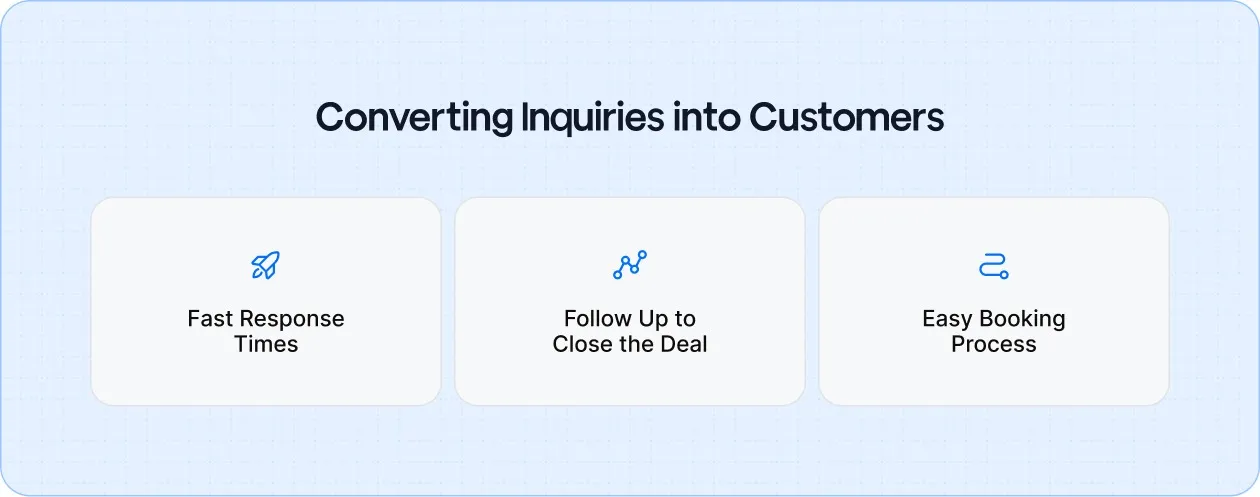
Here's how you can ensure you’re not letting valuable leads slip away.
Fast Response Times
The quicker you respond to a lead, the more likely you are to secure their business, especially in urgent locksmith situations like lockouts. Customers are often looking for immediate help, so timing is critical.
- Respond quickly, ideally within minutes of the inquiry.
- Use automated tools to ensure no lead is left waiting, even outside business hours.
Follow Up to Close the Deal
Following up ensures the lead knows you're serious about helping them and gives you another chance to answer any questions or concerns they might have.
- Send a follow-up email or make a quick call to check in.
- Keep the conversation active with personalized, relevant information to move them closer to booking your service.
Easy Booking Process
A complicated booking process can lose you a customer in seconds. The simpler it is for leads to schedule your services, the more likely they are to convert into customers.
- Offer multiple booking options: website, social media, or phone.
- Keep the process streamlined, no long forms or confusing steps.
- Implement a system to automate the scheduling process, reducing friction for your prospects.
Take Action Now: Simple Steps to Start Growing Your Leads Today
You’ve got the strategies: local SEO, paid ads, social media, and word-of-mouth, that will set your locksmith business up for a steady stream of high-quality leads. With the right tactics in place, attracting and converting customers becomes simpler and more predictable.
It’s time to stop just reading about these strategies and start applying them. Take the first step today and streamline your lead generation efforts.
Grow Your Leads with Smart SEO
Gushwork’s SEO expertise helps you rank higher, attract quality leads, and increase your online presence.
Book a Free SEO Consultation

Digital Marketing
Dec 2, 2025
5 mins
How to Make Your Window and Door Business the Local Favorite: 8 Marketing Tips to Stand Out
Batul Beawarwala
Marketing your window and door business online should be simple and effective.
The key is making sure that when homeowners need your services, they can easily find you. By applying the right strategies, you can increase your visibility, attract more customers, and turn those website visits into real projects.
And the best part? You don’t need a large budget to see results.
This guide will show you practical, no-fuss strategies that will help your business grow, stand out online, and bring in more inquiries without the complexity.
Why Marketing Matters for Window and Door Contractors?
When a homeowner has a window that won’t open or a door that won’t close, they usually search online for help. They’re looking for someone who can fix it fast. If your business isn’t visible, another contractor will be the one to answer the call.
Marketing is how you ensure you’re there when homeowners need you most.
With so many choices out there, it’s vital to show homeowners why you’re the right contractor for their window and door needs.
The right marketing strategies make sure people remember you. By reaching the right audience with the right message, you can turn casual interest into committed customers. When your business is present at the right moment, it leads to more jobs and steady growth.
8 Essential Tips to Grow Your Window and Door Business Online
A strong online presence is crucial for attracting and converting local customers for your window and door business. By optimizing your digital platforms, improving local SEO, and engaging with potential customers through social media and reviews, you can significantly increase visibility and drive business growth.
Here’s how to make sure you’re using every resource to its full potential:
1. How to Optimize Your Google Business Profile and Apple Business Connect
Google Business Profile and Apple Business Connect are essential tools for increasing your visibility when homeowners search for window and door services in your area.
Properly optimizing your site will help you stand out and attract more local customers.
Google Business Profile Optimization:
- Keep your business details up to date, including your hours, phone number, and location. This ensures potential customers have the correct information.
- Upload photos of your work to showcase your skills and the quality of your projects.
- Regularly update your profile with posts and engage with customer reviews to build trust and show you're active in the community.
Apple Business Connect Optimization:
- Claim and update your profile to appear on Apple Maps and be easily found by local customers.
- Add your hours, address, and photos to make sure all the details are easily accessible.
- Encourage customers to leave reviews, as positive feedback helps boost your credibility.
Actionable Tip: Keep your profiles active and consistent by updating details, adding fresh photos, and engaging with customer reviews. A well-maintained profile can significantly improve your visibility and attract more leads.
Is Your Google Business Profile Helping You Reach Local Customers Effectively?
Ensure your online visibility is optimized and that you're capturing every opportunity to connect with local customers.
Improve Your Online Presence
2. Website Optimization Tips to Convert Visitors into Customers
Your website is your storefront, your brand, and your first impression, all rolled into one. When someone lands on your page, they’re looking to see if you can solve their problem. A clean, easy-to-navigate website can make a big difference.
The goal is to make people want to pick up the phone and hire you. Think of your website as a welcoming space that drives action.
Key Elements for Optimization:
- Clear Descriptions: Make sure potential customers know exactly what you offer. A simple “Get a Free Estimate” button is all it takes to make it easy for them to reach out.
- Showcase Your Work: Display before-and-after photos of your projects. This proves your expertise and helps homeowners visualize what they’re investing in.
- Mobile Optimization: A lot of people will find you on their phones. If your website doesn’t work well on mobile, you could lose business. Keep it simple and responsive.
Actionable Tip: Highlight your work with engaging content like project photos and descriptions. Ensure your contact details are easily accessible, especially on mobile devices.
3. Local SEO Strategies to Bring in More Customers
When homeowners search for “window installation” or “door replacement,” they’re looking for a local contractor they can trust.
Local SEO ensures that when they’re searching, you’re right there, ready to help. You need to make sure your business shows up in searches from people who live near you, people who need your services now.
Strategies:
- City-Specific Keywords: Use city or neighborhood-specific terms on your website to make it clear that you serve the local area. “Window Replacement in Tampa” can go a long way.
- Dedicated Location Pages: If you work in multiple areas, create individual pages for each location. This improves your visibility in different parts of your service area.
- Accurate Business Information: Ensure your website includes accurate details about your business, like your address, services, and hours of operation.
Actionable Tip: Incorporate city or neighborhood-specific terms on your website to target local customers and enhance visibility in local search results.
Struggling to keep your local SEO up-to-date?
Let the experts handle the optimization, so you can focus on bringing in more customers and growing your business.
Optimize Your Local SEO
4. How Google Ads and PPC Can Help Reach the Right People
Google Ads and PPC campaigns are powerful tools to get your window and door business in front of customers exactly when they need you.
By targeting users actively searching for your services, these ads ensure you're visible at the moment it counts, helping you capture more leads.
PPC Tips:
- Target Key Terms: Focus on high-intent, location-specific keywords that match what potential customers are searching for. These terms will help you reach people who need your services now.
- Mobile-Friendly Ads: Many people searching for contractors do so on their mobile devices. Setting up ads that appear on mobile phones can help capture urgent leads.
- Track and Improve: Track the performance of your ads. Find out what’s working and adjust to get the best results possible.
Actionable Tip: Target high-intent search terms like “window replacement” in your ads and ensure they’re optimized for mobile. Review ad performance regularly and make necessary adjustments to improve results.
5. Using Social Media to Connect with Your Audience
Social media is a place to build connections, show off your work, and engage with customers in real-time. Facebook, Instagram, and TikTok are powerful tools that help you showcase your projects and expertise.
Using social media to its full potential can help you reach a wider audience and create a personal connection with potential customers. People like doing business with those they feel they know and trust.
Strategies:
- Share Your Work: Post photos, videos, and customer testimonials. Show your projects from start to finish to demonstrate the quality of your work.
- Targeted Ads: Run ads on Facebook and Instagram that target people in your service area. It’s a direct way to put your business in front of the right audience.
- Creative Content on TikTok: TikTok isn’t just for dance videos. Use it to share quick tips, behind-the-scenes footage, or showcase your work in a fun way.
Actionable Tip: Regularly post engaging content that showcases your projects, and run local-targeted ads to attract the right audience in your area.
6. Managing Your Reputation and Getting More Reviews
Customer reviews are crucial for building trust and boosting your search rankings. Positive feedback showcases your reliability, while responding to reviews shows you value customer satisfaction.
A good review can be the deciding factor in whether a potential customer chooses you over a competitor.
Review Management Tips:
- Ask for Reviews: After each job, ask your customers to leave a review. This is one of the easiest ways to gather positive feedback.
- Respond to Reviews: Always respond to reviews, both positive and negative. A simple thank you goes a long way, and it shows you care about your customers’ experience.
- Showcase Your Reviews: Feature positive reviews on your website and social media (Facebook, Instagram, WhatsApp and TikTok). This helps build credibility and encourages others to reach out.
Actionable Tip: Encourage satisfied customers to leave reviews, and make sure to respond to all feedback promptly. Highlight positive reviews to attract new clients.
7. How Retargeting and Automation Can Keep You Top of Mind
Retargeting ads and automated emails help you stay visible to potential customers who’ve already shown interest.
By keeping your business in front of them, these tools ensure you remain top of mind until they're ready to take action.
Key Tactics:
- Retargeting Ads: Set up ads that target people who visited your website but didn’t contact you. These ads will bring them back to your site when they’re ready.
- Automated Emails: Use automated emails to follow up with visitors who showed interest in your services. Send helpful tips, project showcases, or special offers to keep them engaged.
- Chatbots: Set up chatbots to engage visitors on your website instantly. They can answer questions and schedule appointments without delay.
Actionable Tip: Implement retargeting ads and automated email sequences to stay top of mind for customers who visited your site but didn’t convert.
8. Tracking Your Marketing Success Without the Headache
To grow your window and door business effectively, you need to know what’s working and what’s not. Marketing is an investment, and understanding how to measure your success will help you get the most out of your efforts.
Let’s break it down into simple steps, so you can track your progress without feeling overwhelmed.
What You Need to Keep an Eye On:
- Monitor customer inquiries to see how well your website converts visitors into leads.
- Track ad spend and results to ensure your marketing budget is delivering a return on investment.
- Use Google Analytics to track website performance and identify areas for improvement.
Actionable Tip: Track performance metrics like customer inquiries, ad results, and website bounce rate to identify what’s working and adjust accordingly.
Next Steps to Start Growing Your Window and Door Business
To start seeing real growth, focus on making your business visible to homeowners when they need your services most.
By applying the right tools and methods, like optimizing your Google Business Profile, incorporating local SEO, and engaging with customers on social media, you can increase visibility, build trust, and ultimately convert more inquiries into jobs.
With the right strategies in place, you don’t need to break the bank to see results.
Want to scale your business and see real growth?
Partner with experts to optimize your SEO and marketing strategies, drive more qualified inquiries, and grow your window and door business with Gushwork.
Book a Free SEO Consultation
SEO
Nov 27, 2025
5 mins
After Seeing What Top Carpet Cleaners Do Differently, We Have Built These 6 SEO Strategies
Ishani Mitra
You could be the best carpet cleaner in your city, punctual, polite, and thorough, but if no one can find you online, your phone stays quiet. That’s the frustrating part: your quality isn’t the problem. Visibility is.
Today, people don’t ask neighbors first; they ask Google. And if your business doesn’t show up there, someone else gets the job, usually a company that’s not even half as good as you.
Carpet cleaning SEO ensures your business shows up when someone nearby searches for what you do best. It helps your name, your reviews, and your work get seen by the right people at the right time.
In this blog, we’ll walk through what carpet cleaning SEO really is, what a proper setup looks like, and how you can use simple steps to get found, trusted, and booked more often.
What Is Carpet Cleaning SEO?
Carpet cleaning SEO is the process of helping your carpet cleaning business show up in local search results when people nearby look for services.
In plain terms, it’s how you make sure potential customers find your business first when they’re ready to book a cleaning.
Here’s what it really means:
- Local Visibility: Google uses your location, reviews, and business info to decide who shows up in the “map pack.” A complete and active Google Business Profile gets you there faster.
- Website Clarity: When your website clearly explains what you do like stain removal, deep cleaning, or upholstery work and uses the right local keywords, it helps search engines understand your services and show them to the right people.
- User Trust: Real reviews, before-and-after photos, and clear contact details tell potential customers they can rely on you.
- Performance & Accessibility: A fast, mobile-friendly website keeps people from bouncing and tells Google your business is reliable.
How Does It Work?
When someone searches for a local carpet cleaner, Google checks a few things before showing results:
- Relevance: Does your business clearly mention carpet cleaning services?
- Distance: Are you close enough to the searcher’s location?
- Prominence: Does your business look credible; through reviews, photos, and activity?
Your SEO efforts strengthen these signals. Most homeowners start their search online before calling a carpet cleaner. They want someone nearby, available soon, and trustworthy.
Understanding how SEO works is one thing, but seeing it in action is where the picture gets clear.
What Does a Good Carpet Cleaning SEO Setup Look Like?
Here’s what makes an effective setup and how to get each part right:
1. A Google Business Profile (GBP)
If SEO had a front door, this would be it. Your Google Business Profile is what most people see first, even before your website. It’s your online business card, review hub, and map pin all in one.
What to do:
- Choose Carpet Cleaning Service as your main category and add all related services like Upholstery Cleaning, Pet Odor Removal, or Rug Cleaning.
- Fill in every detail: hours, service areas, phone number, and your website link.
- Upload real photos: before-and-after shots, your team, your van, your equipment.
- Post short updates weekly (special offers, cleaning tips, or seasonal reminders).
- Ask every happy customer for a Google review and respond to each one politely.
2. A Clear, Simple Website
Your website should be built for humans first and then for Google. For that, your website needs to help people understand what you do and make it easy to call or book.
What to include:
- A dedicated page for every service you offer like “Deep Carpet Cleaning,” “Stain Removal,” or “Upholstery Cleaning.”
- Each page should have:
- A short intro explaining the service.
- A few benefits (e.g., “removes tough stains,” “safe for pets and kids”).
- Before-and-after photos.
- A clear call to action (like “Book a Cleaning” or “Call for a Free Quote”).
- Add one page per main service area.
3. Local Keywords
SEO keywords should sound like something your customers would actually type. That’s how Google connects your pages to the right people.
Examples:
- “Carpet cleaning in [City]”
- “Best carpet cleaner near me”
- “Pet odor removal service”
- “Steam cleaning carpets in Wisconsin”
Use these naturally in your page titles, subheadings, and a few times in the text. Also, write short meta descriptions (the small text under your page title in search results) that tell people what you offer and where.
4. Technical Basics
Behind every good website is a bit of clean, technical work that keeps it fast and smooth. It’s about making sure nothing gets in the way of a good user experience.
Here’s what to check:
- Speed: Your site should load in 3 seconds or less. Large photos or videos slow it down, compress them.
- Mobile-Friendly: Over 70% of searches come from phones. Make sure your text is readable, buttons are easy to tap, and your phone number is clickable.
- SSL Certificate (HTTPS): This adds the little lock icon in the address bar and makes your site secure.
- Sitemap: It’s a file that helps Google understand your site layout. Your developer (or tools like Yoast SEO on WordPress) can generate one.
5. Real Photos, Reviews, and Local Proof
The best marketing is proof. When people see your real work, they trust you. When they read your reviews, they believe you. When both live on your website, they choose you.
What to do:
- Take photos from every job: before-and-after shots work great.
- Add them to your website and your Google Business Profile regularly.
- Highlight customer reviews directly on your site (with permission).
- Show a short intro about your team or your experience: “10+ years in carpet cleaning across Texas.”
6. Links, Listings, and Local Mentions
If your name, address, or phone number (NAP) is inconsistent online, Google gets confused, and so do customers. A clean online footprint helps you appear trustworthy.
What to do:
- List your business on platforms like Yelp, Angi, Thumbtack, HomeAdvisor, and Facebook.
- Make sure your Name, Address, and Phone Number (NAP) match exactly everywhere.
- Partner with other local businesses like property managers, cleaners, or realtors and ask to be mentioned or linked on their sites.
- Sponsor a local event or post about community involvement on your blog or social media.
Bonus: when local partners (like realtors, cleaners, or landlords) mention your business online, those mentions help your SEO grow faster and improve your visibility across your service area.
Turn Searches Into Real Bookings
Get a clean, effective SEO setup that helps your carpet cleaning business show up, get clicked, and get booked.
Build My SEO Plan
The Main Types of Carpet Cleaning SEO
SEO becomes much easier to understand when you break it into three parts. Each one helps your carpet cleaning business get found and trusted in a different way:
Be the First Name Homeowners See
Stay visible, trusted, and busy, without spending on ads.
Boost My Local SEO
The next step is turning that visibility into something measurable, such as calls, bookings, and long-term customers. That’s where strategy comes in.
Practical Carpet Cleaning SEO Steps That Grow Your Business
Once your website, service pages, and Google Business Profile are set up, the next step is to turn those tools into steady jobs. A good carpet cleaning SEO strategy helps you move beyond just being visible. It helps you attract better customers, get more calls, and build trust that lasts.
Here’s how to do that:
1. Track Which Calls Turn Into Real Jobs: Keep a small log of where each call comes from and whether it becomes a paying job. Over time, you’ll see which sources bring real customers and which ones don’t. This helps you focus on what’s actually working instead of guessing.
2. Test Small Changes on Your Website: Try changing a headline or button text and see if more people call. Simple tweaks like “Same-Day Cleaning” or “Get a Quick Quote” often boost results without needing more traffic.
3. Share Pricing and Availability Clearly: Most people hesitate because they don’t know the cost or timing. Add lines like “Starts at $79 per room” or “Same-day slots available before 11 AM.” Clear info makes calling easier and builds trust.
4. Automate Review and Referral Requests: Set up automatic texts or emails after each job. Ask for a review, then follow up with a small referral offer. This keeps new reviews and word-of-mouth leads coming in without extra effort.
5. Improve How Calls Are Answered: Listen to a few recorded calls (with notice). You’ll hear what customers worry about. Create a short script that covers price range, timing, and next steps. Confident answers lead to more bookings.
6. Offer Simple Maintenance Plans: Give customers the option to book yearly or twice-a-year cleanings at a small discount. It keeps business consistent and increases repeat work, which helps both revenue and SEO.
7. Add the Right Schema Tags: Ask your web person to install a few small codes like AggregateRating, Offer, and ImageObject. They don’t change your site visually, but they help Google understand your business better.
8. Get Mentioned Locally: Share small updates or stories with local community pages, neighborhood groups, or business partners. These mentions are strong local SEO signals and help you stay top-of-mind in your area.
9. Focus on High-Value Neighborhoods: Some areas bring better jobs. Test small ZIP-code-based promotions or posts, then create short pages for the neighborhoods that bring the best work.
10. Review Your Numbers Monthly: Check three things: calls from Google, booked jobs, and top-visited service pages. If something drops, adjust the photo, headline, or pricing. Small, steady improvements add up over time.
Check those numbers once a month. If one page or area drops, don’t panic. Tweak a photo, headline, or price. SEO is about small, steady changes that add up over time.
Wrapping Up
Mastering SEO for your carpet cleaning business is not a one-time task but an ongoing process. By optimizing your website, creating valuable content, and building your local presence, you’re setting your business up for long-term success.
Remember, the goal is to make sure your potential customers find you when they need you the most. With the right SEO strategies in place, you can turn search engine traffic into loyal clients who keep coming back.
So, take the steps today to elevate your business’s visibility, and watch your leads, and your reputation, grow. The right SEO approach is your key to staying ahead of the competition. Let’s get started!
Your Skills Deserve the Attention
Build steady calls, better reviews, and stronger visibility with a proven SEO plan for carpet cleaners.
Talk to an SEO Expert
FAQs
1. What’s the difference between SEO and Google Ads for carpet cleaners?
SEO helps your business appear organically in search results without paying for each click, while Google Ads are paid listings that show up instantly but disappear once your budget runs out. With SEO, you build long-term visibility; with Ads, you get quick visibility that stops when you stop spending. A healthy business often uses both together.
2. How do photos and videos help my SEO?
Photos and short cleaning videos show Google (and customers) that your business is active and real. Uploading before-and-after pictures, job-site clips, or customer testimonials regularly helps your profile stay fresh and can boost your visibility in local searches. It also helps people trust you faster than words alone.
3. Should I list my carpet cleaning business on more than one website?
Yes, but do it carefully. Being listed on trusted platforms like Yelp, Angi, Thumbtack, Facebook, and local directories gives Google more proof that your business exists. Just make sure your name, address, and phone number (NAP) match exactly across all sites. Inconsistent listings confuse search engines and hurt your ranking.
4. Can I do carpet cleaning SEO myself, or do I need to hire someone?
You can handle the basics yourself like claiming your Google Business Profile, adding keywords, and collecting reviews. But if you want faster, more consistent results (especially across multiple service areas), hiring an SEO professional can help with technical fixes, content planning, and tracking progress properly.
5. Does posting on social media help my carpet cleaning SEO?
Indirectly, yes. Social media posts, especially those tagged with your city or showcasing your work, create extra signals for Google that your business is active and locally relevant. They also drive visitors to your site, which helps improve engagement metrics that search engines consider when ranking local businesses.
SEO
Dec 22, 2025
5 mins
If Your Automotive Content Isn’t Selling, You’re Doing It Wrong. Here Are 8 SEO Fixes
Ishani Mitra
Most buyers start their journey online. They search for models, compare prices, check inventory, and read reviews, often from their phones. For dealerships, that means being findable in the exact moments buyers are looking, and making each vehicle listing clear, useful, and trust-worthy.
SEO for the automotive industry is a marketing effort that makes your inventory, service pages, and dealership visible and impactful across search and map results. It’s the mix of local visibility, structured inventory data, strong on-page content, and technical hygiene that turns searches into showroom visits and phone calls.
In this blog, you’ll get hands-on steps for dealership SEO: what matters, how to structure it and the everyday checks that keep your leads steady and qualified.
What is SEO for Automotive Industry?
SEO for automotive industry means optimizing everything a buyer might encounter online: your website, vehicle listings, Google Business Profile, and third-party inventory channels. This is important, so that people searching for vehicles, parts, or services find your dealership and trust your offer.
For dealers, strong SEO breaks down into three practical goals:
- Be found for local searches.
- Present inventory clearly so searchers can judge value fast (price, mileage, condition).
- Convert interest into actions: calls, chat leads, showroom appointments, or Vehicle Description Pages to finance pre-approvals.
Why Automotive SEO Matters Right Now
Most buyers start on Google. They search for known keywords like “used Honda Civic near me” or “best truck deals in Dallas,” and expect to see real vehicles, with real prices, from nearby dealerships. That’s exactly what modern automotive SEO supports.
Here’s what makes it especially important today:
1. Google now connects buyers directly to your live inventory
Google’s vehicle ads and inventory listings let shoppers see your cars, make, model, price, mileage, right inside search results. But this only works if your inventory feed is accurate and up to date. The cleaner your data, the more often your vehicles appear in those high-intent searches.
2. Structured data helps search engines understand your vehicles
Adding “Vehicle schema” (a small code that labels your vehicle details for Google) helps search engines read your listings properly. That means your vehicles can show up with richer info, like price, availability, and photos.
3. Local visibility drives real showroom visits
Your Google Business Profile and local landing pages are what push your dealership into the map section of results. That’s where buyers click for directions, reviews, and calls. A strong local presence means you’re visible to people already ready to test-drive or buy.
Turn Online Searches Into Showroom Visits
Get a clean, optimized SEO setup that helps buyers find your dealership first, not your competitors.
Start My SEO Plan
These three realities make dealership SEO measurable.
8 SEO Strategies That Help Automotive Dealerships Grow
With the right SEO strategies, your dealership can show up where serious buyers are searching and convert clicks into customers. These proven approaches focus on visibility, trust, and consistent lead flow:
1. Local SEO
Local SEO is foundational for dealerships since most buyers are looking for nearby options. By optimizing your local presence, you increase the chances of getting in front of customers who are ready to buy. Here’s how to optimize your local SEO:
Key Focus Areas:
- Google Business Profile (GBP): Claim and verify your GBP listing. Add detailed information, including your business name, address, phone number, business hours, and website. Upload real photos of your dealership and vehicles to increase trust.
- Apple Business Connect: Don’t forget Apple users! Many consumers use Apple Maps to search for services. Optimize your Apple listing by adding contact information, business hours, and photos.
- Local Keywords: Use geo-targeted keywords like “used cars in [city]” or “car dealerships near me” throughout your site and metadata.
- Reviews and Citations: Encourage customers to leave reviews on platforms like Google and Yelp. Respond to each review promptly, whether positive or negative. Ensure your NAP (Name, Address, Phone number) information is consistent across all directories (Yelp, BBB, DealerRater).
Pro Tip: Keep your GBP updated regularly, post new photos, and engage with customers to signal to Google that your business is active and trustworthy.
Ready to Rank Higher in Local Searches?
Get found by in-market buyers through smarter SEO, better Google listings, and consistent local visibility.
Boost My Local SEO
2. On-Page SEO
On-page SEO ensures that your website provides clear, concise information while also ranking well in search engines. By improving content quality, keyword optimization, and site structure, you can significantly enhance your visibility and user experience.
Key Elements to Optimize:
- Keyword Research: Use real-world keywords buyers would use when looking for cars, such as “used SUV under $30,000” or “certified pre-owned Toyota Camry.” Tools like Google Keyword Planner or Ubersuggest can help.
- Meta Titles and Descriptions: Craft unique meta titles and descriptions for each page that include relevant keywords and provide a compelling reason to click. For example:
- Title: “Used Toyota Camry for Sale | Affordable Certified Vehicles in Austin”
- Description: “Find certified pre-owned Toyota Camrys in Austin with easy financing options. Schedule a test drive today!”
- Headings (H1, H2, H3): Organize your content using clear, structured headings. Your H1 should focus on the main page topic (e.g., “Certified Pre-Owned Cars in Austin”), with H2s and H3s breaking down further details (e.g., “Why Choose Certified Vehicles?”).
- Internal Linking: Ensure pages are connected through relevant internal links (e.g., linking from a car page to finance options). This enhances site navigation and helps search engines understand the structure of your website.
- Image Optimization: Use descriptive filenames and alt texts for vehicle images, ensuring that search engines understand the content of your images while improving site accessibility.
Pro Tip: Your Vehicle Description Pages (VDPs) should act as product pages—make sure they are optimized with keywords, vehicle specs, and clear CTAs like “Book a Test Drive.”
3. Technical SEO
Your website’s technical health directly impacts your rankings and user experience. If your site is slow, difficult to navigate, or has broken links, it can significantly hurt your ability to attract and retain visitors. Here's how to address key technical SEO factors:
Key Areas to Optimize:
- Page Speed: Aim for a page load time under 3 seconds. Use tools like Google PageSpeed Insights or GTmetrix to assess and optimize speed. Compress images, enable browser caching, and minimize JavaScript to improve loading times.
- Mobile-Friendly Design: With over 70% of users browsing on mobile devices, ensure your site is fully responsive. Mobile-friendly sites tend to rank higher and provide a better experience for potential customers.
- SSL Security: A secure connection (HTTPS) builds trust and is essential for Google rankings. Ensure your site has an SSL certificate to protect user data.
- Sitemap and Robots.txt: Create and submit an XML sitemap through Google Search Console to ensure your pages are indexed efficiently. Check your robots.txt file to make sure search engines aren’t blocked from crawling important pages.
- Canonical Tags: Prevent issues with duplicate content, especially for product listings with multiple variations (e.g., colors or trims), by implementing canonical tags.
Pro Tip: Regularly monitor and optimize your site’s technical aspects. Small improvements in speed and mobile usability can lead to significant increases in both rankings and conversions.
Build a Dealership Website That Drives Real Leads
We’ll create a fast, professional site from scratch, built to showcase your inventory, attract buyers, and turn every visit into a sales opportunity.
Create My Dealership Site
4. Using Structured Data
Structured data is essential for helping search engines understand your website’s content, and it plays a significant role in SEO. For automotive dealerships, implementing Vehicle schema and LocalBusiness schema can enhance visibility in Google's Rich Results, such as carousels, knowledge panels, and other rich snippets.
How to Implement Schema Markup:
- Vehicle Schema: This schema helps Google display key vehicle details such as make, model, year, price, and mileage directly in search results. It provides structured data that makes your inventory more accessible to users.
Steps to Implement:
- Identify Key Vehicle Pages: These should be the primary inventory pages or vehicle detail pages.
- Add Structured Data: Use the Vehicle schema from schema.org and ensure your pages are enriched with data like the vehicle’s make, model, price, mileage, condition, etc.
- Test Your Schema: Use Google’s Structured Data Testing Tool to confirm that the markup is correctly implemented.
- Monitor Rich Results: Check your website’s performance using Google Search Console to see how rich snippets are impacting traffic.
- LocalBusiness Schema: This schema enables search engines to understand key business details like location, hours of operation, and customer reviews, which can boost local visibility and improve your Google Maps ranking.
Pro Tip: Use Google’s Structured Data Markup Helper to implement schema for your inventory pages. Regularly test schema with Google’s Structured Data Testing Tool to ensure correct implementation.
5. Content SEO
Content marketing helps your dealership engage with potential customers while improving SEO. By answering common questions and providing helpful information, you can position your dealership as a trusted authority in the automotive industry.
Content Ideas:
- Guides and Comparisons: Create buyer’s guides or comparison articles such as “Best Used Cars for Families Under $20,000” or “Certified vs. Non-Certified: What’s the Difference?”
- Local Content: Write blog posts targeting local driving conditions or needs, like “Best SUVs for Winter Driving in [City]” or “Top Cars for Family Road Trips in [Region].”
- FAQs: Address common customer questions like “What do I need to get pre-approved for financing?” or “What is the trade-in process?”
Videos are a great way to engage potential customers:
- Walkthroughs of Vehicles: Create videos showcasing vehicle features, both inside and outside, to engage customers and improve visibility.
- Customer Testimonials: Videos from happy customers can add authenticity to your dealership’s reputation.
- Social Media Posts: Post engaging content on platforms like Facebook and Instagram, such as behind-the-scenes footage or time-lapse videos of vehicle reconditioning.
For any dealership, trust is key. Google’s E-E-A-T principles have become essential for SEO, particularly in industries where buying decisions are heavily reliant on trust (like automotive). Here’s how to improve your E-E-A-T:
- Expertise: Provide educational content about vehicles, financing, and the buying process.
- Authoritativeness: Gain backlinks from respected automotive blogs, industry publications, and local websites.
- Trustworthiness: Encourage customers to leave positive reviews and display certifications, such as “Google Guaranteed” badges, prominently on your website.
Pro Tip: Be consistent with content updates. Aim to publish one to two blog posts per month, focusing on providing value and answering customer questions.
6. Off-Page SEO
Off-page SEO refers to actions taken outside of your website to build credibility and increase visibility. This includes reviews, social mentions, and building relationships with other businesses.
Off-Page SEO Strategies:
- Customer Reviews: Ask customers for reviews on platforms like Google, Yelp, and DealerRater. Positive reviews are crucial for building trust and improving rankings.
- Social Media Engagement: Encourage users to share photos of their new cars on social media, tagging your dealership. Social proof is valuable for SEO and brand recognition.
Backlinks are essential for boosting your website’s authority and search rankings. Here’s how to build quality links:
- Guest Blogging: Write posts for trusted automotive blogs or local business directories that link back to your site.
- Local Sponsorships: Partner with local events or charities to get mentions and backlinks from their websites.
- Influencer Marketing: Collaborate with automotive influencers to gain authoritative backlinks that drive both traffic and trust.
7. Combining SEO with Paid Media (PPC)
Combining SEO and PPC (Pay-Per-Click) strategies can maximize your dealership’s visibility and lead generation. PPC can drive immediate leads, while SEO builds long-term organic traffic.
How to Combine SEO and PPC:
- Google Vehicle Ads: These ads can be paired with organic search strategies to enhance visibility, particularly for high-intent searches such as “used cars in [city]” or “certified pre-owned [make/model].”
- PPC for Immediate Results: Use Google Ads to target high-intent keywords and drive immediate traffic to your site.
- SEO for Long-Term Gains: As you run PPC campaigns, use the data to inform your SEO strategy (e.g., adding top-converting PPC keywords to your website content).
Pro Tip: Combining SEO and PPC ensures that your dealership dominates both organic search results and paid ads, increasing visibility at every stage of the customer journey.
8. Analytics & Tracking
To optimize your SEO strategy continuously, track relevant metrics:
- Google Analytics: Monitor key performance indicators like traffic, bounce rates, conversions, and page engagement.
- Google Search Console: Use this tool to track rankings, crawl errors, and discover which search queries are driving traffic to your site.
- Conversion Tracking: Set up call tracking and form submission tracking to measure the effectiveness of your calls-to-action (CTAs).
Competitor Monitoring: Constantly track your competitors’ performance using SEO tools like Ahrefs and SEMrush to stay ahead of industry trends and keyword opportunities.
Regular SEO Audits: Conduct regular SEO audits to identify areas of improvement. This ensures that your site continues to align with Google’s algorithm updates and provides a better user experience.
In short:
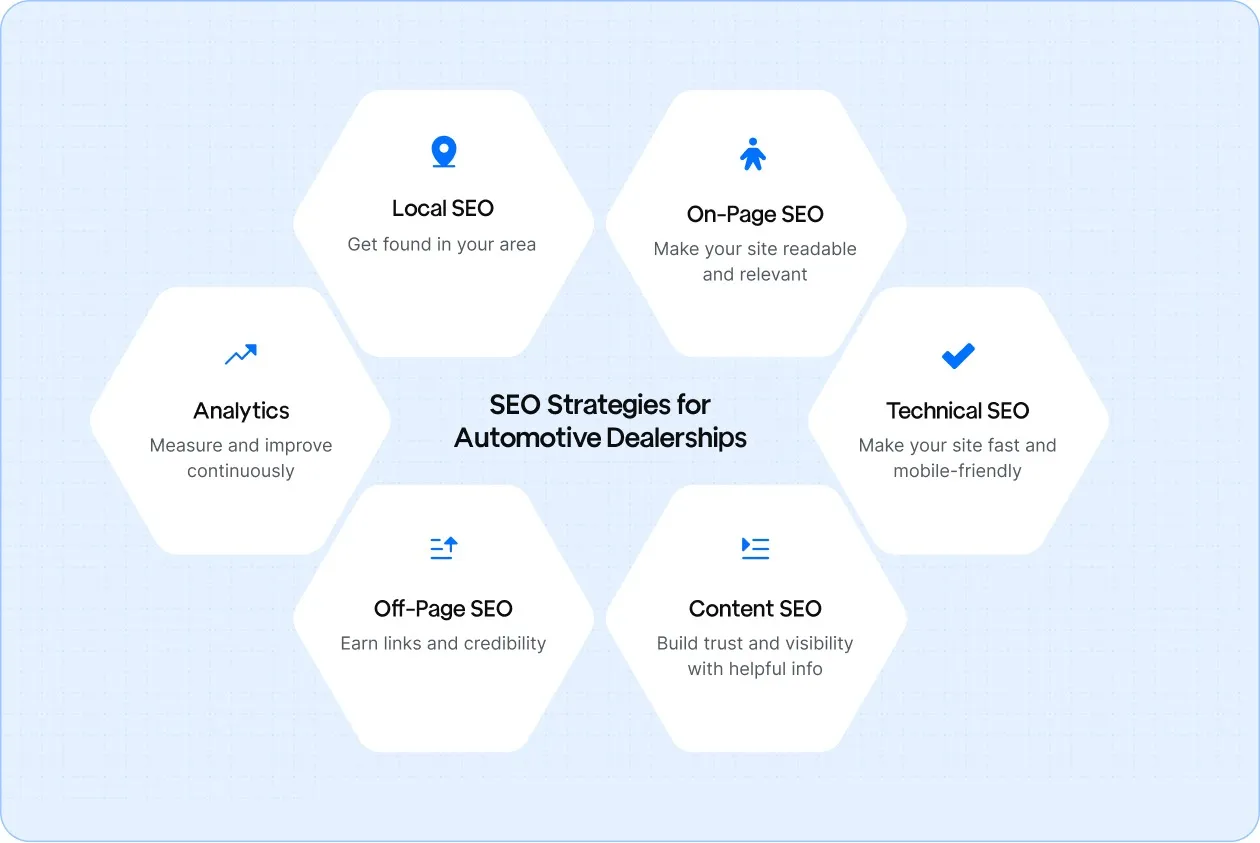
These pieces work together like a sales funnel: visibility → trust → visits → leads.
Building Visibility That Brings Buyers In
When your website, listings, and local search results work together, you earn trust before the buyer even arrives. Small, steady improvements to these details create big shifts in how often buyers find and choose you.
If your dealership is serious about growth, your SEO should work as hard as your sales team. Optimize it once, maintain it consistently, and let it keep doing what it’s built for, bringing the right people straight to your lot.
Make Your Dealership the First Choice Online
Gushwork helps automotive businesses build search-ready websites, optimize inventory pages, and stay visible where real buyers are looking.
Get My Free SEO Audit

