


Home

Resources
Blogs
Blog
Get insights on AI, productivity, and the future of work.


Thank you! Your submission has been received!
Oops! Something went wrong while submitting the form.

Industrial Sales
Aug 15, 2025
5 mins
I've Seen 500+ Line Cards. Only 12 Got Second Meetings. Here's What They Did Differently
Batul Beawarwala
Your line card isn't working. Not because it's bad, but because you're thinking about it wrong.
Most manufacturing companies treat their line card like a business card with product specs. They list what they make, throw in some technical details, and call it marketing. Meanwhile, their customers are drowning in a sea of identical-looking line cards from competitors who all claim to be "quality-focused" and "customer-driven."
Here's what's actually happening: At trade shows, in email attachments, on your website, it's doing the heavy lifting of explaining who you are and why someone should care. And right now, it's probably failing at that job.
This guide will show you exactly how to fix it.
TL;DR
- Most manufacturing line cards are product catalogs disguised as marketing. They list capabilities, specs, and certifications that mean nothing to prospects trying to solve problems. Buyers scan line cards for just 8 seconds at trade shows before deciding to keep or toss them.
- What works instead: Lead with your strongest differentiator in the first few seconds. Connect every capability to specific customer outcomes ("precision machining that prevents production shutdowns" vs "CNC services"). Include proof with real customer results, make it mobile-friendly and searchable online, and give clear next steps for interested prospects.
I. How a Line Card Impacts Your Business and What It’s Doing Right Now
Your line card is a crucial tool for nurturing leads who are already familiar with your company. It helps keep your brand top of mind and reinforces your value proposition after the initial interaction. However, if your line card doesn’t immediately communicate your value, it will fail to keep the lead engaged or move them closer to a decision.
Most line cards fail to perform this essential function. They’re often overly technical or filled with jargon that your leads may not easily relate to. Instead of nurturing, they become a missed opportunity to reinforce your strengths and differentiate you from competitors. So, how do you know if your line card is working for you or against you?
A. Quick Reality Check on Your Current Line Card
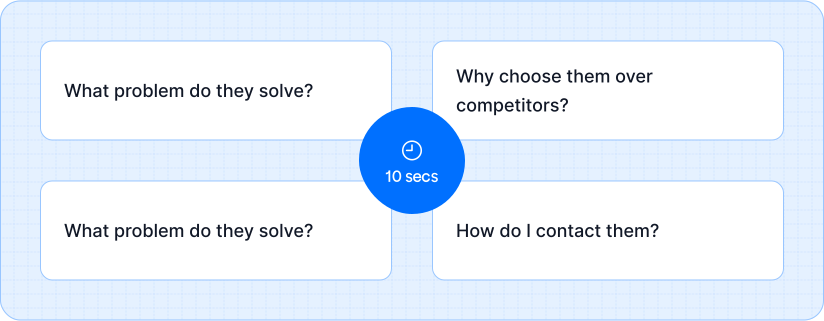
Pull out your current line card, physical or digital, and time yourself. Give yourself exactly 10 seconds to scan it, then answer these questions:
- What problem does this company solve?
- Why shou4ld I choose them over their competitors?
- What's their biggest strength or differentiator?
- How do I contact them if I'm interested?
If you can't answer all four questions clearly, neither can your customers. And if you can't do it in 10 seconds, you're losing prospects who scan even faster than you do.
Most manufacturing line cards fail this test completely. They're product catalogs disguised as marketing materials, full of internal jargon and technical specs that mean nothing to someone who doesn't already know your company.
B. Here's What's Really Happening
At trade shows, buyers spend about 8 seconds scanning each line card before deciding if it's worth keeping or tossing.
Online, they're comparing you to 5-10 other suppliers simultaneously, with your line card open in different browser tabs (if you do have digital line cards!). Your sales team is sending it to prospects who've never heard of you, hoping it explains why you're worth a phone call.
If your line card doesn't immediately communicate what you do and why it matters, you lose. The prospect moves on to the next supplier who does a better job of explaining their value.
The stakes are higher than you think. That line card isn't just marketing collateral, it's often your only shot at making a first impression. Mess it up, and you're not even in the running for the business.
C. How Modern Customers Actually Buy
The industrial buying process has completely changed, but most line cards haven't caught up.
Your customers aren't picking up the phone to ask basic questions anymore. They're doing their homework online first. By the time they contact you, they've already formed opinions about which suppliers are serious contenders and which ones aren't.
At trade shows, buyers collect line cards from every relevant supplier.
Back at the office, they spread them out on a conference table and start eliminating options. The line cards that clearly communicate value stay in the pile. The ones that don't get tossed.
Your line card gets forwarded to purchasing managers, engineers, and executives who've never met you. It needs to make sense to all of them, not just the person who originally picked it up.
If your line card isn't available online, easily shareable, and mobile-friendly, you're creating friction. Modern buyers expect instant access to information, not a request for someone to mail them something.
Is your line card stuck in the past?
A static PDF isn’t enough. You need a digital home base that attracts and nurtures qualified leads.
Go Digital, Get Leads


II. So, You Need to Change How You Think About Line Cards
A. Stop Making Lists, Start Solving Problems
The biggest mistake manufacturers make is treating their line card like a product catalog. Page after page of part numbers, specifications, and capabilities that make perfect sense to you but mean nothing to a prospect trying to solve a problem.
Here's why this happens: You know your products inside and out. You're proud of your capabilities, your equipment, your certifications. When someone asks what you do, your natural instinct is to list everything you can make. It feels comprehensive and professional.
But here's the disconnect:

When they see a list of services and specs, they have to do the mental work of figuring out if any of that actually helps them. Most won't bother.
Shift from listing features to showcasing how your product solves real problems. Highlight the benefits your product brings to the customer, not just the specs.
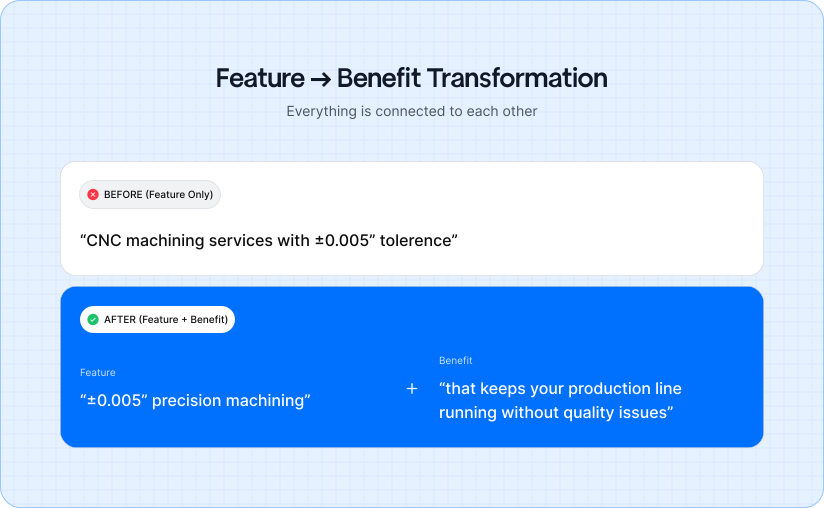
Instead of "CNC machining services with ±0.005" tolerance," try "±0.005" precision machining that keeps your production line running without quality issues."
Instead of "ISO 9001 certified facility with advanced equipment," try "ISO 9001 quality systems that ensure your parts meet spec every time, so you don't waste time on inspection delays."
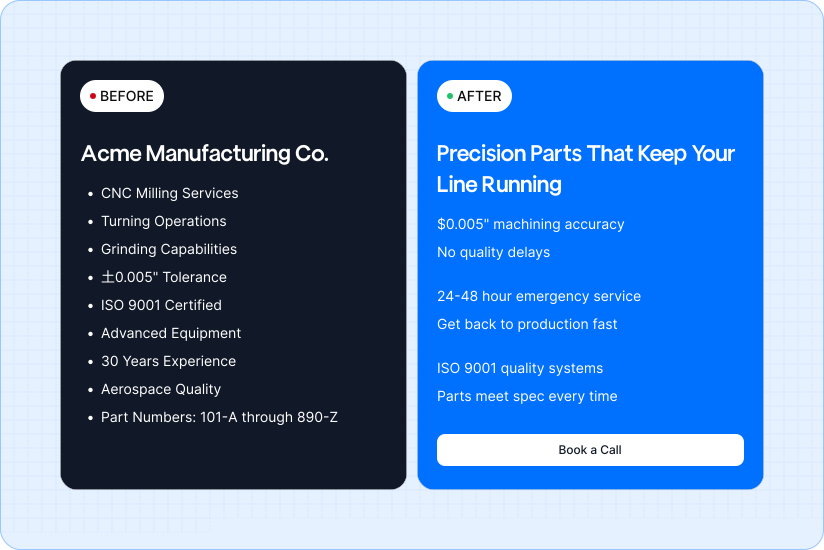
Think like your customer. They have a problem: parts that don't fit, suppliers who miss deadlines, quality issues that shut down production. Your line card should immediately connect what you do to the problems they're trying to solve.
B. Differentiate with Proof
Claims without evidence are just marketing fluff. Your competitors probably say the same things about quality and service that you do. What makes you different is your ability to prove it.
Include customer success stories or results to back up your claims and make your company more credible. Real examples carry more weight than generic statements about excellence.
Instead of "We deliver on time," try "We helped ABC Manufacturing reduce their lead times from 6 weeks to 3 weeks, preventing a costly production shutdown."
Instead of "High-quality parts," try "Our precision components helped XYZ Corp reduce their reject rate from 8% to less than 1%."
Customer testimonials, case studies, photos of your work, and specific results give prospects confidence that you can deliver what you promise. They also help you stand out from competitors who only make claims without backing them up.
C. Think Digital, Not Just Paper
Trade shows aren't dead, but they're not the only game anymore. Your line card needs to work just as well on the screen as it does in a booth.
Customers expect to find information online instantly. Make your line card searchable, shareable, and always current.
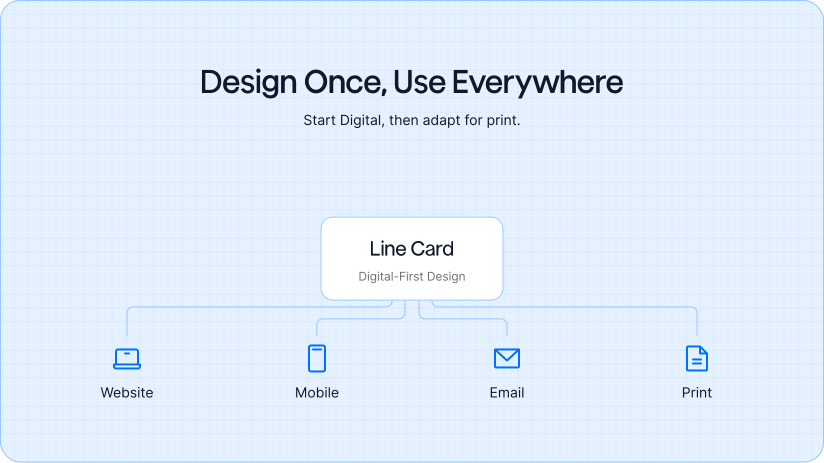
Digital-first approach: Start with how your line card will look and function online, then adapt for print. This ensures it works on mobile devices, loads quickly, and can be easily shared via email or social media.
Always current: Digital line cards can be updated instantly. No more outdated contact information, discontinued products, or last year's certifications. Your line card should always reflect your current capabilities.
Searchable and shareable: If your line card lives online, it can be found by search engines and shared by customers. That's free marketing that works 24/7, not just during trade show season.
III. What Your Line Card Should Actually Do
Your line card has three jobs. If it's not doing all three, it's not working hard enough for your business.
A. Grab Attention Fast
You have seconds, not minutes. At trade shows, buyers are overwhelmed with options. Online, they're comparing multiple suppliers simultaneously. You need to communicate value immediately or lose them forever.
How to do it: Lead with your strongest differentiator. What makes you uniquely valuable? Is it your speed, quality, expertise, or innovative approach? Put that front and center, not buried on page two.
Test it: Remember the 10 second test? This time, show your line card to someone unfamiliar with your business and see if it is working.
B. Build Trust
Manufacturing relationships involve significant investments and long-term partnerships. Customers need confidence that you can deliver on your promises before they'll even consider getting a quote.
How to do it: Provide concrete proof of your capabilities:
- Customer success stories with specific results
- Photos of your actual work or facility
- Industry certifications and quality standards
- Years in business and key partnerships
- Performance metrics that matter to customers
What actually works: Real customer names (with permission), actual project results, and tangible evidence of your expertise. Generic statements about "quality and service" mean nothing. Specific proof builds credibility.
C. Make It Easy to Take the Next Step
Interested prospects shouldn't have to hunt for ways to contact you or figure out what to do next. Every piece of friction in your process sends customers to competitors who make it easier.
How to do it:
- Clear, prominent contact information
- Specific calls-to-action ("Get a quote," "Schedule a tour")
- Multiple contact methods (phone, email, online form)
- Quick response time commitments
- Simple process for moving from inquiry to proposal
The result: More qualified leads who know what they want and are ready to move forward.
IV. How to Actually Build a Better Line Card
A. Research Your Customers’ Needs
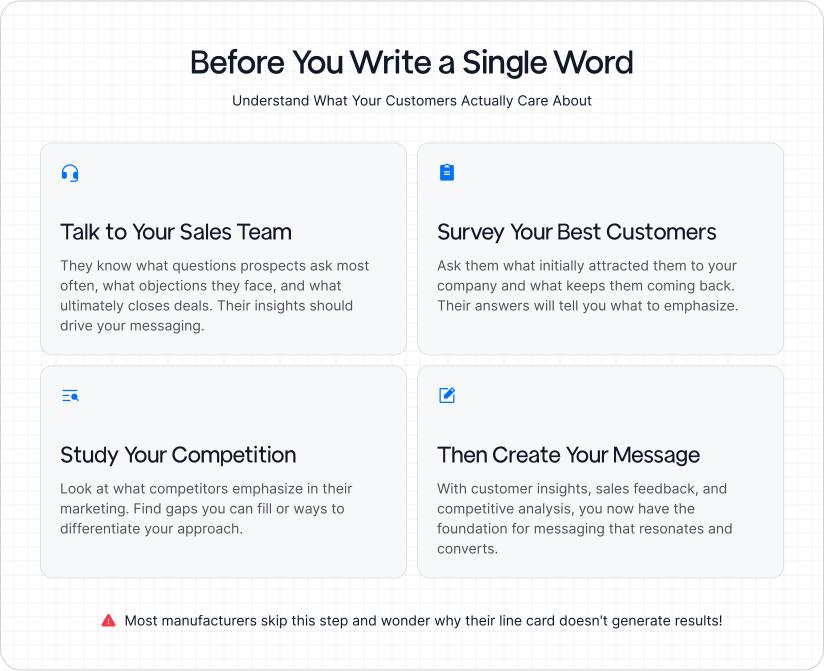
Before you write a single word, invest time understanding what your customers actually care about. Most manufacturers skip this step and wonder why their line card doesn't generate results.
Want to know what messages actually generate leads?
A better line card is a start, but it can’t fix the pipeline on its own. We'll test what works to fill your pipeline with qualified prospects.
Build a 24/7 Lead Channel
B. Focus on Customer Solutions
We’ve discussed this, but it’s really important to take note of it again! Your line card should make it crystal clear what outcome they'll get from working with you.
The formula is simple: [Your capability] + [Customer outcome] = [Compelling message]
Examples that work:
- "24-hour turnaround machining for emergency repairs that get your line back up fast"
- "Food-grade stainless fabrication with full traceability documentation for FDA compliance peace of mind"
- "Prototype to production runs from 1 to 10,000 pieces, so you can test and scale without changing suppliers"
Notice each example includes both the technical capability AND the business outcome. This approach works because it helps prospects immediately understand if you're a fit for their specific situation.
C. Design for Impact
Mobile-first: Many customers will first see your line card on their phone. Make sure it's readable and functional on small screens.
Scannable layout: Use headings, bullet points, and white space so customers can find key information quickly.
Professional appearance: Your line card reflects the quality of your work. Poor design suggests poor attention to detail in manufacturing.
D. Go Digital
Online presence: Your line card should live on your website with its own URL that's easy to share and remember.
Search optimization: Include queries that customers use when searching for solutions like yours. (your marketing team can help you figure out exactly what these queries are, how many and which ones should you actually answer!)
Regular updates: Establish a schedule for reviewing and updating your line card. Outdated information kills credibility.
V. How to Know It's Actually Working
A. Your Sales Team Will Use It
Good signs:
- Salespeople reference it in customer meetings
- They send it to prospects without being reminded
- They ask for updates or additional versions
Warning signs:
- They create their own materials instead
- They avoid using it in presentations
- They complain it doesn't address customer questions
How to measure: Monthly check-ins with your sales team. Ask specifically what's working and what's missing.
B. Customers Will Respond Better
Good signs:
- More quote requests through your website
- Customers come to meetings already understanding your capabilities
- Shorter time between first contact and first meeting
- Higher quality leads who know what they want
Warning signs:
- Prospects ask basic questions that should be answered in your line card
- You're getting inquiries from unqualified leads who aren't a good fit
- Customers seem confused about what you actually do
How to measure: Track website analytics for your line card page, monitor quote request volume and quality, survey new customers about their research process
C. Your Business Will See Results
Good signs:
- Shorter sales cycles
- Higher conversion rates from leads to customers
- Increased average project size
- Better customer retention
Warning signs:
- Sales cycles are getting longer, not shorter
- You're competing mainly on price instead of value
- Win rates are declining despite more activity
- Customers keep asking for references from similar projects
How to measure: Track time from first contact to signed contract, monitor lead-to-customer conversion rates, analyze revenue per customer trends
VI. Practical Steps to Get Started This Month
Week 1: Figure Out What You Have Now
Day 1: Collect all current versions of your line card (print, digital, variations by different team members)
Day 2: Review your website analytics to see how people currently find and interact with your company information
Day 3: Survey your sales team about what works and what doesn't with current materials
Day 4: Analyze 5 competitors' line cards or marketing materials
Day 5: Rate your current line card 1-10 for grabbing attention, building trust, and making next steps clear
Week 2: Fix the Biggest Problems
Day 1: Identify the top 3 issues with your current line card
Day 2 & 3: Rewrite your value proposition to focus on customer problems, not your capabilities
Day 4: Gather proof elements (customer stories, photos, results) that build credibility
Day 5: Simplify your contact information and calls-to-action
Week 3: Make It Look Professional
Day 1: Create a clean, scannable layout with clear hierarchy
Day 2: Ensure all text is readable and jargon-free
Day 3: Add quality images that support your message
Day 4: Test the design on desktop and mobile devices
Day 5: Proofread everything and get team feedback
Week 4: Get It Online and Working
Day 1: Upload your line card to your website with a dedicated URL
Day 2 Optimize for search engines with relevant keywords
Day 3: Set up tracking to measure performance
Day 4: Train your sales team on the new version
Day 5: Share with current customers for feedback
VII. Common Mistakes That Kill Line Card Effectiveness
A. Making It About You Instead of Your Customer
The mistake: Leading with your company history, your equipment, your achievements, your processes.
Why it fails: Customers care about their problems, not your company.
The fix: Start every section with customer benefits.
B. Using Internal Language Customers Don't Understand
The mistake: Technical jargon, internal product codes, industry acronyms without explanation.
Why it fails: Confusion kills sales.
The fix: Write for your customer's level of technical knowledge, not your own.
C. Forgetting to Update It
The mistake: Creating a line card once and using it for years without changes.
Why it fails: Outdated information destroys credibility.
The fix: Schedule quarterly reviews.
VIII. Is Your Line Card Really the Problem?
Here's the honest truth: Your line card might just be a symptom of a bigger issue.
If you're reading this guide because leads aren't converting, sales cycles are too long, or you're losing to competitors on price, your line card is probably part of the problem. But it might not be the whole problem.
The Real Questions You Need to Ask
Are prospects finding you in the first place? If your phone isn't ringing and your website isn't generating inquiries, the best line card in the world won't help. You have a visibility problem, not a conversion problem.
Do you understand what your customers actually value? If you can't clearly articulate why someone should choose you over cheaper alternatives, you have a positioning problem that goes deeper than marketing materials.
Is your entire sales process aligned? If your line card promises one thing but your sales team presents differently, or your website says something else entirely, you have a consistency problem across your entire go-to-market approach.
Is your line card just a band-aid for a bigger problem?
A single piece of collateral can't fix a scattered strategy. Stop patching problems and start nurturing leads with a complete, integrated system.
Book a Consultation

When to Fix It Yourself vs. When to Get Help
Fix it yourself if:
You're getting leads but they're not converting. Your visibility is fine, you just need better sales materials. A line card makeover should fix this bottleneck.
Your sales team knows your value proposition. If your best salespeople can explain why customers choose you, you have what you need. Just capture that knowledge in your line card.
It's mainly a messaging problem. You know what makes you different, you just need to present it better. Maybe a writer can help, but major outsourcing won’t be required.
Consider getting professional help if:
Prospects can't find you. No line card will help if customers don't know you exist. You need a comprehensive strategy to get found online.
You can't explain what makes you different. If you're not clear on your unique value, your line card won't be either. This requires positioning work that goes beyond copywriting.
Everything feels scattered. When your website, line card, and sales team all say different things, you need someone to orchestrate a cohesive system.
You'd rather focus on your business. Building an effective marketing system requires ongoing attention. If you'd rather spend time on operations and customers, get experts to handle marketing.
Most manufacturers try to fix these problems one at a time. They update the line card, then the website, then try advertising. What works better is building a complete system where everything works together.
Your Next Steps (Don’t Wait!)
Before you dive into redesigning your line card, take an honest look at your entire sales and marketing approach. Is your line card the real bottleneck, or is it just the most obvious symptom?
If you're ready to build a complete system that gets you found, trusted, and chosen, we'd be happy to show you how other manufacturers have done exactly that. Connect with our team to discuss your specific situation.
If you just need to fix your line card first, start with the 10-second test and work through the practical steps in Section VI. Either way, don't let another month pass with a line card that's working against you instead of for you.
.webp)
Industrial Sales
Aug 13, 2025
5 mins
Your Sales Stars Face Uphill Battles Daily. Clear These Bottlenecks to Win Big
Preksha Bharadwaj
Most manufacturing businesses unknowingly build sales success around one or two stars who become the company's face, main order source, and keepers of critical knowledge. This creates dangerous dependencies.
When star reps leave, take breaks, or underperform, entire revenue streams are at risk. Worse, their success factors, customer relationships, timing, market shifts, and luck are outside your control.
The solution isn't finding another star player. It's building systems that don't depend on any single person. Here’s why:
1. Because Their Success Depends on Things You Don't Control
Your star salesperson's success isn't just about their talent. It's the result of market conditions, established relationships, and systems you've unknowingly built around one person. When they leave, those systems leave with them.
Think about it: your best salesperson succeeds because of timing (when they call), relationships (who they know), market conditions (what customers need right now), and luck (being in the right place). You can't replicate that by hiring another person.
Companies often mistake individual sales activity for sales strategy, focusing on hiring better salespeople instead of building better systems. When your growth depends on one person working harder, you eventually hit a wall.
But it’s not just about people. Your business also faces major risk when too much depends on one individual.
2. Because One Person Can't Do Everything Forever
Even your best salesperson has limits. They can only make so many calls, visit so many customers, and remember so many details. Manufacturing customers often expect quick, reliable answers about specs, delivery times, and prices. One person can’t handle that alone as your company grows.
Also, if just a few clients make up most of your sales, losing even one can cause a big hit. Spread out your sales efforts, use sales enablement tools and strategies, or inside sales teams to help cover more ground without wearing anyone out.
3. Because Customer Retention Is Built on Trust, Not Just Transactions
In industrial sales, clients want suppliers who solve problems fast, like helping fix a production delay or suggesting a better part.
Your star salesperson can start these relationships, but keeping customers happy means your whole team needs to back that up. For example, your engineering support, after-sales service, and quality control all matter.
Vulnerability & Risk Issues Include:
- Key person dependency – Too much revenue relies on one salesperson.
- Knowledge that quits your company– Critical pricing, customer, and market info leaves with them.
- Customer loyalty to the person, not the company – Clients may follow them to a competitor.
- Weak legal protection – Non-competes are often hard to enforce.
- Exposure during market downturns – Sales roles are cut first when budgets shrink.
- Poor visibility of sales activity – No clear record of what’s working or failing.
Make sure everyone understands their role in keeping customers loyal, so relationships last beyond just a sales contract.
These gaps, if left unaddressed, open your business to serious vulnerability and risk issues.
4. Because Your Best Salesperson Can Become Your Biggest Threat
Your star salesperson knows your costs, customer pain points, and how you win business. If they leave and join a competitor, they can use this info against you.
For manufacturing, this could mean losing a bid because they undercut your prices or pitch better solutions based on your weaknesses. Industrial knowledge and technical expertise that’s tailored to your company specifically:
- Your pricing strategies and profit margins
- Your customer pain points and decision-making processes
- Your operational weaknesses and competitive vulnerabilities
Protect your business by limiting sensitive information to only those who need it and making customer info accessible to the whole sales team, not just one person.
5. Because They May Take Your Customers With Them
That "company loyalty" you think you've built? It's actually a matter of personal loyalty to your salesperson. When they leave:
- Customers often follow them to their new company
- Your "business relationships" disappear overnight
- Non-compete agreements are nearly impossible to enforce in most states
Focus on making your company trustworthy in itself, with consistent quality and service, so customers don’t feel tied to just one person.
6. Because Economic Downturns Hit Salespeople First
As of mid-2024, there were 603k vacant jobs in the U.S. alone in the manufacturing industry. You are competing for a shrinking pool of talent while trying to replace the sales guy who quits with each departure.

Source: Themanufacturinginstitute.org
Your "essential" salesperson becomes "too expensive" overnight, but your bills don't stop. That’s when budgets are tight, and you plan to cut the sales staff first. Systems continue to function when you can't afford personnel.
However, your customers still require parts and service, even during a downturn. That’s why building automated systems, such as online ordering, quick contacts and active RFQs, or multiple product information, keeps your business running smoothly even when budgets shrink.
Today’s industrial customers prefer to do their own research before ever speaking to a salesperson.
7. Because Modern Buyers Don't Want to Talk to Sales First
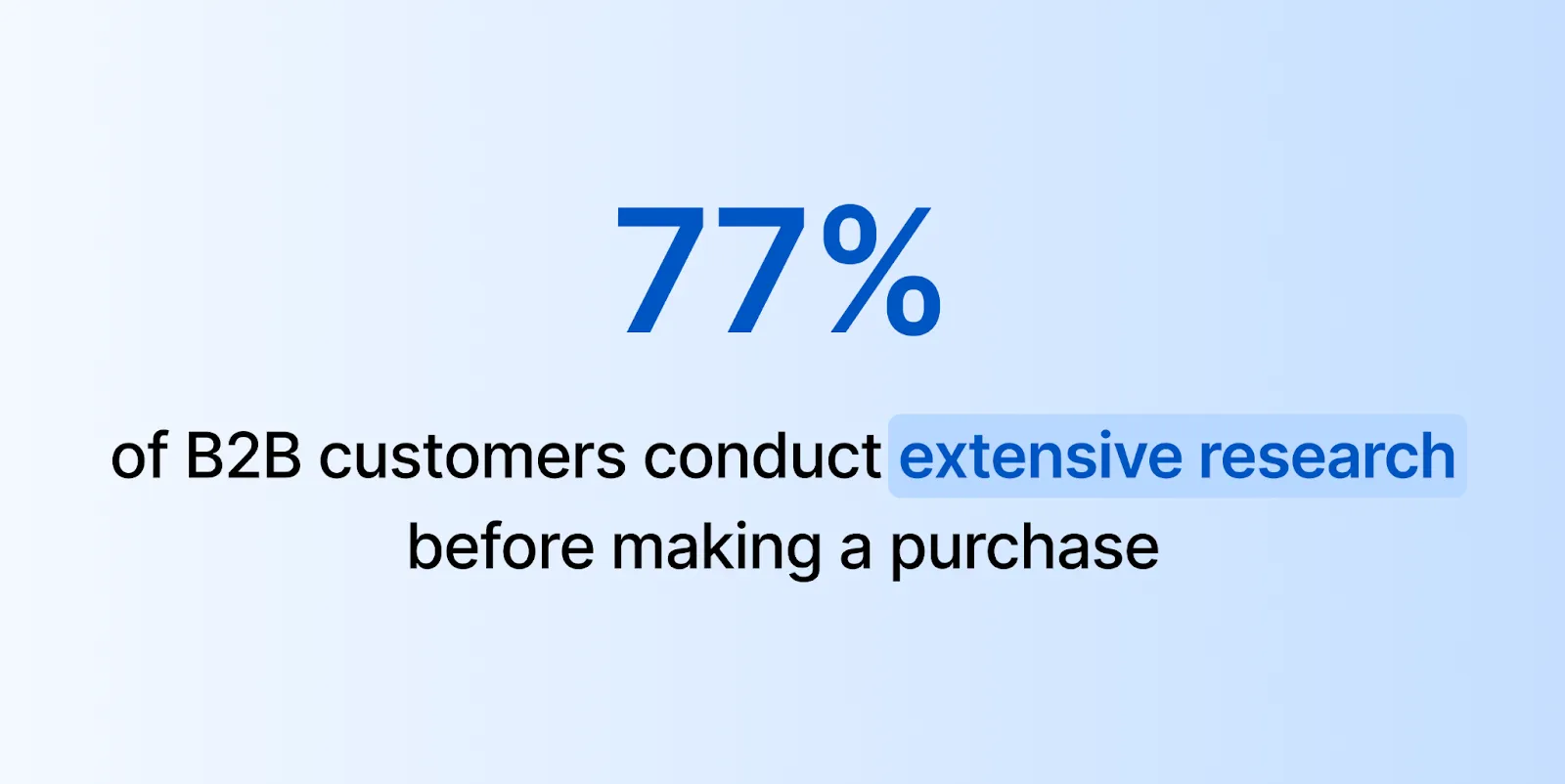
7 in 10 B2B buyers prefer researching online before any contact. They want to see clear info like technical details, delivery times, and pricing on your website or brochures.
If they can’t find this, they move on. Your salespeople become valuable later, helping answer complex questions or negotiate. So focus on giving buyers the info they want upfront, making your company easy to find.
By the time they're ready to talk to sales, they've already eliminated companies they can't find online.
However, being easy to find isn’t enough on its own. What buyers see when they find you matters just as much. A poor reputation can take you off their shortlist before sales ever get a chance.
8. Because Sales Can't Fix a Bad Reputation
One bad Google review reaches more people than your salesperson talks to in a month.
If customers complain online about quality or service, no salesperson can overcome that damage. Monitor online feedback and address problems quickly, so your company’s reputation stays strong and salespeople don’t have to clean up the mess.
Modern buyers check reviews before any sales conversation.
And just like a bad reputation can shut doors before sales start, losing hard-earned industry knowledge when a star sales rep quits can slow you down even when the opportunity is there.
9. Because Your Industry Knowledge Walks Out the Door
Sales skills don't transfer between industries. What works in the automotive industry doesn't necessarily work in manufacturing.
Their replacement will need time to learn the details, suppliers, and regulations unique to that field. To avoid this, train multiple team members on your industry insights and document important findings so that knowledge remains with the company.
When your experienced salesperson leaves, their replacement doesn’t start from zero, even if they're skilled in other industries. And just like they can’t be available around the clock, no amount of sales effort can make up for production problems.
10. Because Sales Can't Fix Production Issues
No matter how good your sales team is, if your parts are late or quality is poor, customers will stop buying.
In manufacturing, consistent quality and on-time delivery are everything. Fixing these problems requires working closely with production and logistics, not just sales.
Make sure your sales and operations teams communicate regularly to manage customer expectations. These operational problems will eventually catch up with even your best relationships.
And while fixing operations is critical, expecting your sales team also to handle marketing only divides their focus and weakens both efforts.
11. Because Sales Can't Double as Your Marketing Team

Asking salespeople also to write website content or run ads takes time away from selling.
Plus, marketing needs a different skill set—understanding how to reach new industrial buyers and explain technical benefits clearly.
Because 90% of B2B buyers use online channels as their first method to look for new suppliers.
Invest in a separate marketing system that can help your sales team by generating leads and sharing product information professionally.
12. Because Sales Can't Work 24/7 (As They Shouldn’t!)
International customers usually research outside business hours. Your industrial customers in different time zones or those working night shifts can’t wait for your salesperson to wake up.
Your website, product catalogs, and online order systems can!
Offering online presence and quick responses helps capture leads and orders even outside business hours, so you don’t miss sales.
While technology keeps your business open around the clock, the reality is that experienced salespeople won’t be with you forever.
13. Because Salespeople Retire (And Take 30 Years of Relationships With Them)
Your 55-year-old star salesperson won't work forever. When they retire, all their industry connections and industry knowledge fade.
This leaves a big gap.
Start building company-wide relationships early, keep customer records updated, and encourage team selling so others know your clients, not just one person.
14. Because Good Salespeople Cost More Than You Think
Hiring a top salesperson means paying more than just salary; they want bonuses, travel budgets, and special perks.
Plus, when they leave, training a new person can take 6 to 12 months before they reach the same level. Instead of spending all on one star, invest in building a strong sales team and good sales processes that don’t rely on one individual.
Beyond the cost and training time, there’s another challenge that follows. No single salesperson can be everywhere your business needs them to be.
15. Because They Can't Be in Multiple Places at Once
Your business may need to operate across multiple factories in different regions, attend several trade shows, and respond promptly to numerous customers.
One person can’t do all this effectively. Use technology, inbound lead systems, and field teams to multiply your reach and keep customer service strong everywhere.
Here’s a Critical Gap You Must Know
Traditional sales processes assume customers already know you exist. However, modern buyers typically Google your company first.
Even the most skilled sales team can't succeed if prospects never discover your company during their research phase.
Without a proper marketing foundation, you're asking your sales team to perform miracles with an invisible company. Recognizing these challenges is important, but the key lies in how you respond to establish long-term sustainability in your business.
How to Turn Sales Crisis Into Long-term Growth
When your star salesperson leaves, you have three choices:
Option 1: Panic and Replace. Hire another expensive salesperson and hope they can replicate the results. This rarely works because you're trying to replace circumstances, not just skills.
Option 2: Double Down on Traditional. Increase trade show budgets, hire more salespeople, and make more cold calls. This might maintain current revenue but won't solve the underlying dependency problem.
Option 3: Build Systems That Work Without Heroes. Create lead generation that works 24/7, regardless of who stays or leaves. This is what smart manufacturers are doing.
Instead of relying on individual stars, successful manufacturers focus on building systems that consistently drive results, no matter who’s on the team. They built a system that:
- Generate leads automatically through optimized websites and targeted content
- Capture prospects who are already researching your services online
- Qualify customers before they reach your remaining sales team
- Work continuously even when people are sick, on vacation, or leave the company

The Results are real. Companies following this approach typically see 40-60% more qualified leads within 6 months, while becoming crisis-proof against personnel changes.
Before the Next Star Salesperson Walks Out, Do This!
Build a 24/7 lead generation system that works, no matter who stays or goes.
Your competitors are still debating whether online presence matters for manufacturing. While they debate, you could be capturing the customers they don't even know they're losing.
The question isn't whether to upgrade, it's whether you'll do it before or after your next crisis forces you to.
If you want to build the kind of lead generation system that made other businesses crisis-proof, Gushwork can help. Here’s what we do:
- Transform your manufacturing website into a 24/7 lead generator.
- Create targeted content, including blogs, service pages, or product pages
- Optimize these pages to rank in Google search results and attract qualified leads to click on your page.
- Build a strategic Google Ads plan to bring in ready-to-buy prospects.
Talk to us today and start building systems that work regardless of who stays or goes.
Frequently Asked Questions (FAQs)
1. How quickly can manufacturers see results from digital marketing?
Most manufacturers see initial traffic increases within 2-3 months, with significant lead generation improvements by month 6. The key is combining digital efforts with existing traditional methods rather than replacing them.
2. What's the biggest mistake manufacturers make with online marketing?
Focusing 80% of effort on content creation and only 20% on distribution. It should be the opposite: great content means nothing if potential customers can't find it. Platforms like Gushwork help with the entire content strategy for generating new leads week-on-week.
3. Do these strategies work during economic downturns?
Yes, often better. When companies cut staff, they increasingly look for suppliers and solutions that improve efficiency. Having strong online visibility becomes even more valuable when budgets tighten.
4. How do we maintain our technical credibility online?
By showcasing actual case studies, technical specifications, and problem-solving capabilities rather than generic marketing speak. Industrial buyers can spot authenticity immediately.
References:
https://www.businessdasher.com/b2b-marketing-statistics/
https://www.webfx.com/blog/manufacturing/statistics/
https://www.leadforensics.com/blog/24-must-know-b2b-marketing-statistics-for-2025/
https://www.orengreenberg.com/blog-post/75-b2b-marketing-statistics-for-2024
https://www.sixthcitymarketing.com/manufacturing-seo-2/

Digital Marketing
Nov 11, 2025
5 mins
How Buyers Choose Suppliers Today Using Industrial Digital Marketing Strategies
Percy Brown
A DemandGen report says 80% of B2B buyers now research online before making any sales contact. They're comparing tolerances, certifications, lead times, and capabilities— before picking up the phone.
And while you’re reading this, there’s probably another buyer right now searching for exactly what you offer… but finding someone else.
Why Digital Marketing for Industries Matters Today
For most US industries, the shift is clear: buyers are no longer relying solely on trade shows, referrals, cold calls, or sales reps.
They now begin their search online, often with a quick Google search or by joining a Facebook group. Digital marketing helps industrial and manufacturing companies appear exactly where decisions are made: Google, Industrial Forums, Facebook, sponsored Ads, etc.
It strengthens your online presence, generates qualified leads, and positions you ahead of competitors still relying on traditional outreach.
In fact, research shows B2B organizations allocate 8.7% of their total annual budget to marketing, and it is expected to hit $19.22 billion on B2B ad spend by 2025–26.
And that’s exactly why digital marketing matters today: it brings your buyers to you instead of relying on chance.
What is Digital Marketing for Industrial Companies?
Digital marketing is a strategic practice for promoting the products or services you sell to your industrial buyers. It uses the internet and digital channels, including websites, social media (LinkedIn, Facebook, YouTube, Instagram), search engines (Google, Yahoo, Bing, or Safari), email, and online ads (Google Ads, Facebook/Meta Ads) to reach and connect with customers.
What Are the Core Principles of Industrial Digital Marketing
Most industries don’t lose leads due to a lack of effort. They lose them due to a lack of direction. When you know who you’re targeting, where they are, and what influences their decisions, digital marketing for industrial businesses becomes predictable, measurable, and scalable.
- Define your ICP clearly: Know the industries you serve, who your buyer is, and their exact pain points. Without this, your marketing becomes generic and attracts low-quality leads.
- Target the right region: Industrial buyers search, compare, and evaluate differently. Your keywords, content, certifications, and messaging must match the region you want to rank in, or Google won’t surface you in search results.
- Understand buyer intent: B2B Industrial buyers look for specs, tolerances, materials, compliance, and case studies. Aligning your content with these patterns builds trust and relevance.
- Build credibility signals: Certifications, technical documents, factory videos, and client logos help engineers validate your capability before sending RFQs.
- Create a consistent content engine: Regular blogs, landing pages, and case studies keep you visible during long industrial buying cycles and steadily move buyers toward conversion.
Once these principles are in place, the next step is choosing the right digital marketing channels that can consistently reach and influence buyers.
What are the Types of Digital Marketing for Industries?
There are two main sides to digital marketing: inbound and outbound.
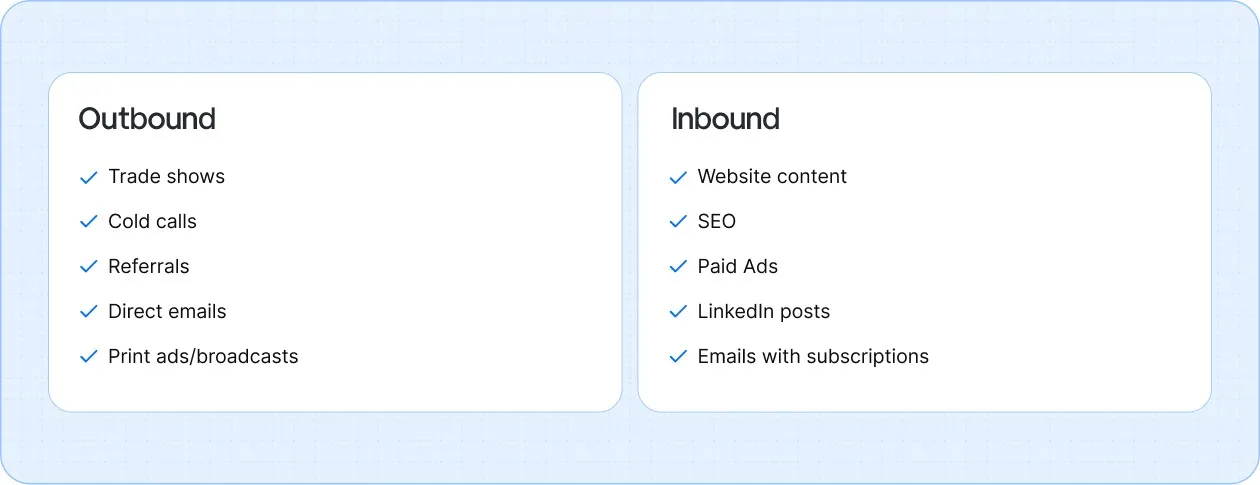
Outbound is what you already know: trade shows, cold calls, referrals, TV ads, print ads, billboards, or direct emails without subscriptions. That’s you reaching out.
Inbound, on the other hand, is when buyers come to you, through Google searches, your website content, videos, SEO (Search Engine Optimization), paid ads (Search Engine Marketing), or even a LinkedIn post they stumbled upon.
The best industries today don’t choose one over the other. They combine both.
Outbound helps you chase big contracts. Inbound builds a steady, predictable pipeline of qualified RFQs, even while you’re on the shop floor.
Think of digital marketing like your online industrial floor. Each of its channels plays a role.
In short:
- Owned Channels = Visibility (you control how you want to look online)
- Paid Channels = Speed (you amplify the reach to your customers)
- Earned Channels = Trust (others vouch for your services or products)
What are the Proven Strategies of B2B Digital Marketing for Industries?
In digital marketing for the industrial sector, not all channels perform the same way. Some build online visibility, some bring instant leads (when you pay for it), and others strengthen your credibility, over time.
Here’s how each one contributes, starting with online search visibility.
1: SEO (Search Engine Optimization)
Be the Manufacturer They Find You First
If your factory isn’t showing up when buyers search for your exact capabilities, they’re finding someone else. Even if your quality, lead times, and certifications are better, they chose your competitor over you.
That’s where SEO helps. Search Engine Optimization (SEO) ensures your website appears in front of them, organically and cost-effectively. It’s how you get found on Google (Safari or even Bing) without paying for any clicks.
If you answer the questions your buyers are typing/searching for, you simply show up at the top.
Use this ready-to-use 3-month content plan built for industrial digital marketing for free. View Content Plan
Remember, there is always a strategy to be on top.
How to do it: Update your website pages monthly with technical content and case studies to improve rankings consistently.
Focus on:
- Optimizing your website pages for buyer-specific keywords (e.g., CNC machining in Ohio), through blog pages, service pages, product pages, etc.
- Adding technical details, certifications (ISO 9001 or AS9100), and case studies to build trust with your readers.
- Keeping your site fast (loading under 3 seconds), mobile-friendly, and updated with fresh information.
Buyers rarely scroll past page one; Good SEO strategies for industries help you appear on the first page and directly drive more RFQs.
Think of it as: Your digital factory floor, where clarity, structure, and precision help buyers (and Google) understand what you do best.
How visible are you on Google right now?
Check your website visibility for free to see how your factory appears on Google.
Book a Call
2. Paid Ads and PPC
Instant Visibility for New Products or Markets
Sometimes you need instant visibility to reach buyers in new regions or launch a new service. Relying solely on SEO may cost you time these valuable contracts.
Paid channels like Google Ads, LinkedIn Ads, or Facebook/Meta Ads help you reach buyers instantly. However, paid channels are effective only as long as you pay for them. It stops getting you results once you stop paying for it. Therefore, you must have solid plans to work with paid channels.
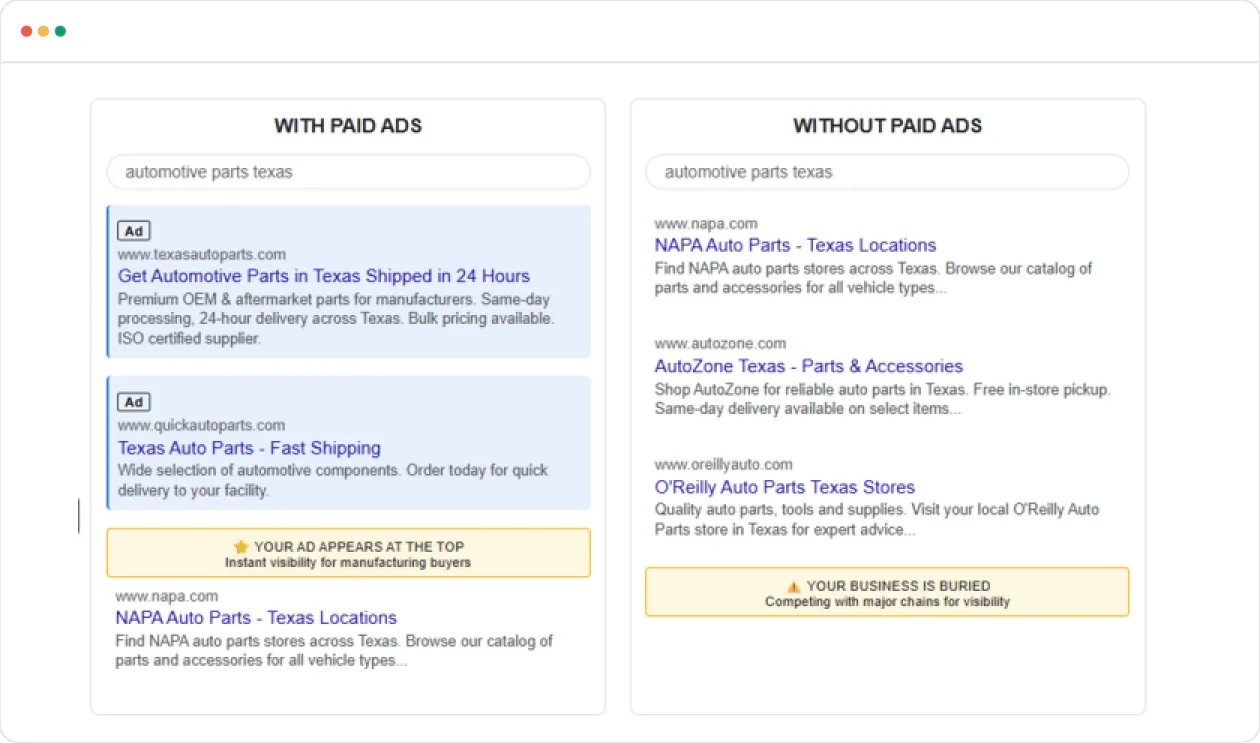
How to do it: Start small with highly targeted campaigns, monitor clicks, and adjust keywords weekly to maximize ROI. Track where they land once they click.
Focus on:
- Targeting engineers or procurement teams who search with precise keywords.
- Using LinkedIn Ads to promote capabilities, whitepapers, or RFQ offers.
- Tracking conversions to measure ROI, not just clicks, using Google Search Console or Google Analytics.
Paid ads capture buyers who aren’t yet aware of you, preventing high-value lost contracts.
Think of it as: Your fast lane to online visibility while SEO builds long-term results.
Read more: PPC for Manufacturers: A Complete guide
3. Content Marketing
Make Your Website Work as Hard as Your Sales Team
Your website is not just a digital brochure. It’s a 24/7 sales floor that educates your buyers and converts interest into leads while your team focuses on production.
Content marketing strategies such as blogs, videos, and capability pages should educate your buyers about your expertise and processes.
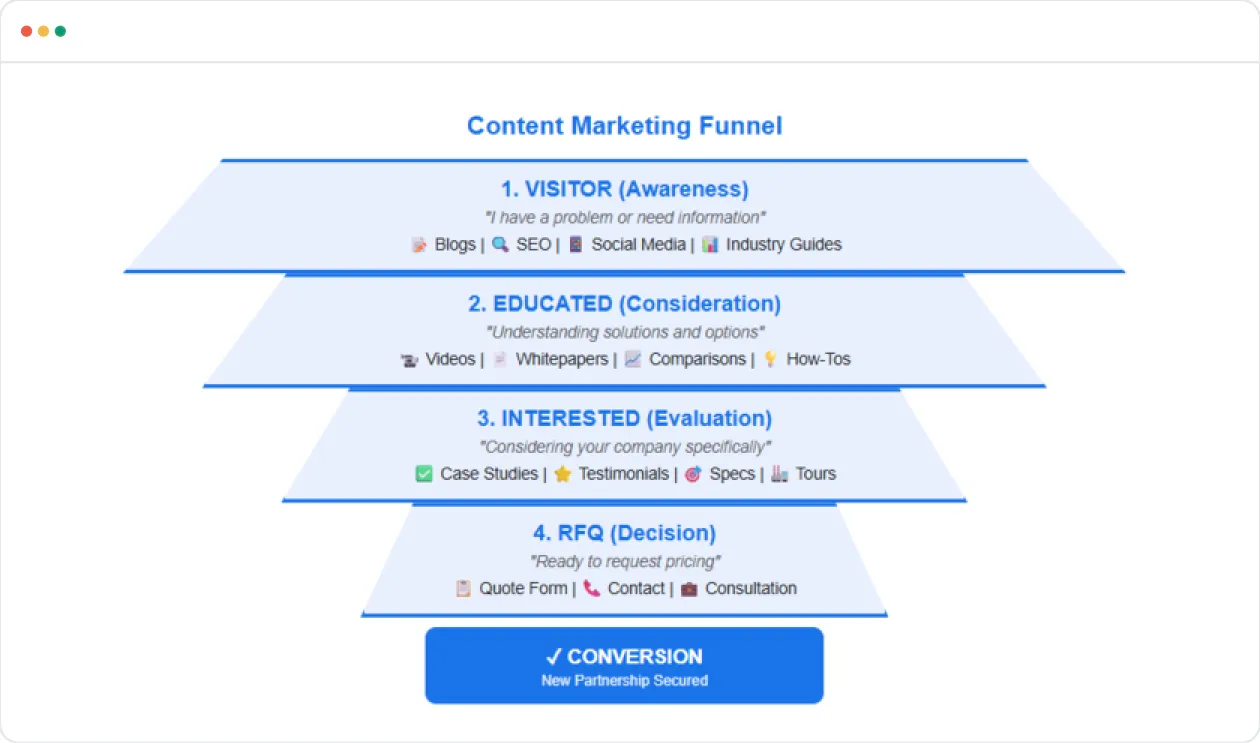
How to do it: Build content on solving buyer questions and showing process transparency, not just marketing speak.
Focus on:
- Writing content around “how it’s made” or “design for manufacturability.”
- Adding visuals from your factory floor to build trust.
- Publishing case studies and success stories.
Educated buyers are more likely to submit RFQs because they trust your expertise.
Think of it as: Turning your knowledge into buyer confidence.
4. Email Marketing
Keep Buyers Coming Back To You
Not every buyer is ready to order on first contact. A structured email campaign keeps you top-of-mind, so when they’re ready, you’re the first company they call.
How to do it: Use automated sequences for follow-ups and segment lists to ensure each audience type receives relevant content.
Focus on:
- Segmented email lists (prospects, repeat buyers, partners).
- Monthly newsletters with technical content or new certifications.
- Automated follow-ups after trade shows or downloads.
Buyers forget vendors if you don’t stay in touch. Always remember to keep them at the back of your mind.
Think of it as: Your digital handshake that keeps relationships warm.
Here’s a ready-to-use email template
5. Social Media Marketing
Be Where Your Buyers Are
B2B decision-makers often look for proof of expertise before contacting any suppliers. Sharing project updates or process videos online can make your brand memorable.
For manufacturers, LinkedIn is the best platform. It’s where engineers, OEMs, and sourcing managers scroll. Some manufacturers also build their presence on Facebook or YouTube.
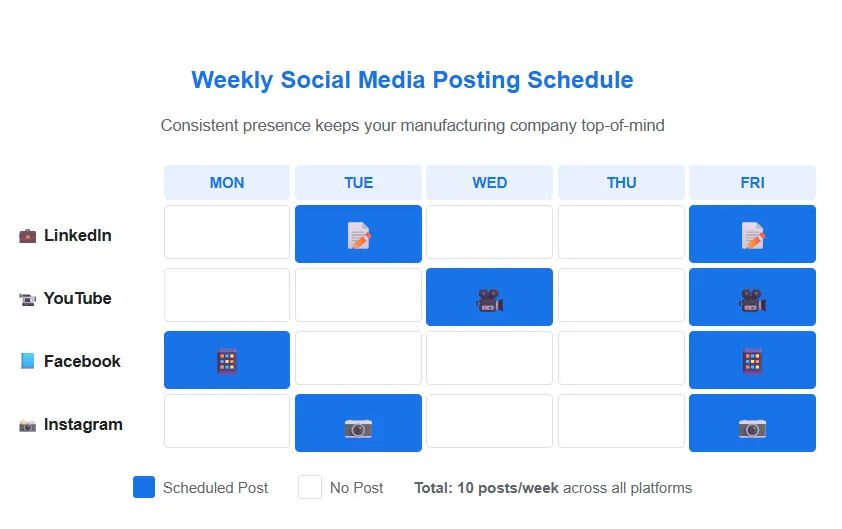
How to do it: Post at least once a week, share behind-the-scenes, and respond to comments to show engagement.
Focus on:
- Sharing process videos, project spotlights, and factory milestones.
- Engaging in industry discussions or groups. Even on Reddit or Quora.
- Encouraging team members to share posts for a expand reach.
Decision-makers often research companies on LinkedIn before filling out RFQs; visibility builds trust.
Think of it as: Showcasing your credibility in the digital marketplace.
6. Earned Media
Let It Come From Others To Build That Trust
Buyers trust third-party validation more than self-promotion. Positive reviews and trade mentions instantly boost credibility. Earned media builds trust, helping your buyers understand that you are credible and not “scam-y”. This eventually drives RFQs.
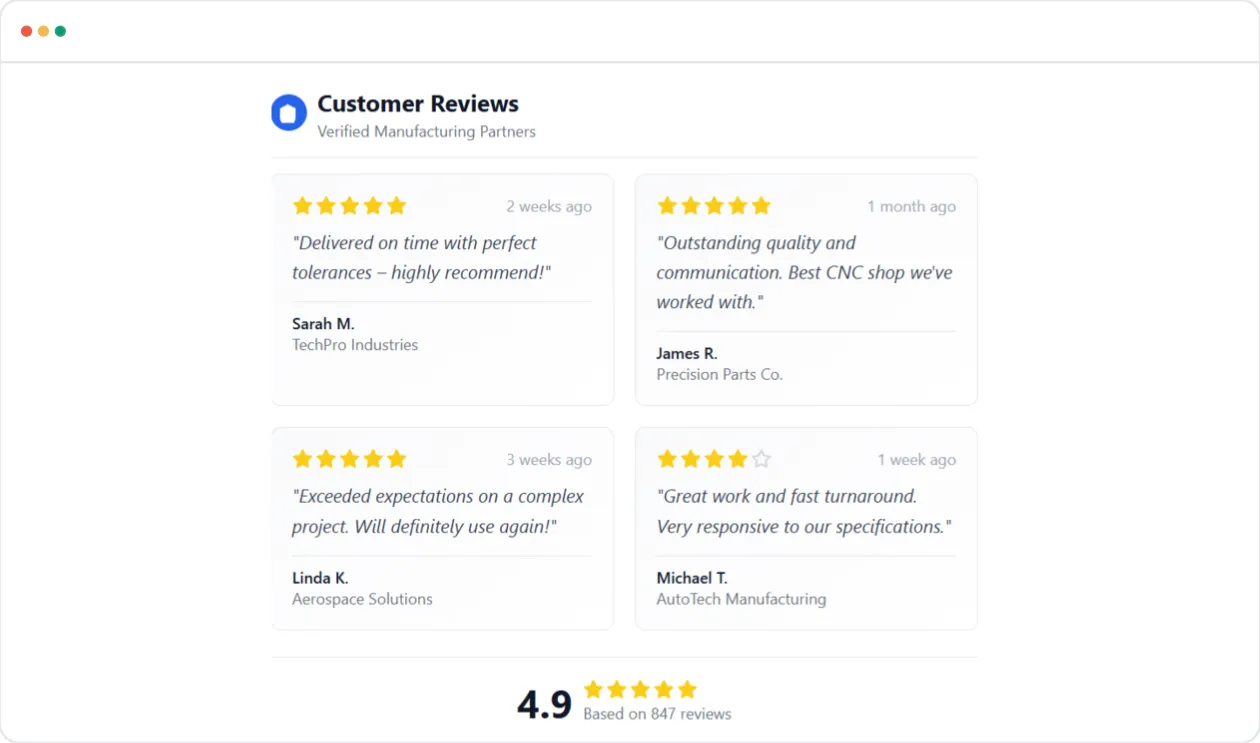
How to do it: Encourage reviews after completed orders and actively share press mentions on your website and LinkedIn.
Focus on:
- Collecting Google reviews. Interacting with your readers on LinkedIn.
- Sharing success stories in trade media or engineering blogs.
- Responding to mentions on Reddit or Quora to boost authority.
Buyers trust third-party validation more than marketing claims, thereby shortening RFQ decision time.
Think of it as: Word-of-mouth for the digital age.
When done right, all of these digital marketing channels work together to make your manufacturing business easier to find, trust, and choose online.
Not all channels perform the same way, and it’s easy to miss gaps. Use this quick scorecard to see where your factory is strong—and where you might need improvement:
How to use it: Note how often you post, update, or run campaigns in the Frequency column.
When gaps appear, you’ll know exactly which channels need more focus or guidance from a trusted partner.
Who Should Handle Digital Marketing for B2B Industries?
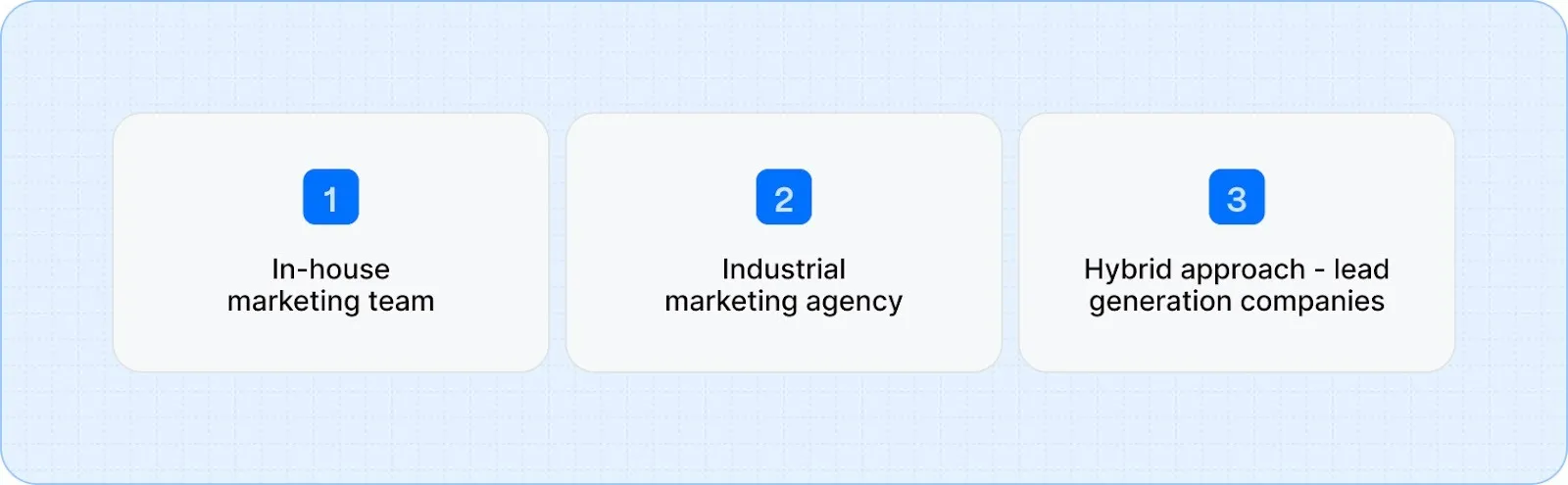
You don’t need a 10-person marketing department to compete online. You just need the right setup for your size and goals. There are a few ways to get it done effectively:
- An in-house marketing team that knows your products and buyers.
- A specialized industrial digital marketing agency.
- Combine the two: an internal expert plus an external partner for execution.
The right choice depends on your size, goals, and how quickly you want to start generating RFQs.
Option 1: In-house Marketing Team. Great for Long-Term Consistency
If you already have someone who understands your products and buyers, upskilling them in SEO and content can go a long way. The challenge is time.
Most manufacturing marketing leads juggle multiple roles —quoting, trade shows, and brochures —leaving little time for consistent online visibility work.
Option 2: Industrial Marketing Agency. Quick Ramp-Up, Higher Cost
Agencies can help you move fast, especially for website redesigns or paid ads. But they often come with long retainers, slower feedback loops, and a learning curve about your technical products. In niche industries like yours, it can be an expensive experiment before results appear. Plus, if you just need leads, this is a long journey.
Option 3: Hybrid Approach. Your Expertise + External AI Execution
This model works best for most manufacturers today. You bring industry knowledge — such as your tolerances, materials, and processes — while specialized revenue growth partners handle content creation, SEO, and analytics.
AI-powered SEO in the market, explicitly built for manufacturing marketing, significantly improves lead generation in 3 months. It helps make your website, product pages, capability pages, case studies, and SEO content in weeks.
These AI-SEO agents can deliver 4 weeks of content in 4 weeks, whereas most teams take 6 months to achieve the same. This helps you generate qualified leads faster and more efficiently.
5 Questions Manufacturers Should Ask Before Doing Digital Marketing
1. Who is my ideal buyer, and where are they searching online?
Understand whether engineers, procurement managers, or OEMs are your audience and which platforms they use.
2. What are my most valuable products, services, or capabilities to promote?
Focus your digital marketing on channels that deliver the highest ROI.
3. Do I have the right internal resources, or should I partner with experts?
Consider time, expertise, and bandwidth before deciding on in-house, agency, or hybrid models.
4. How will I measure success?
Define Key Performance Indicators, such as RFQs, website landers (traffic), leads, or quote conversions, not just clicks.
5. What gaps exist in my current online presence that I need to fix first?
Identify missing capability pages, outdated case studies, poor SEO, or unclear CTAs before investing in new campaigns.
How Much Should You Spend on Industrial Digital Marketing?
For most US manufacturers, allocating around 5-7% of annual revenue to digital marketing offers a strong balance between investment and return.
Within that budget, we recommend that the digital-marketing portion be structured roughly as:
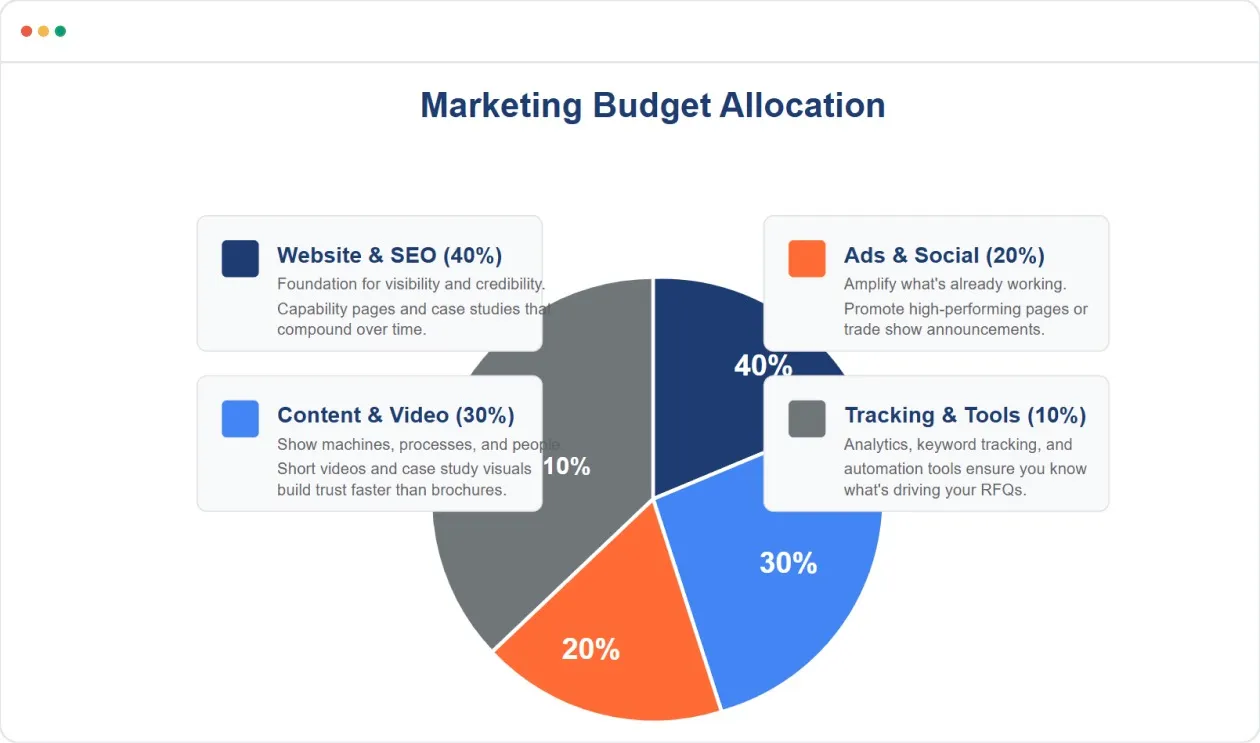
- Website & SEO (40%): This is your foundation. A well-optimized site with capability pages and case studies builds visibility and credibility that compounds over time.
- Content & Video (30%): Show how your machines, processes, and people work. Share short videos or case-study visuals online and build trust faster than any brochure ever will.
- Ads & Social (20%): Use paid campaigns only to amplify what’s already working. For example, promoting high-performing capability pages or trade show announcements.
- Tracking & Tools (10%): Analytics, keyword tracking, and automation tools ensure you know what’s driving your RFQs.
A mid-sized manufacturer can usually invest around $5,000/month in digital marketing and start seeing 10–20 qualified sales per month within six months.
If allocating that much is challenging, AI-SEO companies help with industry-focused marketing strategies helping you generate revenue in 3-6 months— for $500–$1,000/month.
Even small manufacturers can achieve similar outcomes without adding headcount, enabling them to compete for visibility and leads alongside larger players.
The key isn’t how much you spend. It’s how consistently you execute. A steady flow of monthly content, keyword tracking, and visible proof of work will outperform big ad bursts every time.
What matters more than budget is consistency. Posting monthly case studies and tracking keyword gains beats random ad bursts.
Where Should You Start to Get the Best Digital Marketing Results?
Digital marketing without a clear plan can waste months on content or ads that don’t generate results. A structured roadmap ensures that every action—from improving visibility to building credibility—contributes to qualified RFQs.
Many manufacturers follow this step-by-step approach to move from “invisible online” to a consistent flow of high-quality leads.
You don’t need expensive software to make this plan work. Use the following tools to keep you consistent.
What are the Tools That Make Execution Easier?
Every manufacturer that scaled visibility fast had one thing in common. They tracked, automated, and optimized from day one. Here’s how you can too.
- SEO & Analytics: Semrush, Ahrefs, Google Search Console, Google Analytics, Hotjar, etc., are heavily used by manufacturers in the US.
- CRM & Marketing Automation: HubSpot, ActiveCampaign, Salesforce, and Zoho CRM are particularly popular with SMBs and mid-market US companies.
- Website/CMS: WordPress, Webflow, and Shopify are among the most dominant platforms.
- Design & Content: Canva, Adobe Express, ChatGPT, Jasper, etc, are used for content creation and visuals.
- Project Management & Automation: Trello, Asana, Monday.com, or Zapier, for workflow automation and team collaboration.
How to Track to Know What’s Driving Your Results?
Without tracking what drives leads, you might spend money on tactics that don’t generate sales. Data tells you what’s working and what to fix. Every click, visit, or form submission tells a story. Tracking these helps refine your strategy.
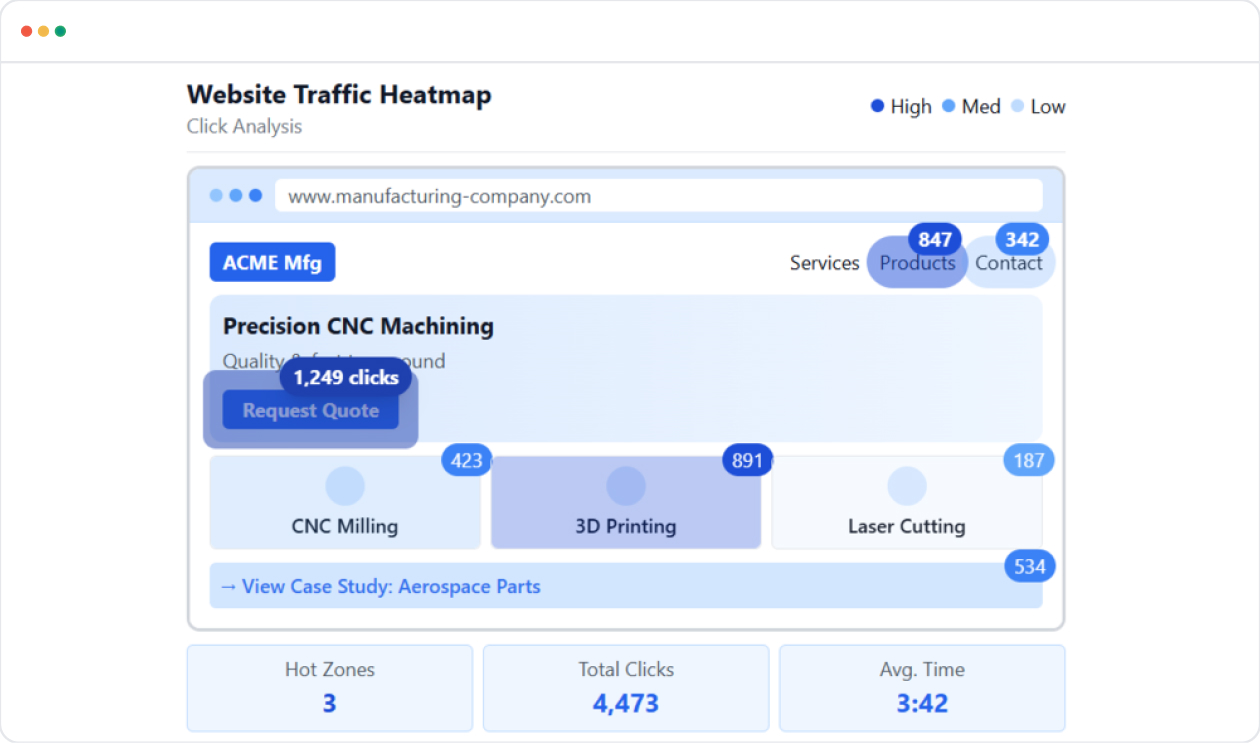
How to do it: Set clear goals (form fills, downloads) and review dashboards weekly to optimize campaigns and content.
Focus on:
- Setting up Google Analytics and tracking conversions (RFQs, downloads).
- Monitoring keyword searches and ad spend ROI.
- Testing pages to improve lead quality.
Without tracking, you won’t know which channels are generating sales, where your buyers are landing, and what they like the most.
Why Most Manufacturers Get Industrial Digital Marketing Wrong?
Most manufacturers don’t fail at digital marketing because they lack tools or channels. They fail because their marketing is built for visibility, not buying behavior.
In industrial markets, buyers don’t “discover brands.” They search for solutions to specific operational problems—often under pressure, with limited time, and multiple stakeholders involved. That’s where digital marketing for manufacturers becomes critical.
Unlike generic digital campaigns, digital marketing for industries must support:
- Long and fragmented sales cycles
- Technically informed buyers (engineers, QA, procurement)
- High-risk purchasing decisions with low tolerance for ambiguity
This is why copying tactics from SaaS or consumer brands breaks down in manufacturing.
What are the Common Digital Marketing Mistakes Manufacturers Make?
Many manufacturers struggle because of common pitfalls that they share with us, often on sales calls. Avoiding these mistakes early ensures consistent execution, smarter decisions, and steady growth in digital marketing results.
- Not Measuring Success: If you don’t track performance, you can’t improve. Monitor traffic, RFQs, and conversions to know what works.
- Being a Bottleneck: Approving every minor detail slows execution. Delegate decision-making to keep content moving.
- Chasing Shiny Objects: Don’t let every new idea derail your plan. Stick to your goals and empower your team to stay focused.
- Tactics-First Thinking: Random campaigns rarely work. Build a strategy around SMART business goals, track results, and adjust tactics intentionally.
- Perfection Paralysis: Marketing isn’t a zero-defect operation. Launch good content, test, measure, and improve, rather than waiting for perfection.
- Expecting Results Too Fast: Digital marketing compounds over time. Quick wins happen, but sustained effort over months drives measurable RFQs and visibility.
Tip: Combine the right tools with steady execution and real proof —that’s how manufacturers actually generate qualified RFQs.
The Strategic Shift Manufacturers Must Make
The biggest shift manufacturers must make is this:
Stop treating digital marketing as promotion.
Start treating it as buyer enablement.
That mindset change is what separates companies experimenting with multiple online marketing strategies for manufacturing from those building long-term growth.
Once that shift occurs, channels such as SEO, content, and even social media marketing for industrial companies begin to work together rather than feel disconnected.
A Quick Recap
In today’s manufacturing world, visibility decides who gets the RFQ. Buyers don’t wait for calls or trade shows; they search, compare, and shortlist online.
That’s where digital marketing wins. A clear website, consistent SEO practices, strategic paid channels, and proof-driven content make your industry in the US show up first and get chosen faster. You don’t need a big budget or team. You just need the right setup and rhythm.
Every page, post, and case study compounds your reach. Start small, stay consistent, and within months, you’ll see your website working harder than any sales rep ever could.
Remember, the buyer hasn’t changed what they want (precision, reliability, speed), but they have changed how they find it. And in 2025, that search starts online.
Glossary for Industrial Digital Marketing
- RFQ (Request for Quote): A formal request from a buyer asking your company to provide pricing and details for a specific product or service.
- SEO (Search Engine Optimization): Optimizing your website so it ranks higher in search results when buyers search online.
- SEM (Search Engine Marketing): Paid ads on search engines like Google or Bing to appear instantly when buyers search for your products.
- Inbound Marketing: Marketing that attracts buyers to your company online through content, SEO, or social media.
- Outbound Marketing: Traditional marketing where your company reaches out directly to buyers via calls, trade shows, or emails.
- Capability Pages: Website pages that clearly describe what your factory can produce, including specifications, processes, and certifications.
- Case Study: A real example showing how your company solved a client problem or achieved results.
- Paid Channels: Marketing methods you pay for, like Google Ads, LinkedIn Ads, or sponsored listings.
- Earned Media: Reviews, press mentions, or third-party endorsements that build trust without paying for promotion.
- Analytics / Conversion Tracking: Measuring actions like website visits, downloads, or RFQs to understand what marketing drives results.
- Hybrid Model: Combining in-house team expertise with external agencies or AI tools for marketing execution.
- AI-assisted Platforms: Tools that use artificial intelligence to create content, optimize SEO, and track leads efficiently.
- CMS (Content Management System): Software like WordPress, Webflow, or Shopify is used to build and manage your website pages.

Industrial Sales
Aug 8, 2025
5 mins
Can Industrial Manufacturers Double Sales in 3 Months?
Preksha Bharadwaj
You make incredible products at your facility. Too bad your customers will never know.
Your parts meet spec every time. You deliver on time. Your customers trust you. And when you quote a deal, you always provide what you promised.
So why did you lose that last big contract to a company with worse reviews than yours?
Here's what actually happened: The buyer called for quotes from three suppliers. Your competitor had a clear value proposition ready. They said, "We deliver precision parts with 99% on-time delivery, 2 days faster than the industry standard."
Your sales team said: "We've got state-of-the-art CNC machines and we've been doing precision machining for over 20 years. Our quality control is really thorough, and we work with all kinds of materials."
You're not wrong. But your competitor focused on the buyer's outcome. You focused on your process. And you lost the deal.
When the next customer asked for pricing, your competitor sent a quick text with numbers and delivery time. You spent two days preparing a formal proposal with technical specifications. Your competitor closed the deal before you even reached the decision stage.
This keeps happening because you're treating sales completely differently from how you run the rest of your business.
You wouldn't run your production floor on gut instinct and hope. Every job has specifications, every process has procedures, and every outcome is measurable. Here’s what you need to keep in mind.
Build a Sales System That Works Like Your Production Floor

Most manufacturers treat sales as if it doesn't need the same rigor as everything else.
Maybe you handle everything in sales yourself, jumping between production issues and customer calls. Or you have a star salesperson who works entirely from memory but can't teach anyone else what he knows.
When your sales rep gets busy, overwhelmed, or takes a vacation, your entire revenue stream stops and falls behind. New inquiries pile up. Follow-ups get forgotten. Hot prospects go cold while you're putting out fires on the production floor.
That's not a sales process—that's a single point of failure.
Some manufacturers that have doubled their sales have built systems that work whether their best salesperson is available or not. Their teams know exactly what to say in conversations. They have schedules for follow-ups. They track and nurture prospects systematically.
The goal isn't to replace good salespeople; it's to give them a system that makes success predictable.
Here's exactly how to build that foundation.
#1 Create a Value Message That Buyers Can Actually Understand
You probably tell people, “We make precision parts” or “We do custom fabrication.”
That’s great to know. But that’s not a reason to buy. Every other manufacturer says the same thing. How can you stand out?
Today’s buyers want to know exactly what you do, but even more importantly, why they should choose you over the others.
Craft one simple value statement that connects to your buyer’s needs. This is not just any marketing fluff; it can be a clear message that says: “We deliver pumps with 99% uptime reliability, shipped within 48 hours.”
Here’s How You Do It: Think about your best customer. What do they care about most? Speed? Cost? Reliability? Speak about that in one sentence, connecting what you do to what they want. Use this line everywhere, on your website, brochures, WhatsApp messages, and email signature. Or maybe even as your Tagline.
Now that you have thought of building a clear value message that resonates with buyers, you need to back it up with action.
Because here's the reality: Even the most compelling value proposition won't matter if you can't respond when opportunity knocks. And in today's fast-moving market, opportunity doesn't wait around...
#2 Speed Up Your Quote Response Time
If you take three days to quote, your buyer has already moved on.
Today's procurement managers don't wait around. They're comparing multiple suppliers, and whoever responds fastest usually wins. While you're crafting the perfect email response or personalizing a brochure for them, someone else just sent a quick quote and got the order.
Instead, start treating quotes like conversations, not contracts.
The fastest manufacturers are using tools that their buyers already check constantly, such as their website, WhatsApp, SMS, and even quick phone calls. No fancy software needed. Just immediate, personal responses that feel human.
Try these simple steps.
Step 1: Create three message templates you can send instantly:
- Quick response: "Got your request for [product]. Sending specs and pricing now, any specific requirements I should know?"
- The quote: "Here's pricing for [product]: [price] with [delivery time]. Happy to answer any questions."
- Follow-up: "Wanted to make sure you got the quote. Ready to move forward or need anything adjusted?"
Step 2: Ask your sales team to save these on their phone. When an inquiry comes in, they can respond in under a minute instead of waiting until they’re back at their computer. Also, set a phone reminder to follow up in 2-3 days. Not next week, this week.
The goal isn't to be pushy. It's to be present when your buyer is making decisions.
While your competition is still "preparing comprehensive proposals," you're already building relationships and closing deals.
Speed gets you in the conversation, but what keeps you there? What turns that quick response into a closed deal?
It's not just about being fast; it's about speaking their language. You see, there's often a disconnect between what we know as manufacturers and what buyers actually care about.
#3 Turn Your Production Expertise Into Sales Conversations

You are familiar with tolerances, lead times, and material properties. Your buyers care about uptime, cost savings, and project deadlines.
This disconnect kills more manufacturing deals than price ever will.
When a prospect asks about your CNC capabilities, you probably start talking about spindle speeds and tool changes. But what they really want to know is: "Can you keep my production line running?"
The manufacturers who consistently win deals have learned to translate technical excellence into business outcomes that buyers actually care about.
For every technical capability you mention, add the business benefit.
Instead of: "We maintain +/- 0.001" tolerance"
Say: "We maintain +/- 0.001" tolerance, which eliminates costly rework and keeps your assembly line moving"
Collect specific customer success stories.
"We delivered 500 units two days early, helping ABC Company avoid a $50K penalty".
"Our quality control caught a design issue that saved XYZ Corp three weeks of downtime"
Use their industry language, not yours
If they say "minimize disruption," don't say "optimize efficiency".
If they say "budget constraints," don't say "cost-effective solutions"
Your technical expertise is your competitive advantage. But it only becomes valuable when buyers understand how it solves their real problems.
When you master the art of translating technical expertise into business benefits, something amazing happens.
Your customers start to truly understand your value. And when customers really get what you do for them, they naturally want to share that experience with others facing similar challenges. The question is: are you making it easy for them to do that?
#4 Create a Referral System That Actually Works
Your best customers know exactly who else needs what you make. But they're not referring to anyone because you never asked properly.
Most manufacturers treat referrals like luck - hoping satisfied customers will somehow remember to mention their name.
Meanwhile, they're missing the most qualified leads possible: prospects that come pre-recommended by people who've seen your work.
The problem isn't that your customers don't want to help. It's that you're making it too hard for them to help you.
Time your ask perfectly
Right after successful delivery: "Now that this project's complete and running smoothly, who else do you know facing similar challenges?"
Also during regular check-ins: "We've expanded capacity - are there other companies in your network that might need our services?"
Make it specific and easy
Instead of: "Know anyone who might need manufacturing?"
Ask: "Do you know other maintenance managers dealing with long lead times on replacement parts?"
Offer to do the work
"If you're comfortable sharing their contact info, I'll reach out and mention you suggested we connect"
"Or I can send you a quick email you can forward to them"
Close the loop and show appreciation
Update the referrer on results: "Thanks to your introduction, we're now working with ABC Company"
Send a small thank you - not a commission, just acknowledgement
Use industry connections systematically
Trade shows: "Who else should I be talking to here?"
Supplier relationships: "Which of your other customers might benefit from what we do?"
Professional associations: Turn casual conversations into subtle business introductions
One quality referral is worth more than 100 cold calls. Your satisfied customers are your best sales team - you just need to activate them properly.
Having satisfied customers actively referring new business to you is powerful. But what happens between referrals? What about those weeks or months when your phone isn't ringing with recommendations?
Here's the thing—while you're waiting for the next referral to come in, there are potential customers out there actively searching for what you do. Maybe, even at 2am on a Sunday. The question is: when they find you, are you ready to capture that interest?
#5 Build Your 24/7 Digital Sales Engine
Your website is your biggest missed opportunity.
While you are reading this, potential customers are already searching for what you sell. They're comparing suppliers online, reading reviews, and making shortlists. But when they find your website, what happens? Probably nothing.
Most manufacturing websites are digital brochures, static pages with basic company info and a "contact us" form that feels like shouting into the void.
Meanwhile, your competitors are capturing leads, nurturing prospects, and converting visitors into customers.
If you want leads coming in without your sales team doing a cold reach, try these methods.
1. Create a website with content on what your buyers want to know
Instead of hoping visitors will call, give them something valuable in exchange for their contact information. A capability guide, pricing worksheet, or technical specification sheet that can be downloaded instantly.
When someone downloads your guide or requests information, follow up automatically with helpful content. Not sales pitches, useful information that builds trust and keeps you top-of-mind.
2. Make it easy to take the next step.
Clear calls-to-action, simple contact forms, or RFQs. Remove every possible barrier between interest and action.
Help them with the next steps. Your sales team can also send out product brochures or solid information on a deal that you gave other customers.
3. Track what's working and improve it.
Know which pages convert visitors, which pages get downloaded, and which follow-up messages get responses.
If setting up lead generation systems is simple. All you need to keep in mind is how your business should be generating leads around the clock.
Here’s how you can do it.
Create Your Digital Sales Infrastructure

You need good content that attracts buyers, product specs, pricing, and pages that convert visitors, tracking systems that show what's working, and follow-up processes that turn inquiries into orders.
Create blog content that attracts your target audience and answers their questions through informative and engaging content.
Optimize your service and product pages to convert more visitors.
Set up Google Ads that target serious buyers, and implement tracking systems so you know exactly which leads are coming from where.
Most importantly, make sure nothing falls apart. That's exactly where Gushwork helps you seal the crack.
We help in turning manufacturing websites into lead-generating machines.
We specialize in providing top-quality content where every lead and inquiry gets tracked, and you get clear reports on what's driving real business results.
While you focus on manufacturing excellence, we focus on making sure your expertise gets found by the right buyers at the right time.
Talk to us for a free trial here!
FAQs
1. How can a manufacturing company increase sales quickly?
To increase sales quickly, manufacturers should focus on improving their sales process by speeding up responses to inquiries and simplifying quotes. Targeting high-value clients and strengthening relationships with existing customers can also drive faster revenue. Additionally, leveraging digital channels, like a professional website and LinkedIn outreach, helps reach new buyers. Automating follow-ups ensures leads don’t get cold. Small, consistent improvements in communication and process often bring quick wins.
2. What are effective sales strategies for manufacturing businesses?
Effective sales strategies for manufacturers combine understanding buyer needs with clear product differentiation. Prioritize creating a strong value proposition that highlights how your product solves specific problems. Use data-driven targeting to identify high-potential clients, and implement consistent follow-ups. Incorporate digital tools like CRM systems or simple messaging templates for speed. Also, build trust with testimonials and case studies. A mix of relationship-building and process automation often yields the best results.
3. Why are my manufacturing sales declining despite good products?
Good products alone don’t guarantee sales growth. Declines often happen when sales efforts rely too much on old methods like trade shows or word of mouth, without systematic follow-up. Buyers today expect faster responses, clearer value messaging, and easy online access to product info. Without a structured sales process and digital presence, potential leads can slip away. Assess where communication or process bottlenecks exist and adopt simple tools to keep your sales pipeline active.
4. How can digital marketing help increase manufacturing sales?
Digital marketing expands your reach beyond traditional channels. A well-designed website with clear product info and calls to action can turn visitors into leads. Content marketing, like blogs, videos, and case studies, builds credibility and attracts search traffic. Social media, especially LinkedIn, helps connect with procurement professionals and decision-makers. Email and messaging campaigns automate follow-ups. Digital marketing works best when integrated with sales efforts, ensuring no lead goes unnoticed.
5. What role does follow-up play in increasing manufacturing sales?
Follow-up is critical in manufacturing sales because decisions often take time and require multiple touchpoints. Many leads are lost simply because no one followed up promptly or consistently. A simple follow-up system—whether by phone, email, or messaging apps, keeps your product top of mind and answers buyer questions. Automating reminders or message templates ensures reps never miss opportunities. Timely, relevant follow-up builds trust and moves leads closer to a purchase.

Industrial Sales
Aug 8, 2025
5 mins
If Your Reps Can’t Explain Your Value In 30 Seconds, These Training Ideas Will Fix It
Preksha Bharadwaj
You just watched a $400K deal walk out the door.
Your equipment was better. Your delivery timeline was faster. Your price was competitive.
But the buyer chose your competitor because their sales rep could instantly calculate ROI, explain integration challenges, and answer every technical question on the spot. Your rep said "Let me get back to you on that" three times in one meeting.
Here's what stings: This happens to manufacturers every single day. You're losing profitable deals not because you can't deliver, but because you can't prove it when it matters.
Every month you delay proper sales training, your competitors are stealing deals that should be yours. Not because they're cheaper or better—because their reps sound more credible when it counts.
The manufacturers winning today aren't just building better products. They're building sales teams that can effectively sell to them. While you're hoping your reps will "figure it out," they're systematically training theirs to close deals faster and at higher margins.
Here’s what a Reddit user said about sales leaders being bad trainers.

This shows how your star salesperson became your sales manager because he could sell. Not because he could teach.
He can't explain why his methods work. So new hires learn by copying him, picking up bad habits along with good ones. The gap isn't huge. But it's costing you deals and $$$, of course.
The right sales training can close that gap fast.
Research says that for every $1 spent on sales training, companies are making $3.50 back. That's real money left on the table. Yes, a 350% return on investment!
Yet 1 in 4 industrial companies spend absolutely nothing on training their sales team.
The ones that do try? Mostly just stick their top performer in a room and say, "teach them what you do."
So, how can you make it better?
Your Sales Team Is Costing You Money Every Day
Here's the uncomfortable truth: Your sales reps are having the same conversation with prospects that your competitors' reps are having. But one team is consistently winning more deals.
The difference isn't your product—it's preparation.
When your rep can't immediately explain why your 5-year warranty matters more than a competitor's 3-year warranty, you lose credibility. When they can't calculate the payback period on the spot, the buyer starts wondering what else they don't know. When they promise to "follow up with specifications" instead of having them ready, the buyer moves you to their backup list.
Every untrained rep interaction costs you in three ways:
- Lost deals: Buyers don't give second chances when reps can't answer basic questions
- Damaged reputation: Word spreads fast in manufacturing circles about unprofessional sales experiences
- Wasted marketing spend: You pay for leads, trade shows, and referrals just to watch undertrained reps squander them
Today's buyers complete 70% of their research before contacting you. They're not looking for product education; they're looking for proof that you can deliver on it. Your rep has one conversation to demonstrate competence. Most fail this test.
The Real Problem: Your Reps Aren't Ready for Today's Buyers
Your experienced reps know your products. They've been in manufacturing for years. So why are deals still slipping away?
The issue isn't product knowledge—it's that buyer behavior has fundamentally changed. Your prospects now complete most of their research before contacting you. They come to sales conversations with specific questions, clear expectations, and predetermined alternatives.
Most reps still approach these conversations like it's 2010: leading with product features, asking generic discovery questions, and hoping to "build relationships" over multiple calls.
That approach fails with today's time-pressed, well-informed buyers.
The Real Cost: Deals You Don't Even Know You Lost
The deals you lose to "We're going with another supplier" are obvious. But what about the prospects who just disappear? The ones who requested quotes but never responded? The warm referrals that went cold after the first meeting?
These are the deals your untrained reps are killing without you realizing it.
Manufacturing buyers don't usually tell you why they chose someone else. They just stop returning calls. So you blame market conditions, pricing pressure, or "bad leads" instead of recognizing that your sales process is the problem.
What Manufacturing Sales Training Actually Fixes
Manufacturing isn't like other industries. You're not selling software or services. You're selling machines, parts, and equipment that directly impact how other businesses operate.
Your sales team needs to hold real conversations with industrial engineers and procurement heads—people who know more about the industry than your reps do. They need to explain complex product value, not just quote prices and hope something sticks.
Here's what effective training actually teaches your team:
1. How to Handle Today's Informed Buyers
Instead of starting from scratch with product education, trained reps learn to:
- Ask smart questions that reveal what buyers already know
- Fill in gaps rather than repeat what they've already researched
- Position your advantages against specific competitors
- Address concerns before they become objections
Real example: When a buyer says, "Your competitor is 5% cheaper," untrained reps panic or start discounting. Trained reps respond with, "Help me understand what's most important beyond price—is it delivery time, technical support, or long-term reliability?"
2. How to Navigate Complex Sales Cycles
Manufacturing sales cycles can easily stretch up to 6-18 months.

However, trained reps learn to:
- Map out all decision-makers from day one
- Understand each stakeholder's priorities and concerns
- Keep deals moving with the right follow-up at the right time
- Recognize when deals are stalling and how to restart momentum
3. How to Close Without Being Pushy
Engineers and procurement professionals hate being "sold to." Training teaches reps how to:
- Guide buyers through their decision process naturally
- Provide the exact information needed at each stage
- Build trust through expertise, not relationship fluff
- Make it easy for buyers to choose you
Does this sound like what your team needs? Here's how to make it happen.
The 5 Areas Your Manufacturing Sales Training Must Cover
1. Product Knowledge That Actually Matters
Your reps need more than feature lists. They need to understand:
- How your products solve specific manufacturing problems
- ROI calculations that matter to buyers
- Integration challenges and solutions
- Competitive advantages that actually differentiate you
Quick test: Can your newest rep explain why your product is worth 10% more than the competition in 30 seconds? If not, you've found your starting point.
2. Strategic Account Management
Your top 20% of customers generate 80% of your revenue. Yet most reps treat all accounts the same. Training should cover:
- Quarterly business reviews that add value
- Growth opportunity identification
- Proactive problem-solving before issues escalate
- Contract renewal strategies that increase wallet share
3. Modern Buyer Psychology
Buyers today are different. Training helps reps understand:
- Why buyers prefer to research independently first
- How to add value beyond product information
- When to push forward vs. when to give space
- How to handle buyers who've already decided on competitors
4. Sales and Marketing Alignment
Gartner research says that 75% of B2B buyers prefer a no-reps sales experience. But self-service purchases are far more likely to result in purchase regret.
Sales and marketing must be able to identify the right mix of digital and human interaction to drive profitable purchase decisions.
Here's what most manufacturers miss: Your marketing should make selling easier, not harder. When sales and marketing work together:
- Reps know which content to share at each stage
- Marketing creates materials that actually help close deals
- Follow-up sequences nurture leads automatically
- Everyone speaks with the same brand voice
Trained reps learn to use marketing materials strategically instead of just dumping brochures on prospects.
5. Systematic Follow-Up
Most deals die between months 3-5 when momentum fades. Training provides:
- Stage-by-stage follow-up templates
- Methods to restart stalled conversations
- Ways to stay top-of-mind without being annoying
- Clear criteria for when to keep pushing vs. when to walk away
Why Most Training Programs Fail (And How to Avoid It)
Even good training can fail if you make these common mistakes:
Mistake #1: Treating Training Like a One-Time Event
The Problem: Two-day workshop, then nothing. Reps revert to old habits within weeks.
The Fix: Break training into bite-sized, ongoing sessions. Weekly 30-minute role-plays work better than quarterly all-day sessions.
Mistake #2: Too Much Theory, Not Enough Practice
The Problem: PowerPoint presentations about "consultative selling" that don't translate to real conversations.
The Fix: Use actual scenarios your reps face. Practice handling "Your competitor is cheaper" or "Send me a quote first" objections until responses become natural.
Mistake #3: No Management Buy-In
The Problem: Reps learn new methods, but managers still only track monthly targets.
The Fix: Train your sales managers too. Have them review call quality, not just quantity. When management reinforces training, reps know it matters.
Mistake #4: Resistance from Experienced Reps
The Problem: Your veteran reps think they don't need training and stick to old methods.
The Fix: Don't force change. Show results. When a newer rep using new methods closes a big deal, share that success. Make it easy to try new approaches without abandoning what already works.
But Here's the Real Challenge: Where Are the Leads Coming From?
You can train your team perfectly, but if they're not talking to enough qualified prospects, even the best sales skills won't matter.
Think about it: Trade shows happen twice a year. Google Ads stop working the moment you stop paying. Referrals are unpredictable.
Today's buyers don't wait for you to find them. They search online, read content, and compare options before they ever pick up the phone.
If your brand doesn't show up during that research phase, you're not even in the running.
This is where sales training needs support from consistent lead generation:
- Helpful content that answers buyer questions and positions you as the expert
- Product pages that clearly explain your offerings without requiring a sales call
- Strategic online presence that captures interest from active buyers
- Follow-up systems that nurture prospects until they're ready to buy
When your sales team has a steady stream of warm, qualified leads to work with, their training actually pays off.
Your Next Step: Don't Try to Do Everything at Once
Start with these three simple actions this week:
- Identify your biggest training gap. Is it product knowledge? Handling objections? Follow-up? Pick one.
- Create one piece of helpful content. Write a blog post answering your most common customer question. This supports both training and lead generation.
- Track what's working. Which lead sources produce the best customers? Which reps close deals fastest? Focus your efforts there.
Remember: Your competitors are already training their teams and building systematic lead generation. The question isn't whether you need both—it's how quickly you can implement them.
How Gushwork Supports Your Sales Training Investment
You don't need a massive team or complex systems. Gushwork helps manufacturers build the marketing foundation that makes sales training actually work:
- Lead generation through targeted content and strategic online presence
- Sales enablement materials that support your newly trained team
- Follow-up systems that nurture prospects automatically
- Performance tracking that shows which efforts drive real results
You focus on your products and training your team. We handle the systems that bring qualified buyers to your door.
Ready to stop losing deals to competitors? Your sales training is only as good as the prospects your team gets to practice on.
FAQs
1. How to get into sales for manufacturing?
Start by learning about the products and industry basics, whether it’s machines, parts, or supplies. Gain experience in customer service or sales roles to build communication skills. Networking with manufacturers and attending trade shows really helps. Consider sales training specific to manufacturing to understand buyer needs and sales cycles. Strong technical knowledge combined with sales skills is key.
2. How to Break into Industrial/Manufacturing Sales?
Focus on understanding complex products and buyer challenges. Get familiar with the manufacturing sales cycle and decision-making process. Seek out entry-level roles or internships in industrial sales. Training programs that cover technical knowledge and sales techniques for manufacturers can give you a big advantage.
3. What skills are needed for manufacturing sales training?
Major skills include product knowledge, communication, negotiation, and understanding customer needs. Training also covers managing long sales cycles and working with multiple decision-makers. Adaptability and problem-solving are also important.
4. Why is sales training important for manufacturers?
Manufacturing sales involve complex products and long decision processes. Training equips reps to handle technical questions, build trust, and navigate multiple stakeholders, improving closing rates and customer retention.
5. How can sales training improve manufacturing sales performance?
Training provides reps with structured processes, better product knowledge, and effective communication strategies. This reduces lost deals, shortens sales cycles, and increases revenue by aligning sales efforts with modern buyer behaviors.

Industrial Sales
Aug 8, 2025
5 mins
Mastering B2B Sales Enablement: Strategies, Tools, and Best Practices
Preksha Bharadwaj
B2B sales today involve more people, more scrutiny, and longer decision cycles than it did a few years ago. Buyers compare options carefully, involve multiple stakeholders, and expect every interaction to move them closer to clarity.
When enablement works, sales conversations feel informed instead of introductory. Reps stop explaining basics and start addressing real concerns. Buyers feel understood earlier, which changes how quickly and confidently decisions are made.
In this blog, we break down what B2B sales enablement really looks like today, how it supports modern buying behaviour, what assets and systems matter most, and how to build enablement that actually improves deal progression.
What Is B2B Sales Enablement?
Sales enablement is the repeatable system that gives your sellers the right content, the right training, and the right data, exactly when they need it. It’s an ongoing process that arms reps with usable assets, playbooks, and signals they can act on in real conversations.
Why Businesses Must Adopt It?
Without a repeatable enablement function, sales teams often use out-of-date decks, reinvent follow-ups, and ask the same questions on every call. That wastes time and weakens buyer confidence.
Organizations that invest in disciplined enablement report measurable payoffs: faster ramp times, higher win rates, and clear ROI on training and content programs. It’s the practical system that aligns sales, product, and marketing around making every deal easier to close.
6 Core Pillars of B2B Sales Enablement
Sales enablement works when it is built on a few strong pillars, not scattered initiatives. These pillars ensure sellers are consistently supported across the entire buying cycle, without adding friction or unnecessary complexity.
Enablement Content That Supports Real Sales Conversations
Sales content should exist to move deals forward, not to fill folders.
- Buyer-stage–aligned assets: Create content specifically for discovery, evaluation, and decision stages. Each asset should answer a clear buyer question or objection that comes up repeatedly in sales calls.
- Practical, field-tested material: Focus on case examples, comparison sheets, implementation explainers, and ROI narratives that sellers can confidently share without rewriting or re-framing.
- Single source of truth: All sales content should live in one accessible place, clearly labeled by use case. This prevents outdated decks and inconsistent messaging from creeping back in.
Sales Training and Ongoing Skill Development
Enablement is not a one-time onboarding event. It is continuous.
- Role-specific training: SDRs, account executives, and account managers need different enablement. Training should reflect their responsibilities and buyer interactions.
- Contextual learning: Training tied to real deals, recent losses, or new objections is far more effective than abstract theory.
- Reinforcement over time: Short refreshers, call reviews, and scenario-based coaching help skills stick and improve performance steadily.
Tools and Technology That Reduce Friction
Technology should simplify selling, not slow it down.
- Enablement tools integrated with CRM: Content access, playbooks, and insights should be available where sellers already work, not in disconnected platforms.
- Clear guidance: Fewer well-integrated tools outperform large stacks that sellers ignore.
- Usage visibility: Teams should be able to see which assets are used, when, and in which deal stages.
Process Alignment Across Revenue Teams
Enablement breaks down when teams operate in isolation.
- Shared definitions and expectations: Sales, marketing, and leadership must agree on buyer stages, qualification criteria, and success metrics.
- Clear handoffs between teams: Marketing-to-sales and sales-to-customer-success transitions should be documented and repeatable.
- Feedback loops: Sales insights should regularly inform content creation, messaging updates, and training priorities.
Data, Measurement, and Continuous Improvement
Enablement must prove its value in business terms.
- Metrics tied to deal progression: Track win rates, cycle length, deal size, and ramp time, not just content downloads or training completion.
- Content effectiveness measurement: Identify which assets actually influence progression or closing, and retire those that don’t.
- Iteration based on evidence: Enablement improves when teams refine based on data, not assumptions.
Leadership Ownership and Accountability
Enablement only works when it has clear ownership.
- Dedicated responsibility: Someone must own enablement strategy, prioritisation, and execution, even if it’s a small team.
- Executive support: Leadership buy-in ensures enablement stays aligned with revenue goals rather than becoming a side project.
- Clear priorities: Enablement efforts should focus on the highest-impact sales motions first, not everything at once.
Together, these pillars turn sales enablement into a durable system.
How To Build a Modern B2B Sales Enablement Strategy?
A strong sales enablement strategy is built deliberately. It starts with understanding what already exists, then putting structure around people, content, and systems so sellers can perform consistently across complex deals:
1. Start With A Full Baseline Audit: Content, Skills, And Tools
You cannot improve what you do not understand. A blunt, honest audit reveals which assets are actually used, which training gaps block deals, and which tools create friction.
What to do this week:
- Content inventory. List every seller-facing asset: decks, one-pagers, specs, case studies, battlecards, and videos. Tag each asset with owner, last updated date, primary buyer stage, and usage signals (how often it’s sent or viewed).
- Skills assessment. Run short role-based assessments or listening sessions. Score reps on discovery, qualification, objection handling, demo-to-value translation, and closing asks. Use call samples to validate self-reported skills.
- Tool audit. Map every tool in the stack and note overlap and gaps. Which tools are single sources of truth? Which require copy/paste between systems? Which tools are actually used on calls?
Quick outputs to create:
- A single spreadsheet (or dashboard) that shows content age, usage, and gaps.
- A skills heatmap by rep and by region showing training hotspots.
- A tool map that highlights one or two integration priorities.
How to measure progress:
- Reduction in “ not found” asset tickets.
- % of content with usage metrics attached.
- Number of tool handoffs removed in key workflows.
2. Define Crisp Personas And Buying-Committee Profiles
Deals in B2B rarely hinge on one person. They hinge on groups of people with distinct questions, timelines, and approval criteria. If your enablement assets don’t reflect those roles, reps waste time convincing the wrong people.
What to do this month:
- Build 3–5 buyer personas relevant to your ICP. Include title, responsibilities, success metrics, common objections, top three evaluation questions, and what “proof” convinces them. Keep each persona to one page.
- Map the buying committee. For target accounts, identify typical committees: influencer(s), technical evaluator(s), economic buyer(s), and procurement/contract owner. Note who needs what evidence at which stage.
- Create decision-criteria sheets. For each persona, make a one-page list of “must-have” and “nice-to-have” criteria that procurement or buyers will use.
Micro-tactics:
- Validate personas by interviewing 5 customers and 5 lost-opportunity accounts.
- Attach persona tags to content so reps can filter assets by the role they are selling to.
How to measure progress:
- Time saved in discovery calls (shorter qualification).
- Increase in first-call conversion to next-stage meetings for deals where the persona map was used.
3. Map Content And Training To Each Buyer Stage
Random assets create chaos. Mapping forces discipline: one primary asset per buyer moment, clear purpose, and a measurable outcome.
What to do next quarter:
- Define buyer stages your sales process actually uses. Examples: Awareness, Qualification, Solution Validation, Pilot/POC, Procurement, Close.
- For each stage, pick the one primary enablement asset that best advances the buyer. Example: Qualification = discovery script + 1-page value checklist. Validation = 2-page technical validation brief and recorded demo segment. Procurement = final T&Cs checklist and SLA summary.
- Create play instructions. For every asset include a 3-line “how to use” note a rep can read in 30 seconds: when to send, what to say, and what follow-up action to expect.
Training pairing:
- Build short micro-learning modules tied to assets: 5–8 minute videos plus a 2-question quiz that proves comprehension.
- Run role-play scenarios weekly that map to the stage-specific asset usage.
How to measure progress:
- Asset-to-opportunity conversion rate: % of deals where the stage asset was used and the deal progressed.
- Completion rate for micro-learning modules and changes in associated KPI (e.g., shorter validation cycles).
4. Centralize Enablement On A Platform And Connect Integrations
If assets live in three places and CRM stages don’t surface content, reps don’t use enablement. Centralization plus integrations equals adoption.
What to implement:
- Single source of truth. Choose a content hub or enablement platform where assets are searchable, version-controlled, and tagged by persona and stage.
- Key integrations. Surface assets inside the CRM, inside the call tool (Zoom/Teams), and inside the sales cadence tool. Make it one click to share or drop an asset link into an email.
- Access control and governance. Ensure easy editing, a review workflow, and clear ownership for each asset.
Operational practices:
- Use analytics from the platform to show which assets are used on-call vs. in follow-ups.
- Automate nudges to reps when new or updated assets are published for their territory/product.
How to measure progress:
- % of deals with at least one hub-sourced asset attached.
- Time-to-attach: median time from asset publication to first use.
- Reduction in duplicate assets across drives and folders.
5. Build Structured Readiness Programs And Manager-Led Coaching
Training without coaching rarely sticks. Readiness programs plus manager coaching convert knowledge into consistent behaviour.
How to structure readiness:
- Role-based onboarding tracks. New hires get a 30/60/90 plan with checkable milestones: 10 discovery calls shadowed, two live demos led, 3 proposal reviews.
- Experience-based refreshers. For tenured reps, run monthly short labs on a single skill: objection handling for price, technical validation, or packaging deals.
- Manager coaching framework. Managers should have a one-page coaching guide per rep covering 3 metrics to watch, 2 action items for the week, and a 10-minute call template to run weekly.
Delivery methods:
- Use bite-size content plus live practice. Commit to role defined sessions.
- Record exemplars: 2–3 minute model calls that show effective use of an asset.
How to measure progress:
- Ramp time: days to first qualified meeting or to first closed deal for new reps.
- Coaching coverage rate: % of reps with weekly documented coaching touchpoints.
- Skill delta: pre/post scores on targeted role-play rubrics.
6. Define KPIs And Build Analytics Workflows That Prove Impact
Enablement must be tied to outcomes. Measure both adoption and influence: whether assets are used and whether they move deals.
Core KPIs to track:
- Adoption metrics: asset views, shares, and training completion rates.
- Influence metrics: % of deals where asset X was present and the deal progressed within Y days.
- Outcome metrics: win rate change, average sales cycle length, average deal size, and ramp time.
- Activity metrics: coaching cadence, content update frequency, and tool usage stats.
Analytics workflow:
- Tag everything. Tag assets by persona, product, stage, and owner. Tag CRM opportunities where assets were used.
- Build composite dashboards. Combine CRM opportunity data with content hub usage to create signals like “assets-per-opportunity” and “time-to-first-asset.”
- Review weekly, decide monthly. Weekly operational check-ins for red flags. Monthly review to decide content retirements or new plays. Quarterly business review for strategic shifts.
How to calculate simple influence metric:
- Asset Influence Rate = (Number of opportunities using the asset that progressed to next stage ÷ Number of opportunities where asset was used) × 100. Use this to rank assets by real deal impact.
7. Set A Cadenced Update Process For Content, Playbooks, And Coaching
Markets change. Product features change. Buyers change. If enablement is not updated regularly it decays quickly.
Operational cadence to adopt:
- Weekly triage. Small issues reported by sales go into a 15-minute backlog triage. Fixes that take under an hour are assigned and closed that week.
- Monthly content sprints. Product or marketing owners refresh one to three high-traffic assets, guided by usage analytics.
- Quarterly playbook review. Sales leadership, product, and enablement meet to refresh the playbook for top 3 buyer motions. This includes updating scripts, pricing guidance, and objection playbooks.
- Bi-annual skills audit. Re-run the skills assessment and re-prioritise coaching topics.
Governance and roles:
- Assign a product/content owner for each asset category.
- Make a manager accountable for coaching metrics in each region.
- Publish a public roadmap of upcoming changes so reps know what to expect.
How to measure progress:
- % of assets updated in the last 12 months.
- Time between issue report and fix.
- Manager compliance: % of scheduled coaching sessions completed.
Common B2B Enablement Pitfalls and How to Avoid Them
Even the most well-planned B2B sales enablement strategies can encounter obstacles that hinder success.
Understanding these common pitfalls and how to avoid them can help your team stay on track, make better use of resources, and ultimately close more deals.
Treating Enablement As Content Creation Instead Of Decision Support
Many teams equate enablement with producing more assets. Decks, PDFs, one-pagers, and battlecards pile up, but sales still struggles to move buyers forward.
How to avoid it: Anchor every enablement asset to a specific buyer decision. Ask what question this asset helps the buyer answer, such as feasibility, risk, comparison, or internal justification. If it does not clearly support a decision, it does not belong in enablement.
Building Assets For Internal Assumptions
Enablement often reflects how the company wants to sell, not how buyers actually evaluate vendors. This leads to content that sounds polished but feels disconnected in real conversations.
How to avoid it: Base enablement on real sales interactions. Review call recordings, lost deals, and late-stage objections. Let buyer language, not marketing language, shape the structure and wording of enablement materials.
Overloading Sales With Too Many Tools And Documents
When everything is labelled “important,” nothing is. Sales teams waste time searching, choosing, or avoiding enablement altogether.
How to avoid it: Reduce the surface area. Create a small, clearly structured enablement set tied to buying stages. Make it obvious which asset to use during discovery, evaluation, comparison, and procurement.
Ignoring Cross-Functional Alignment
Enablement breaks when marketing, sales, product, and customer success work in silos. Each team creates assets from its own perspective, resulting in inconsistency and confusion.
How to avoid it: Define enablement ownership and review cycles across teams. Product should validate technical accuracy. Sales should validate usability. Marketing should maintain clarity and consistency. Enablement only works when all three contribute.
Focusing On Features Instead Of Risk Reduction
B2B buyers rarely stall because they do not understand features. They stall because they are unsure about risk, fit, or internal approval.
How to avoid it: Shift enablement toward proof, constraints, and trade-offs. Include content that addresses implementation risk, limitations, compliance, and operational impact. Buyers trust vendors who acknowledge boundaries.
Leaving Enablement Static After Launch
Markets shift, products evolve, and buyer expectations change. Static enablement quietly becomes outdated, even if no one complains.
How to avoid it: Treat enablement as a living system. Schedule regular reviews tied to sales feedback, win-loss insights, and market changes. Retire assets that no longer reflect reality instead of letting them linger.
Measuring Usage Instead Of Effectiveness
Tracking downloads or views does not reveal whether enablement helps close deals.
How to avoid it: Evaluate enablement by its influence on deal progression. Look at where assets are used in successful deals, how they shorten cycles, or how they reduce objections. Effectiveness matters more than activity.
Must-Have Tech for B2B Sales Enablement
To truly empower your sales team, having the right tools is essential. Each piece of technology serves a specific function in the broader sales enablement strategy.
Here’s a breakdown of the must-have tech:
CRM Systems (Salesforce, HubSpot)
These platforms help manage customer relationships by tracking interactions and providing real-time updates on where prospects are in the sales cycle.
They also store crucial information like customer preferences and deal history, which allows your team to personalize interactions and improve closing rates.
Sales Enablement Platforms (Showpad, Highspot)
These platforms act as central hubs for content management and training. They ensure sales reps can access the right resources, such as a product demo, case study, or competitive battle card, right when they need them.
This can significantly streamline workflows and increase productivity.
Sales Intelligence Tools (Gong, ZoomInfo)
These tools help your team gain valuable insights into leads, competitors, and market trends. With Gong, for example, sales reps can analyze recorded calls to understand what works and refine their approach.
ZoomInfo provides detailed company and contact profiles, helping reps connect with the right decision-makers faster.
Real-Time Analytics
Using analytics tools that provide performance metrics on sales rep productivity, content effectiveness, and lead conversion is key.
These tools help you measure the impact of your sales enablement efforts and allow you to make data-driven decisions that can improve sales outcomes.
Why Feedback is Your Secret Weapon in B2B Sales Enablement?
Feedback is the key to refining and improving your sales enablement strategy. Sales reps and customers provide the real-world insights needed to ensure your tools and content stay relevant and effective.
Importance of Continuous Feedback
- Sales reps are on the frontlines and have direct knowledge of what works. Regular feedback helps you avoid outdated content and inefficient processes.
- Collecting consistent feedback ensures your sales enablement efforts evolve and stay aligned with buyer needs.
How to Collect Feedback
- Surveys: Use structured surveys to gather insights from both sales reps and customers on content and tools.
- Performance Metrics: Track sales metrics like win rates and content usage to see what’s resonating and what isn’t.
- One-on-One Interviews: Conduct in-depth interviews for more specific feedback on training, content, and tools.
Advanced B2B Sales Enablement Tactics
Once you’ve mastered the basics, it’s time to implement advanced tactics that will set your strategy apart. These strategies take personalization and automation to the next level.
Account-Based Selling (ABS)
- Tailored Outreach: Focus on high-value accounts with personalized content and targeted messaging based on the specific needs of each prospect.
- Maximized Engagement: Use custom content to engage decision-makers throughout the buying process.
Buyer Enablement
- Empower Early: Provide educational resources and tools like ROI calculators to help prospects make informed decisions earlier in their journey.
- Build Trust: Use guides, case studies, and solution resources to educate.
AI & Automation
- AI-Powered Personalization: Use AI to automate tasks, personalize outreach, and recommend the best content based on buyer behavior.
- Automation for Efficiency: Automate repetitive tasks like data entry and follow-up emails to free up your team for high-impact activities.
Wrapping Up
Your sales enablement strategy is the foundation of your sales team’s success. By equipping your reps with the right tools, training, and content, you can transform their performance and accelerate your sales results.
- Sales enablement is about giving your team the resources they need to succeed: content, tools, and training.
- Misalignment and poor adoption can derail even the best strategies.
- Continuously refining your approach based on real feedback will ensure sustained success.
The real challenge is implementing it effectively. Your team is already fighting an uphill battle to meet buyer expectations. Don’t let inefficient tools and outdated processes stand in your way.

Digital Marketing
Nov 24, 2025
5 mins
B2B Manufacturing Marketing Is Noisy. These 6 Strategies Actually Work
Percy Brown
Most small- to medium-sized industrial manufacturers think marketing is confusing, expensive, and, honestly… unnecessary. And marketing is one of those things only big companies with big budgets can afford.
Well, that’s not true.
This belief is costing these manufacturers real revenue.
74% of manufacturers now report having a formal marketing strategy. And yet, most small manufacturers still don’t know what to do or where to start.
In this guide, you’ll understand what manufacturing marketing really means, why it’s no longer optional, and the exact strategies small manufacturers are using to generate revenue—without big budgets or prior marketing experience.
What is Manufacturing Marketing?
Manufacturing marketing is the process by which industrial companies promote and sell their products to other businesses. It focuses on helping the right buyers understand what you make, trust your technical expertise, and reach out—often over long, complex sales cycles.
This includes practical efforts like non-digital marketing (trade shows, cold calls, print ads) and digital marketing (content, SEO, paid ads) that connect your production capabilities with real buyer needs.
And here’s where most manufacturers miss something important: marketing and sales aren’t separate entities. They are correlated.
Why Sales Needs Marketing (and Vice Versa)
Sales teams bring in customers, but marketing makes their job easier. Instead of relying solely on cold calls, trade shows, or chance referrals, marketing helps attract people who are already interested — like someone filling out a form on your website, messaging you on LinkedIn, or finding your brochure at a trade show.
When sales and marketing work together, your team gets fewer “Who are you?” conversations and more “We’ve heard of you, can we talk?” leads.
This saves time, expands your reach, and creates a more predictable customer flow. This shows how marketing prepares the customer to buy; sales closes the deal.

You don’t need a full marketing team to get started. You can begin small, test one or two channels, and scale only when you see results.
6 Proven B2B Manufacturing Marketing Strategies (Start Here)
There are multiple channels to build a strong B2B manufacturing marketing strategy. Here are some results-oriented channels for you to begin with.
1. Content Marketing (Your Expertise, Published Simply)
Content marketing is a process of explaining your capabilities, processes, tolerances, materials, and applications.
These can primarily be delivered through multiple digital platforms, such as LinkedIn, Facebook, Reddit, Industry forums, and, most importantly, your website (blogs, service pages, capability pages, case studies, e-books, white papers, etc.).
How to Start:
- Decide the purpose of your content: educate buyers, showcase capabilities, or support sales.
- Pick 2–3 content formats you can realistically maintain (case studies, capability pages, blogs, LinkedIn posts, videos).
- Build a simple content calendar — even one post every 2 weeks is enough.
- Align topics with what sales gets asked most often, so your content actually reduces workload.
Download a free 3-month manufacturing content plan (30 topics) you can use as-is.
Manufacturers win sales by building trust. Content helps them build it before the first call.
2. Trade Show & Expo Marketing (Old School but Still Powerful)
Still one of the best channels for manufacturers.
Trade shows help you meet engineers and procurement teams face-to-face. This is where you get real, unfiltered insights: what they’re struggling with, what budgets look like this year, and which suppliers they’re actively searching for.
How to Start:
- Pick 1–2 industry shows your real buyers attend (not generic expos).
- Bring a clear one-page capabilities sheet with specs, materials, tolerances, and industries served.
- Capture every RFQ or inquiry and log it in a simple CRM/Google Sheet so follow-ups never slip through the cracks.
Trade shows turn months of “no responses” outreach into 2 days of “we got your business cards, we’ll get in touch soon” conversations.
Suggested Read: 30 Definitive Ways to Capture Leads at Manufacturing Trade Shows
3. Search Engine Optimization (SEO)
Manufacturing SEO is the process of optimizing your website to appear in Google search results when buyers search for your services. This helps your buyers and Google (search engines) understand what you do, so you show up when someone types what you make.
Buyers typically search on Google using part number, material, tolerance, and process, not generic marketing terms such as “cutting-edge services, innovative engineering, excellent B2B manufacturing services,” or “end-to-end capabilities.” Therefore, it’s essential to implement effective B2B SEO strategies to outrank your competitors online.
Industrial SEO can be achieved by targeting the keywords your buyers exactly search for (based on your industrial niche) and writing content (blog posts, capability pages, etc.) around those keywords on your website.
How to Start:
- List your core services and industries that you serve. These become your core (website) content pages.
- Ensure every page includes clear specs, materials, tolerances, FAQs, and process steps.
- Fix the technical basics: fast-loading website (under 3 seconds), mobile-friendly, no broken pages. Seek help from professional SEO companies.
- Keep adding new pages over time instead of trying to “perfect” them upfront.
- Consider a team of SEO experts who can handle all of these for you easily when you manage your industrial floor.
SEO brings consistent, high-intent visitors who already know what they need. It can be overwhelming at first, but there are tons of beginner-friendly guides and tools that make it easier.
4. Paid Search and PPC Marketing (Fast Visibility, Controlled Spend)
On average, SMBs invest 7X more in PPC than in SEO.
PPC (Pay-Per-Click) or Paid Ads help manufacturing teams compete with bigger suppliers instantly. This has a significant impact on new line launches or major announcements.
How to Start:
- Identify 5–10 high-intent keywords related to your capabilities.
- Set a small monthly budget and test one campaign at a time.
- Write simple ad copy focused on capabilities, not clever wording.
- Track which keywords bring actual RFQs and shift the budget accordingly.
Paid search puts you in front of buyers now, while SEO builds long-term growth.
Follow these simple steps to get started with PPC today.
5. PR & Partnership Marketing for Manufacturers
PR and Partnership marketing is all about getting your brand in front of buyers through trusted third parties—suppliers, OEMs, distributors, directories, trade publications, and industry platforms where your buyers are already searching for vendors.
How to Start:
- Create co-branded capability sheets with suppliers or OEM partners.
- List your company on high-intent industry directories (engineering platforms, regional vendor lists).
- Share updates like certifications, machine upgrades, quality improvements, or sustainability efforts through trade media.
- Publish simple thought-leadership content: “How we machine X material,” “Common tolerance issues,” etc.
When credible platforms, partners, or publications talk about you, buyers take you more seriously—making it easier to win more sales, justify pricing, and build long-term relationships.
6. Email & Lead Marketing
Most manufacturers need a clean, reliable way to respond to inquiries quickly and keep the conversation moving.
Staying top-of-mind with prospects through timely, simple communication that guides them from initial inquiry → high-quality lead → confirmed order without delays or confusion.
How to Start:
- Set up an introductory auto-confirmation email so buyers know their inquiries have been received.
- Make a rule for a human reply within 12 hours—faster than 90% of your competitors.
- Send case studies, capability sheets, or sample work to build instant confidence.
In manufacturing, speed closes deals. Most suppliers lose opportunities not because of pricing, but because they respond too slowly or inconsistently.
~47,000 Manufacturing Searches Happen Online Daily. Are You Showing Up?
Show Me Where I Stand
However, most manufacturers ask us this question: how can we ensure that our marketing strategy is on point?
What are the Objectives of Manufacturing Marketing?
The following objectives turn marketing from “random promotion” into a predictable system that attracts the right buyers, builds trust, and helps manufacturers win more RFQs with less effort.
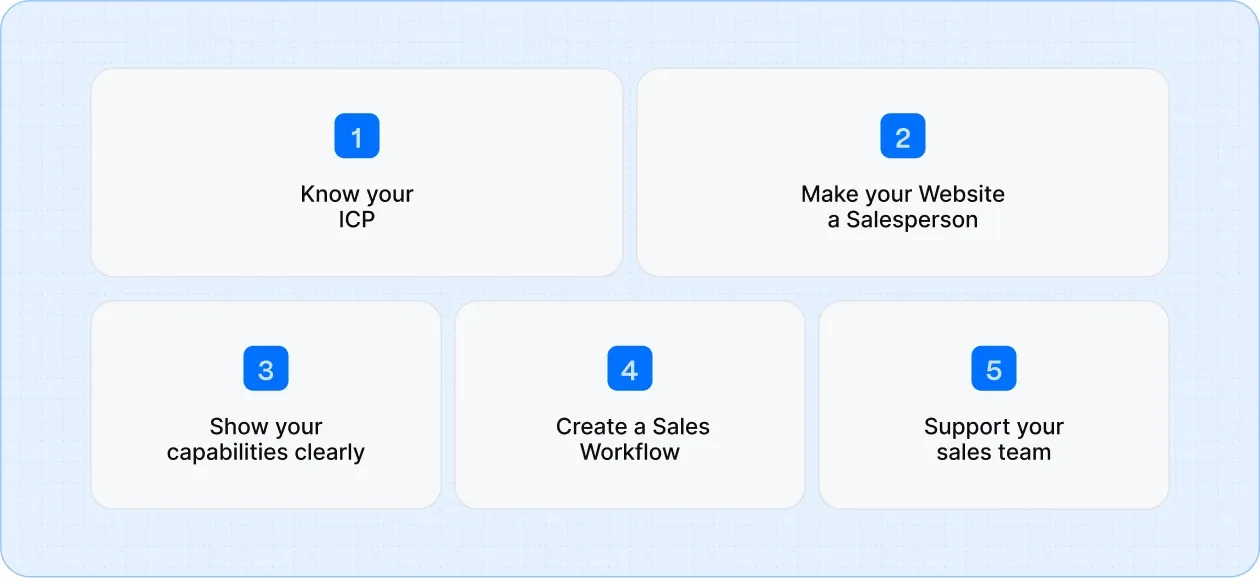
- Know Exactly Who Your Ideal Customer Profile Is (Your ICP): You can’t market to “everyone.” You need to know which industries, part specs, tolerances, volumes, and decision-makers are the best fit. This helps avoid wasting time on low-quality leads.
- Make Your Website Your Best Salesperson: Your website should clearly show what you make, how you make it, and why someone should trust you. Good web design simply means fewer questions, fewer back-and-forths, and more sales. Consider some of the manufacturing website design examples for the same.
- Show Your Capabilities Clearly & Confidently: Buyers want to know specifics: materials, tolerances, industries served, certifications, machines, and turnaround times. Clear capability communication cuts sales cycles in half.
- Create Predictable Sales Flow (Not Seasonal or Random): Marketing should help you avoid slow months. When done right, you know how many leads you can expect each week or month, providing stability for production planning and revenue.
- Support Your Sales Team With Better Leads: Sales teams shouldn’t waste time chasing poor-fit buyers. Good marketing gives them qualified leads who already know what they want, making every conversation more productive.
To add to this, here’s what a Reddit user said:
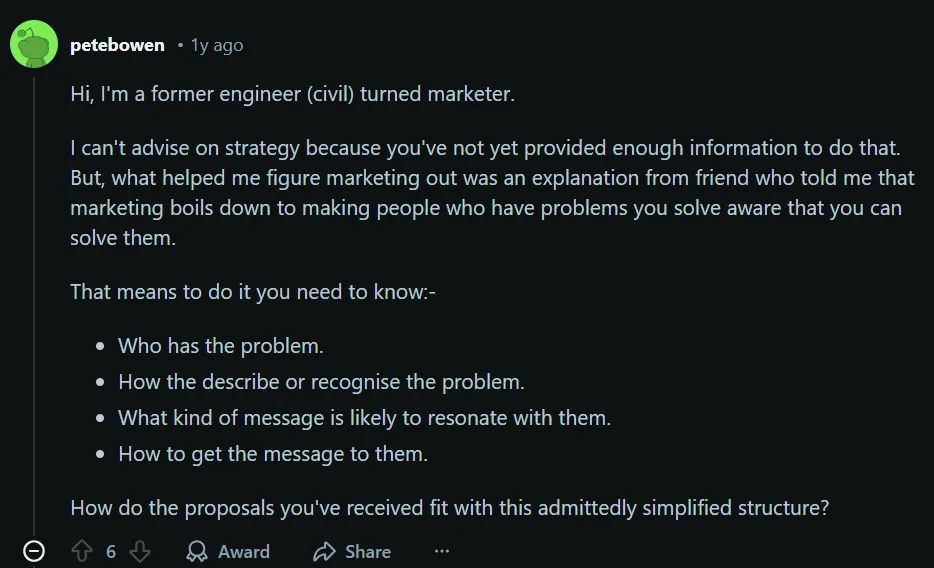
If you understand the objectives correctly, you are half the way there.
What Manufacturing Marketing Actually Looks Like in a Real Industrial Business
If you run a manufacturing company, marketing probably feels confusing because it’s rarely explained in practical terms.
You don’t need viral posts. You don’t need fancy branding. And you definitely don’t need to “be everywhere.”
Marketing for manufacturing companies is about making it easier for the right buyers to find, understand, and contact you.
In a real manufacturing business, marketing usually shows up in particular ways:
- A buyer Googles how to machine a specific material or who can meet a certain tolerance
- Someone from procurement checks your website after getting your name at a trade show
- An engineer wants to quickly confirm your capabilities before sending an RFQ
- A prospect compares you with 2–3 other suppliers before deciding who to call
Manufacturing marketing exists to support these exact moments.
That’s why marketing in manufacturing companies looks very different from consumer or software marketing. Your buyers are not impulse buyers. They are engineers, sourcing managers, and operations leaders trying to reduce risk.
For most manufacturers, effective marketing includes:
- A clear website that explains what you make, how you make it, and for whom
- Capability pages that list materials, tolerances, machines, certifications, and industries
- Simple content that answers common buyer questions, so salespeople don’t have to repeat the same explanations
- A basic follow-up system so inquiries don’t get lost or delayed
This is the real role of marketing in the manufacturing industry: Reduce confusion, build trust faster, and help sales conversations start at a higher level.
You don’t need a massive manufacturing marketing plan to begin. Most small and mid-sized manufacturers start with just one or two channels—often content marketing, SEO, or trade shows—and build from there once they see what works.
When done correctly, marketing for manufacturers doesn’t replace sales.
It makes sales easier, faster, and more predictable.
Manufacturing Marketing Covers More Than One Channel
For most small and mid-sized companies, manufacturing marketing is not one activity—it’s a set of coordinated efforts.
A practical manufacturing marketing plan often includes:
- Content marketing for manufacturers to explain capabilities and answer buyer questions
- Manufacturing digital marketing, like SEO and PPC, to capture active search demand
- Trade shows and partnerships to support relationship-driven sales
- Email and follow-ups to move leads through long B2B sales cycles
This is why marketing strategies for manufacturing companies look different from those in other industries. You’re not marketing to consumers—you’re doing B2B manufacturing marketing and industrial manufacturing marketing, where trust and clarity matter more than volume.
What is the Cost of Manufacturing Marketing in the US?
Marketing costs can vary widely depending on how you execute it and which channels you use. Let’s break it down simply so you can plan effectively.
Additional Marketing Expenses
If you plan to include PPC, social media marketing, or trade show participation, expect to allocate an additional 20–30% of your marketing budget. This is separate from content, SEO, or web design and is meant to amplify reach or drive specific campaigns for more revenue and growth.
The right approach depends on your company's size, budget, and goals. Small manufacturers can start small, measure results, and scale investments gradually, without committing to huge upfront costs.
Avoid These Manufacturing Marketing Mistakes Without Fail
It’s easy to stumble in ways that waste time, money, and energy. Here are the pitfalls most manufacturers fall into, and how you can avoid them.
- Trying to Do Everything at Once: Some companies jump on every channel—SEO, PPC, LinkedIn, emails, trade shows—at the same time. Nothing gets done well without a strategic plan. Focus on channels that actually reach your buyers first. Then, start building over it.
- Not Tracking What Works: If you’re not measuring clicks, inquiries, or leads, you’re flying blind. Simple tracking shows what’s actually generating interest, so you can spend your money wisely.
- Copying Others Blindly: Just because a competitor posts a certain way doesn’t mean it fits your products or buyers. Adapt strategies to your business and your buyers’ needs.
- Failing to Nurture Leads: Getting an inquiry is just the start. Many manufacturers lose deals by not following up consistently or giving buyers the info they need. Timely emails, calls, or capability sheets can turn a curious lead into a long-term order.
- Not Aligning Marketing with Sales: Marketing that doesn’t sync with your sales team creates confusion and missed opportunities. Ensure your campaigns, content, and messaging support the sales process from first contact to RFQ.
Wrapping Up
Marketing for manufacturers doesn’t have to be complicated or expensive. By understanding your buyers, using the right mix of digital and offline strategies, aligning marketing with sales, and consistently measuring results, even small and mid-sized manufacturers can generate leads, build trust, and grow revenue.
Start simple, focus on high-value actions, and scale your efforts as you see results—marketing becomes a predictable system for business growth rather than a guessing game.
Talk to a team of AI SEO experts for manufacturers to gain more revenue in 3-6 months, and to avoid wasting money on common SEO mistakes.

SEO
Nov 11, 2025
5 mins
SEO for Manufacturers: A Complete Guide For Industries in the US
Percy Brown
You might have the best machines on your industry floor, a solid team, and a reputation for quality work.
But if modern buyers can’t find you online, your competitors are getting the calls that should’ve come to you.
In today’s world, most customers start their search on Google.
If your company doesn’t show up there, it’s like having a great product locked inside a warehouse with no sign outside.
In short, being visible online means more people who need what you make can actually find you. And that can turn into more RFQs, faster.
The Shift to Digital Marketing in Manufacturing
Most manufacturers still rely on traditional outreach: trade shows, distributor networks, referrals, and word of mouth. These channels work, especially for long-term clients. But they’re slow, expensive, and hard to measure.
While your sales team spends hours chasing leads or attending expos, your potential buyers are already online, searching for suppliers, comparing capabilities, and checking certifications.
That’s the gap digital marketing fills.
Digital channels now make up about 75% of marketing budgets across all industries, including manufacturing. Digital marketing helps manufacturers get found when buyers are looking, not when you’re pitching. It’s measurable, scalable, and works 24/7, even when your sales team doesn’t.
At its core, digital marketing for manufacturers includes:
- Search Engine Optimization (SEO): Improves your visibility on Google when buyers search for your products or capabilities.
- Paid Advertising (PPC): Boosts your visibility quickly for launches, announcements, or when you’re entering new markets.
- Email and LinkedIn Outreach: Keeps your brand in front of potential and existing clients.
- Content Marketing: Educates buyers through blogs, case studies, and videos that show your expertise.
Among all these, SEO stands out because it builds long-term authority and credibility.
Unlike ads that stop when your budget does, SEO compounds — driving consistent leads month after month.
What is SEO for Manufacturers?
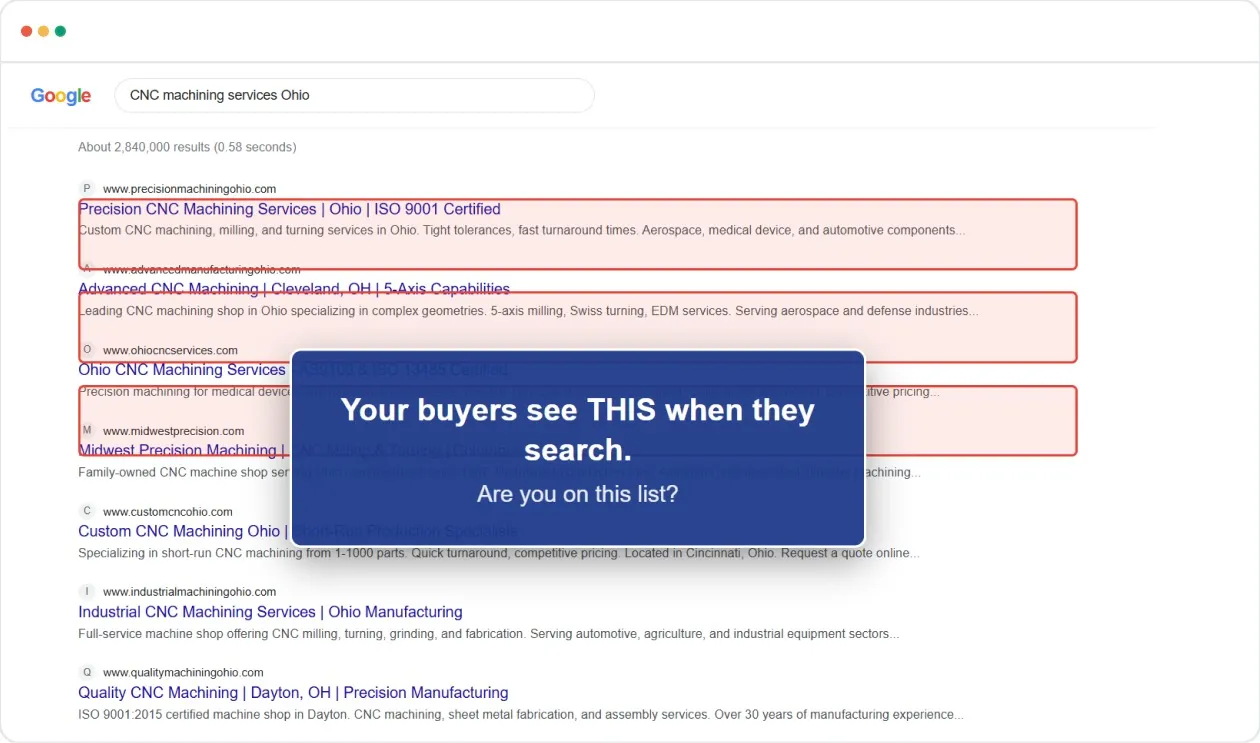
Search Engine Optimization, or SEO, in the manufacturing industry is simple, yet strategic. It’s the process of helping search engines like Google, Yahoo, Safari, and Bing understand what you do so they can show your business to the right people.
Think of it like this: If someone types “custom machining in Ohio,” Google decides which manufacturers deserve to appear first. SEO is how you make sure you’re that manufacturer.
It is like a digital trade show booth, open 24/7 and reaching buyers across the US (and even globally). Every search is a potential buyer walking down the aisle; the goal is to make sure they see your booth first.
Buyer searches on Google → Your site appears → They click on your website → You capture leads.
How Are Manufacturers Doing SEO Using AI?
Watch this snippet of 30 seconds to exactly know how SEO manufacturing in the US is making $$$ in revenue using AI SEO agents.
Why SEO for Manufacturing Matters?
Research shows that 57% of B2B companies say SEO brings in more leads than any other marketing channel.

It is mainly because it provides:
- Credibility and trust: Appearing on the first page signals authority and reliability.
- High-quality leads: Your site attracts decision-makers searching for your exact capabilities.
- Long-term ROI: Unlike paid ads, SEO keeps working even when you stop spending.
- Lower acquisition costs: Organic visibility means more qualified inquiries without recurring ad budgets.
So, how do manufacturers actually achieve these results?
The Two Core Parts of SEO That Drive Online Presence
Think of SEO as two engines driving your digital visibility — one on your website, and one outside it. For industries, both are equally critical because your buyers evaluate you in two stages:
- Can they find you when searching for a specific capability (e.g., precision CNC machining for aerospace)?
- Once they find you, does your website prove your expertise, reliability, and scale?
It comes down to two key parts of SEO working together: On-page SEO and Off-page SEO.
1. On-page SEO: Build a Website That Speaks the Buyer’s Language
On-page SEO covers everything that lives on your website. It’s how you communicate your expertise, not just to potential buyers, but also to Google.
Here’s what to focus on:
- Keyword optimization: The term “keyword” means exactly what your buyers are searching for. Use the exact terms on your website that the buyers use. For instance, “custom stainless steel fabrication”, across titles, headers, and body text.
- Meta tags and descriptions: Every page should have a unique title and meta description (the information you see under a title in Google search) that summarizes what the page offers. This helps search engines (such as Google) index (read) your content correctly.
- Header structure (H1, H2, H3): Organize your content logically. For example, your service page might include headers such as “Capabilities,” “Industries Served,” and “Certifications.”
- Image optimization: Use quality images to improve load times and include descriptive alt text (brief image information)
- Internal linking: Link related pages (e.g., your materials page linking to your product page) to help Google understand your site’s hierarchy.
- Content quality: Create pages that clearly explain your processes, tolerances, and materials. The goal is to become a trusted educational source, not just a vendor.
Good on-page SEO ensures your site communicates value. When Google understands your expertise, it ranks you higher, helping buyers find you faster.
How it impacts your business: A well-optimized site keeps buyers engaged longer, leading to more quote requests and fewer lost opportunities.
2. Off-page SEO: Build Authority Beyond Your Website
Off-page SEO is everything that happens outside your website that boosts your credibility. It tells Google (and your prospects) that you’re trusted across the industry.
Here’s what to focus on:
- Backlinks from credible industry sites: Aim to get featured or listed on authoritative platforms like Thomasnet, MFG.com, Engineering.com, or IndustryNet. Each link acts like a “vote of confidence” for your brand.
- Guest content & thought leadership: Contribute technical articles or case studies to trade publications or associations. This helps you earn both links and recognition.
- Online reviews: Encourage satisfied clients to leave positive reviews on Google Business Profile and industry directories.
- Social signals: Sharing updates, certifications, or project photos on LinkedIn and other professional platforms helps reinforce your brand’s legitimacy.
- Mentions without links: Even when a site mentions your company name without linking, it still counts as a credibility signal in Google’s eyes.
Search engines view backlinks and brand mentions as proof of reliability. The more trusted websites vouch for you, the more confidence Google and your buyers will have in your business.
How it impacts your business: A strong off-page SEO profile helps your website rank for competitive industry keywords like custom injection molding or ISO-certified sheet metal fabrication.

When both on-page and off-page SEO work together, your website doesn’t just rank — it becomes a trusted website for buyers searching online.
Read about the Best Platforms for SEO for Manufacturing
How to Start SEO for Manufacturers (The Practical Way)
SEO for industrial companies takes time to work. It helps Google understand your website better and show it to the right buyers. Here are some of the top online manufacturers' SEO strategies that compound over time:
1. Start With The Foundation: Your Website
Most manufacturing websites were built years ago and have never been touched since. But your homepage is the first thing buyers and Google look at; it’s your digital storefront.
If your site opens with “Welcome to ABC Manufacturing,” you’ve already lost them. Buyers (and Google) need clarity right away:
“Custom Automotive Parts Manufacturer | ISO-Certified Products in Michigan.”
That one line instantly tells both humans and search engines what you make and where you’re based.
Once that’s clear, make sure your website loads quickly, looks fine on mobile, and feels modern, because a slow, outdated site sends a signal that your business might be too.
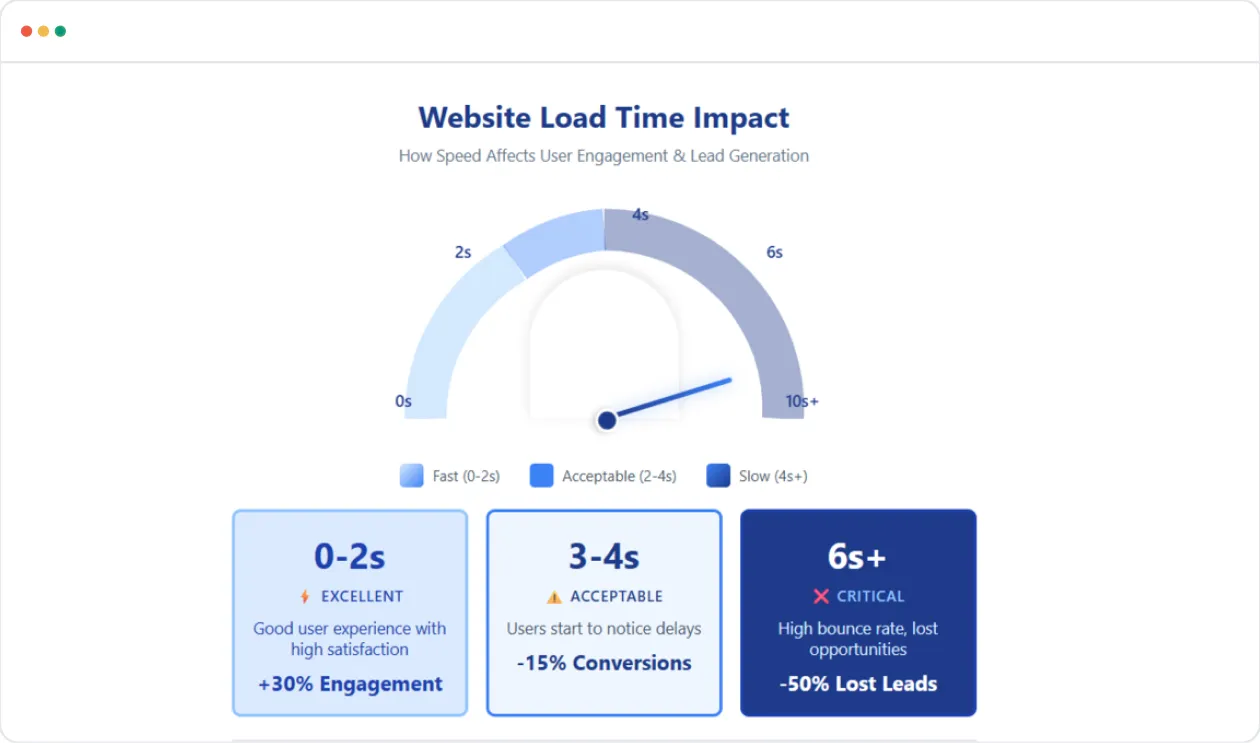
In manufacturing, your buyers judge credibility fast. If your site loads slowly or looks broken on mobile, they won’t wait; they’ll find another supplier who looks more reliable online.
A slow website can also kill leads faster than poor pricing.
Use tools like Google Analytics or GTmetrix to check load times, mobile experience, and performance suggestions. Even a 1–2 second improvement in page load can keep buyers on your site longer and help you rank higher.
Google primarily uses your mobile site when determining rankings. That means your pages need to look and work perfectly on phones and tablets, not just desktops. If a buyer struggles to navigate your site on their phone, your ranking suffers, and so do your leads. This is one of the best SEO solutions for manufacturing.
2. Speak Your Buyer’s Language
Earlier, we covered how on-page SEO helps Google and your buyers understand your website. This is where speaking your buyer’s language takes it to a level deeper. It’s about aligning your keywords with what real buyers actually search for.
Here’s where most manufacturers get it wrong.
You describe your services using technical or branded terms, “precision-engineered polymer solutions,” while your buyers search for “plastic injection molding company in Ohio.”
If your SEO content for manufacturers differs, that’s a significant mismatch.
Do this quick exercise:
- Open your inbox or RFQ tracker.
- Pick 3-5 recent quote requests or buyer inquiries.
- Highlight the exact words they use to describe your service. (Example: Can you please share details on “CNC machining for aerospace parts,” “custom sheet metal fabrication in Texas.”)
- Now, check your website. Are those exact phrases anywhere on your pages?
If not, that’s your first SEO fix.
Why it works: Those buyer-used phrases are your most valuable keywords. They’re real, proven, and directly connected to purchase intent. Once you start using them naturally across your site, Google and buyers both recognize what you truly offer.
3. Show Depth, Not Just Presence
Don’t hide everything under a single “Services” tab. If you do CNC machining, sheet metal fabrication, or injection molding, each deserves its own page.
Why?
Because when a buyer searches for “CNC machining aerospace parts,” Google wants to send them to a page that proves you know that specific work, with specs, tolerances, certifications, and even a few photos or project highlights.
Use the Right Content to Show Expertise
Your pages don’t have to be just text.
Think of what buyers want to see: photos of past projects, short demo videos, team introductions, or case studies showing capabilities.
Blogs can answer common buyer questions. These content types not only help Google understand what you offer but also make buyers trust you more.
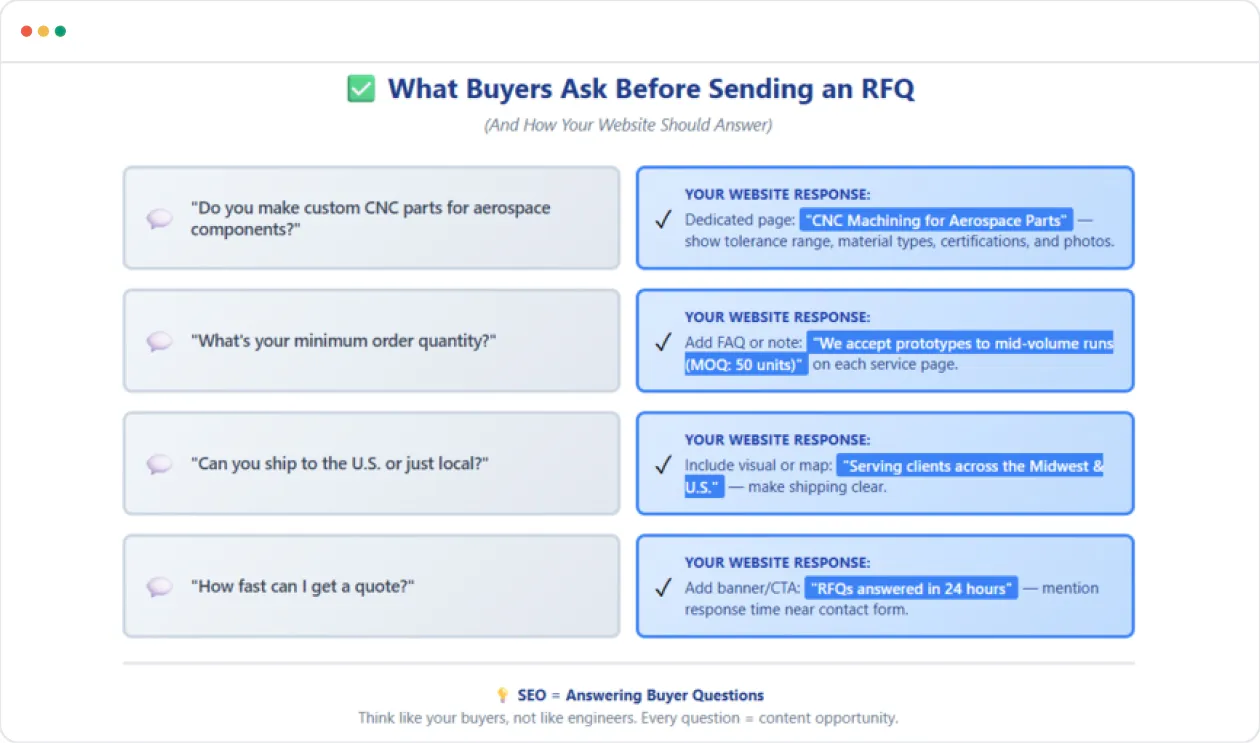
The more helpful and complete your pages are, the more Google trusts you.
4. Get Credibility From the Right Places
You’ve probably seen marketing blogs talk about “backlinks.”
Backlinks simply mean other trusted sites mentioning or linking back to you, and Google takes that as proof you’re legitimate.
Backlinks aren’t the only credibility signal. Reviews on Google, industry directories, and even LinkedIn recommendations matter. Encourage satisfied clients to leave feedback. Positive reviews make your business more visible and trustworthy, which directly influences leads.
How Trustworthy Is Your Online Presence?
- Is your Google profile updated? If yes, how often do you update it?
- Do you have at least 3 client reviews?
- Are your certifications visible on your site?
- Do your partners link back to you?
- Have you published any case studies?
A few solid mentions on those sites can do more for your credibility than hundreds of random backlinks from unrelated sites.
5. Don’t forget Local Searches (“Near me” searches)
Most buyers prefer working with manufacturers nearby. That’s why local SEO matters more than you’d think.
Beyond your Google Business Profile, ensure your company is listed consistently across industry directories like Thomasnet, MFG.com, or your local chamber of commerce. Keep your NAP (name, address, phone) identical everywhere.
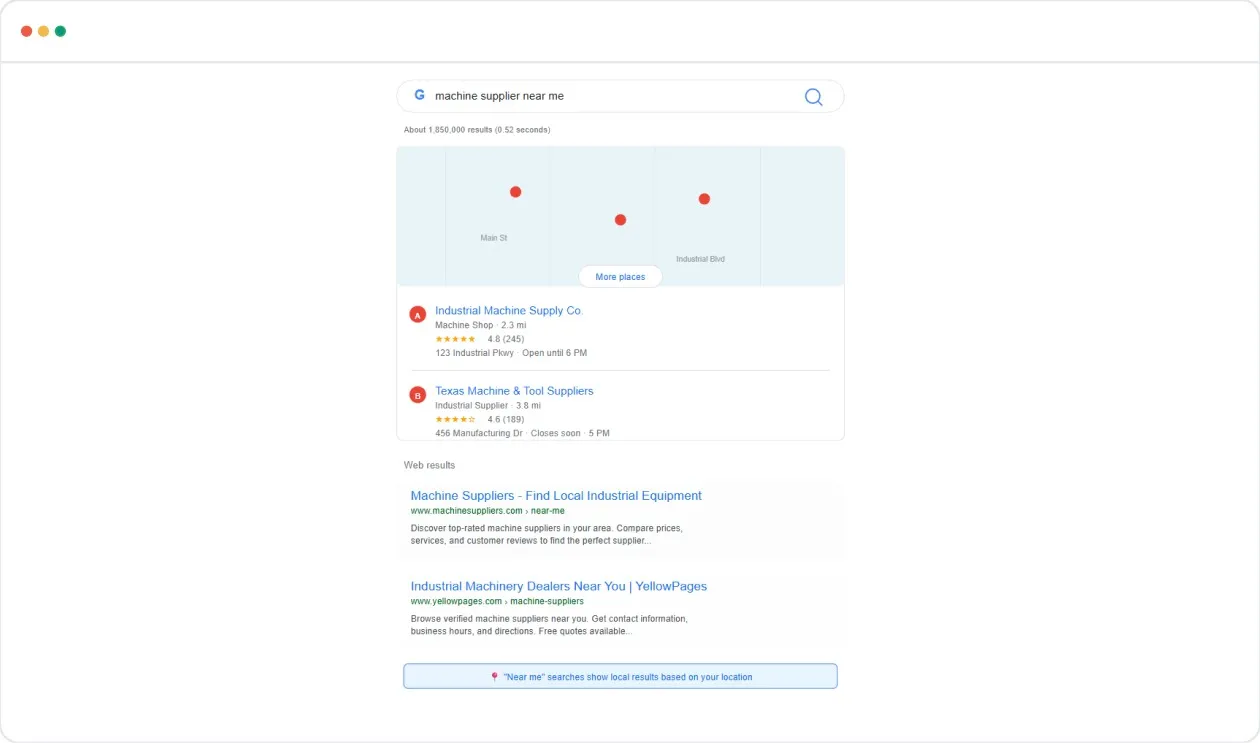
You’re not just helping Google here. You’re helping the next buyer who wants to find someone like you but doesn’t know you exist yet.
6. Track What’s Working (and What’s Worth Your Effort)
SEO is not set-and-forget.
Use free tools like Google Search Console. It tells you what people searched before landing on your site, which pages get the most visits, and what’s leading to quote requests or calls.
SEO isn’t just about traffic on your website; it’s about real business results. Track which keywords bring visitors, which pages lead to RFQs, and how your visibility grows over time.
Even a small boost in leads can justify months of effort, and over time, SEO continues working—unlike paid ads that stop the moment you stop paying.
When you put all of this together (clarity, credibility, and consistency), SEO stops sounding too techy and becomes a lead engine.
What Success Should Look Like (Track These 3 KPIs)
- Website traffic: Are more buyers visiting your site?
- Quote requests: Are your contact or RFQ forms getting more submissions?
- Keyword rankings: Are you showing up higher for the terms your buyers actually search for?
You’re not trying to “beat the algorithm” here. You’re just explaining your work in a way Google understands and buyers can find.
Once your basics are in place, it’s time to step up your game. This is where a few advanced SEO moves can help you stay ahead of competitors and keep your rankings strong for years.
Advanced SEO Strategies for Manufacturers
Once your basics are in place, your website is clear, fast, and showing up for the right searches, you can go one step further.
This is where a few advanced manufacturing SEO strategies can help you stay ahead of your competitors and keep your rankings strong for years.
1. Help Google Understand Your Products with Schema Markup
Now, schema markup sounds highly technical. But it isn’t too difficult for you to achieve. It is like adding labels and part numbers (basically, precise details) to your web pages.
“Think of Schema Markup as a Spec Sheet for Google.”
It tells Google exactly what your content is, whether it’s a product, service, or customer review.
For example, if you sell custom aluminum parts, you can add a “Product page with specs, pricing, capabilities, etc,” so Google knows that page shows a product, not just text.
When done right, this helps your pages appear with extra details, directly in search results. That means more visibility, more clicks, and more credibility.
Technical SEO Checklist
Make sure your site ticks all these boxes:
- HTTPS secured (buyers trust secure sites)
- XML sitemap updated (helps Google read your pages)
- Schema markup (precise info) for all products and services
- No broken links or 404 errors
- Fast loading (< 3 seconds) on all devices
Get an expert review of what’s slowing your SEO performance. Talk to us here.
Once your website is technically sound, it’s time to see how you compare to yourself in the market.
2. Use AI to Spot What Your Competitors Are Ranking For
Here’s where technology can actually save you time.
Instead of spending hours figuring out what to write or where your site is missing keywords, AI Agents can analyze competitor websites, keywords your buyers are searching for, and page load time – all in minutes.
You don’t need to guess what to post; AI can help you decide what will actually bring more RFQs. It’s like having a digital analyst quietly map your entire market, showing you which areas to target so you can attract more RFQs without guesswork.
3. Support SEO with Paid Ads
Once you know what buyers search for, it’s time to scale.
SEO takes time, but paid ads can give your website an instant visibility boost while your organic rankings build up. When used together, they make sure your brand shows up in both paid and organic search results — doubling your exposure to buyers.
Remember, paid ads work best when you already have some visibility and need to promote new launches or announcements.
Relying only on paid ads isn’t sustainable, they stop the moment you stop spending, while SEO continues to deliver leads long after.
Here’s how to do it right:
- Target high-intent keywords: Run ads for the same phrases your SEO is targeting (e.g., “custom metal fabrication Michigan”). This helps you appear on top while your SEO pages climb organically.
- Use ads to test messaging: Track which ad headlines and descriptions get the most clicks. The best-performing copy can guide your website’s SEO content.
- Retarget past visitors: Paid ads can re-engage engineers or procurement managers who visited your site but didn’t submit an RFQ.
- Balance your spend: Use paid campaigns to fill short-term lead gaps while SEO builds long-term traffic.
- Use a clear landing page: Create a landing page/redirect your readers with the right information when they click. Take them through a journey until they fill out a form.
When your SEO, content, and paid ads start working together, you’ll notice your visibility improving and more qualified buyers visiting your site. Eventually, giving you leads.
How Long Does SEO for a Manufacturer Take to See Results?
Here’s the part every manufacturer wonders about: how long should I wait to see results?
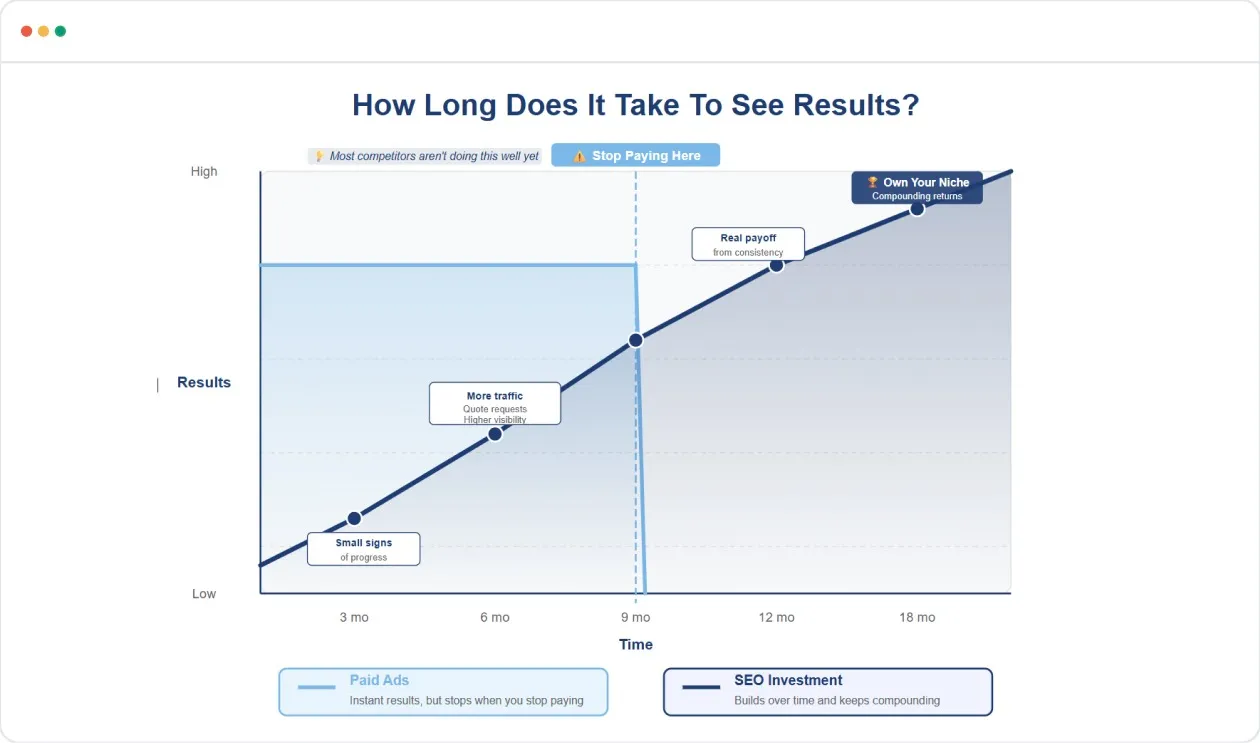
Most manufacturers start seeing progress in 3–6 months. More pages, more visitors, more quote requests.
Remember, SEO compounds. Every update strengthens your authority, and the sooner you start, the sooner you pull ahead of competitors still waiting for referrals.
And here’s the best part: Most of your competitors aren’t doing this well yet. So if you start now and stay consistent, you could own your niche on Google before they even realize what happened.
Pro Tip: There are AI SEO Agents in the market that can do 6 months of content and SEO in just 4 weeks. Many manufacturers in the US already have found 30+ leads in 3-4 months using AI platforms.
Success in SEO isn’t just about doing more. It’s about doing it right. Many manufacturers unknowingly make small mistakes that undo months of progress.
Common SEO Mistakes Manufacturers Make
Even experienced manufacturers who have tried SEO fall into a few traps. These aren’t technical errors that they make, but just blind spots that quietly block your visibility.
1. Hiding Everything Under One ‘Services’ Page
If you list all your capabilities (machining, molding, fabrication, finishing) on one page, Google can’t tell which one to show for a specific search.
So when someone searches “sheet metal fabrication Ohio,” you disappear.
Fix: Give each service its own page, with clear titles, specs, certifications, and even sample projects. It shows depth, and Google rewards expertise.
2. Ignoring Local SEO (“near me” Searches)
Most buyers prefer working with manufacturers nearby. But if your Google Business Profile (Your business listing on Google) is outdated or your address appears differently across directories, you’re invisible in local searches.
Fix: Keep your NAP (name, address, phone) consistent across your website, Google profile, and directories. Add phrases like “CNC machining in Michigan” naturally into the text on your website, especially on your homepage, service pages, and about section.
3. Chasing Cheap Backlinks Instead of Real Credibility
Many “SEO packages” promise hundreds of backlinks for cheap prices (Yes, you have to pay for other sites to link to your articles), but those links often come from spammy, irrelevant sites.
For manufacturers, it’s not about volume, it’s about authority.
Fix: Get listed on trusted industry platforms like Thomasnet, MFG.com, or your local chamber of commerce. One solid mention there can outweigh 50 low-quality links.
Still unsure where to start?
It’s okay! Even the best manufacturers aren’t SEO experts. An expert’s input early can save you months of trial and error.
Talk to an expert SEO
4. Treating SEO as a One-Time Project
SEO isn’t a campaign you check off. It’s an ongoing part of how your business stays visible online. SEO takes time. It takes 6 months to 1 year to show real results. But it is sustainable and compounding. Once it starts showing results, it gives you leads for 2-3 years.
If you stop updating your pages, checking site speed, or publishing new capabilities, your rankings slowly slip.
Fix: Review your site quarterly. Check what’s ranking, what’s slow, and what’s outdated. Even minor improvements add up.
Avoiding these mistakes alone can put you ahead of 80% of your competitors. Most of whom are still treating SEO like an afterthought rather than an ongoing growth channel.
How SEO Works Across the Manufacturing Industry (From Strategy to Execution)
SEO for manufacturers is not a single tactic—it’s a system that adapts across industries, buyer stages, and markets.
Whether you’re exploring industrial marketing agencies or evaluating industrial SEO services, the fundamentals stay consistent while execution varies by complexity.
Manufacturing SEO vs Industrial SEO: What Changes?
Manufacturing SEO focuses on product-led searches, applications, certifications, and buyer education. SEO for industrial companies adds layers like distributor visibility, regional demand, and specification-driven content. Both rely on manufacturing search engine optimization, but industrial SEO often requires a more robust technical infrastructure and greater authority.
What a Manufacturing SEO Strategy Must Cover
A strong manufacturing SEO strategy aligns content, site architecture, and search intent. This includes:
- SEO for the manufacturing industry across products, use cases, and comparisons
- Manufacturing search marketing that supports long buying cycles
- Content designed for engineers, procurement teams, and operations leaders
This is why manufacturing company SEO differs from generic company SEO.
When to Work With an SEO Agency or Consultant?
A manufacturing SEO consultant supports audits and strategy, while a manufacturing or industrial SEO agency executes at scale. Growing manufacturers often partner with manufacturing SEO companies for content, technical, and international SEO as demand expands.
How to Scale SEO Across Markets and Industries?
As manufacturers grow, industrial SEO and search marketing become critical—especially for global reach. At this stage, manufacturing SEO agencies must support technical content, regional intent, and industry-specific competition.
- Standardize your SEO foundation: Build a repeatable manufacturing SEO structure covering technical SEO, core pages, and content templates before expanding into new industries or regions.
- Localize search intent by market: Adapt keywords, terminology, and use cases for each geography or industry segment, especially for industrial SEO and international SEO for manufacturers.
- Expand content by application, not products: Scale manufacturing search marketing by targeting real-world applications, specifications, and buyer problems across industries.
- Strengthen authority with internal linking: Connect related manufacturing SEO pages to signal topical depth and relevance across markets.
Measure revenue signals, not just rankings: Track qualified leads, inquiries, and conversions to ensure SEO for manufacturing companies scales profitably, not just visibly.
Here’s How A Manufacturing Tech Brand Got 78 RFQs with SEO in 12 Months
A manufacturing-tech exporter was stuck chasing customers. Then they flipped the script: 78 qualified RFQs in 12 months — zero ad spend.
They ranked in the top 3 for 250+ high-intent keywords, pulled in 12,700+ monthly visitors, and turned websites into lead machines.
Digital Marketing
Jul 8, 2025
5 mins
If Your Manufacturing Order Book’s Empty, This B2B Lead Strategy Will Fill It (USA Edition)
Batul Beawarwala
Here’s a question most manufacturers never ask out loud:
If someone looked at your lead generation process today, would it look intentional or accidental?
For a lot of B2B manufacturers, leads show up in unpredictable waves. One month the inbox is full. Next, it’s silent. Not because the market changed, but because the system behind lead generation was never built in the first place.
B2B manufacturers who grow consistently have one thing in common: they treat lead generation like a real process. They build simple steps that attract the right buyers, explain their capabilities clearly, and move prospects toward a conversation without forcing it. It starts feeling engineered.
In this guide, you’ll find practical strategies and clear steps that help B2B manufacturers build a lead system that actually works.
Why B2B Lead Generation Matters for Manufacturers?
Good lead generation gives you three things manufacturers depend on:
1. Predictability: You shouldn’t have to guess where next month’s opportunities will come from. A clear lead system gives your team a steady flow of qualified prospects.
2. Better-fit projects: Not every inquiry is worth your time. When you attract buyers who match your capabilities, certifications, capacity, and industries served, your pipeline gets cleaner and sales conversations get easier.
3. Shorter sales cycles: When prospects understand your strengths before they talk to sales, they move faster. They’ve seen your proof, checked your specs, and know what you can deliver.
This is why lead generation matters. It doesn’t just fill the top of your funnel. It supports the entire business by making growth more stable, more intentional, and far more efficient.
But to do this well, you first need to understand how modern buyers actually make decisions.
The Modern B2B Buyer Journey
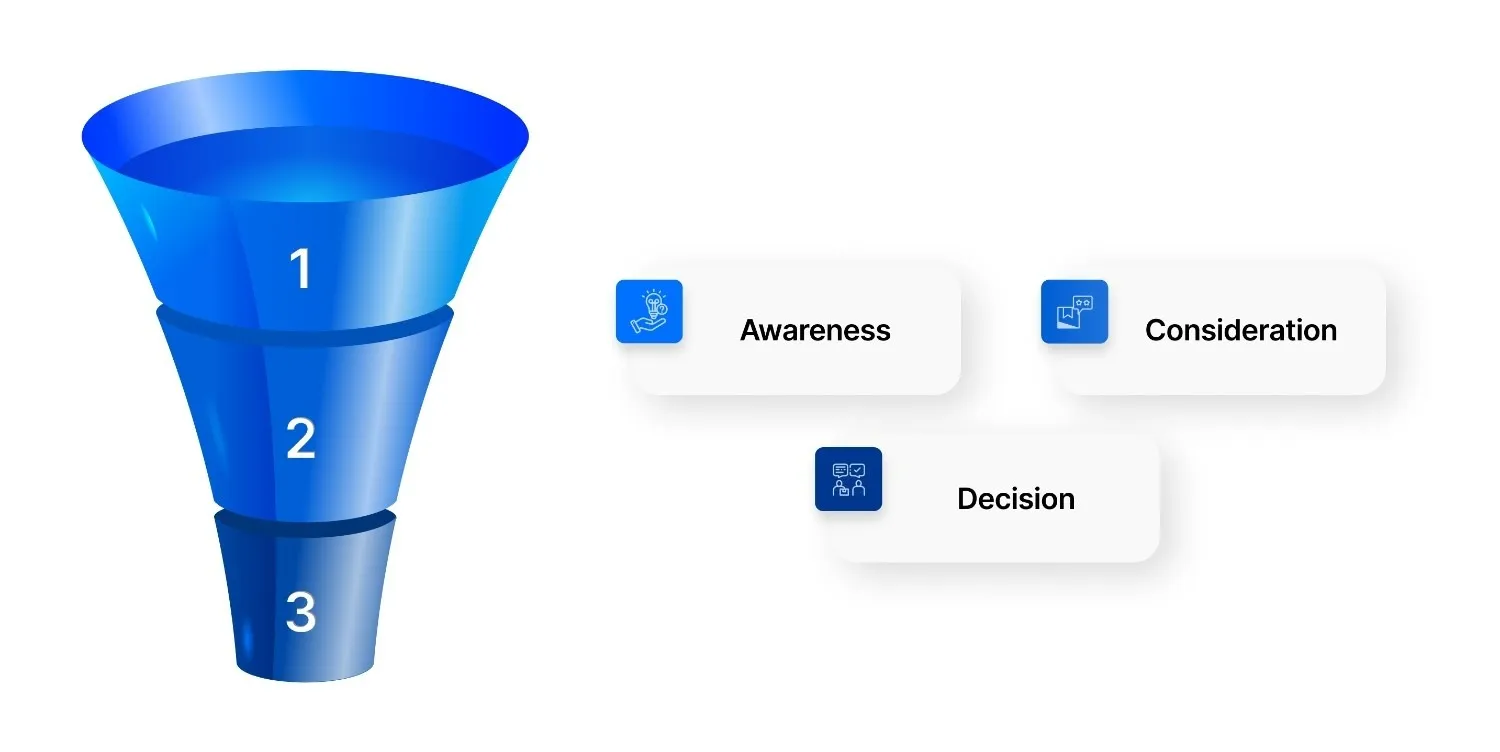
Today’s buyers follow a clear, research-driven path, and your lead generation needs to meet them at every step:
- Awareness: They realize they have a need and start researching.
- Consideration: They compare suppliers, read reviews, and create a shortlist.
- Decision: They reach out, negotiate, and place an order.
Many manufacturers focus only on the decision stage, but by then, preferences are already set. The best strategies ensure your brand is visible and trusted at every stage. Next, let’s look at the strategies that help you do just that.
10 B2B Lead Gen Strategies for Manufacturers
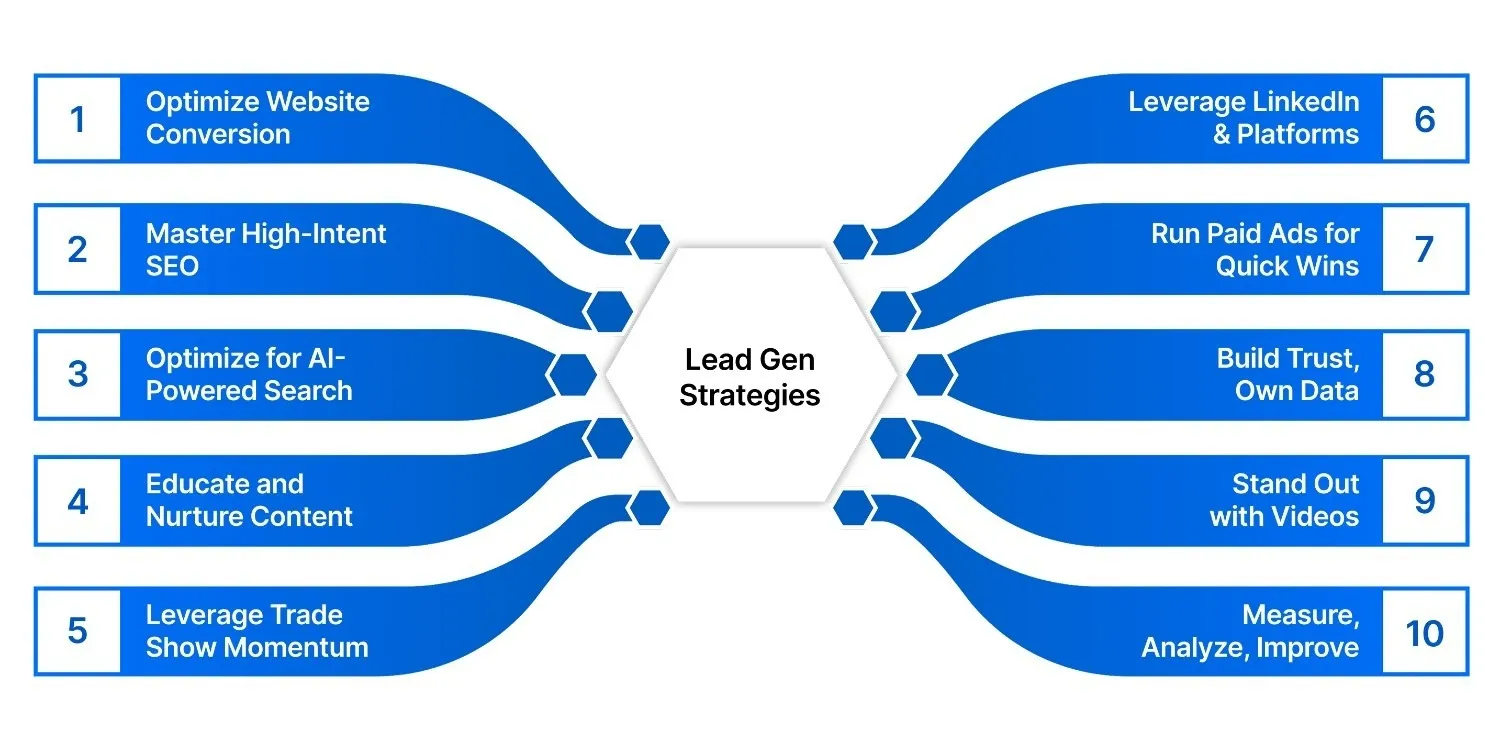
Successful B2B lead generation starts with clarity. You need clear goals, a solid understanding of your ideal buyers, and targeted messaging that speaks to their needs.
Here are 10 proven strategies manufacturers can use to consistently attract and convert high-quality leads:
Strategy #1 - Build a Conversion-Optimized Website
Your website is your #1 sales tool, but most manufacturing websites aren't designed to convert visitors into leads.
What to do:
- Make it fast, mobile-friendly, and easy to navigate.
- Use clear calls-to-action (“Request a Quote”, “Contact Sales”).
- Highlight trust signals like certifications, customer logos, and testimonials.
- Create a clean product catalog with specs, downloadable resources, and inquiry forms.
- Optimize your most-visited pages for high-intent keywords.
Pro tip: Review your analytics to see which pages already get traffic, and optimize those first. Gushwork helps manufacturers revamp websites to rank for niche, high-intent queries.
Strategy #2 - Master SEO for High-Intent Keywords
Your buyers are already searching online, and SEO ensures you show up when they do.
What to do:
- Research bottom-of-funnel (BOFU) keywords like “custom CNC parts supplier Texas.”
- Create individual landing pages for each product and region.
- Add helpful, evergreen content (guides, FAQs, videos).
- Use schema markup to help search engines understand your site.
- Review your rankings and adjust quarterly.
SEO takes time, but compounds into consistent, qualified inbound leads.
Get Found for the Right High-Intent Searches
We’ll help you target the exact keywords your buyers use and build pages that bring in steady, qualified leads.
Get My SEO
Strategy #3 - Optimize for AI-Powered Search
AI-driven tools like ChatGPT, Perplexity, and Google's AI Overviews are changing how buyers discover suppliers. They’re asking full, conversational questions — and expect clear answers.
What to do:
- Write structured, Q&A-style content.
- Use natural, conversational language that directly answers buyer questions.
- Add FAQ sections and semantic markup.
- Audit your performance on AI search with tools like an AI Search Grader.
Being discoverable on AI-powered platforms puts you ahead of competitors who still focus only on traditional search.
Strategy #4 - Publish Content That Educates and Nurtures
B2B manufacturing sales cycles are usually long. Buyers need time to evaluate options, compare specs, and justify budgets. Your content should help guide them through that process, and keep your brand top of mind.
Types of content to create:
- Blog posts answering specific buyer questions.
- Case studies showing real-world results for your customers.
- Virtual factory tours and process videos.
- Whitepapers & spec sheets gated behind lead forms.
- Plan your content calendar around industry trends, seasonal demand, and key trade shows to stay relevant and timely.
Create Content Your Buyers Actually Use
We’ll help you plan educational content and resources that support long sales cycles and keep prospects engaged.
Build My Content
Strategy #5 - Leverage Trade Show Momentum
Trade shows are still an important part of the manufacturing world. But too often, manufacturers fail to capitalize on the post-event opportunity.
How to keep the momentum going:
- Create a dedicated landing page for each show to collect leads before, during, and after.
- Use QR codes at your booth to capture visitor details instantly.
- Follow up within 48 hours with personalized emails or LinkedIn messages.
- Run retargeting ads to stay in front of show attendees after the event.
This way, you retain the momentum from trade shows and turn short-term spikes into long-term leads.
Strategy #6 - Use LinkedIn and Industry Platforms
LinkedIn is one of the best platforms for manufacturers to connect directly with decision-makers. With 1 billion users of senior influencers and buyers active every day, it's hard to ignore.
What to do:
- Optimize your company page and team profiles.
- Post thought leadership, customer success stories, and videos regularly.
- Join and contribute to relevant industry groups.
- Use LinkedIn Sales Navigator to build prospect lists and nurture them.
- Run Lead Gen Form ads to capture leads without forcing users off the platform.
Experiment with different creatives and audience segments, and double down on what performs best.
Strategy #7 - Run Paid Ads for Quick Wins
Organic traffic and SEO take time, but paid ads can give results fast. Perfect for trade shows, new product launches, or filling a short-term gap. With over 8.5 billion searches a day, Google is one of the best places for lead generation.
Where to focus:
- Google Ads for high-intent keywords (like “CNC parts supplier Chicago”).
- LinkedIn Ads to reach specific industries, roles, or regions.
- Retargeting ads to re-engage visitors who didn’t convert.
Pro Tip: Make sure your landing pages are fast and mobile-friendly, set a realistic budget, and keep testing creatives and bids to improve ROI.
Strategy #8 - Build Buyer Trust and Own Your Data
Relying solely on platforms like IndiaMART or Alibaba means giving up control and paying commissions. Your goal should be to collect and own your own leads.
How to build trust:
- Use secure, user-friendly forms to capture leads on your site.
- Highlight your certifications, guarantees, and company story.
- Showcase reviews, testimonials, and awards prominently.
- Invest in a CRM to track, organize, and nurture leads effectively.
Strategy #9 - Use Personalized Videos to Stand Out
Sometimes, the smallest personal touch makes the biggest difference. Short, authentic videos sent directly to prospects show that you understand their needs and make your outreach hard to ignore.
What to do:
- Record 30–60 second videos addressing the prospect by name and mentioning something specific about their situation.
- Send via email, LinkedIn, or even text.
- Use video platforms that track views and engagement so you can follow up at the right time.
Use personalized videos for both cold outreach and warm follow-ups; they can improve response rates by 30–90%.
Strategy #10 - Measure, Analyze, Improve
Lastly, none of these strategies will succeed unless you measure and improve them. Lead generation is an ongoing process, and manufacturers who track and refine consistently see the best results.
Key metrics to monitor:
- Website traffic, bounce rates, and conversions
- Form submissions and lead quality
- Keyword rankings and backlinks
- Email open and click-through rates
- Campaign ROI
Set up monthly KPI reviews, double down on what’s working, and tweak underperforming efforts. Use tools like Google Analytics, Search Console, LinkedIn Analytics, and your CRM to stay on top of trends.
Start small, pick 2–3 strategies that suit your business right now, and build from there. The key is to take consistent, measurable action, and you'll see your pipeline grow. Before you move ahead, you need to be aware of dos and don'ts to help you avoid common mistakes.
What Works and What Doesn’t in Manufacturing Lead Generation
B2B lead gen isn't about trying every tactic you can think of. It’s about avoiding the common traps and doubling down on what actually works.
Here’s a simple checklist to keep you on the right track:
Stick to these best practices, and you’ll build a sustainable, high-quality lead gen engine that keeps your pipeline healthy.
Final Thoughts
The manufacturing world is changing fast. Buyers are digital-first, AI is reshaping search, and middlemen are no longer your only option. With the right B2B lead gen strategy, you can build direct, profitable relationships with your customers, all through your own branded presence.
At Gushwork, we help manufacturers modernize their websites, rank higher (on search and AI platforms), and build a steady pipeline of qualified leads, without paying commissions or giving up control.
- Conversion-focused websites
- SEO and AI-ready content
- Full-funnel B2B lead gen strategies for manufacturers
Ready to Build a Steady Lead Pipeline?
Get a simple plan that attracts better buyers and supports your sales team from first touch to closed deal.
Start My Lead Plan

