


Home

Resources
Blogs
Blog
Get insights on AI, productivity, and the future of work.


Thank you! Your submission has been received!
Oops! Something went wrong while submitting the form.

Digital Marketing
Oct 14, 2025
5 mins
Top B2B Marketing Agencies Helping U.S. Manufacturers Drive Real Growth
Ishani Mitra
B2B marketing looks very different when you’re selling manufactured products in the US. You’re not convincing someone to click “buy now.” You’re helping engineers validate specs, procurement teams compare suppliers, and leadership teams reduce risk before they commit to a long-term decision.
That’s why a lot of manufacturing marketing fails. It borrows playbooks from SaaS or generic B2B, focuses too much on traffic or branding, and ignores how real buying decisions actually happen on the factory floor and in sourcing meetings.
In this blog, we break down what an effective B2B demand generation agency for manufacturers is, the agencies that understand this space well, and how to choose the right partner based on how you sell.
What B2B Marketing Looks Like for U.S. Manufacturers?
B2B marketing works differently in manufacturing because buyers don’t impulse-purchase. Engineers validate specs, procurement compares suppliers, operations checks feasibility, and leadership signs off on risk. That creates a long evaluation cycle, so marketing that tries to hustle a demo or a gated ebook usually lands flat.
Effective B2B marketing for U.S. manufacturers does three things well:
- It answers technical questions early with proof-led content that reduces risk.
- It creates visibility for high-intent searches tied to processes, materials, part types, and compliance needs.
- It supports sales enablement, so conversations move faster once a buyer raises their hand.
The result you care about isn’t traffic. It’s qualified RFQs, stronger SQL rates, and faster quote velocity.
Get Found By Serious Manufacturing Buyers
Build search visibility around specs, materials, processes, and use-cases, so engineers and procurement teams land on pages that answer real evaluation questions.
Strengthen Our SEO Foundation


Best B2B Marketing Agencies for US Manufacturers
Not every B2B marketing agency understands manufacturing. And honestly, that gap shows fast.
A good manufacturing partner knows how to market to buyers who care about specs, proof, and risk reduction. They build content that engineers actually trust, landing pages that feel serious, and demand-gen that attracts RFQs instead of junk leads.
Below is a curated list of agencies and teams that work well for US manufacturers:
1) Gushwork

Gushwork helps manufacturers who need dependable hands-on marketing without hiring a full team. Instead of locking you into long agency cycles, they plug into your workflow and help you ship content, SEO work, and demand-gen support at a steady pace.
Best Features:
- Core offering: Ongoing content and SEO plus campaign execution. They run blogs, technical guides, capability pages, and targeted landing pages that speak to engineers and procurement.
- Execution model: A retainer-style engagement with a dedicated team that plugs into your calendar and product cycles. Expect regular sprints, editorial calendars, and weekly status updates.
- Typical deliverables: Monthly blog posts, case studies with measurable outcomes, optimized product/capability pages, and one-off campaign builds.
- Content depth: Focus on technical assets, spec sheets, CAD-ready files, process explainers, failure-mode analyses, and teardown videos when helpful. These assets are written to reduce evaluation friction.
- SEO approach: Keyword mapping by part numbers, materials, and process terms; topic clusters for buyer intent; on-page technical SEO for specification pages; and internal linking that supports product discovery.
Gushwork focuses on shipping the work you need: content that answers technical questions, SEO that targets buyer intent, and demand-gen that produces qualified RFQs, with the execution you’d expect from a b2b demand generation agency for manufacturers.
2) Gorilla 76
Gorilla 76 is one of the most widely recognized industrial marketing agencies in the US, and they’ve built their reputation by working with B2B companies across the manufacturing ecosystem. They’re a strong fit when you need real industrial positioning and long-term inbound growth.
Best Features:
- Inbound strategy for industrial buying cycles: Best for manufacturers selling complex products with long evaluation timelines.
- Industrial content that supports revenue goals: Strong at building topic authority and buyer-focused assets that compound over time.
- Manufacturing-specific audience familiarity: Known for working across OEMs, contract manufacturers, robotics integrators, and industry 4.0 players.
3) TREW Marketing
TreW Marketing is a strong pick when your buyer is technical, and your product needs to be understood before it can be trusted. They work well for manufacturers who sell to engineers, technical evaluators, and niche industrial decision-makers.
Best Features:
- Engineering-first content marketing: Useful when your sales cycle depends on education, feasibility proof, and credibility.
- SEO that supports technical intent: Works well for manufacturers trying to win searches tied to specs, processes, compliance, materials, and comparisons.
- Long-cycle nurture and trust-building: A fit when the deal needs multiple internal approvals and your marketing has to keep you top-of-mind.
4) Thomas (Thomasnet + Thomas Marketing Services)
Thomas is less of a “classic marketing agency” and more of a manufacturing buyer ecosystem. For US manufacturers, it can work as a demand source because buyers already use Thomasnet to search for suppliers and shortlist vendors.
Best Features:
- Visibility in supplier discovery: A strong option if you need to show up where industrial procurement teams already search.
- Lead-gen for parts, components, and services: Often useful for manufacturers selling within established sourcing categories.
- Industrial audience access: Helpful if your challenge is “getting found” more than “building a brand from scratch.”
5) Ironpaper
Ironpaper is a B2B growth agency that’s strong on strategy + execution when the goal is measurable pipeline impact. They’re a good fit for manufacturers and industrial brands that need more than visibility, especially if you’re trying to tighten lead quality, improve conversion, and build a marketing engine that supports long sales cycles.
Best Features:
- Inbound + performance combined: Useful when you want SEO and content working alongside conversion-focused landing pages and demand-gen.
- Conversion-first website thinking: Works well for manufacturers whose site gets traffic but isn’t turning visits into serious inquiries or RFQs.
- B2B lead quality focus: A fit when your biggest problem is not “more leads,” but better-fit leads that sales can actually move forward.
6) Straight North
Straight North tends to show up as a lead-gen focused agency option. For manufacturers, they’re usually evaluated when the goal is clear: improve visibility for high-intent searches and turn that traffic into inquiries that sales can follow up on.
Best Features:
- Lead-driven SEO and paid search: Best when you want measurable pipeline contribution, not just impressions.
- Conversion improvements on core pages: Helpful when the site gets traffic but doesn’t convert consistently into RFQs or calls.
- Manufacturers with defined offers: Works better when you have clear services/products that map to search intent cleanly.
7) Industrial Strength Marketing (ISM)
Industrial Strength Marketing is positioned as an industrial-first specialist, often shortlisted by companies that want an agency that “gets” manufacturing language without long onboarding cycles.
Best Features:
- Manufacturing-focused specialization: Useful when your audience is niche and generalist messaging keeps falling flat.
- Content + inbound for industrial buyers: A fit when your marketing has to educate while still driving commercial outcomes.
- Brand + pipeline balance: Often a good middle ground if you need credibility and leads together.
8) IMB (Industrial Marketing & Branding)
IMB sits in the space between branding and performance. Manufacturers typically look at IMB when their site and messaging feel dated, and they need a modern presence that still supports demand-gen fundamentals.
Best Features:
- Website + messaging upgrades: Helpful if your site feels like a brochure and doesn’t support evaluation-driven buying.
- SEO foundations with industrial relevance: Works well when you’re rebuilding structure (capability pages, industries, use cases) alongside content.
- Mid-sized manufacturers evolving their positioning: A fit when you’re trying to tighten “what we do” and “why us” at the same time.
9) New Breed (HubSpot-focused growth agency)
New Breed is often brought in when the problem isn’t just lead flow, but systems. If your manufacturing business has marketing happening, but tracking, handoff, nurture, and lifecycle alignment are messy, this type of partner becomes valuable.
Best Features:
- HubSpot onboarding + automation: Useful for manufacturers that want clean lifecycle stages, attribution, and consistent nurture.
- RevOps alignment: Helps when sales and marketing are active, but there’s friction in follow-up, lead quality, or reporting.
- Long-cycle deal support: A fit when you need lead nurturing that feels practical, not like newsletters.
10) Directive Consulting

Directive is known more for performance-led B2B growth. Manufacturers tend to consider them when paid media and conversion systems matter, and when you care about tying spend to pipeline outcomes.
Best Features:
- Paid search built around revenue outcomes: Strong when you want demand capture from high-intent searches, not broad awareness.
- Landing pages + conversion workflow thinking: Useful when you need dedicated pages for services, industries, and intent-based campaigns.
- High-value funnels: Fits manufacturers selling expensive products/services where a few deals matter more than lead volume.
11) Brafton
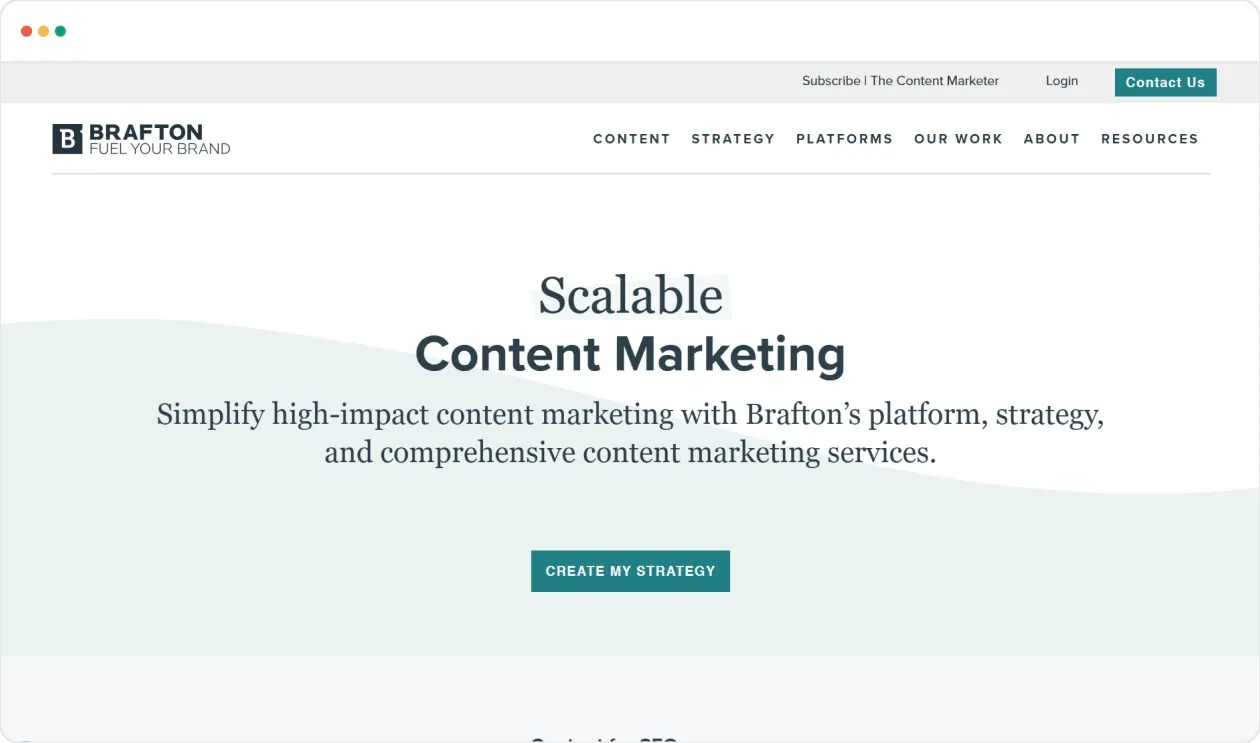
Brafton is typically considered when a company needs content output at scale. For manufacturers, that can help when you have a strong internal POV but not enough internal bandwidth to publish consistently.
Best Features:
- Consistent content production: Useful when content is part of the growth plan, but your team can’t keep up.
- SEO-driven blogging programs: Helps build a base layer of search visibility over time.
- Editorial workflow support: Good if your bottleneck is writing, editing, and production ops rather than strategy.
12) Velocity Partners
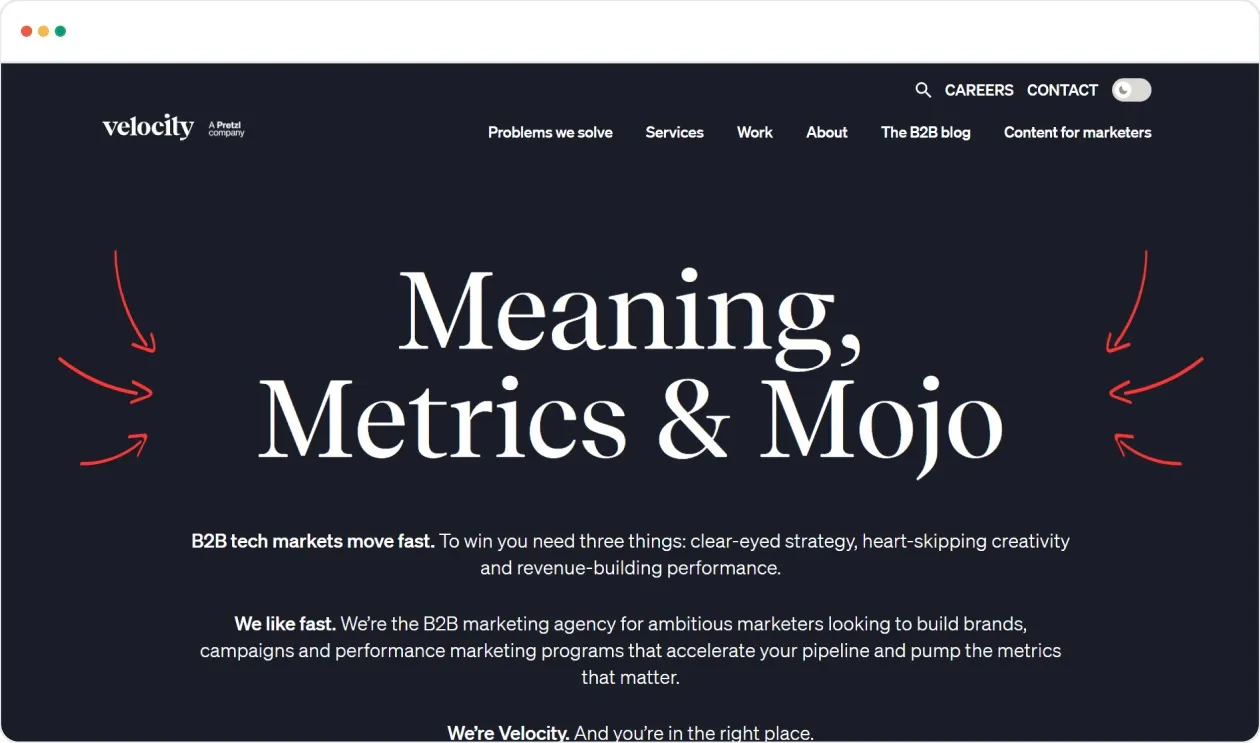
Velocity Partners is more “sharp messaging and content” than ongoing execution volume. Manufacturers who compete in crowded categories tend to shortlist them when differentiation and clarity are the real problems.
Best Features:
- Positioning and narrative clarity: Useful if your website sounds like every other supplier in your space.
- High-conviction B2B content: Strong when you need credible long-form content that doesn’t read like SEO filler.
- Competitive differentiation: Best when “we do quality work” isn’t enough and you need sharper messaging to win deals.
Move Faster Without Building An In-House Team
Get a dedicated execution team that ships consistently, with clear sprints, dependable output, and a workflow built around your review cycles.
Get Hands-On Execution Support
How to Choose the Right B2B Marketing Partner as a US Manufacturer?
A good B2B demand generation agency for manufacturers will make it easier for the right buyers to understand you, trust you, and reach out with serious intent.
Here’s what to look for before you sign anything:
- True manufacturing fluency: They speak engineering language and understand buying workflows. That means familiarity with spec sheets, CAD assets, compliance, lead times, and the multi-stakeholder approvals that slow decisions.
- Portfolio of technical work that actually converts: Ask to see case studies and content that aren’t just blog posts. Look for spec downloads, teardown videos, comparison pages, and case studies that list numbers. The proof should show real outcomes.
- Execution muscle, not just strategy: They must deliver on cadence: editorial calendars, sprinted launches, CRO tests, paid campaigns, and landing pages. Strategy matters, but manufacturers need output that engineers and procurement can use.
- Sales enablement built into the process: Content should hand off cleanly to sales. Expect engineer-to-engineer one-pagers, procurement-focused datasheets, pricing guidance, and battlecards that shorten evaluation calls. Marketing that creates work for sales is not helping.
- Measurement tied to lead quality: KPIs should prioritize qualified RFQs, SQL rate, and lead-to-quote velocity. Traffic and rankings are useful, but only as signals that feed the quality metrics. They should show how they define and measure a qualified manufacturing lead.
- A practical onboarding and 30/60/90 plan: The right partner has a clear audit, a prioritized content backlog, and early wins mapped out. You want a documented ramp that shows what they will fix in month one, month two, and month three.
- Fast technical review loops: Engineers and production teams must be able to review assets without bottlenecks. The agency should have a lightweight, documented review process so technical approvals don’t slow every deliverable.
- Flexible resourcing and predictable pricing: They should scale output up or down for launches and seasonal demand, and pricing should be transparent. You need clarity on scope and what “enough” looks like.
- Cross-channel capability with sensible prioritization: They should run SEO, content, and conversion work as foundational plays, and layer paid and account work where it fits your sales motion.
- References you can verify quickly: Get at least two references from manufacturers of similar size or complexity. Ask for a sample content piece, the KPIs it moved, and a contact who will confirm the story.
Fix The Handoff Between Marketing And Sales
Track what matters (qualified RFQs, SQLs, quote velocity) and support sales with enablement assets that reduce back-and-forth and speed up decisions.
Align Marketing With Revenue Goals
Final Thoughts
There’s no shortage of agencies willing to market to manufacturers. The harder part is finding one that understands how manufacturing buyers think, evaluate, and decide.
Whether you build this capability in-house or partner with a B2B demand generation agency for manufacturers, the focus should stay the same. Clarity over creativity. Proof over polish. Outcomes over activity.
If you want this done without building a full in-house team, Gushwork can help. We produce technical content, SEO, and demand-gen built for how manufacturing buyers research and decide. Talk to us to see what a steady, execution-first growth system looks like.

Industrial Sales
Oct 13, 2025
5 mins
Mastering Manufacturing Costs: Calculation, Optimization, and Better Profits
Batul Beawarwala
Manufacturers face constant pressure to stay competitive, and a structured, customer-centric sales approach is key.
Understanding the true cost of sales is crucial for improving profitability. Tracking direct expenses like materials, labor, and overhead is simple. Although, hidden costs like material price volatility, supply chain disruptions, and production inefficiencies often go unnoticed. These costs can quietly erode margins, leaving little room for growth.

This guide breaks down the process of calculating your cost of sales and offers practical strategies to optimize it, helping you reduce waste, streamline operations, and boost profitability.
What’s the Real Cost of Your Sales? Let's Break It Down
Cost of sales, also known as cost of goods sold (COGS), includes all direct costs associated with producing the goods that a company sells. This includes:
- Raw Materials: The cost of the basic materials used in manufacturing products.
- Labor: The wages of workers directly involved in the production process.
- Manufacturing Overhead: Indirect costs that are essential for production, such as factory utilities, machinery maintenance, and insurance.
COGS captures production costs. Operating expenses (OPEX) are the costs to run the business that aren’t tied to making units, e.g., marketing, administrative salaries, office rent, and head-office utilities.
Many manufacturers assume COGS is just about materials and labor, but there's a deeper layer that can impact your profitability significantly. Let’s break it down.
COGS vs. Operating Expenses:
It’s crucial to understand the difference between COGS and Operating Expenses (OPEX).
- COGS refers to the direct costs associated with the production of goods, including raw materials, labor, and overhead costs.
- Operating Expenses (OPEX), on the other hand, are the expenses not directly tied to production, like marketing, salaries of sales staff, rent, and office supplies.
Why does this matter?
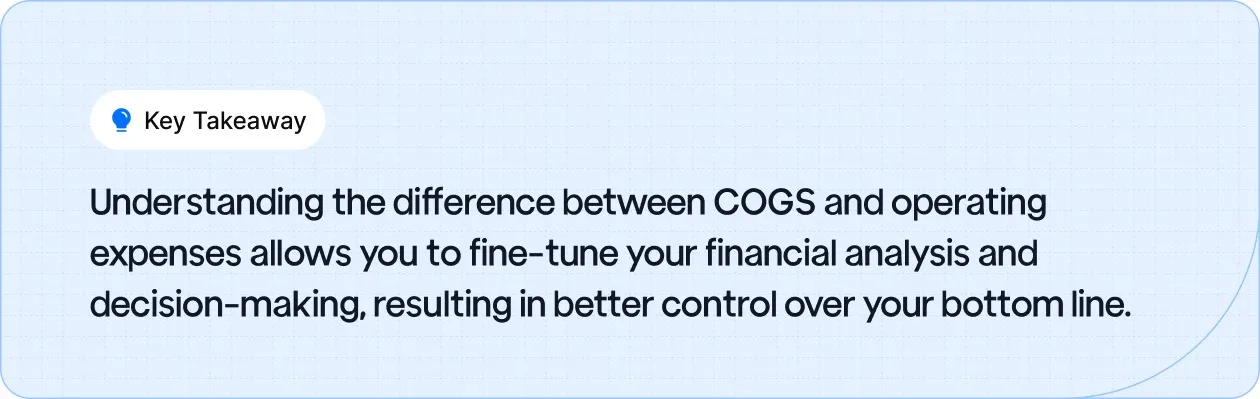
The distinction is key in financial reporting. By accurately categorizing your costs, you can:
- Improve profitability analysis.
- Gain clearer insights into cost drivers.
- Make better pricing and financial decisions.
How to Crunch the Numbers: COGS Calculation Made Simple
The basic formula for calculating COGS is simple but requires accuracy at each step:

Detailed Breakdown:
- Direct Materials: Define direct materials as the raw materials that become part of the finished product. Calculate material costs based on inventory records and purchase receipts.
- Direct Labor: Direct labor costs are wages paid to workers who are directly involved in the production process. This includes both full-time employees and temporary labor used in production.
- Manufacturing Overhead: These are indirect costs that support the production process. This includes factory rent, utilities, equipment depreciation, and factory supplies.
These costs can be harder to track, but are just as important for accurate cost calculation.
Example Calculation: Let's say your company's inventory details are as follows:
- Beginning inventory: $50,000
- Purchases during the period: $120,000
- Ending inventory: $40,000
So, the COGS would be: COGS = $50,000 + $120,000 - $40,000 = $130,000
This means your direct production costs for the period total $130,000.
What’s Killing Your Costs? The Factors You Can't Ignore
Manufacturers face constant pressure from rising costs that erode their margins. Fluctuating material prices, inefficient labor, and overhead costs can quickly drive up your expenses, making it crucial to take control of these factors.
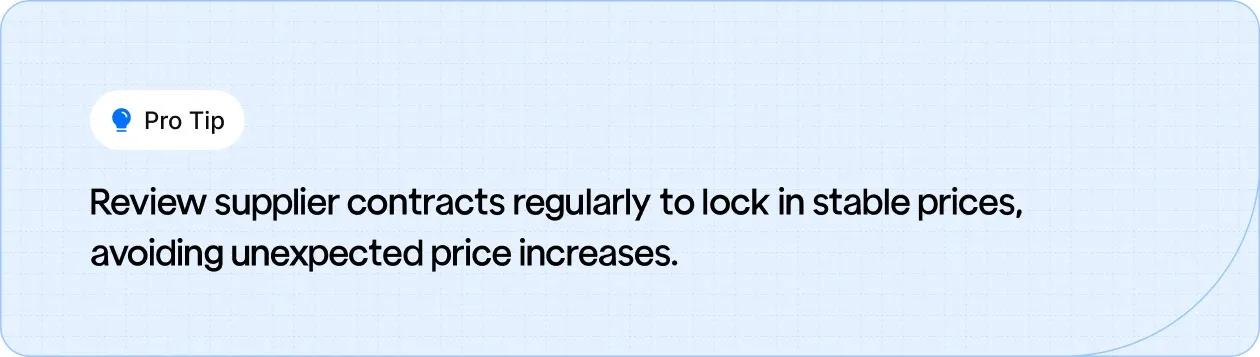
- Material Costs: Fluctuating raw material prices can drive up your COGS quickly. Volatility in commodity markets and supplier price hikes can throw off your cost projections.
- Mitigation Strategies: Lock in prices with long-term supplier contracts and bulk purchasing to reduce material cost fluctuations.
- Labor Costs: Labor efficiency directly impacts COGS. Inefficient workflows and overtime can escalate labor costs.
- Optimization Strategies: Automate routine tasks and invest in cross-training employees to maximize productivity while reducing reliance on overtime.
- Overhead Costs: Indirect costs like factory rent and utility bills can silently eat into your margins.
- Supply Chain Factors: Global supply chain issues, like tariffs and shipping delays, can increase production costs.
Inventory Valuation Methods: FIFO, LIFO, and the Rest, Which One's Right for You?
FIFO (First In, First Out): FIFO assumes that the oldest inventory items are sold first. This method works well during periods of inflation as older, cheaper inventory is sold first, keeping COGS lower.
FIFO results in a higher ending inventory value and can boost profit margins in times of rising material costs.
LIFO (Last In, First Out): LIFO assumes that the most recent inventory is sold first. This method is advantageous during inflationary periods as it matches higher current costs to sales revenue, resulting in a higher COGS and lower taxable income.
Average Cost Method: The average cost method smooths out the fluctuations in material prices by averaging the cost of all units, regardless of when they were purchased.
This method helps maintain consistent COGS over time, especially in industries with high inventory turnover or volatile material costs.
Choosing the Right Method: The right inventory valuation method depends on your:
- Production Type: High-turnover, low-cost items may benefit from FIFO or Average Cost, while high-value, low-volume items might favor LIFO.
- Financial Strategy: FIFO generally results in higher profits (during inflation), which could be useful for showing strong performance, while LIFO could benefit companies looking to reduce tax liabilities in times of price hikes.
More COGS = Less Profit: How This Affects Your Bottom Line
Understanding how COGS affects your bottom line is crucial for staying competitive. A high COGS can eat into profits, making it essential to optimize production and pricing strategies.
Gross Profit and Margin
COGS directly impacts your gross profit, which is calculated by subtracting COGS from revenue. If COGS is high, your gross profit margin will shrink. A lower margin means you will need to either increase sales or reduce costs to maintain profitability.
Impact on Pricing Strategy
Knowing your COGS helps set the right price for your products. If your COGS is too high, increasing your prices might be necessary. However, the price hike must still be competitive in the market.
Failing to optimize COGS might force you to raise prices, risking a loss of market share to competitors.
Operational Efficiency
Optimizing COGS is about improving operational efficiency. Reducing inefficiencies in production by eliminating waste, improving labor productivity, and automating processes can lower COGS without sacrificing quality.
Small improvements can lead to significant savings over time.
Example: A company specializing in custom-made furniture noticed that rising labor costs were inflating its COGS.
After re-engineering their production process and investing in automated equipment, they reduced labor costs and improved production efficiency, increasing their gross profit margin by 15%.
Get Your Sales Costs Under Control: 6 Ways to Optimize COGS
Managing your COGS is the key to unlocking higher profits. Even a small increase in production costs can eat away at your margins, making it harder to stay competitive.
1. Negotiating Better Supplier Terms
One of the easiest ways to lower material costs is through better supplier negotiations. By locking in favorable prices with long-term contracts or purchasing materials in bulk, manufacturers can control material cost fluctuations, leading to more predictable COGS.
2. Lean Manufacturing Techniques
Lean manufacturing is all about eliminating waste in production processes. By minimizing waste, reducing overproduction, and optimizing labor, you can significantly lower COGS. The less waste you generate, the fewer materials and labor costs you incur.
3. Technological Advancements
Investing in automation or adopting AI-driven technologies can lower labor costs and improve production efficiency. AI systems can optimize production schedules, reduce downtime, and maintain consistency in output, leading to a reduction in COGS.
4. Process Automation
Automating tasks such as assembly, inspection, or packaging can cut down on manual labor, reduce errors, and improve speed. Over time, this leads to significant savings in labor costs and a decrease in COGS.

5. Inventory Management
Just-in-time (JIT) inventory systems can help keep inventory costs low by reducing the need for excessive stock storage, which reduces overhead costs and minimizes material waste.
6. Energy Efficiency
Reducing energy consumption in production processes is another way to lower overhead costs and improve overall COGS efficiency.
Investing in energy-efficient equipment, optimizing heating/cooling systems, and using renewable energy sources can drive down utility costs and improve your cost structure.
COGM vs. COGS: Know the Difference, Boost Your Profits
COGM, or Cost of Goods Manufactured, includes the total costs involved in producing goods, such as direct materials, labor, and manufacturing overhead.
This differs from COGS, which is the cost of the goods that were actually sold. COGM is used to assess manufacturing efficiency, while COGS shows the direct expenses related to sales.

Link to COGS: By understanding COGM, you can accurately calculate COGS. COGM provides the production cost of all goods made during the period, while COGS reflects the cost of those goods sold.
Both metrics are crucial for tracking your profitability and performance over time.
Example: A company with $50,000 in direct material purchases, $30,000 in direct labor, and $20,000 in overhead will have a COGM of $100,000. If $60,000 worth of goods were sold, the COGS for that period would be $60,000.
Track, Tweak, Repeat: The Key to Mastering Manufacturing Costs
Mastering manufacturing costs is an ongoing process of constant evaluation. By tracking costs in real-time and continuously refining your strategies, you can stay ahead of rising expenses and boost profitability.
Real-Time Tracking with ERP Systems
By using ERP (Enterprise Resource Planning) systems, manufacturers can track material costs, labor, and overhead in real-time, ensuring more accurate financial data and faster decision-making.
Real-time data enables better control over COGS and allows you to address issues as they arise.

Continuous Improvement
Manufacturers should embrace continuous improvement practices like Kaizen to constantly evaluate and improve cost management strategies.
This can involve everything from streamlining production workflows to optimizing supplier relationships.
Cost Reduction Initiatives
Consider initiatives like outsourcing non-core functions (e.g., packaging or administrative tasks), improving supply chain management, and automating certain production processes to further reduce COGS and improve profitability.
Avoid These Costly Mistakes in Sales Management
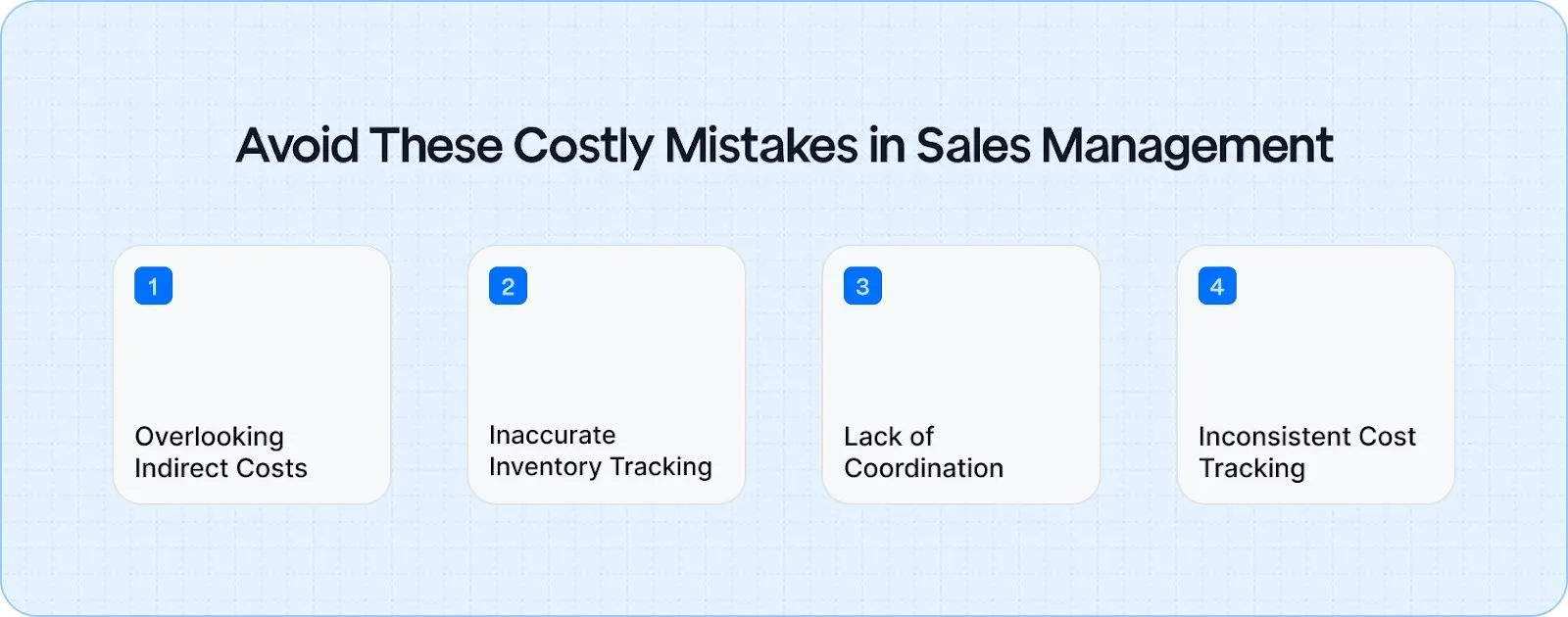
Mistakes in cost management can snowball, leading to higher COGS and thinner margins. Avoiding these pitfalls ensures a more accurate financial picture and positions your company for long-term profitability.
Overlooking Indirect Costs
Manufacturers often focus on direct costs like materials and labor, neglecting indirect costs such as overhead, administrative expenses, and equipment depreciation. These can distort profitability estimates if not properly accounted for.
Why it Matters: Ignoring indirect costs inflates margins, leading to poor decision-making and misaligned pricing strategies.
Actionable Tip: Regularly review and allocate indirect costs across production lines to ensure your cost structure is accurate.
Inaccurate Inventory Tracking
Errors in inventory counts or outdated valuation methods can seriously impact COGS, leading to:
- Overstating or understating inventory values.
- Incorrect COGS calculations, skewing profitability.
- Stockouts or overstocking resulting in lost sales or excess inventory costs.
Why it Matters: Inaccurate inventory tracking can lead to poor purchasing decisions and inefficiencies in production.
Actionable Tip: Invest in automated inventory systems and conduct regular physical counts to ensure accuracy.
Lack of Cross-Department Collaboration
When sales, production, and finance teams operate in silos, optimizing COGS becomes difficult. Misaligned priorities can lead to:
- Sales are pushing for higher prices without considering production costs.
- Production is failing to communicate material shortages.
- Finance is lacking real-time data for accurate cost forecasting.
Why it Matters: A lack of alignment can increase costs and hinder efficiency across departments.
Actionable Tip: Foster cross-department communication with shared cost-tracking dashboards and regular collaboration.
Inconsistent Cost Tracking
Inconsistent cost tracking practices across periods can lead to unreliable data, making it harder to:
- Benchmark performance
- Identify trends and cost-saving opportunities
Why it Matters: Inconsistent methods distort financial analysis and make cost management less reliable.
Actionable Tip: Standardize cost-tracking methods and use accounting software that ensures consistency.
Ready to Take Control of Your Manufacturing Costs? Let’s Make It Happen!
By now, you understand how critical managing and optimizing your cost of sales (COGS) is to improve profitability and stay competitive in the manufacturing sector. Efficient cost management is about streamlining operations, improving productivity, and enhancing your bottom line for sustainable growth.
- Accurately calculating COGS helps you understand where your costs are coming from and how to manage them better.
- Optimizing labor, material, and overhead costs is essential to boosting your profit margins without compromising quality.
- The more strategic control you have over your manufacturing costs, the more competitive and profitable your business can be.
Manufacturers often try to manage costs with quick fixes, but without a well-structured approach, the challenges continue.
FAQs
Q1: What is the cost of sales in manufacturing?
A1: The cost of sales (COGS) in manufacturing refers to the direct costs associated with producing goods sold during a specific period. This includes raw materials, labor costs, and manufacturing overhead.
Q2: How does COGS affect manufacturing profitability?
A2: COGS directly impacts profitability by reducing gross profit. The higher the COGS, the lower the profit margin, making it crucial to manage and reduce production costs to stay competitive.
Q3: What’s the difference between COGS and operating expenses in manufacturing?
A3: COGS includes direct production costs like materials, labor, and factory overhead, while operating expenses (OPEX) cover indirect costs like marketing, administration, and rent, which are not tied directly to production.
Q4: How can manufacturers track their costs effectively?
A4: Manufacturers can track costs effectively by using tools like ERP systems that provide real-time data on materials, labor, and overhead, allowing for accurate cost analysis and better decision-making.
Q5: What are the best ways to optimize the cost of sales in manufacturing?
A5: To optimize COGS, manufacturers should focus on streamlining production processes, negotiating better supplier contracts, adopting lean manufacturing techniques, and investing in automation to reduce labor and material costs.
Q6: How do inventory management methods impact COGS?
A6: Different inventory methods (FIFO, LIFO, or average cost) affect COGS calculations. FIFO tends to reduce COGS during inflationary periods, while LIFO can provide tax advantages, though it may result in higher COGS and lower profits.
Q7: What is the relationship between COGM and COGS in manufacturing?
A7: Cost of Goods Manufactured (COGM) represents the total production costs for goods completed during a period, while COGS reflects the costs of goods actually sold. Understanding both helps accurately track profitability.

Digital Marketing
Oct 13, 2025
5 mins
How To Overcome Manufacturing Sales Challenges: A Complete Guide
Batul Beawarwala
You’ve experienced it: chasing leads that eat up your team’s time and drain valuable resources.
In manufacturing sales, the stakes are even higher. You're offering solutions that demand technical expertise and significant investment. So, why waste your time on leads who don't see the value of what you're offering? Pursuing unqualified prospects is costing your company money.

This misallocation of resources not only hampers productivity but also leads to missed revenue opportunities.
This guide is for manufacturers who are tired of the endless back-and-forth with the wrong people and want to focus on closing deals with those who truly need your products.
The Real Sales Struggles Manufacturers Face (And How to Beat Them)
With rising competition and supply chain disruptions, manufacturers face significant challenges in generating consistent revenue.
Let’s break down these issues and discuss how to tackle them head-on.
Rising Competition
Globalization and digital transformation have intensified competition, making it harder for manufacturers to stand out. Competing locally and globally requires a unique value proposition and swift adaptation to changing market demands.
Key Points:
- Focus on differentiating your brand and finding a niche.
- Adjust quickly to stay ahead of local and global competitors.
Pricing Pressures
Fluctuating material costs and customer demands for better pricing are squeezing margins. To stay profitable, manufacturers must find a balance between competitive pricing and value delivery.
Considerations:
- Regularly evaluate pricing strategies to ensure profitability.
- Emphasize the value your product offers over just the price.
Long Sales Cycles
Manufacturing sales cycles are often long due to high-cost, customized products and multiple decision-makers. These lengthy processes can hurt cash flow and profitability.
Impact:
- Longer sales cycles delay revenue and complicate forecasting.
- Streamlining processes and focusing on high-quality leads can help.
Supply Chain Instability
Disruptions in the supply chain, whether due to global events or internal inefficiencies, affect product delivery and production schedules, which can damage customer trust.
Challenges:
- Disruptions lead to delays and uncertain delivery times.
- Communication with customers is essential during delays to maintain trust.
Tackling Sales Roadblocks: What Actually Works in Manufacturing
Let’s move beyond the challenges and focus on solutions. These straightforward strategies can help overcome common sales roadblocks and improve efficiency.
Adopt Value-Based Selling
Switch from focusing on product features to emphasizing the value your product brings to customers. Highlight how it solves their problems, improves their operations, or saves them money.
Leverage Technology for Efficiency
Implement CRM systems, AI, and sales automation tools to streamline your sales process. These technologies help your team spend less time on administrative tasks and more time selling.
Why It Works:
- Automating tasks like follow-ups and lead scoring increases team productivity.
- Integrated tools ensure smooth communication and data flow between departments.
Build Strong Customer Relationships
Long-term relationships are crucial. By maintaining regular contact and offering excellent after-sales support, you build customer loyalty and increase repeat business.
Train Sales Teams on Consultative Selling
Equip your team with the skills to identify customer pain points and tailor solutions that address those specific needs. This makes your sales approach more consultative and effective.
Benefits:
- Consultative selling positions your team as trusted advisors.
- Customers value this personalized approach and are more likely to commit.
Aligning Sales and Marketing: Why Your Teams Need to Speak the Same Language
When sales and marketing align, it improves campaigns, boosts lead quality, and streamlines the sales process. Here’s why syncing them up is essential.
Integrated Sales & Marketing Campaigns
Combining insights from both teams creates more targeted campaigns. Marketing gathers data, while sales ensures the message resonates. This collaboration improves lead quality and conversions.
Why It Works: Shared insights increase campaign relevance and effectiveness.
Example: Marketing focuses on cost efficiency, and sales tailors the message to address specific prospect concerns.
Customer Insights for Better Targeting
Marketing data helps sales craft personalized pitches. By sharing insights, sales can address customer pain points more effectively.
How It Helps: Targeted outreach improves conversion chances.
Example: Sales can highlight fast delivery if marketing data shows this as a key concern in a region.
Cross-Department Collaboration
Collaboration ensures consistent messaging and more effective strategies. When both teams work together, they stay aligned and focused on the same goals.
Consistent Messaging: Both teams communicate the same message across all touchpoints.
Example: Sales feedback helps marketing tweak campaigns to emphasize key benefits.
Automate Your Sales Game: Stop Wasting Time on Repetitive Tasks
Sales automation is a game-changer for manufacturers, too. With the right tools, you can eliminate repetitive tasks, giving your team more time to focus on what truly drives growth, building relationships and closing deals.
Sales Workflow Automation
Automate follow-ups, lead scoring, and scheduling to cut down on administrative work. This ensures consistent follow-ups and faster response times, helping your sales reps focus on high-quality leads and closing deals.
Lead Generation Tools
AI-powered tools capture and qualify leads in real-time, so your sales team spends less time prospecting and more time engaging with qualified leads, improving conversion rates.
Inventory and Order Management Automation
Integrating CRM with inventory management ensures your team has real-time data on stock levels, enabling faster decision-making and accurate delivery timelines, improving customer trust and closing speed.
Data Doesn’t Lie: Using Insights to Power Your Sales Strategy
Data is one of the most powerful tools you can use to fine-tune your sales strategy and stay ahead of the competition.
By harnessing real-time insights, manufacturers can make smarter decisions, anticipate customer needs, and optimize their sales efforts for better outcomes. Let’s explore how data can give you the edge.
Sales Forecasting & Performance Tracking
Predictive analytics can help you forecast future sales by analyzing past trends and customer behaviors.
By understanding when demand will peak, which products are likely to perform well, and what factors influence purchasing decisions, you can proactively adjust your strategy to meet market demand.
How It Works:
- Anticipating Demand: Predictive models help you prepare for future sales surges, ensuring your production, inventory, and marketing efforts are aligned.
- Optimizing Sales Efforts: With accurate performance tracking, you can identify high-performing sales tactics and focus on replicating those strategies.
Market Trends and Consumer Behavior
Staying ahead of market shifts is crucial, especially when consumer preferences can change rapidly. By analyzing market trends and consumer behavior, you can align your product offerings with what your customers are looking for right now.
This helps you make smarter product decisions and adjust your sales approach accordingly.
Why It Matters:
- Adapt to Market Shifts: Data helps you spot emerging trends, such as a rising demand for eco-friendly products, allowing you to pivot your offerings ahead of competitors.
- Target the Right Audience: By understanding what customers want and how they behave, you can refine your marketing efforts to speak directly to their needs.
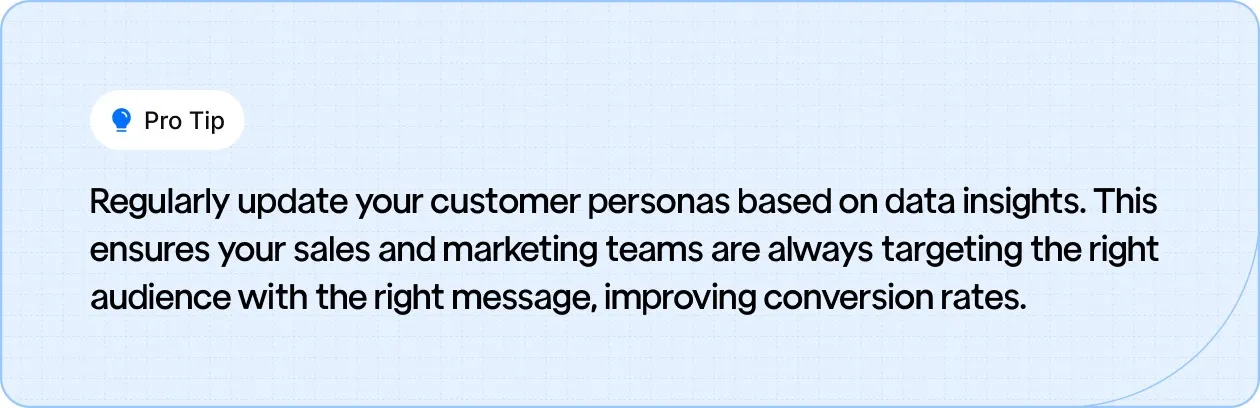
Your Online Presence is Your Sales Secret Weapon: Are You Using It?
With the right sales strategy, your website and social media can drive qualified leads, nurture prospects, and ultimately increase sales. Let's ensure you’re making the most of these digital opportunities.
E-commerce and Digital Sales Channels
Expanding into e-commerce is no longer optional for manufacturers. Having an online sales channel allows you to tap into a much larger market, reaching potential customers who prefer to browse and buy online.
With the right e-commerce platform, you can streamline the buying process and provide a seamless customer experience from start to finish.
Why It Works:
- Larger Market Reach: E-commerce opens your products to a global audience, breaking down geographic limitations and attracting customers from across the world.
- Convenience for Customers: An online store allows customers to view product details, compare options, and make purchases at their convenience, leading to higher conversion rates.
Example: If you’re a manufacturer of industrial tools, offering them for purchase directly on your website could capture customers who are ready to buy, without them having to contact a sales rep first.
SEO and Social Media Marketing
Optimizing your website for search engines (SEO) and using social media effectively can significantly increase your brand visibility. By ranking higher in search results and engaging with customers on platforms like LinkedIn or Instagram, you ensure that potential buyers can find you when they need your products.
How It Helps:
- SEO: With effective SEO strategies, your website can rank for relevant keywords, driving organic traffic from people searching for products like yours.
- Social Media: Regularly posting and engaging on social media platforms helps you stay top-of-mind for potential customers and builds trust and credibility.
Customer Testimonials and Case Studies
Social proof is a powerful tool in the buyer’s journey. When potential customers see that others have successfully used your products, it builds credibility and trust.
Incorporating testimonials and case studies into your marketing materials can influence buying decisions and boost conversions.
Why It Works:
- Builds Trust: Prospects are more likely to buy from you if they see that others like them have had a positive experience with your product.
- Proven Results: Case studies show real-world applications of your product, providing tangible evidence of how it solves customer problems.
Closing Thoughts: Time to Get Your Sales Strategy in Gear
Manufacturing sales is about working smarter, aligning your processes, and embracing the right technology to stay ahead of the curve.
Align your teams, automate workflows, and strengthen customer relationships. Taking charge of your strategy will set you apart in a competitive market.
The days of relying on outdated methods are over; your sales approach needs to evolve with the changing times.
Ready to transform your manufacturing sales?
Explore how powerful automation and marketing can change the way you do business with the right tools.
Book Your Consultation
FAQs
Q1. What is sales automation, and how does it benefit manufacturers?
A1. Sales automation involves using software to streamline repetitive tasks such as lead tracking, follow-ups, and data entry. For manufacturers, this means more time for sales teams to focus on building relationships and closing deals, leading to increased efficiency and revenue.
Q2. Can sales automation integrate with existing CRM and ERP systems?
A2. Yes, many sales automation tools are designed to integrate seamlessly with CRM and ERP systems. This integration ensures that data flows smoothly across platforms, providing a unified view of customer interactions and streamlining the sales process.
Q3. What tasks can be automated in the sales process?
A3. Manufacturers can automate various tasks, including:
- Lead generation and qualification
- Follow-up emails and reminders
- Data entry and CRM updates
- Scheduling meetings and appointments
- Generating quotes and proposals
This automation reduces manual workload and accelerates the sales cycle.
Q4. How does sales automation improve lead management?
A4. Sales automation tools prioritize leads based on predefined criteria, ensuring that sales teams focus on high-potential prospects. Automated lead scoring and routing help in timely follow-ups, increasing the likelihood of conversions.
Q5. Is sales automation suitable for small and medium-sized manufacturers?
A5. Absolutely. Sales automation is scalable and can be tailored to fit the needs of small and medium-sized manufacturers. With the right tools, even businesses with limited resources can streamline their sales processes and compete effectively
Q6. What are the common challenges in implementing sales automation?
A6. Challenges may include:
- Integrating new tools with existing systems
- Ensuring data quality and consistency
- Training staff to use new technologies
- Choosing the right automation tools that align with business needs
Addressing these challenges involves careful planning and selecting solutions that integrate well with current workflows.
Q7. How do I choose the right sales automation tool for my manufacturing business?
A7. When selecting a sales automation tool, consider:
- Compatibility with existing CRM and ERP systems
- Ease of use and user interface
- Customization options to fit specific business needs
- Customer support and training resources
- Cost and scalability
Evaluating these factors will help in choosing a tool that enhances your sales process and drives growth.

Digital Marketing
Oct 10, 2025
5 mins
If Your Sales Team Is Guessing Their Way Through In Calls, These 9 Tactics Will Change It
Batul Beawarwala
For many manufacturers, the biggest hurdle is managing the right leads through a long, intricate sales process.
When you're dealing with high-ticket products, multiple stakeholders, and often, customized solutions, a generic sales approach simply doesn’t cut it.
The result? Wasted time, misaligned expectations, and lost revenue.

You know the struggle: you spend hours on a potential client, only to realize they weren’t truly qualified to make a purchase.
This article will explore how an effective sales process in manufacturing can ensure you're engaging the right leads, at the right time, while making every sales conversation count.
1. Map Out Your Sales Pipeline: It’s Your Roadmap to Success
A clear, structured sales pipeline helps you track every lead and ensures nothing falls through the cracks. By mapping each stage, you can identify where opportunities are and focus on moving them through efficiently.
Prospecting to Close: The Stages Every Manufacturer Should Know
In manufacturing, the sales pipeline is the backbone of your sales process. Mapping each stage from prospecting to closing helps ensure nothing gets overlooked and leads progress smoothly. These stages typically include:
- Prospecting: Generate brand awareness and reach out to potential leads through marketing campaigns, networking, or outreach.
- Lead Qualification: Identify which leads have the potential to convert by evaluating factors like their budget, need for your product, and decision-making power.
- Contact: Initiate conversations with leads by presenting your solutions and addressing their concerns.
- Negotiation: Discuss pricing, terms, and conditions while aligning expectations with the prospect.
- Deal Close: Finalize the sale, get the contract signed, and complete the transaction.
- Retention: Offer post-sale support to nurture long-term relationships, ensuring repeat business.
Avoiding the Sales Black Hole: Keep Your Leads Moving
Without clear visibility into where leads are in the pipeline, they risk stagnating. It’s crucial to proactively move leads through each stage to avoid losing momentum.
Regular follow-ups and CRM tools are key to ensuring that leads don’t get stuck or slip into the “sales black hole.”
2. Lead Scoring: Don’t Waste Time on the Wrong Leads
Lead scoring is a powerful method that helps you focus on leads that are most likely to convert. By ranking leads based on key factors, you can prioritize your sales efforts and close deals faster.
Prioritize Like a Pro: Focus on the Leads That Matter
Lead scoring helps you allocate your time and resources efficiently. It enables you to focus on high-quality leads that are more likely to convert by scoring them based on factors such as:
- Budget: Does the prospect have the financial resources to make a purchase?
- Need for the Product: How urgently do they need your product or solution?
- Decision-Making Power: Is the lead a key decision-maker or influencer in the buying process?
Speed Up Your Sales: Skip the Time-Wasters and Close Faster
Lead scoring reduces guesswork by helping your team prioritize high-value leads, leading to faster closing times.
Focusing on leads with the highest potential helps improve conversion rates and ensures your sales efforts are spent on the right prospects.
Also Read: Craft a Winning Sales & Marketing Budget for Manufacturers
3. Teamwork Makes the Dream Work: Sales, Marketing, & Ops in Sync
When your sales, marketing, and operations teams work together, it creates a seamless flow that drives efficiency and boosts sales success.
By aligning these departments, you ensure everyone is on the same page, making it easier to close deals faster.
Unified Front: How Cross-Department Collabs Can Win Big Deals
A fragmented team leads to inefficiencies and missed opportunities. By aligning sales, marketing, and operations, your team can share valuable insights and strategies, ensuring a seamless approach to closing deals.
Real-Time Visibility: Why All Teams Should Be on the Same Page
Using integrated tools like CRM and ERP systems gives every department visibility into the sales process, ensuring real-time updates.
This transparency helps your team stay aligned and respond more effectively to customer needs.

4. Power Up Your Sales Team: Equip Them with the Right Tools
To close more deals, your sales team needs the right tools at their fingertips. By providing them with the essential resources, like CRM systems and product catalogs, you enable them to engage with prospects more effectively and drive conversions.
Sales Enablement: The Tools That Turn Your Reps into Closers
Sales enablement is all about providing your team with the right tools and resources to close more deals. Equip them with:
- CRM Systems: To track and manage leads, contacts, and customer data.
- Product Catalogs: Ensure reps have the latest product info to share with prospects.
- Customer Success Stories: Use case studies to build credibility and trust.
Also Read: Sales Enablement for Manufacturing: 5 No-Nonsense Ideas
The Tech You Need: CRM, Catalogs, and Content that Convert
An equipped sales team is a productive sales team. Implementing CRM software helps your team stay organized, while tailored content like product catalogs or customer success stories helps build trust with leads, making them more likely to convert.

5. Know Your Market Like the Back of Your Hand
To effectively sell to your customers, you need to deeply understand their unique challenges.
By identifying their pain points and building accurate buyer personas, you can craft solutions that directly address their needs and resonate with them.
Customer Pain Points: Speak Their Language, Solve Their Problems
Understanding your customers’ specific pain points helps you position your product as the solution. For example:
- If your customer is focused on reducing downtime, tailor your pitch around how your product can improve efficiency and reliability.
- If they’re concerned with reducing operational costs, highlight the cost-saving features of your product.
Get Inside Their Heads: Build Buyer Personas That Actually Work
Creating detailed buyer personas helps you identify key attributes of your target customers, such as their job roles, pain points, and buying behavior.
This enables you to create personalized outreach and tailor your sales pitch accordingly.
6. Automation & Tech: Let the Machines Do the Heavy Lifting
Automation frees your sales team from repetitive tasks, allowing them to focus on what truly matters.
By leveraging AI and automation tools, you can streamline processes and make smarter, data-driven decisions that accelerate sales.
Automation for Manufacturers: Boost Efficiency and Cut the Fat
Automating repetitive tasks helps your sales team focus on high-value activities. Common automation tools include:
- Email Marketing Automation: Nurture leads with automated email campaigns.
- Lead Nurturing: Automate follow-ups to keep prospects engaged.
- Scheduling: Automatically schedule meetings, calls, or demos to streamline outreach.
AI Tools: Make Smarter Decisions Without the Guesswork
AI tools can help analyze customer behavior and predict the likelihood of conversion. By using AI to forecast trends and optimize sales strategies, your team can make data-driven decisions that enhance the overall sales process.
7. Create Recurring Revenue: The Aftermarket Strategy You’re Missing
By offering aftermarket services like maintenance, repairs, and spare parts, manufacturers can create a steady stream of recurring revenue while building stronger, long-term customer relationships.
Don’t Let the Sale End at the Transaction: How Aftermarket Sales Can Keep the Cash Flowing
Post-sale revenue is crucial for long-term business growth. Aftermarket services, such as maintenance, repairs, and spare parts, provide manufacturers with recurring revenue streams and strengthen customer loyalty.
Repeat Business Goldmine: The Secret to Building Loyalty
By focusing on after-sales, manufacturers can keep their customers engaged and loyal, increasing the lifetime value of each customer. Offering service reminders or setting up automatic parts orders are great ways to generate repeat business.

8. Own Your Digital Presence: Get Seen, Get Leads
Your digital presence is a lead-generating powerhouse. By optimizing your website and leveraging social media, you can build trust, engage prospects, and convert them into valuable leads.
Website That Works: Not Just a Catalog, It’s a Sales Machine
Your website should be optimized to attract and convert leads. Make sure your website:
- It is SEO-optimized to appear in search results.
- Has lead capture forms to turn visitors into prospects.
- Offers easy navigation for a seamless user experience.
Social Media Mojo: Engage, Educate, and Convert Leads
Social media is a powerful tool for engaging with prospects. Share relevant content, respond to questions, and showcase customer success stories to build trust and attract qualified leads.
Must Read: Top 5 Lead Generation Companies for Manufacturers to Boost Your Sales
9. Measure, Improve, Repeat: Keep Your Sales Process Sharp
To stay ahead of the competition, continuously monitor and evaluate your sales process. By tracking key metrics and making small, strategic adjustments, you can refine your approach for better results and sustained growth.
Track the Right Metrics: Know What’s Working and What’s Not
Monitor key metrics like:
- Sales cycle length
- Conversion rates
- Customer acquisition costs
- Retention rates
Tracking these metrics helps you understand which parts of your sales process are working and where improvements are needed.
Optimize Like a Pro: Small Tweaks for Big Wins
Regularly reviewing your sales process and making small adjustments can lead to significant improvements.
Refining your lead qualification criteria and adjusting your outreach strategy are essential for continuous optimization, which is key to long-term success.

Why Personalization and Value-Based Selling Are Game Changers for Manufacturing Sales?
Customers want solutions that directly address their needs. By personalizing your approach and focusing on the value you bring, you can build stronger, more lasting relationships with your customers.
The Changing Landscape of Buyer Expectations
Today’s buyers expect more than just a product; they want tailored solutions that address their specific needs.
Personalization is now a key differentiator. Buyers need to see how your solution directly aligns with their challenges, meaning manufacturers must adapt to evolving expectations.
Building Trust Through Value, Not Just Price
Focusing solely on price can create short-term, transactional relationships. Instead, value-based selling centers on solving customer problems and demonstrating long-term benefits. Here's how:
- Identify Pain Points: Understand what issues your customer is trying to resolve.
- Provide Tailored Solutions: Position your product as the solution, emphasizing outcomes.
- Build Lasting Relationships: Focusing on value creates trust and encourages long-term partnerships.
Positioning Yourself as a Strategic Partner
Shifting to consultative selling positions you as a strategic partner rather than just a vendor. This approach helps:
- Demonstrate Industry Knowledge: Show that you understand their business challenges.
- Provide Relevant Insights: Offer tailored solutions that address their unique needs.
- Support Long-Term Growth: Help customers achieve their goals, leading to sustained business relationships.
Long-Term Impact on Growth
Value-based selling drives repeat business and customer loyalty. Here’s how it works:
- Higher Customer Satisfaction: Customers see real value in your solutions.
- Increased Lifetime Value: Nurturing relationships leads to more sales and referrals.
- Reduced Churn: Happy customers are more likely to stay loyal and return.
By focusing on customer success, you build a foundation for long-term growth and sustained revenue.
Let’s Wrap It Up: Time to Supercharge Your Manufacturing Sales Process
Manufacturers face constant pressure to stay competitive, and a structured, customer-centric sales approach is key.
By focusing on personalizing your sales strategies, aligning teams, and leveraging the right tools, you ensure you’re building lasting relationships with your customers.
To truly optimize your sales process, investing in powerful tools like CRM systems, sales enablement programs, and AI-powered analytics is essential to stay competitive.
Looking to streamline your sales process even further?
Gushwork helps you implement the right SEO strategy to drive performance.
Book a Free Consultation
FAQs
Q1. What is an effective sales process in manufacturing?
A1. An effective sales process in manufacturing involves clearly defined stages from prospecting to deal closure. It focuses on understanding customer needs, qualifying leads, and using tools like CRMs to track progress.
Q2. How can lead scoring improve the sales process?
A2. Lead scoring helps manufacturers prioritize leads based on their likelihood to convert. By evaluating factors like budget, product need, and decision-making power, sales teams can focus their efforts on high-potential prospects.
Q3. How do sales, marketing, and operations alignment drive better results?
A3. When sales, marketing, and operations are aligned, there’s greater visibility and communication across departments. This ensures that all teams are working towards the same goals, sharing insights, and responding quickly to customer needs.
Q4. Why is personalization important in the sales process for manufacturers?
A4. Personalization allows manufacturers to tailor their offerings to the specific needs of each customer, which helps differentiate their products in a competitive market. By addressing the unique pain points and goals of each prospect, manufacturers build trust and establish long-term relationships, leading to higher conversion rates and repeat business.
Q5. What role does automation play in improving the manufacturing sales process?
A5. Automation streamlines repetitive tasks like data entry, lead nurturing, and follow-ups, allowing your sales team to focus on high-value activities. Using tools like CRM systems and AI-powered analytics, you can forecast trends, optimize strategies, and increase lead conversion rates, making your sales process more efficient and data-driven.
Q6. How can manufacturers create recurring revenue beyond the initial sale?
A6. By offering aftermarket services like maintenance, repairs, and spare parts, manufacturers can create a steady stream of recurring revenue. These services also strengthen customer loyalty by ensuring long-term relationships.
Q7. How can CRM and sales enablement tools optimize my manufacturing sales process?
A7. CRM and sales enablement tools help manufacturers manage leads, track interactions, and streamline communication across teams. These tools provide real-time data and insights, making it easier to engage prospects, close deals faster, and track key metrics.
CRM
Oct 10, 2025
5 mins
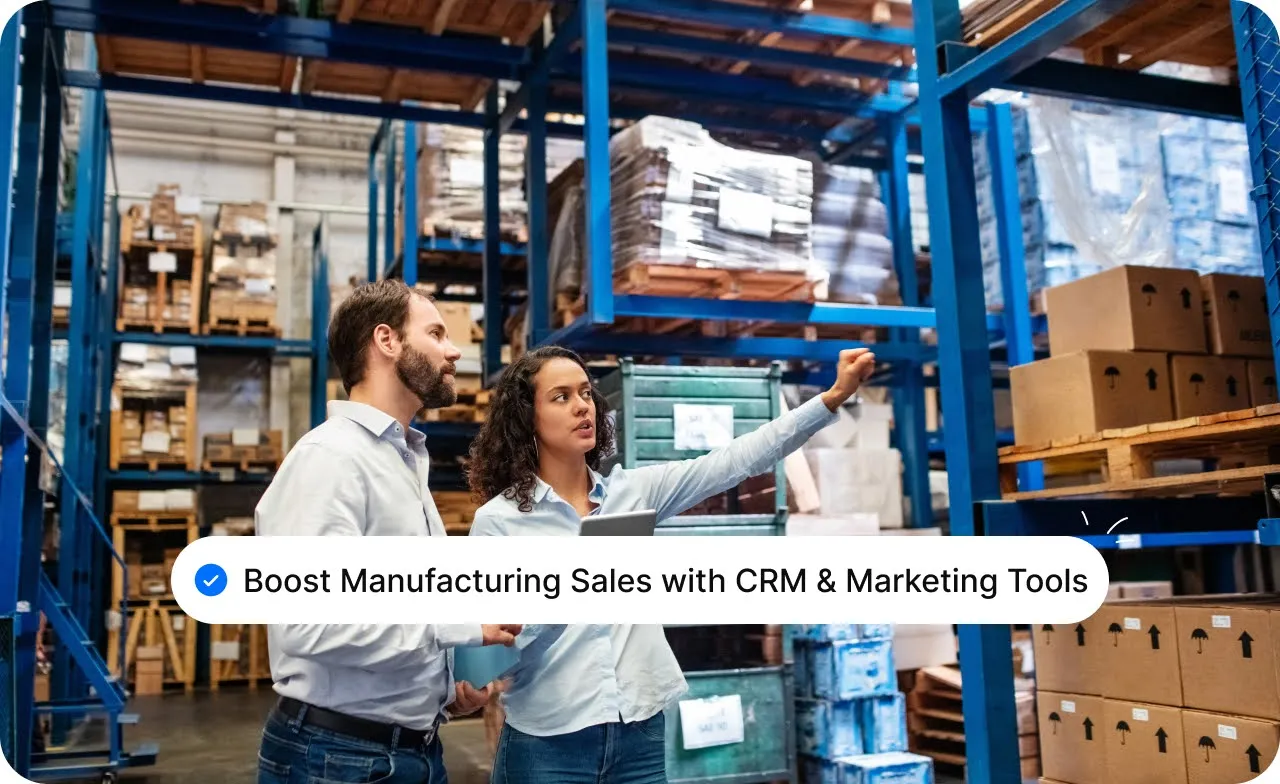
Transform Your Manufacturing Sales with CRM and Marketing Tools
Batul Beawarwala
In manufacturing, managing customer relationships and marketing separately leads to inefficiencies, missed opportunities, and wasted resources.
With long sales cycles and complex orders, data silos between your CRM and marketing tools create disconnects that slow down progress.
Integrating these systems offers real-time data sync, streamlined workflows, and targeted campaigns, ensuring your teams work with accurate, up-to-date information. This is about aligning your sales and marketing strategies for faster growth and better customer experiences.
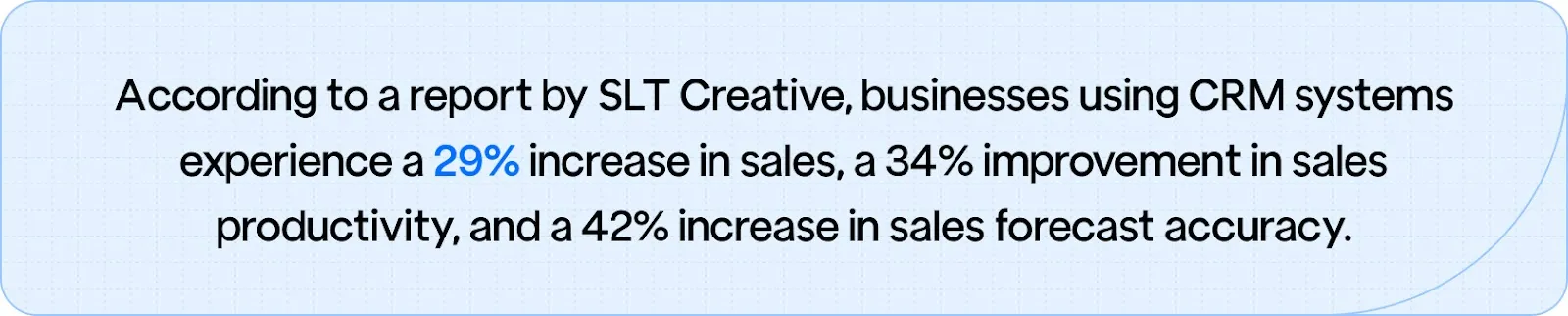
Here’s how CRM and marketing tool integration can drive efficiency and success for your manufacturing company.
Why Every Manufacturer Needs CRM and Marketing Tool Integration?
In manufacturing, managing customer relationships and marketing efforts separately can cause inefficiencies. CRM systems help track and manage customer interactions, while marketing tools optimize outreach.
However, the true potential lies in integrating both systems. Without integration, manufacturers face data silos, poor coordination between sales and marketing, and missed opportunities for personalized engagement.
Key Pain Points:
- Lack of Coordination Between Sales and Marketing: Sales teams may rely on outdated information, while marketing teams create campaigns based on assumptions.
- Data Silos Across Departments: Information in separate systems leads to confusion and duplicated efforts.
- Missed Opportunities for Personalized Marketing: Without real-time customer data, marketing becomes less targeted and less effective.
Solution: Integrating CRM with marketing tools unites customer data, streamlines workflows, and facilitates collaboration across teams, improving sales, lead management, and customer engagement.
Streamlining Customer Engagement: Where CRM Meets Marketing Magic
Effective customer engagement is critical in the manufacturing industry, where long sales cycles and complex products require personalized attention. When CRM and marketing tools work in tandem, manufacturers can provide a more tailored customer experience.
Personalization at Scale
CRM tools track customer behavior, preferences, and history, allowing marketing teams to use this data to create personalized messages. This can lead to higher engagement rates, better conversion, and stronger customer loyalty.
Automated Campaigns
With CRM and marketing integration, manufacturers can automate email, SMS, and social media campaigns based on customer data. For instance, a customer’s past purchase history might trigger an automated follow-up email with a special offer or a reminder about a product update.
Sales and Marketing Alignment
Sales and marketing teams can use a single source of truth to understand where a lead is in the buyer journey. With synchronized data, both teams ensure consistent messaging and follow-ups, creating a seamless customer experience.
The Power of Real-Time Data: How CRM and Marketing Tools Work Together
Real-time data is a game-changer for manufacturers. When CRM and marketing tools are integrated, manufacturers gain access to up-to-date customer information, enabling faster decision-making and more targeted outreach.
Real-Time Insights = Real-Time Success
Manufacturers need data to make quick decisions, from adjusting production schedules based on customer orders to targeting specific customer segments with relevant offers. Real-time data integration ensures teams are always working with the latest information.
Why Data Silos are the Silent Killer of Your Business?
When CRM and marketing tools aren’t connected, you risk operating with incomplete or outdated data. This results in poor decision-making, missed opportunities, and inconsistent communication with customers.
Integrated systems eliminate these silos, offering a single, unified view of all customer interactions.
Key Benefits of Real-Time Data Integration
- Improved Decision-Making: Access the latest customer data to make quicker, more informed decisions.
- Enhanced Customer Targeting: Personalize marketing efforts with up-to-date insights into customer behavior and preferences.
- Streamlined Communication: Align sales and marketing teams with a single source of truth, ensuring consistent messaging and follow-ups.
- Increased Efficiency: Reduce manual updates and errors by synchronizing data across systems in real time.
Also Read: Best CRM for Manufacturing Companies: 5 Platforms That Track Leads Better
Redefining Sales Forecasting and Production Planning with CRM Integration
Manufacturers often struggle to forecast demand and plan production schedules accurately, which can result in overproduction, stockouts, or wasted resources. By integrating CRM with marketing tools, manufacturers can align production and sales efforts more effectively.
Sales Insights for Better Forecasting
CRM systems track customer behavior, order history, and other valuable data points. By analyzing this data, manufacturers can forecast future demand with greater accuracy, ensuring they have the right amount of inventory available at the right time.
Aligning Production with Customer Demand
By synchronizing CRM and marketing tools, manufacturers can ensure that production schedules align with customer demand. This reduces waste and ensures that manufacturers meet customer needs in a timely and cost-efficient manner.
Overcoming the Hurdles: Integrating CRM and Marketing Tools Without the Headaches
Integrating CRM and marketing tools can be a complex task, especially for manufacturers already relying on legacy systems. But the benefits of integration far outweigh the challenges.
Data Integration Issues
Manufacturers often face difficulty integrating CRM and marketing tools with other systems like ERP or inventory management software. This can lead to data silos, inaccuracies, and inefficiencies.
Choosing the Right Tools
To ensure seamless integration, manufacturers must select CRM and marketing tools that are compatible with their existing software stack. Look for platforms that offer robust integration capabilities and scalable solutions that can grow with your business.
Implementation Tips
Proper training and monitoring are key to a successful integration. Manufacturers should invest in training their teams on how to use the integrated systems and regularly review workflows to identify any inefficiencies or issues.
Best CRM and Marketing Tools for Manufacturing Companies
When it comes to selecting CRM and marketing tools, manufacturers have several great options to choose from. Here are a few of the top solutions that can help manufacturers streamline their processes:
Top CRM Solutions:
- Salesforce Manufacturing Cloud: A robust CRM solution that offers deep integration with ERP systems, making it ideal for large manufacturers looking for advanced analytics.
- HubSpot CRM: Known for its ease of use, HubSpot offers powerful marketing automation features that are great for small to medium-sized manufacturers.
- Zoho CRM: An affordable option with strong marketing automation features, perfect for small and medium-sized manufacturing businesses.
Best Marketing Tools:
- Mailchimp: A popular email marketing tool that integrates seamlessly with CRMs to automate email campaigns and improve customer engagement.
- Hootsuite: A powerful social media management tool that integrates with CRMs to track social media interactions and analyze customer sentiment.
Ready to streamline your manufacturing business?
Gushwork equips you with the most effective CRM and marketing tools to enhance efficiency, optimize workflows, and drive growth.
Get Started with Gushwork
Real-World Manufacturing Success: John Maye's 17 Leads in 30 Days with CRM + Marketing Integration
John Maye Company, a respected name in the packaging industry for over 40 years, was struggling to make its mark in the digital age. Despite its strong reputation, they had little to no online visibility, causing them to miss out on high-intent buyers.
After integrating CRM with their marketing tools and implementing an AI-driven SEO strategy, John Maye turned their digital presence around in a big way.
Within just 30 days, they generated 17 qualified leads by optimizing their website and targeting high-intent keywords.
Key Results:
- 17 qualified leads generated in the first 30 days
- 100% high-intent prospects
- Consistent, 24/7 lead flow with no cold outreach
Impact: This strategic integration allowed John Maye to shift from inefficient cold outreach to engaging with warm, qualified leads who found them online.
By improving their SEO and integrating CRM, they created a scalable lead-generation engine that will continue to deliver for years to come.
It’s time to move beyond the basics and start using tools that help you scale.
A solid CRM and marketing integration can be your key to growth.
Scale Your Business Today
Is Your Manufacturing Business Ready for a Game-Changer?
Integrating CRM with marketing tools is a game-changing strategy for manufacturers looking to streamline customer engagement, enhance sales forecasting, and improve production planning.
When done right, this integration empowers your teams to make smarter decisions and grow your business faster.
Choosing the right CRM and marketing tools is critical for seamless integration and unlocking maximum potential. The old ways of working in silos and relying on disconnected systems are no longer enough to stay competitive.
Ready to improve your manufacturing business’s efficiency?
Leverage Gushwork’s solutions to elevate your CRM and marketing capabilities, optimize your operations, and scale faster with ease.
Book a Consultation
FAQs
Q1. What is CRM, and why is it important for manufacturing companies?
A1. CRM (Customer Relationship Management) systems help manufacturing companies track and manage customer interactions, sales, and service processes. It enables manufacturers to streamline operations, improve customer engagement, and make data-driven decisions to drive growth.
Q2. How does CRM and marketing tool integration benefit manufacturers?
A2. Integrating CRM with marketing tools allows for a unified approach to managing leads, improving customer targeting, automating campaigns, and enhancing sales and marketing alignment. It eliminates data silos, ensuring all teams work with real-time customer insights.
Q3. What are the key features to look for in a CRM for manufacturing companies?
A3. A CRM for manufacturers should include features like sales pipeline management, lead tracking, inventory integration, real-time customer data access, and after-sales support tools. It should also integrate seamlessly with other systems like ERP and marketing tools.
Q4. Can CRM integration help improve sales forecasting?
A4. Yes, CRM integration allows manufacturers to analyze customer behavior, past purchasing data, and market trends, which can significantly improve demand forecasting. This leads to better alignment between sales, marketing, and production, reducing waste and increasing efficiency.
Q5. What challenges do manufacturers face when integrating CRM and marketing tools?
A5. Common challenges include dealing with data silos, choosing the right tools that integrate well with existing systems (ERP, WMS, etc.), and ensuring proper training for staff. However, these challenges can be overcome with the right approach and continuous monitoring.
Q6. How can real-time data help manufacturing companies make better decisions?
A6. Real-time data integration between CRM and marketing tools provides up-to-date customer insights, allowing manufacturing companies to make quicker, more informed decisions. This includes adjusting production schedules, responding to customer needs, and identifying sales opportunities promptly.
Q7. What results can manufacturers expect from integrating CRM and marketing tools?
A7. Manufacturers can expect improved lead generation, better customer targeting, higher conversion rates, streamlined sales processes, and more efficient production planning. Real-world examples show increased qualified leads, enhanced customer satisfaction, and long-term business growth.

Digital Marketing
Oct 10, 2025
5 mins
Mastering B2B Sales Enablement: Strategies, Tools, and Best Practices
Batul Beawarwala
B2B sales today involves more people, more scrutiny, and longer decision cycles than it did a few years ago. Buyers compare options carefully, involve multiple stakeholders, and expect every interaction to move them closer to clarity.
When enablement works, sales conversations feel informed instead of introductory. Reps stop explaining basics and start addressing real concerns. Buyers feel understood earlier, which changes how quickly and confidently decisions are made.
In this blog, we break down what B2B sales enablement really looks like today, how it supports modern buying behaviour, what assets and systems matter most, and how to build enablement that actually improves deal progression.
What Is B2B Sales Enablement?
Sales enablement is the repeatable system that gives your sellers the right content, the right training, and the right data, exactly when they need it. It’s an ongoing process that arms reps with usable assets, playbooks, and signals they can act on in real conversations.
Why Businesses Must Adopt It?
Without a repeatable enablement function, sales teams often use out-of-date decks, reinvent follow-ups, and ask the same questions on every call. That wastes time and weakens buyer confidence.
Organizations that invest in disciplined enablement report measurable payoffs: faster ramp times, higher win rates, and clear ROI on training and content programs. It’s the practical system that aligns sales, product, and marketing around making every deal easier to close.
6 Core Pillars of B2B Sales Enablement
Sales enablement works when it is built on a few strong pillars, not scattered initiatives. These pillars ensure sellers are consistently supported across the entire buying cycle, without adding friction or unnecessary complexity.
Enablement Content That Supports Real Sales Conversations
Sales content should exist to move deals forward, not to fill folders.
- Buyer-stage–aligned assets: Create content specifically for discovery, evaluation, and decision stages. Each asset should answer a clear buyer question or objection that comes up repeatedly in sales calls.
- Practical, field-tested material: Focus on case examples, comparison sheets, implementation explainers, and ROI narratives that sellers can confidently share without rewriting or re-framing.
- Single source of truth: All sales content should live in one accessible place, clearly labeled by use case. This prevents outdated decks and inconsistent messaging from creeping back in.
Sales Training and Ongoing Skill Development
Enablement is not a one-time onboarding event. It is continuous.
- Role-specific training: SDRs, account executives, and account managers need different enablement. Training should reflect their responsibilities and buyer interactions.
- Contextual learning: Training tied to real deals, recent losses, or new objections is far more effective than abstract theory.
- Reinforcement over time: Short refreshers, call reviews, and scenario-based coaching help skills stick and improve performance steadily.
Tools and Technology That Reduce Friction
Technology should simplify selling, not slow it down.
- Enablement tools integrated with CRM: Content access, playbooks, and insights should be available where sellers already work, not in disconnected platforms.
- Clear guidance: Fewer well-integrated tools outperform large stacks that sellers ignore.
- Usage visibility: Teams should be able to see which assets are used, when, and in which deal stages.
Process Alignment Across Revenue Teams
Enablement breaks down when teams operate in isolation.
- Shared definitions and expectations: Sales, marketing, and leadership must agree on buyer stages, qualification criteria, and success metrics.
- Clear handoffs between teams: Marketing-to-sales and sales-to-customer-success transitions should be documented and repeatable.
- Feedback loops: Sales insights should regularly inform content creation, messaging updates, and training priorities.
Data, Measurement, and Continuous Improvement
Enablement must prove its value in business terms.
- Metrics tied to deal progression: Track win rates, cycle length, deal size, and ramp time, not just content downloads or training completion.
- Content effectiveness measurement: Identify which assets actually influence progression or closing, and retire those that don’t.
- Iteration based on evidence: Enablement improves when teams refine based on data, not assumptions.
Leadership Ownership and Accountability
Enablement only works when it has clear ownership.
- Dedicated responsibility: Someone must own enablement strategy, prioritisation, and execution, even if it’s a small team.
- Executive support: Leadership buy-in ensures enablement stays aligned with revenue goals rather than becoming a side project.
- Clear priorities: Enablement efforts should focus on the highest-impact sales motions first, not everything at once.
Together, these pillars turn sales enablement into a durable system.
How To Build a Modern B2B Sales Enablement Strategy?
A strong sales enablement strategy is built deliberately. It starts with understanding what already exists, then putting structure around people, content, and systems so sellers can perform consistently across complex deals:
1. Start With A Full Baseline Audit: Content, Skills, And Tools
You cannot improve what you do not understand. A blunt, honest audit reveals which assets are actually used, which training gaps block deals, and which tools create friction.
What to do this week:
- Content inventory. List every seller-facing asset: decks, one-pagers, specs, case studies, battlecards, and videos. Tag each asset with owner, last updated date, primary buyer stage, and usage signals (how often it’s sent or viewed).
- Skills assessment. Run short role-based assessments or listening sessions. Score reps on discovery, qualification, objection handling, demo-to-value translation, and closing asks. Use call samples to validate self-reported skills.
- Tool audit. Map every tool in the stack and note overlap and gaps. Which tools are single sources of truth? Which require copy/paste between systems? Which tools are actually used on calls?
Quick outputs to create:
- A single spreadsheet (or dashboard) that shows content age, usage, and gaps.
- A skills heatmap by rep and by region showing training hotspots.
- A tool map that highlights one or two integration priorities.
How to measure progress:
- Reduction in “ not found” asset tickets.
- % of content with usage metrics attached.
- Number of tool handoffs removed in key workflows.
2. Define Crisp Personas And Buying-Committee Profiles
Deals in B2B rarely hinge on one person. They hinge on groups of people with distinct questions, timelines, and approval criteria. If your enablement assets don’t reflect those roles, reps waste time convincing the wrong people.
What to do this month:
- Build 3–5 buyer personas relevant to your ICP. Include title, responsibilities, success metrics, common objections, top three evaluation questions, and what “proof” convinces them. Keep each persona to one page.
- Map the buying committee. For target accounts, identify typical committees: influencer(s), technical evaluator(s), economic buyer(s), and procurement/contract owner. Note who needs what evidence at which stage.
- Create decision-criteria sheets. For each persona, make a one-page list of “must-have” and “nice-to-have” criteria that procurement or buyers will use.
Micro-tactics:
- Validate personas by interviewing 5 customers and 5 lost-opportunity accounts.
- Attach persona tags to content so reps can filter assets by the role they are selling to.
How to measure progress:
- Time saved in discovery calls (shorter qualification).
- Increase in first-call conversion to next-stage meetings for deals where the persona map was used.
3. Map Content And Training To Each Buyer Stage
Random assets create chaos. Mapping forces discipline: one primary asset per buyer moment, clear purpose, and a measurable outcome.
What to do next quarter:
- Define buyer stages your sales process actually uses. Examples: Awareness, Qualification, Solution Validation, Pilot/POC, Procurement, Close.
- For each stage, pick the one primary enablement asset that best advances the buyer. Example: Qualification = discovery script + 1-page value checklist. Validation = 2-page technical validation brief and recorded demo segment. Procurement = final T&Cs checklist and SLA summary.
- Create play instructions. For every asset include a 3-line “how to use” note a rep can read in 30 seconds: when to send, what to say, and what follow-up action to expect.
Training pairing:
- Build short micro-learning modules tied to assets: 5–8 minute videos plus a 2-question quiz that proves comprehension.
- Run role-play scenarios weekly that map to the stage-specific asset usage.
How to measure progress:
- Asset-to-opportunity conversion rate: % of deals where the stage asset was used and the deal progressed.
- Completion rate for micro-learning modules and changes in associated KPI (e.g., shorter validation cycles).
4. Centralize Enablement On A Platform And Connect Integrations
If assets live in three places and CRM stages don’t surface content, reps don’t use enablement. Centralization plus integrations equals adoption.
What to implement:
- Single source of truth. Choose a content hub or enablement platform where assets are searchable, version-controlled, and tagged by persona and stage.
- Key integrations. Surface assets inside the CRM, inside the call tool (Zoom/Teams), and inside the sales cadence tool. Make it one click to share or drop an asset link into an email.
- Access control and governance. Ensure easy editing, a review workflow, and clear ownership for each asset.
Operational practices:
- Use analytics from the platform to show which assets are used on-call vs. in follow-ups.
- Automate nudges to reps when new or updated assets are published for their territory/product.
How to measure progress:
- % of deals with at least one hub-sourced asset attached.
- Time-to-attach: median time from asset publication to first use.
- Reduction in duplicate assets across drives and folders.
5. Build Structured Readiness Programs And Manager-Led Coaching
Training without coaching rarely sticks. Readiness programs plus manager coaching convert knowledge into consistent behaviour.
How to structure readiness:
- Role-based onboarding tracks. New hires get a 30/60/90 plan with checkable milestones: 10 discovery calls shadowed, two live demos led, 3 proposal reviews.
- Experience-based refreshers. For tenured reps, run monthly short labs on a single skill: objection handling for price, technical validation, or packaging deals.
- Manager coaching framework. Managers should have a one-page coaching guide per rep covering 3 metrics to watch, 2 action items for the week, and a 10-minute call template to run weekly.
Delivery methods:
- Use bite-size content plus live practice. Commit to role defined sessions.
- Record exemplars: 2–3 minute model calls that show effective use of an asset.
How to measure progress:
- Ramp time: days to first qualified meeting or to first closed deal for new reps.
- Coaching coverage rate: % of reps with weekly documented coaching touchpoints.
- Skill delta: pre/post scores on targeted role-play rubrics.
6. Define KPIs And Build Analytics Workflows That Prove Impact
Enablement must be tied to outcomes. Measure both adoption and influence: whether assets are used and whether they move deals.
Core KPIs to track:
- Adoption metrics: asset views, shares, and training completion rates.
- Influence metrics: % of deals where asset X was present and the deal progressed within Y days.
- Outcome metrics: win rate change, average sales cycle length, average deal size, and ramp time.
- Activity metrics: coaching cadence, content update frequency, and tool usage stats.
Analytics workflow:
- Tag everything. Tag assets by persona, product, stage, and owner. Tag CRM opportunities where assets were used.
- Build composite dashboards. Combine CRM opportunity data with content hub usage to create signals like “assets-per-opportunity” and “time-to-first-asset.”
- Review weekly, decide monthly. Weekly operational check-ins for red flags. Monthly review to decide content retirements or new plays. Quarterly business review for strategic shifts.
How to calculate simple influence metric:
- Asset Influence Rate = (Number of opportunities using the asset that progressed to next stage ÷ Number of opportunities where asset was used) × 100. Use this to rank assets by real deal impact.
7. Set A Cadenced Update Process For Content, Playbooks, And Coaching
Markets change. Product features change. Buyers change. If enablement is not updated regularly it decays quickly.
Operational cadence to adopt:
- Weekly triage. Small issues reported by sales go into a 15-minute backlog triage. Fixes that take under an hour are assigned and closed that week.
- Monthly content sprints. Product or marketing owners refresh one to three high-traffic assets, guided by usage analytics.
- Quarterly playbook review. Sales leadership, product, and enablement meet to refresh the playbook for top 3 buyer motions. This includes updating scripts, pricing guidance, and objection playbooks.
- Bi-annual skills audit. Re-run the skills assessment and re-prioritise coaching topics.
Governance and roles:
- Assign a product/content owner for each asset category.
- Make a manager accountable for coaching metrics in each region.
- Publish a public roadmap of upcoming changes so reps know what to expect.
How to measure progress:
- % of assets updated in the last 12 months.
- Time between issue report and fix.
- Manager compliance: % of scheduled coaching sessions completed.
Common B2B Enablement Pitfalls and How to Avoid Them
Even the most well-planned B2B sales enablement strategies can encounter obstacles that hinder success.
Understanding these common pitfalls and how to avoid them can help your team stay on track, make better use of resources, and ultimately close more deals.
Treating Enablement As Content Creation Instead Of Decision Support
Many teams equate enablement with producing more assets. Decks, PDFs, one-pagers, and battlecards pile up, but sales still struggles to move buyers forward.
How to avoid it: Anchor every enablement asset to a specific buyer decision. Ask what question this asset helps the buyer answer, such as feasibility, risk, comparison, or internal justification. If it does not clearly support a decision, it does not belong in enablement.
Building Assets For Internal Assumptions
Enablement often reflects how the company wants to sell, not how buyers actually evaluate vendors. This leads to content that sounds polished but feels disconnected in real conversations.
How to avoid it: Base enablement on real sales interactions. Review call recordings, lost deals, and late-stage objections. Let buyer language, not marketing language, shape the structure and wording of enablement materials.
Overloading Sales With Too Many Tools And Documents
When everything is labelled “important,” nothing is. Sales teams waste time searching, choosing, or avoiding enablement altogether.
How to avoid it: Reduce the surface area. Create a small, clearly structured enablement set tied to buying stages. Make it obvious which asset to use during discovery, evaluation, comparison, and procurement.
Ignoring Cross-Functional Alignment
Enablement breaks when marketing, sales, product, and customer success work in silos. Each team creates assets from its own perspective, resulting in inconsistency and confusion.
How to avoid it: Define enablement ownership and review cycles across teams. Product should validate technical accuracy. Sales should validate usability. Marketing should maintain clarity and consistency. Enablement only works when all three contribute.
Focusing On Features Instead Of Risk Reduction
B2B buyers rarely stall because they do not understand features. They stall because they are unsure about risk, fit, or internal approval.
How to avoid it: Shift enablement toward proof, constraints, and trade-offs. Include content that addresses implementation risk, limitations, compliance, and operational impact. Buyers trust vendors who acknowledge boundaries.
Leaving Enablement Static After Launch
Markets shift, products evolve, and buyer expectations change. Static enablement quietly becomes outdated, even if no one complains.
How to avoid it: Treat enablement as a living system. Schedule regular reviews tied to sales feedback, win-loss insights, and market changes. Retire assets that no longer reflect reality instead of letting them linger.
Measuring Usage Instead Of Effectiveness
Tracking downloads or views does not reveal whether enablement helps close deals.
How to avoid it: Evaluate enablement by its influence on deal progression. Look at where assets are used in successful deals, how they shorten cycles, or how they reduce objections. Effectiveness matters more than activity.
Must-Have Tech for B2B Sales Enablement
To truly empower your sales team, having the right tools is essential. Each piece of technology serves a specific function in the broader sales enablement strategy.
Here’s a breakdown of the must-have tech:
CRM Systems (Salesforce, HubSpot)
These platforms help manage customer relationships by tracking interactions and providing real-time updates on where prospects are in the sales cycle.
They also store crucial information like customer preferences and deal history, which allows your team to personalize interactions and improve closing rates.
Sales Enablement Platforms (Showpad, Highspot)
These platforms act as central hubs for content management and training. They ensure sales reps can access the right resources, such as a product demo, case study, or competitive battle card, right when they need them.
This can significantly streamline workflows and increase productivity.
Sales Intelligence Tools (Gong, ZoomInfo)
These tools help your team gain valuable insights into leads, competitors, and market trends. With Gong, for example, sales reps can analyze recorded calls to understand what works and refine their approach.
ZoomInfo provides detailed company and contact profiles, helping reps connect with the right decision-makers faster.
Real-Time Analytics
Using analytics tools that provide performance metrics on sales rep productivity, content effectiveness, and lead conversion is key.
These tools help you measure the impact of your sales enablement efforts and allow you to make data-driven decisions that can improve sales outcomes.
Why Feedback is Your Secret Weapon in B2B Sales Enablement?
Feedback is the key to refining and improving your sales enablement strategy. Sales reps and customers provide the real-world insights needed to ensure your tools and content stay relevant and effective.
Importance of Continuous Feedback
- Sales reps are on the frontlines and have direct knowledge of what works. Regular feedback helps you avoid outdated content and inefficient processes.
- Collecting consistent feedback ensures your sales enablement efforts evolve and stay aligned with buyer needs.
How to Collect Feedback
- Surveys: Use structured surveys to gather insights from both sales reps and customers on content and tools.
- Performance Metrics: Track sales metrics like win rates and content usage to see what’s resonating and what isn’t.
- One-on-One Interviews: Conduct in-depth interviews for more specific feedback on training, content, and tools.
Advanced B2B Sales Enablement Tactics
Once you’ve mastered the basics, it’s time to implement advanced tactics that will set your strategy apart. These strategies take personalization and automation to the next level.
Account-Based Selling (ABS)
- Tailored Outreach: Focus on high-value accounts with personalized content and targeted messaging based on the specific needs of each prospect.
- Maximized Engagement: Use custom content to engage decision-makers throughout the buying process.
Buyer Enablement
- Empower Early: Provide educational resources and tools like ROI calculators to help prospects make informed decisions earlier in their journey.
- Build Trust: Use guides, case studies, and solution resources to educate.
AI & Automation
- AI-Powered Personalization: Use AI to automate tasks, personalize outreach, and recommend the best content based on buyer behavior.
- Automation for Efficiency: Automate repetitive tasks like data entry and follow-up emails to free up your team for high-impact activities.
Wrapping Up
Your sales enablement strategy is the foundation of your sales team’s success. By equipping your reps with the right tools, training, and content, you can transform their performance and accelerate your sales results.
- Sales enablement is about giving your team the resources they need to succeed: content, tools, and training.
- Misalignment and poor adoption can derail even the best strategies.
- Continuously refining your approach based on real feedback will ensure sustained success.
The real challenge is implementing it effectively. Your team is already fighting an uphill battle to meet buyer expectations. Don’t let inefficient tools and outdated processes stand in your way.
.webp)
Digital Marketing
Oct 9, 2025
5 mins
Digital Marketing Problems Manufacturers Face (and How to Fix Them)
Batul Beawarwala
In the manufacturing industry, marketing intricate, high-cost products that require specialized knowledge from your customers can be a tough nut to crack.

The challenge is crafting the right message that resonates with the engineers, procurement teams, and decision-makers who need to understand the technical details without getting lost in jargon.
Despite the surge in digital marketing tools, many manufacturers still pour resources into strategies that generate leads that aren't ready to convert. Misaligned content, poor targeting, and outdated tactics all result in wasted time, money, and effort.
This article dives deep into the specific digital marketing problems manufacturers face and provides practical solutions to build a more effective, results-driven marketing strategy that cuts through the noise and brings in the right leads.
How to Demystify Complex Products and Make Them Sell Like Hotcakes
Manufacturers often face the challenge of marketing highly technical products to a broad audience. Without simplifying product details, you risk alienating key decision-makers who need to understand the product’s value.
The real task is converting complex specifications into clear, relatable benefits.
Challenges:
- Overcomplicated messaging for non-technical buyers
- Losing potential leads due to complex descriptions
Solutions:
- Focus on benefits over features
- Use educational content like how-to videos and case studies
- Leverage visuals (infographics, demos) to clarify product value
Want content that cuts through the complexity?
We can help you create messaging that resonates with your target audience.
Start Engaging Now
Keep the Sales Engine Running: Nurturing Leads Through the Long Haul
B2B manufacturing sales cycles can stretch for months, with multiple decision-makers involved. During this time, staying engaged with prospects is crucial to prevent them from losing interest.
The key is nurturing leads with timely, relevant content at each stage of their buying journey.
Challenges:
- Keeping leads engaged over long cycles
- Multiple decision-makers are slowing down the process
Solutions:
- Use marketing automation to keep the conversation alive
- Tailor content to each stage of the buyer’s journey
- Segment your audience for personalized email campaigns
Small Budgets, Big Impact: How to Make Your Marketing Work Harder
With limited resources, manufacturing companies often struggle to maximize the impact of their marketing spend. The solution lies in focusing on high-return, cost-effective strategies that give the most bang for your buck, without cutting corners.
Challenges:
- Struggling to get the most out of a tight marketing budget
- Limited resources for executing big campaigns
Solutions:
- Invest in SEO and content marketing for long-term growth
- Use marketing automation to scale efforts without increasing costs
- Leverage data analytics to allocate budget to the highest-performing channels
If you're looking to maximize ROI with limited resources, we can help.
Our team will streamline and automate your marketing efforts to drive better results.
Maximize Your ROI
Who Are You Really Selling To? Nail Your Target Audience Every Time
Manufacturers often face a broad and fragmented market, making it tough to pinpoint the right audience. Without clear buyer personas, marketing efforts can miss the mark, wasting time and resources on the wrong leads.
Challenges:
- Lack of understanding of the target audience's behavior
- Difficulty in segmenting the audience for tailored campaigns
Solutions:
- Develop buyer personas based on real customer data
- Use segmentation tools to craft personalized campaigns
- Engage prospects through targeted channels (social media, webinars, SEO)
Also Read: The Ultimate Guide to Manufacturing B2B Lead Generation: Proven Strategies and Techniques
Stuck in the Past? It's Time to Ditch Outdated Strategies and Get Digital
Many manufacturers are still relying on traditional methods like trade shows and direct mail. While these tactics have their place, digital marketing strategies are essential to stay relevant in today's fast-moving market.
Challenges:
- Resistance to shifting from traditional to digital marketing
- Reliance on outdated methods that don’t reach modern buyers
Solutions:
- Integrate content marketing, SEO, and social media to reach online buyers
- Provide a roadmap for transitioning to digital-first strategies
- Showcase successful case studies to highlight digital success
Ready to transition from traditional methods and embrace AI Agent marketing?
Let us guide you through the process.
Transform Your Strategy
Prove It Works: Measuring ROI in Manufacturing Marketing
Measuring the success of your digital marketing efforts can feel like a guessing game without clear metrics. Without a solid ROI framework, it's hard to demonstrate the value of marketing initiatives to decision-makers.
Challenges:
- Lack of clear ROI metrics
- Difficulty tying marketing efforts to business outcomes
Solutions:
- Set clear KPIs aligned with business goals (e.g., lead generation, sales)
- Use integrated analytics tools for real-time performance tracking
- Implement dashboards for transparent, actionable insights
Adapt or Fall Behind: Embracing the Fast-Paced Digital Marketing World
The speed of digital marketing evolution can overwhelm any manufacturer trying to keep up. New tools and platforms emerge regularly, and staying agile is key to adapting and keeping your competitive edge.
Challenges:
- Keeping pace with rapid changes in marketing trends and tools
- Adapting to evolving buyer behavior and expectations
Solutions:
- Invest in ongoing learning for marketing teams
- Regularly update marketing strategies based on industry shifts
- Implement agile marketing practices to quickly pivot when needed
Struggling to adapt to the digital age?
Let us show you how AI-driven tools can keep you ahead of the competition.
Adapt Now
Stand Out in a Crowded Market: Building a Brand That’s Impossible to Ignore
In a saturated market, differentiating your brand is critical. Many manufacturers fall into the trap of using generic messaging, which fails to resonate with prospects and ultimately gets lost in the noise.
Challenges:
- Lack of clear brand differentiation
- Overuse of buzzwords that fail to engage the audience
Solutions:
- Develop a unique value proposition that speaks directly to your audience’s needs
- Use testimonials and case studies to build trust and credibility
- Create content that positions your company as an expert in the industry
Building a Strong Digital Marketing Foundation
Manufacturers face unique challenges in digital marketing, from simplifying complex products to navigating long sales cycles and tight budgets.
While the DIY approach may seem tempting, the reality is that relying on outdated strategies or underdeveloped plans leads to wasted resources and missed opportunities.
- The key to success lies in adopting a strategic, digital-first approach.
- Nurturing leads with valuable content and personalization is critical.
- Marketing automation and data-driven insights are your best allies.
Wasting time on ineffective strategies only prolongs your challenges.
Ready to enhance your marketing and streamline your processes?
Gushwork helps you implement the right tools and strategies for lasting success.
Book a Free Consultation
FAQs
Q1: What are the top digital marketing challenges for manufacturing companies?
A1: Manufacturers often struggle with limited online presence, generating high-quality leads, and adapting to changing algorithms and platforms.
Q2: Why isn't our content converting into sales?
A2: Many manufacturers' content is overly technical, focused on features instead of addressing customer problems, and misaligned with buyer needs at different stages.
Q3: How can we improve our lead generation efforts?
A3: Focusing on SEO, content marketing, and organic social media can help attract targeted traffic without significant costs.
Q4: What role does marketing automation play in manufacturing marketing?
A4: Marketing automation tools help in timely follow-ups, personalized email campaigns, and segmenting audiences effectively to nurture leads.
Q5: How do we measure the ROI of our digital marketing efforts?
A5: Establishing clear KPIs aligned with business goals, using integrated analytics tools, and providing real-time reporting dashboards can help measure performance.
Q6: What are the common mistakes manufacturers make in digital marketing?
A6: Mistakes include believing that content will sell itself, neglecting to promote content actively, and creating content that is too technical or not customer-focused.
Q7: How can we adapt to the fast-paced digital marketing world?
A7: Investing in continuous learning for marketing teams, regularly updating strategies based on industry trends, and adopting agile marketing practices can help manufacturers stay ahead.

Digital Marketing
Oct 9, 2025
5 mins
Manufacturing Marketing Trends for 2025 and Beyond
Batul Beawarwala
In 2025, manufacturers face the challenge of staying competitive amidst constant technological advancements and market shifts.
The real issue? Many are still relying on outdated marketing tactics, wasting resources on strategies that attract the wrong leads.

Marketing for manufacturers is about reaching the right decision-makers who understand your specialized products and precision. If your marketing isn't targeting the right audience, you're wasting time and money.
This article focuses on strategies to help manufacturers connect with the right buyers in 2025 and beyond.
AI in Manufacturing Marketing: Why You Can't Afford to Miss Out
AI is transforming marketing for manufacturers, making campaigns more efficient, personalized, and smarter. By automating processes and predicting customer behavior, manufacturers can streamline operations and focus on high-value prospects.
Key Trends:
- Predictive Analytics: AI forecasts buyer behavior to optimize lead generation.
- Generative AI: Automating content creation improves efficiency without sacrificing quality.
Pro Tip: Start integrating AI tools into your lead nurturing strategies to align with modern customer expectations.
Ready to elevate your marketing strategy with advanced tools?
Many manufacturers are turning to platforms that automate and optimize marketing efforts.
Transform Your Strategy
Personalization Isn’t Just for E-Commerce: Why It’s Your Secret Weapon in Manufacturing?
Manufacturing buyers expect tailored experiences. Personalization helps you meet those demands and stand out in a crowded market.
Key Trends:
- Dynamic Content Delivery: Use data to personalize emails, websites, and product recommendations.
- Behavioral Targeting: Adjust marketing strategies based on real-time customer insights.
Go Green: Sustainability as Your Brand's New Power Play
Sustainability is no longer optional; it’s essential. Showcasing your eco-friendly initiatives builds customer loyalty and trust.
Key Trends:
- Eco-friendly Manufacturing: Market your sustainable production practices to boost loyalty.
- Transparency: Showcase your sustainability efforts in packaging, sourcing, and lifecycle management.
Pro Tip: Use content marketing (blogs, videos) to highlight your sustainability initiatives and engage eco-conscious customers.
Lights, Camera, Action: Why Video is Your Best Salesperson (No, Really)
Video isn’t just a tool; it’s your best asset for engaging and converting manufacturing customers. Videos help customers understand your product, build trust, and ultimately drive sales.
Key Trends:
- Product Demonstrations: Use how-to videos to explain complex products.
- Customer Testimonials and Case Studies: Real-world success stories build credibility.
Account-Based Marketing: Stop Throwing Darts at a Board, Hit Your Target Every Time
ABM focuses on highly targeted outreach, helping manufacturers reach key decision-makers with personalized messaging.
Key Trends:
- Tailored Messaging: Create specific messages for target accounts.
- Sales and Marketing Collaboration: Break down silos for cohesive strategies.
Your CRM Is the Backbone of Your Marketing Strategy
A CRM is crucial for aligning sales and marketing, ensuring smoother workflows and improved lead nurturing.
Key Trends:
- Automated Lead Scoring: Identify high-potential leads automatically.
- Seamless Data Flow: Integrate CRM with marketing automation to optimize campaigns.
Ready to Navigate the Future of Manufacturing Marketing?
As we move further into 2025, the manufacturing marketing landscape is shifting toward innovation, personalized experiences, and the strategic use of emerging technologies.
With trends like AI, video content, sustainability, and voice search changing the way manufacturers connect with their customers, it's clear that the future belongs to those who embrace these shifts.
- Personalization is no longer optional; it's essential for connecting with modern manufacturing buyers.
- AI and automation are the backbone of streamlined, efficient marketing strategies.
- Sustainability is an opportunity to differentiate your brand and build customer loyalty.
Manufacturers who don't adapt to these trends risk falling behind. But with the right tools, you can lead the charge and scale your marketing efforts effectively.
Looking to streamline your processes even further?
Learn how platforms like Gushwork can help automate and optimize your marketing strategy for smarter, more efficient results.
Book a Consultation
FAQs
Q1. What is predictive analytics, and how can it benefit my manufacturing marketing strategy?
A1. Predictive analytics uses AI to analyze customer behavior and trends, allowing manufacturers to anticipate buying patterns and tailor their marketing efforts for more effective lead generation and higher conversion rates.
Q2. How can I integrate AI into my manufacturing marketing efforts without overwhelming my team?
A2. Start by automating repetitive tasks like content creation and lead scoring. Implementing AI tools in stages, such as using AI for predictive analytics or content generation, helps your team ease into new technology without disrupting workflows.
Q3. Why is personalization crucial in manufacturing marketing, and how can I achieve it?
A3. Personalization helps you deliver relevant content to potential buyers, increasing engagement and conversions. Use CRM data, behavioral insights, and dynamic content delivery to tailor emails, product recommendations, and marketing campaigns to specific customer segments.
Q4. How do I leverage sustainability in my manufacturing marketing strategy?
A4. Showcase your sustainable practices, like eco-friendly production processes and transparent sourcing, to build trust and appeal to environmentally-conscious consumers. Use blog posts, videos, and case studies to highlight your sustainability efforts.
Q5. What role does video marketing play in manufacturing marketing, and how can I get started?
A5. Video is powerful for demonstrating complex products, building trust, and driving sales. Start by creating product demos, behind-the-scenes videos, and customer testimonials. Ensure your video content is high-quality, informative, and aligned with customer pain points.
Q6. How can voice search optimization impact my manufacturing marketing?
A6. Optimizing for voice search helps your brand appear in more search results as customers increasingly use voice assistants to find products. Focus on using natural language, question-based keywords, and local SEO to ensure your content is discoverable via voice queries.
Q7. What is Account-Based Marketing (ABM), and why should manufacturers adopt it?
A7. ABM focuses on personalized marketing strategies aimed at specific high-value accounts. Manufacturers can tailor messaging and content for key decision-makers in targeted companies, increasing the chances of converting those accounts into loyal customers.

SEO
Oct 9, 2025
5 mins
Most SEO For Suppliers Fails Because Manufacturers Skip These 6 Essential Practices
Batul Beawarwala
Ever searched for a supplier online and only called the first two results you saw? Your buyers do the same.
The difference is, they’re not just looking for a name. They’re judging whether you feel credible, capable, and worth their time in a matter of seconds. A confusing website, unclear product details, or weak structure can quietly push you off their list before any real comparison even begins.
SEO changes that moment. It shapes how your business appears, how easily buyers understand your offering, and whether they move forward or move on. When it’s done well, it improves how seriously your business is taken.
In this guide, you’ll find seven essential SEO tips designed specifically for suppliers who want to stand out clearly, earn buyer confidence faster, and turn searches into real enquiries.
What SEO Really Does for Suppliers?
SEO helps suppliers show up where buyers search and makes it easier for them to evaluate your capabilities. It’s not about chasing trends. It’s about giving procurement teams, distributors, and manufacturers the information they need in a format they trust.
Here’s what strong SEO for suppliers delivers:
- Clarity: Buyers quickly see what you supply, your specs, and the industries you serve.
- Discoverability: Your pages appear for the exact terms tied to your products or materials.
- Trust: Detailed product info, certifications, and case examples help you look credible immediately.
- Better enquiries: More of your traffic comes from people who actually need what you offer.
This foundation sets you up to apply the seven tips that follow, making your visibility stronger and your enquiries more qualified.
Essential 6 SEO Practices Manufacturers Must Master
Strong SEO for manufacturers rests on a balanced mix of smart keyword targeting, valuable content, technical precision, and ongoing optimisation. These core practices work together to improve visibility, attract the right buyers, and build long-term authority in competitive markets:
1. Keyword Research
Effective keyword research is the cornerstone of SEO. For manufacturers, this means identifying and targeting the search terms that best reflect the problems your products solve.
Don't focus on generic keywords; instead, hone in on long-tail keywords that capture the specificity of your business.
Targeting What Matters:
- Use Google Keyword Planner, SEMrush, and Ahrefs to uncover the keywords driving traffic in your industry.
- Focus on long-tail keywords such as “custom CNC parts for automotive manufacturing” instead of generic terms like “metal parts.”
Target the Right Keywords
We find the search terms your buyers actually use and align your pages with real supplier demand.
Refine Your Keyword Strategy
2. Content That Converts
Manufacturers must create content that resonates with both their audience and search engines. Your content should directly address customer pain points, while also showcasing your industry knowledge.
Whether it's a blog post or a product page, content that educates and informs positions you as a trusted leader.
Crafting Compelling Content:
- Blogs: Offer valuable insights into the manufacturing process or industry trends.
- Case Studies: Show how your products solve specific problems for clients.
- Product Pages: Highlight your offerings’ features and benefits in a way that speaks to buyers’ needs.
Create Content That Attracts Buyers
Publish clear, useful content that answers buyer questions and supports stronger search performance.
Improve Your Content Strategy
3. Building Links
Backlinks are critical to SEO success. They signal to Google that your website is credible and relevant. For manufacturers, getting backlinks from industry publications, directories, and high-quality blogs boosts your authority and improves search engine rankings.
Authority Through Backlinks:
- Partner with industry blogs for guest posts or features.
- Get listed in reputable directories and associations.
- Share case studies or original research that attract media mentions.
4. Technical SEO
Technical SEO ensures that your website is optimized behind the scenes. It covers everything from page load speed to mobile optimization, ensuring that users (and Google) can access your site easily and quickly.
From Mobile Optimization to Speed:
- Use Google PageSpeed Insights to test and optimize your site’s loading times.
- Make sure your site is mobile-friendly, as an increasing number of users browse on smartphones.
Tools to Use: Google PageSpeed Insights, Screaming Frog, and GTmetrix.
5. Local SEO
If your manufacturing business serves specific locations, local SEO is crucial. Optimize your website for regional searches to ensure local clients can find your business when searching for suppliers near them.
Dominate Your Local Area:
- Optimize your Google My Business listing with up-to-date contact info, images, and descriptions.
- Use localized keywords like “metal fabrication in Detroit” or “custom parts in California.”
- Encourage reviews on local platforms to build trust and credibility.
6. Tracking Results
SEO is an ongoing effort. To maximize your ROI, you need to track key metrics and adjust your strategy accordingly. Use tools like Google Analytics and Google Search Console to monitor your site's performance.
The Metrics That Matter:
- Traffic: Monitor organic search traffic to gauge SEO impact.
- Conversions: Track how many visitors turn into leads or sales.
- Keyword Rankings: Keep an eye on how your target keywords are performing.
Tools to Use: Google Analytics, Google Search Console, Ahrefs, and SEMrush.
Common SEO Mistakes to Watch Out For
SEO is an ongoing effort, but even small mistakes can significantly hinder your progress. Here are the most common SEO pitfalls suppliers should avoid to stay ahead of the competition. Avoid common errors:
Keyword Stuffing
- Mistake: Overloading content with keywords.
- Solution: Use keywords naturally within relevant content. Prioritize long-tail, industry-specific terms.
Neglecting Mobile Optimization
- Mistake: A non-mobile-friendly site can drive users away.
- Solution: Ensure your site is responsive and optimized for mobile browsing.
Ignoring Site Speed
- Mistake: Slow websites harm user experience and rankings.
- Solution: Optimize your site’s speed using tools like Google PageSpeed Insights and improve load times.
Overlooking Technical SEO
- Mistake: Issues like broken links or poor site structure affect rankings.
- Solution: Conduct regular technical SEO audits to fix issues like broken links and improve crawlability.
Not Updating Content Regularly
- Mistake: Outdated content leads to lower rankings.
- Solution: Update content regularly to ensure freshness and relevancy, like adding new product details or industry insights.
Neglecting User Experience (UX)
- Mistake: Poor navigation and design hurt site engagement.
- Solution: Focus on intuitive site design and ensure visitors can easily find what they need.
Ignoring Local SEO
- Mistake: Missing out on local customers and suppliers.
- Solution: Optimize Google My Business and use location-based keywords to improve local visibility.
Failing to Track SEO Performance
- Mistake: Without monitoring, you won’t know what’s working.
- Solution: Use Google Analytics and Google Search Console to track key metrics and adjust your SEO strategy.
By avoiding these SEO mistakes, you can enhance your site’s performance, attract the right leads, and stay competitive in your industry. Optimize for success and watch your supplier business thrive.
Why SEO Should Be Your Go-To Strategy for Growth?
In a competitive market, suppliers often struggle to stand out. With SEO, you can make sure your business gets found by potential customers who are actively searching for products or services like yours.
SEO is about connecting with the right audience at the right time and building your brand's credibility.
Why SEO Matters for Suppliers?
- Increased Visibility: High search engine rankings put you in front of customers at the moment they're searching for what you offer. Sites on the first page of search results receive 75% of clicks.
- Attract Quality Leads: SEO helps you target intent-driven keywords, meaning you attract customers who are already interested in what you sell, leading to more qualified leads.
- Long-Term Results: Unlike paid ads, SEO delivers sustained visibility with minimal ongoing costs.
- Builds Trust and Credibility: Appearing at the top of search results establishes your brand as an authority in your industry, building trust with potential buyers.
SEO is essential for suppliers to gain visibility, attract qualified leads, and stay competitive. By investing in SEO, you can ensure your brand stands out in a crowded market and reaches the right audience when it matters most.
Strengthen Your SEO Foundation
We build a structured SEO approach that improves visibility and supports consistent growth.
Enhance Your SEO Approach
Ready to Step Up Your Supplier SEO Game?
As a supplier, simply hoping to attract more traffic isn’t enough; you need targeted visibility and qualified leads to drive real business results. SEO for suppliers is a proven approach to long-term growth.
By focusing on the right keywords, creating valuable content, optimizing for local search, and building credibility through backlinks, you can ensure your brand rises above the competition and gets noticed by the right people.
Ready to Improve Your Visibility?
Get expert guidance on applying SEO strategies that support sustainable supplier growth.
Book A Consultation

